✅ Author Profile: A Matlab simulation developer passionate about research, skilled in data processing, modeling simulation, program design, complete code acquisition, paper reproduction, and scientific simulation.
🍎 Previous reviews, follow the personal homepage:Matlab Research Studio
🍊 Personal motto: Investigate to gain knowledge, complete Matlab code and simulation consultation available via private message.
🔥 Content Introduction
In today’s era of renewable energy, batteries, as the core component of energy storage, have their performance and lifespan under close scrutiny. TheState of Charge (SOC) is a key indicator reflecting the remaining battery capacity, directly affecting the device’s endurance and the battery’s cycle life. In the process of smart battery charging, how to accurately control SOC to avoid overcharging and undercharging has become a focal point of industry research. The PID controller, with its powerful dynamic adjustment capability and stability, shows significant advantages in optimizing SOC control.
SOC, or State of Charge, simply refers to the percentage of remaining battery capacity. Accurately grasping SOC not only allows users to reasonably schedule usage time but also provides important basis for formulating charging strategies. Improper SOC control can lead to overcharging, which causes internal temperature rise, electrolyte decomposition, and in severe cases, even explosions; undercharging can gradually reduce battery capacity and shorten lifespan. Therefore, achieving precise control of SOC is one of the core objectives of smart battery charging technology.
The PID controller is a classic closed-loop control algorithm composed of three parts: Proportional (P), Integral (I), and Derivative (D). The proportional part adjusts based on the deviation between the current SOC and the target SOC; the larger the deviation, the stronger the adjustment, allowing for rapid response to deviations. The integral part eliminates static errors by adjusting based on the accumulation of deviations, ensuring the system ultimately stabilizes at the target value; the derivative part reacts in advance based on the rate of change of the deviation, suppressing system overshoot and improving control stability.
Applying the PID controller to optimize SOC in smart battery charging involves the following workflow: first, the Battery Management System (BMS) collects real-time parameters such as battery voltage, current, and temperature, using appropriate algorithms to estimate the current SOC value; then, the current SOC is compared with the preset target SOC to obtain the deviation value; finally, the PID controller calculates the corresponding control amount based on the deviation value and its change, adjusting the charging current or voltage accordingly.
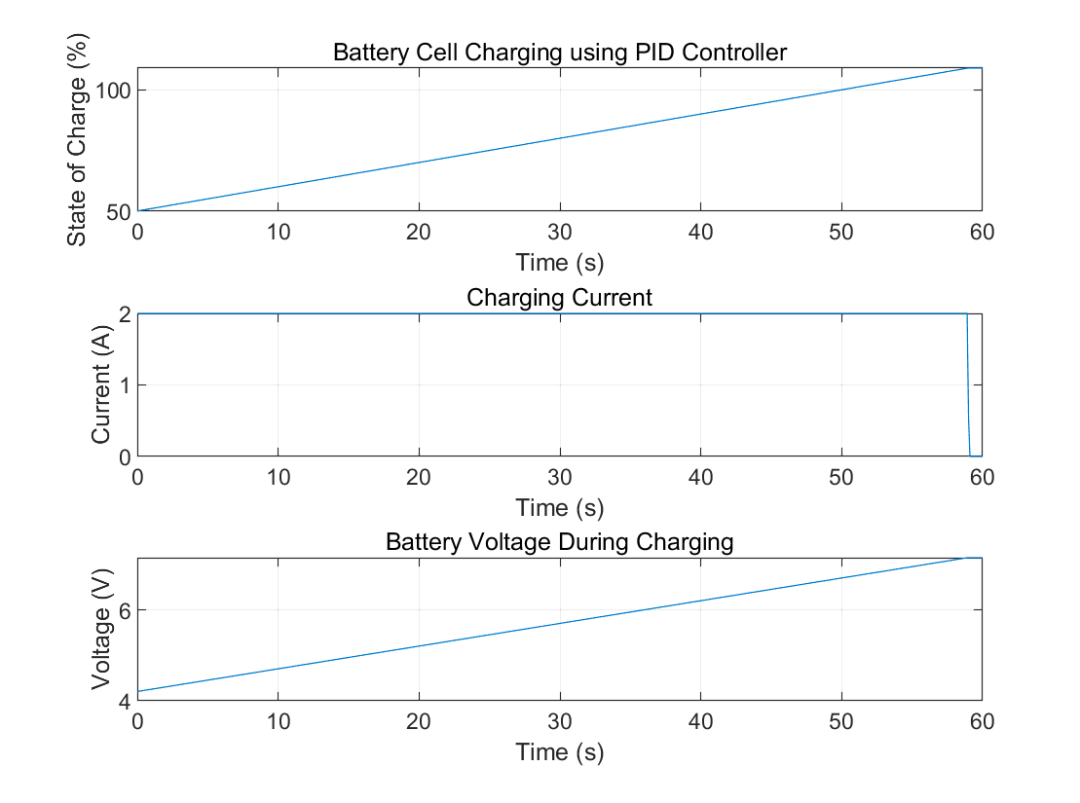
In practical applications, tuning the parameters of the PID controller is crucial. Reasonable parameter settings can enable the system to accurately control SOC while ensuring charging speed, avoiding overcharging and undercharging. For example, in the early stages of charging, when the battery SOC is low and the deviation is large, the proportional part plays a major role, using a larger charging current to accelerate charging speed; as SOC gradually approaches the target value and the deviation decreases, the integral part begins to take effect, gradually reducing the charging current to ensure SOC stabilizes at the target value; the derivative part can preemptively reduce the charging current when SOC is rapidly approaching the target value to prevent overshoot.
Moreover, the PID controller also exhibits good adaptability and robustness. When factors such as battery aging and temperature changes cause battery parameters to change, the PID controller can maintain the precision and stability of SOC control by continuously adjusting the control amount. For instance, in low-temperature environments, the battery’s charging acceptance capability decreases, and the PID controller will automatically reduce the charging current based on the SOC changes to avoid damage to the battery due to excessive charging current.
Utilizing the PID controller to optimize SOC in smart battery charging can effectively enhance the safety, accuracy, and efficiency of charging, extending the battery’s lifespan. With the continuous development of renewable energy technology, the application of PID controllers in battery management will become more widespread and in-depth, providing strong support for the performance enhancement of smart batteries.
⛳️ Operating Results
🔗 References
[1] Liang Yuanbo. Model Predictive Control Based on SOC Optimization Trajectory for Plug-in Hybrid Electric Vehicles [D]. Chongqing University, 2013. DOI:10.7666/d.D354690.
[2] Wang Feng. Research on Segmented Intelligent Charging Strategy for Lithium-ion Power Batteries [D]. Shandong University, 2017.
[3] Xu Zhiqi. Research on Charging of Lead-acid Batteries Based on Fuzzy PID Control [D]. Lanzhou Jiaotong University, 2015.
📣 Sample Code
🎈 Some theoretical references are from online literature; if there is any infringement, please contact the author for deletion.
👇 Follow me to receive a wealth of Matlab e-books and mathematical modeling materials
🏆 The team specializes in guiding customized MATLAB simulations in various research fields, helping to realize research dreams:
🌈 Various intelligent optimization algorithm improvements and applications
Production scheduling, economic scheduling, assembly line scheduling, charging optimization, workshop scheduling, departure optimization, reservoir scheduling, 3D packing, logistics site selection, cargo location optimization, bus scheduling optimization, charging pile layout optimization, workshop layout optimization, container ship loading optimization, pump combination optimization, medical resource allocation optimization, facility layout optimization, visual domain base station and drone site selection optimization, knapsack problem, wind farm layout, time slot allocation optimization, optimal distributed generation unit allocation, multi-stage pipeline maintenance, factory-center-demand point three-level site selection problem, emergency supply material distribution center site selection, base station site selection, road lamp post arrangement, hub node deployment, transmission line typhoon monitoring device, container scheduling, unit optimization, investment optimization portfolio, cloud server combination optimization, antenna linear array distribution optimization, CVRP problem, VRPPD problem, multi-center VRP problem, multi-layer network VRP problem, multi-center multi-vehicle VRP problem, dynamic VRP problem, two-layer vehicle routing planning (2E-VRP), electric vehicle routing planning (EVRP), hybrid vehicle routing planning, mixed flow shop problem, order splitting scheduling problem, bus scheduling optimization problem, flight shuttle vehicle scheduling problem, site selection path planning problem, port scheduling, port bridge scheduling, parking space allocation, airport flight scheduling, leak source localization
🌈 Machine learning and deep learning time series, regression, classification, clustering, and dimensionality reduction
2.1 BP time series, regression prediction, and classification
2.2 ENS sound neural network time series, regression prediction, and classification
2.3 SVM/CNN-SVM/LSSVM/RVM support vector machine series time series, regression prediction, and classification
2.4 CNN|TCN|GCN convolutional neural network series time series, regression prediction, and classification
2.5 ELM/KELM/RELM/DELM extreme learning machine series time series, regression prediction, and classification
2.6 GRU/Bi-GRU/CNN-GRU/CNN-BiGRU gated neural network time series, regression prediction, and classification
2.7 Elman recurrent neural network time series, regression prediction, and classification
2.8 LSTM/BiLSTM/CNN-LSTM/CNN-BiLSTM long short-term memory neural network series time series, regression prediction, and classification
2.9 RBF radial basis function neural network time series, regression prediction, and classification
2.10 DBN deep belief network time series, regression prediction, and classification
2.11 FNN fuzzy neural network time series, regression prediction
2.12 RF random forest time series, regression prediction, and classification
2.13 BLS broad learning system time series, regression prediction, and classification
2.14 PNN pulse neural network classification
2.15 Fuzzy wavelet neural network prediction and classification
2.16 Time series, regression prediction, and classification
2.17 Time series, regression prediction, and classification
2.18 XGBOOST ensemble learning time series, regression prediction, and classification
2.19 Transform various combinations time series, regression prediction, and classification
Directions cover wind power prediction, photovoltaic prediction, battery life prediction, radiation source identification, traffic flow prediction, load forecasting, stock price prediction, PM2.5 concentration prediction, battery health state prediction, electricity consumption prediction, water body optical parameter inversion, NLOS signal identification, precise prediction of subway stops, transformer fault diagnosis
🌈 In image processing
Image recognition, image segmentation, image detection, image hiding, image registration, image stitching, image fusion, image enhancement, image compressed sensing
🌈 In path planning
Traveling salesman problem (TSP), vehicle routing problem (VRP, MVRP, CVRP, VRPTW, etc.), drone 3D path planning, drone collaboration, drone formation, robot path planning, grid map path planning, multimodal transport problem, electric vehicle routing planning (EVRP), two-layer vehicle routing planning (2E-VRP), hybrid vehicle routing planning, ship trajectory planning, full path planning, warehouse patrol
🌈 In drone applications
Drone path planning, drone control, drone formation, drone collaboration, drone task allocation, drone secure communication trajectory online optimization, vehicle collaborative drone path planning
🌈 In communication
Sensor deployment optimization, communication protocol optimization, routing optimization, target localization optimization, Dv-Hop localization optimization, Leach protocol optimization, WSN coverage optimization, multicast optimization, RSSI localization optimization, underwater communication, communication upload and download allocation
🌈 In signal processing
Signal recognition, signal encryption, signal denoising, signal enhancement, radar signal processing, signal watermark embedding and extraction, EMG signals, EEG signals, signal timing optimization, ECG signals, DOA estimation, encoding and decoding, variational mode decomposition, pipeline leakage, filters, digital signal processing + transmission + analysis + denoising, digital signal modulation, bit error rate, signal estimation, DTMF, signal detection
🌈 In power systems
Microgrid optimization, reactive power optimization, distribution network reconstruction, energy storage configuration, orderly charging, MPPT optimization, household electricity
🌈 In cellular automata
Traffic flow, crowd evacuation, virus spread, crystal growth, metal corrosion
🌈 In radar
Kalman filter tracking, trajectory association, trajectory fusion, SOC estimation, array optimization, NLOS identification
🌈 In workshop scheduling
Zero-wait flow shop scheduling problem (NWFSP), permutation flow shop scheduling problem (PFSP), hybrid flow shop scheduling problem (HFSP), zero idle flow shop scheduling problem (NIFSP), distributed permutation flow shop scheduling problem (DPFSP), blocking flow shop scheduling problem (BFSP)
👇