Sports AI and Sports AI Agents are not two separate concepts, but rather“basic applications” and“advanced forms” that are interrelated—— Sports AI Agents are an integrated and upgraded version of Sports AI with core differences focused on“autonomy” and“systemic synergy”, which will be visually presented through“definitions+ core dimension comparisons+ evolutionary logic” to illustrate the connections and differences between the two.
 01Core Definitions
|
Concept |
Essential Positioning |
Core Features |
Technical Foundation Summary |
|
Sports AI |
Fragmented AI tools for sports scenarios AI toolset |
Task binding, passive response, single-point functionality |
Linear architecture (data input→algorithm computation→result output), relying on supervised learning and basic computer vision technology |
|
Sports AI Agent |
Autonomous closed-loop intelligent system for sports scenarios |
Goal-oriented, proactive collaboration, full-process coverage |
Closed-loop collaborative architecture (perception→decision-making→execution→feedback), integrating reinforcement learning, multi-modal fusion, and multi-agent collaboration technologies |
In simple terms: Sports AI is “a tool that can only perform specified actions”, while Sports AI Agent is “a partner that can autonomously plan to achieve goals”, where the former serves as the technical foundation for the latter, and the latter is a system-level upgrade of the former.
02Direct Comparison of Single Core Dimensions
|
Comparison Dimension |
SportsAI |
SportsAI Agent |
Common Interpretation (Easy to Understand) |
|
Decision Logic |
Driven by manual instructions, no autonomous goals |
Goal-oriented closed-loop, autonomously setting sub-tasks |
Sports AI:“You ask me to analyze cadence, and I will do it”;Agent:“Noticing you are overloading, I proactively adjust training + arrange recovery” |
|
System Architecture |
Independent functional modules, no collaboration |
Distributed collaboration, multi-module linkage forming a closed loop |
Sports AI:“Action analysis and physical statistics are two separate tools”;Agent:“A system integrates both and can also link to recovery modules” |
|
Data Processing |
Unidirectional static transformation, relying on structured data |
Bidirectional dynamic iteration, autonomously supplementing multi-modal data |
Sports AI:“Input running video, output cadence 180 steps / minute”;Agent:“Cadence is too high + knee load is excessive, recommend adjusting to 170 steps / minute” |
|
Adaptability |
Strong binding to scenarios, high cost of cross-project migration |
Cross-domain adaptability, adjusting parameters to fit multiple projects |
Sports AI:“Football action analysis models cannot be used in basketball”;Agent:“The same system can adapt to athletics, swimming, and ball training” |
|
Human-Machine Interaction |
Operation – feedback mode, relying on frequent manual intervention |
Goal – collaboration mode, only synchronizing at key nodes |
Sports AI:“You need to upload videos and input parameters for it to work”;Agent:“You set‘improve 0.5 seconds in sprinting’, I will push it through the entire process” |
|
Core Value |
Enhancing efficiency for a single task (doing the right thing) |
Achieving core goals (getting things done) |
Sports AI:“Making action analysis faster and more accurate”;Agent:“From training to recovery, I help you achieve performance improvement throughout” |
03Connections and Evolutionary Logic
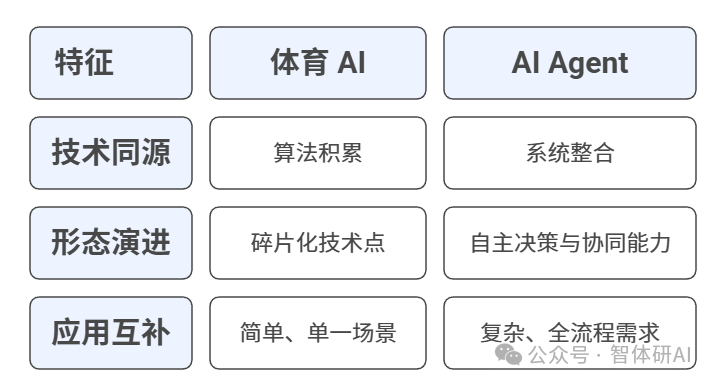
1. Common Technical Origin:The core functional modules of Sports AI Agents are all derived from the algorithm accumulation of SportsAI without the technical foundation of SportsAI there would be noAgent system integration
2. Evolution of Forms:Sports AI is“fragmented technology points”,Agent links these technology points through an agent framework, endowing them with “autonomous decision-making” and “collaborative capabilities”, which is equivalent to “assembling scattered tools into a robot that can work autonomously”
3. Complementary Applications:Sports AI is suitable for solving simple, single scenario needs, whileAgent is suitable for handling complex, full-process needs), the two are not in a replacement relationship, but rather layered to adapt to different needs
 04In-Depth Summary
Sports AI and Sports AI Agents are the“basic version” and“advanced version”, with the core connection being“common technical origin and evolutionary inclusion”, and the core difference being“whether they possess autonomous closed-loop and collaborative capabilities”.
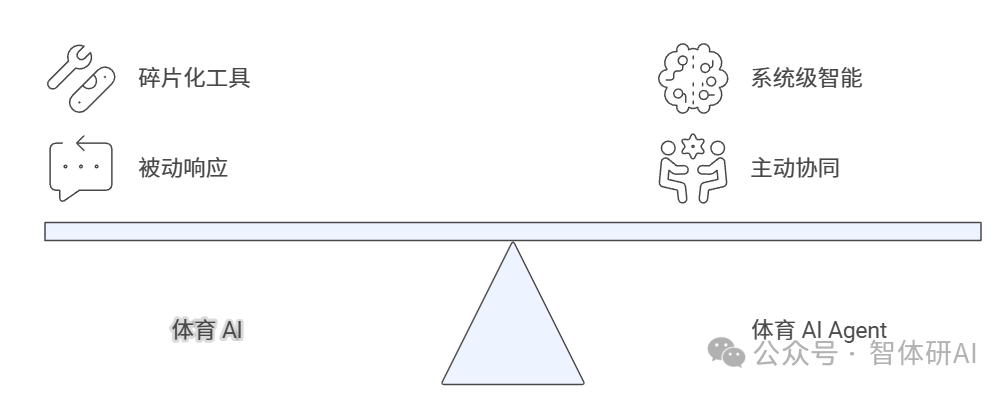
SportsAI is centered around“fragmented tools” to enhance the efficiency of single tasks, serving as a passive response technology empowerment; Sports AI Agent is centered around“system-level intelligence” to autonomously integrate resources and advance the full process, serving as proactive collaborative intelligence empowerment. The two are not separate, but rather layered to adapt to different needs — simple tasks are efficiently solved by SportsAI while complex goals are achieved through SportsAI Agent in a closed loop.
In the future, SportsAI will continue to evolve towards the Agent form, breaking down scenario barriers through technological integration, becoming the core engine for the intelligent transformation of the sports industry.

Find Us
FIND US

AI Sports Research + Agent
AI Medical Research + Agent