Previously, I introduced the production process of PCB, specifically PCB equipment (equivalent to a surgical knife), and learned thatthe global PCB equipment market exceeds 50 billion yuan, with drilling/exposure/testing equipment having the highest value. Among them, I focused on drilling equipment, where I introduced two main drilling methods and processes, namely mechanical drilling and laser drilling, emphasizing their respective advantages and disadvantages along with relevant leading companies. If you are interested, you can look back and follow up, as we will continue to update. PCB Exposure EquipmentNow that we have a certain understanding of drilling, let’s talk about the remaining equipment with significant value — exposure equipment.
Regarding exposure equipment, we currently have two main processes: traditional film exposure and laser direct imaging.
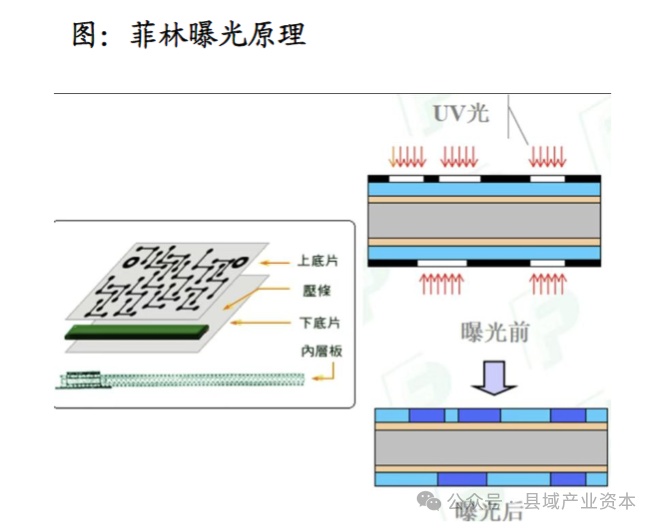
◆1) Traditional Film Exposure: This process uses a specific light source (such as ultraviolet light) to cause a chemical reaction in the photosensitive material on the film, thereby transferring the circuit pattern or graphic information from the film to the target material (such as copper-clad boards, photosensitive resins, etc.).
◆2) Laser Direct Imaging (LDI): Laser direct imaging technology employs a fully digital production model, eliminating multiple process steps in traditional exposure technology, and avoiding quality issues caused by film materials in traditional exposure, making it more suitable for high circuit density HDI.In recent years, as the downstream application markets for PCBs, such as smartphones and tablets, have developed towards large-scale integration, lightweight, and high intelligence, the requirements for PCB manufacturing processes have continuously increased, particularly for exposure accuracy (minimum line width). The market demand for mid-to-high-end PCB products such as multilayer boards, HDI boards, flexible boards, and IC substrates has been growing, thus driving the continuous maturation of direct imaging technology.
 Comparison of PCB Exposure Equipment Processes
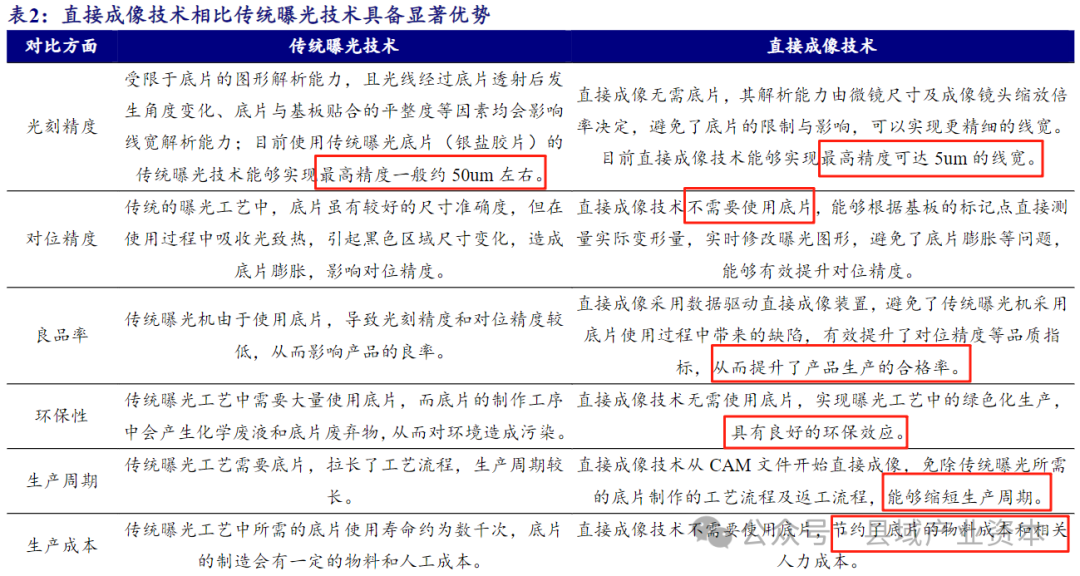
Compared to traditional exposure technology, direct imaging equipment has advantages in photolithography accuracy, alignment accuracy, yield rate, environmental friendliness, production cycle, production cost, flexible production, and automation level. As technology continues to improve and equipment costs decrease, direct imaging equipment has been widely applied in the manufacturing of mid-to-high-end PCB products, becoming the mainstream development technology in PCB manufacturing exposure processes.LDI is more aligned with HDI exposure requirements, and the equipment is still in the early stages of domestic substitution.HDI boards have higher circuit density, prompting laser direct imaging to replace traditional photolithography processes.
◆Competitive Landscape: Foreign brands dominate, with a low domestic substitution rate. Currently, exposure equipment is still dominated by overseas players, including Israel’s Orbotech, Japan’s ORC, and FujiFilm, while domestic players mainly include DAHUA CNC and Chip Qu Micro.

Summary
Today, I only introduced the core exposure equipment, and I encourage everyone to pay attention to the leading companies DAHUA CNC and Chip Qu Micro. Overall, the PCB equipment industry is relatively small compared to other industries, with a global scale of about 50 billion yuan and approximately 30 billion yuan in China.
Among them, exposure and drilling equipment have relatively high value, accounting for 17% and 21%, respectively. Together, they account for nearly 40% of the market share. However, as the downstream application markets for PCBs, such as smartphones and tablets, develop towards large-scale integration, lightweight, and high intelligence, the requirements for PCB manufacturing processes continue to increase, particularly for exposure accuracy (minimum line width). Therefore, the market demand for PCB equipment is also rising.
In fact, the entire equipment process is increasingly calling for domestic substitution, and the technology is indeed improving. The core stage of the entire industry chain is actually just a few companies: DAHUA CNC and Chip Qu Micro. Others include: consumables【Ding Tai Gao Ke】【Zhong Tung Gao Xin】; for the electroplating segment, pay attention to【Dong Wei Technology】, and for the solder paste printing segment, pay attention to【Kai Ge Precision Machinery】. Here, we will not elaborate on the consumables, electroplating, and printing segments. Let’s focus on the most core DAHUA CNC and Chip Qu Micro (drilling and exposure equipment).
Today, I will leave you with a thought-provoking question: how do you view DAHUA CNC and Chip Qu Micro? We will continue to analyze this tomorrow. If you have any questions you would like to know, feel free to follow, leave a message, and communicate at any time. Then, I will provide you with a brokerage (Dong Wu Securities) profit forecast for your cautious reference.

After we summarize everything, I will share it with you tomorrow, ensuring it is the most comprehensive! The most authoritative! The most in-depth! The most effective! I welcome everyone to like, follow, comment, and share.
Finally, please think carefully. I wish everyone prosperity in their investments!!!
Follow me to focus on the development of the technology industry and step into the technology industry in China!