
PART/1
Field of Achievement
Electronic Information
PART/2
Achievement Name
Implementation of Fiber Optic Sensing Data Acquisition and Processing Algorithm Based on FPGA
PART/3
Achievement Introduction
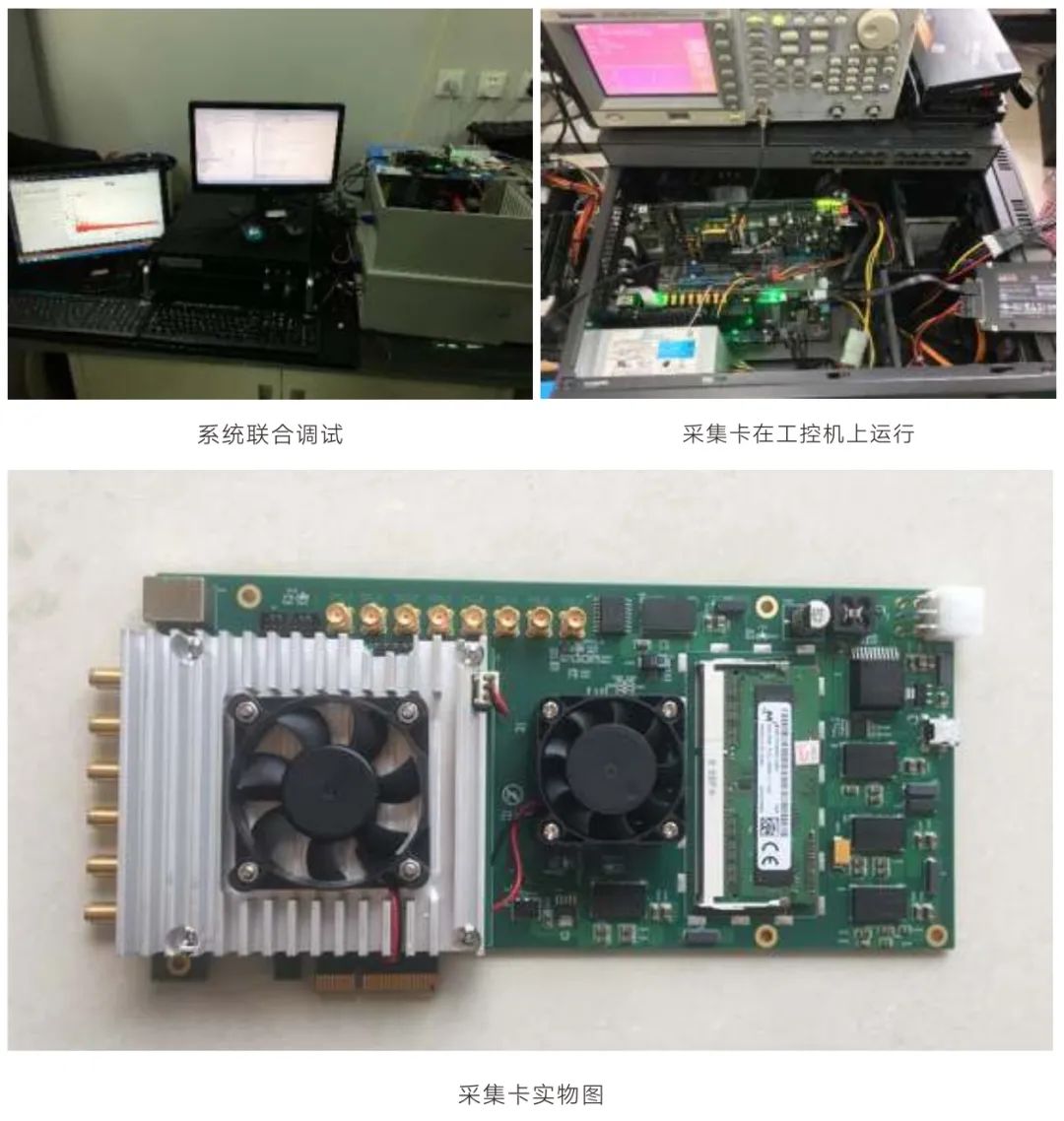
The implementation of the fiber optic sensing data acquisition and processing algorithm based on FPGA utilizes a development board based on Xilinx A7 FPGA, 1GB DDR3 memory, and PCIe×4 high-speed interface. It employs a dual-channel 250MSPS high-speed acquisition sub-board to perform real-time acquisition of Φ-OTDR distributed fiber optic sensing data. The FPGA is used for dual-channel I/Q demodulation, DDR3 storage for large-capacity data, fast matrix transposition based on DDR3 memory, short-time energy accumulation calculation, sliding differential filtering calculation, and high-speed DMA data transmission via the PCI Express bus. The achieved distributed fiber optic sensing distance can reach up to 40KM, with a trigger pulse repetition frequency of ≥2KHz, significantly enhancing the resolution and real-time performance of the distributed fiber optic sensor system, while also allowing data to be uploaded to a PC for storage.
PART/4
Application Fields
Fiber optic hydrophone, landslide detection, bridge vibration monitoring
PART/5
Holder Introduction
Sheng Qinghua, male, from the School of Electronic Information, Lankai City, Zhejiang Province. He obtained a master’s degree in Circuit and System from Xi’an University of Electronic Science and Technology in March 2003 and has been teaching at Hangzhou Electronic Technology University since then. His main research directions include electronic system integration (marine electronics, IoT embedded systems), FPGA hardware acceleration (high-speed ADC acquisition, 4K video transmission), and video coding and processing (H.266/VVC, video intelligent detection and recognition). As the principal investigator, he has led two sub-projects of the National Key Research and Development Program, two sub-projects of the Zhejiang Provincial Key Research and Development Program, and over ten cooperative projects with enterprises and institutions; in recent years, he has published more than 20 academic papers in domestic and international journals and at academic conferences, with nearly 10 included in the three major retrieval institutions; he has applied for over 20 patents and software copyrights, with more than 10 authorized; published one textbook; received a third prize in the Zhejiang Provincial Science and Technology Award; guided students to win the highest award in the 2023 National College Student Electronic Design Competition (TI Cup) and received the Outstanding Contribution Award for the 30th Anniversary of the National College Student Electronic Design Competition (individual), as well as five awards for Outstanding Instructor in the Zhejiang Division of the National College Student Electronic Design Competition.
PART/6
Related Intellectual Property of the Achievement

PART/7
Research Projects
1. Implementation of Fiber Optic Sensing Data Acquisition and Processing Algorithm Based on FPGA, Shanghai Institute of Optics and Fine Mechanics
2. Research on Real-Time Demodulation Acceleration Algorithm for Sensing Phase Based on FPGA, Shanghai Institute of Optics and Fine Mechanics
PART/8
Achievement Photos
Source|Center for Integration of Industry, Academia, and Research
Typesetting|Ye Yuanyuan
Review|Li Hu

|Hangzhou University of Technology Research|
Inspiring Innovation Leading the Future
Technological Innovation
The Future is Wonderful Because of You