In industries such as automotive automation production lines and heavy equipment manufacturing, where precision and reliability in motion control are critical, PROFIBUS-DP serves as a stable and reliable bus standard, carrying control commands and status feedback for key servo drives. However, when equipment layouts extend over hundreds of meters and production environments are filled with interference from variable frequency drives and large motors, traditional RS-485 transmission can lead to system instability—issues such as signal attenuation, electromagnetic interference (EMI), and ground loop problems frequently occur, resulting in servo response delays, positioning jitter, and even communication interruptions, directly affecting production yield and equipment.
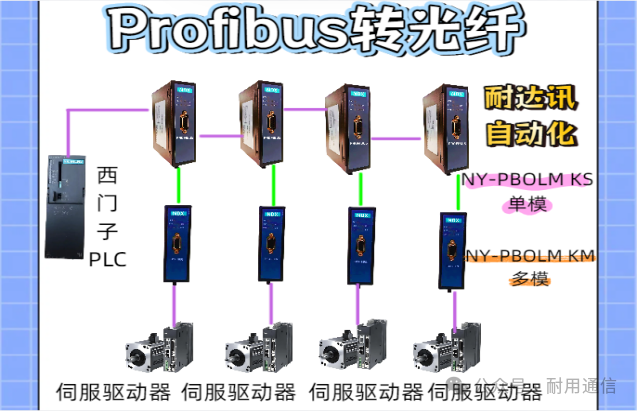
Durable Automation’sPROFIBUS to fiber optic industrial communication conversion solution is a key technological bridge designed to address this industry pain point. Its core lies in leveraging the inherent advantages of fiber optic transmission to achieve lossless, long-distance, and interference-resistant transmission of PROFIBUS signals in complex industrial environments:
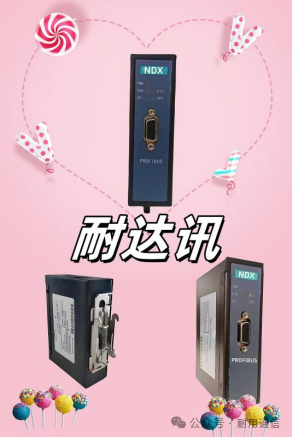
Core Technology Principles and Key Parameter Analysis
1. Electro-Optical / Opto-Electrical Precision Conversion:
The converter is equipped with a high-precision codec chip that converts the differential electrical signal of RS-485 from the master station (PLC) or slave station interface (compliant with PROFIBUS-DP IEC 61158/EN 50170 standards) into an optical signal in real-time (with wavelengths typically at 850nm for multimode or 1310/1550nm for single mode).
The reverse process converts the optical signal received from the fiber back into a standard PROFIBUS electrical signal, which is sent to the servo drive (e.g., Siemens).
2. Exceptional Anti-Interference Capability:
Electrical Isolation Strength: The isolation voltage between input/output terminals and power supply is ≥2500V AC RMS (or 3750V DC), effectively blocking common-mode interference caused by ground potential differences.
EMI Immunity: The fiber itself is an insulating medium, naturally immune to strong electromagnetic fields generated by variable frequency drives, high current switches, and welding equipment (up to >100V/m), ensuring signal purity.
3. Long-Distance Transmission Breakthrough:
Multimode Fiber Application: Supports stable transmission over 2 kilometers at a baud rate of @12Mbps (typical value, using OM3/OM4 fiber), far exceeding the 100-200 meter limit of copper cables.
Single Mode Fiber Extension: With single mode optical modules, transmission distances can be extended to 20 kilometers or even over 40 kilometers (@12Mbps), meeting the needs of ultra-large factories and inter-workshop networking.
Baud Rate Adaptability: Fully compatible with the full range of PROFIBUS-DP 9.6Kbps to 12Mbps rates, unaffected by rate switching.
4. Low Latency and High Real-Time Assurance:
Transmission Latency: High-quality converters achieve end-to-end transmission latency of < 1 bit time (approximately <83ns at 12Mbps), ensuring compliance with the strict real-time requirements of PROFIBUS.
Clock Synchronization Accuracy: Provides a stable channel for multi-axis precision servo systems (such as electronic gears and cam curve applications) that rely on isochronous synchronization, ensuring clock synchronization accuracy between slaves can reach ±1 microsecond.
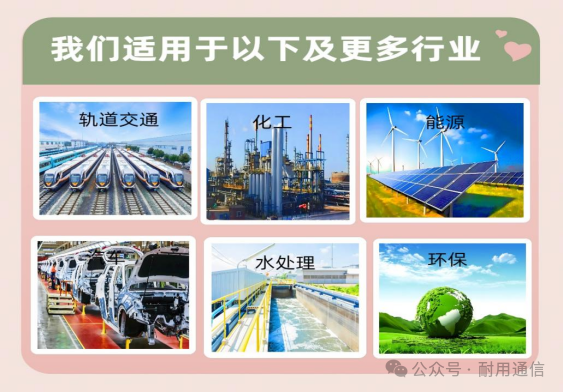
Durable Automation’sPROFIBUS to fiber optic solution is not merely a simple medium replacement, but a strategic upgrade in industrial communication reliability. When your production line faces servo performance bottlenecks due to distance or interference, deploying Durable Automation’s fiber optic conversion solution is worth a try!