As the leader in the global PC industry, Intel has defined the development of various technologies and architectures, continuously leading the performance leaps and technological transformations in the PC industry. On September 19, 2023, Intel officially unveiled the long-rumored Meteor Lake architecture and its corresponding Core Ultra brand. Compared to previous Intel products, the Meteor Lake architecture represents a comprehensive upgrade, bringing revolutionary advancements in almost every aspect, including architecture, process, structure, and technical features.
According to Intel’s introduction, the Meteor Lake architecture and the corresponding Core Ultra series products are the most advanced, improved, and technologically innovative products Intel has released in recent years, marking a historic and revolutionary overall advancement. Next, let’s take a preliminary look at the relevant information about the Meteor Lake architecture as introduced by Intel. We will publish more detailed content in the upcoming issue of Microcomputer Magazine, which will include in-depth technical analysis. We hope you enjoy it.
Process: Intel 4 Achieves Mass Production, 3D Foveros Shines
Intel previously mentioned in its IDM 2.0 goals that it plans to achieve progress in five process nodes over four years. This includes the Intel 7 process widely used in Raptor Lake and the Intel 4 process introduced today for Meteor Lake. The Intel 4 process is particularly significant as its success means Intel is starting to widely adopt EUV lithography technology and manufacture FinFET transistors using EUV lithography. Don’t underestimate the introduction of EUV lithography technology; compared to DUV, EUV simplifies the manufacturing process, reduces manufacturing steps, and improves manufacturing quality. With the introduction of EUV, Intel no longer needs techniques like multiple exposures to manufacture smaller transistors (for example, Intel mentioned one grid + four collection layers), as EUV lithography can accomplish this in one go. Furthermore, EUV lithography reduces the number of masks and decreases process steps, leading to lower production costs and improved efficiency and yield.
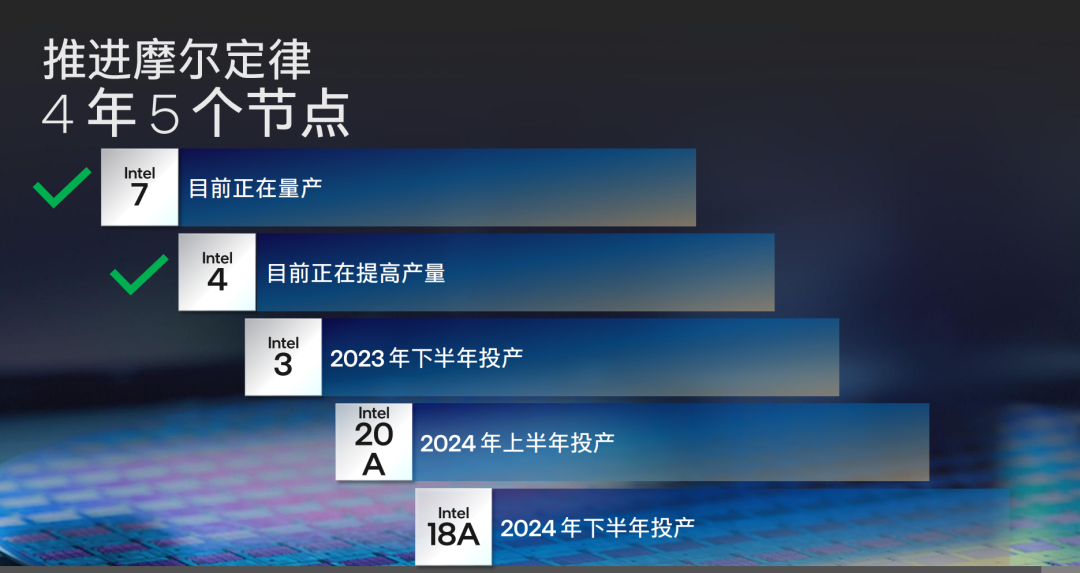
▲ Intel’s process development roadmap, five nodes in four years.
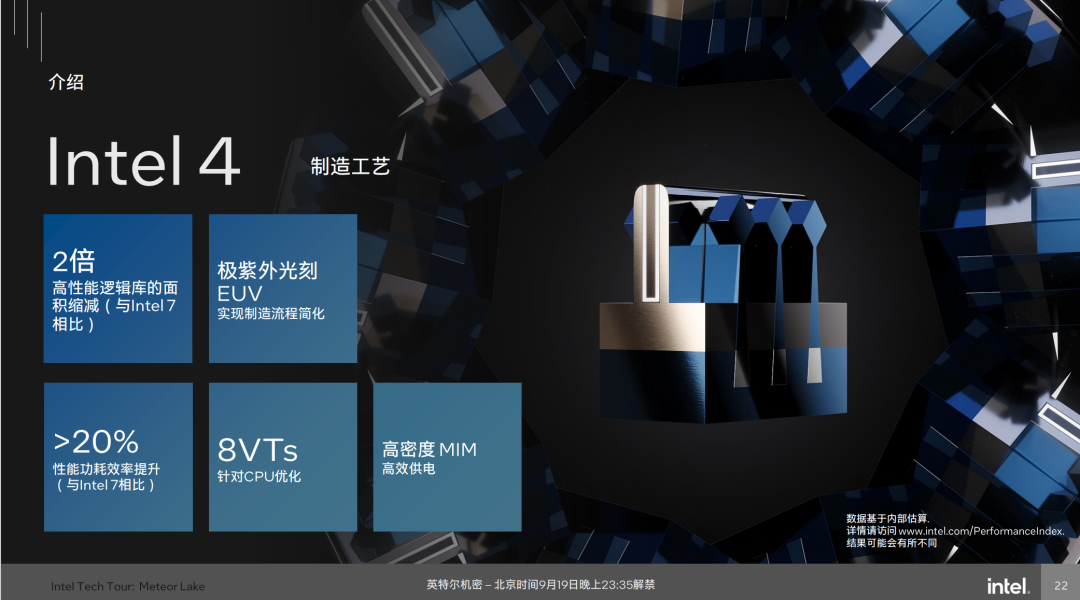
▲Intel 4 process brings significant improvements in manufacturing technology.
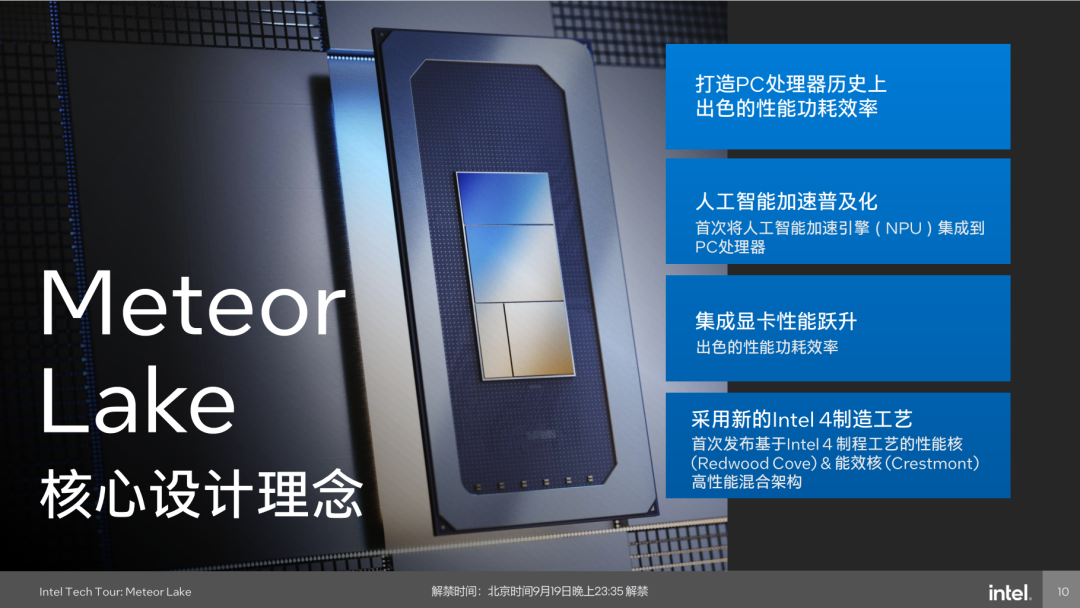
▲Meteor Lake features numerous revolutionary improvements, marking the largest transformation in Intel’s processor products in recent years.
With the introduction of EUV lithography and related manufacturing technologies, the Intel 4 manufacturing process can finally begin mass production of the Compute Tile portion of Meteor Lake. In fact, the entire Meteor Lake processor consists of four block sections: the Compute Module, SoC Module, Graphics Module, and IO Module. The Compute Module uses the Intel 4 process, while the other modules use other suitable processes for production, which may not even come from Intel. Intel employs 3D Foveros technology to package all four modules together and interconnect them via a high-speed bus, enabling coordinated operation of all parts of the module.
Architecture: All Four Modules Redesigned, Significant AI Performance Boost
In terms of architecture design, Intel specifically mentioned that the Compute Module, SoC Module, Graphics Module, and IO Module have all been completely redesigned to better meet the demands of modern computing.
First, let’s look at the Compute Module. Intel has introduced a new performance core, Redwood Cove, and an efficiency core, Crestmont, in Meteor Lake. Intel can now provide up to six performance cores and eight efficiency cores.
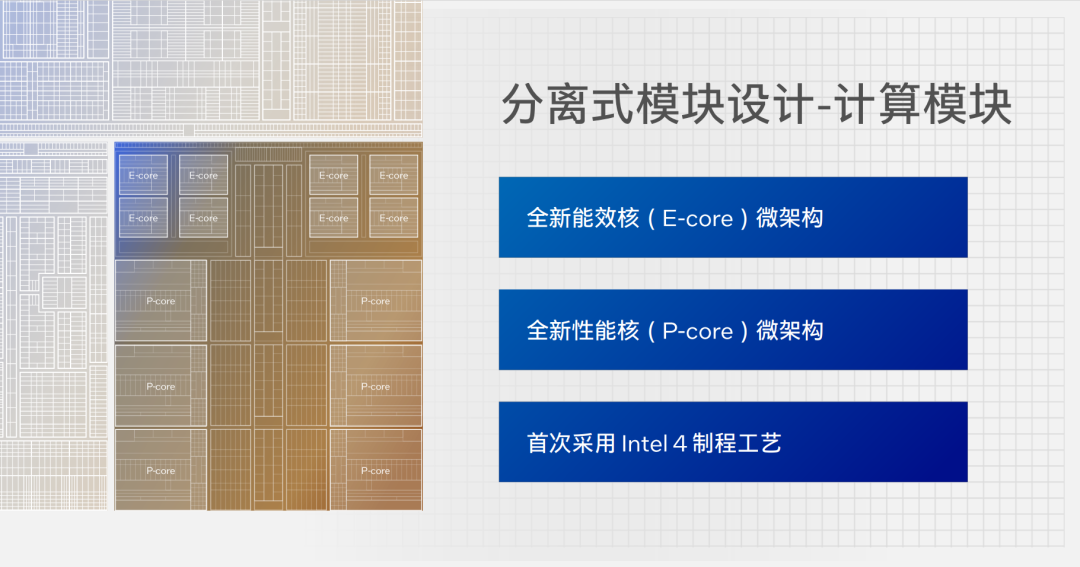
▲Intel has adopted a separate Compute Module design, with significant updates to the overall architecture.
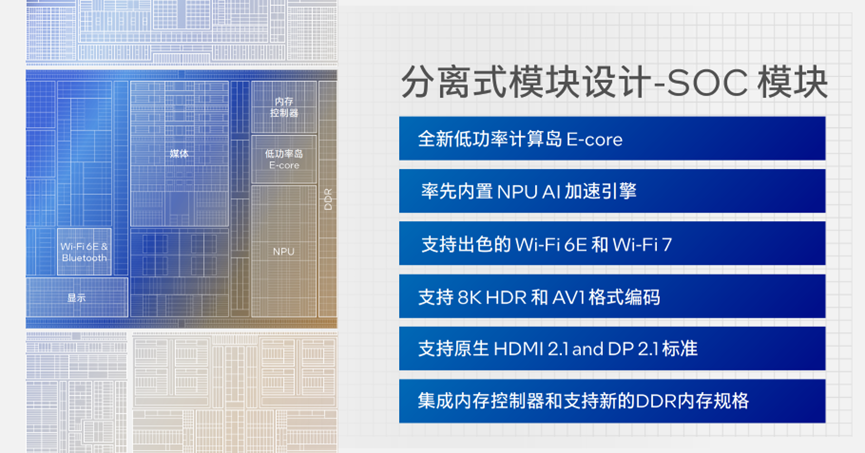
▲The SoC module of Meteor Lake integrates numerous functions.
Next is the SoC Module. Intel has reorganized its internal architecture, integrating the display, NPU, media, memory controller, Wi-Fi, and Bluetooth components into the SoC Module. Notably, Intel has added a low-power island to the SoC Module for the first time, embedding a low-frequency efficiency core, which exhibits excellent overall energy efficiency, referred to by Intel as the LP E-Core. With the presence of this LP E-Core, lightweight tasks such as media playback, screen display, and NPU operations can be handled by the LP E-Core, allowing the Compute Module, GPU, and other modules to be powered down for energy savings. Consequently, the performance and power level configuration of the entire processor has shifted from P-Core and E-Core levels to P-Core, E-Core, and LP E-Core levels. With the increase in levels, task scheduling becomes more complex, prompting Intel to design a new thread scheduler that, in conjunction with Microsoft’s latest Windows operating system, can maximize overall energy efficiency.
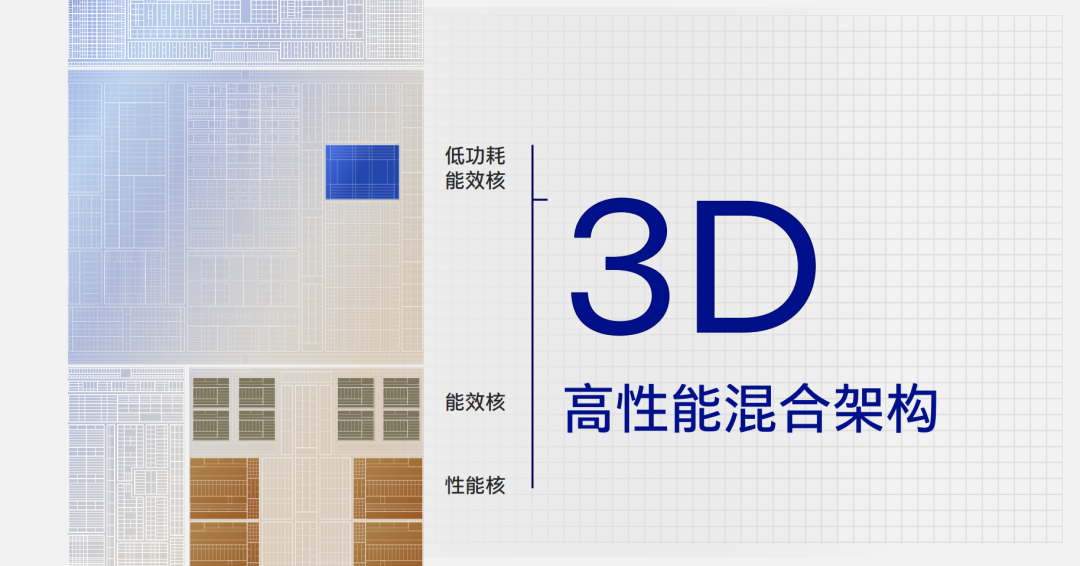
▲The CPU architecture level of Meteor Lake has transformed into three levels: P-Core, E-Core, and LP E-Core.
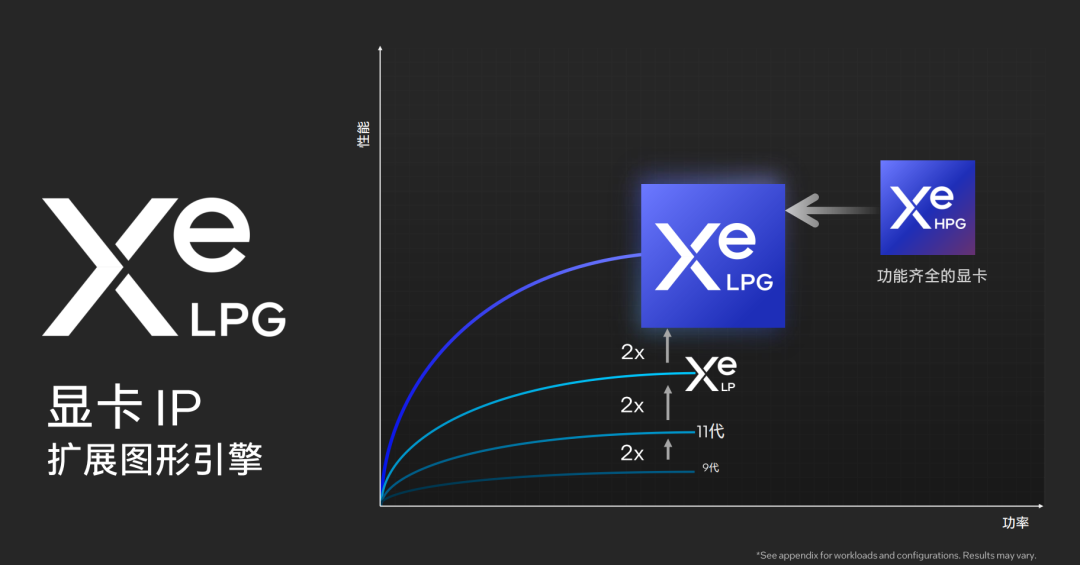
▲The GPU section of Meteor Lake adopts the Xe LPG architecture, offering better performance and energy efficiency.
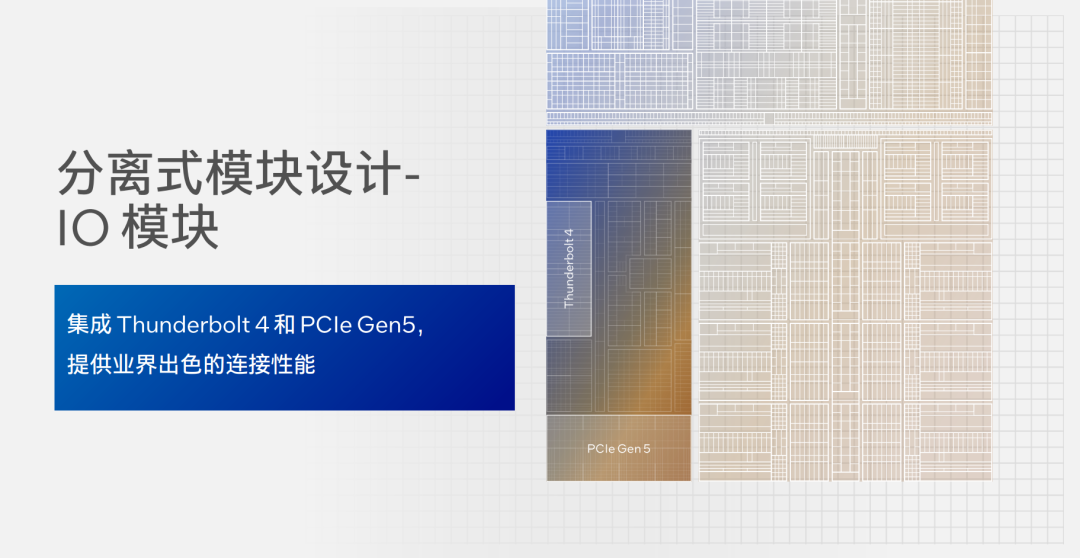
▲The IO module of Meteor Lake supports PCIe 5.0 and Thunderbolt 4 technology.
Thirdly, in the Graphics Module, due to the separate design, Intel can significantly enhance the scale of the GPU. The GPU section of Meteor Lake can have up to eight Xe LPG units, 128 vector engines, two geometry pipelines, eight sampling engines, eight ray tracing units, and four pixel backends, representing a leap in performance compared to the previous generation.
Fourth, in the IO Module, Intel has integrated Thunderbolt 4 and PCIe 5.0 controllers. Intel claims that the IO module will offer excellent flexibility and outstanding performance.
Overall, due to its fully modular design, Meteor Lake brings a completely different design, usage, and functional experience compared to previous processors. For more detailed content, please look forward to the in-depth analysis in the official publication.
AI Computing: Joint CPU, GPU, and NPU for Significant Enhancement
AI computing has become the hottest topic in the industry and has spawned numerous effective applications. In terms of AI computing, the new Meteor Lake will combine the CPU, GPU, and newly added NPU to bring significant enhancements to AI computing.
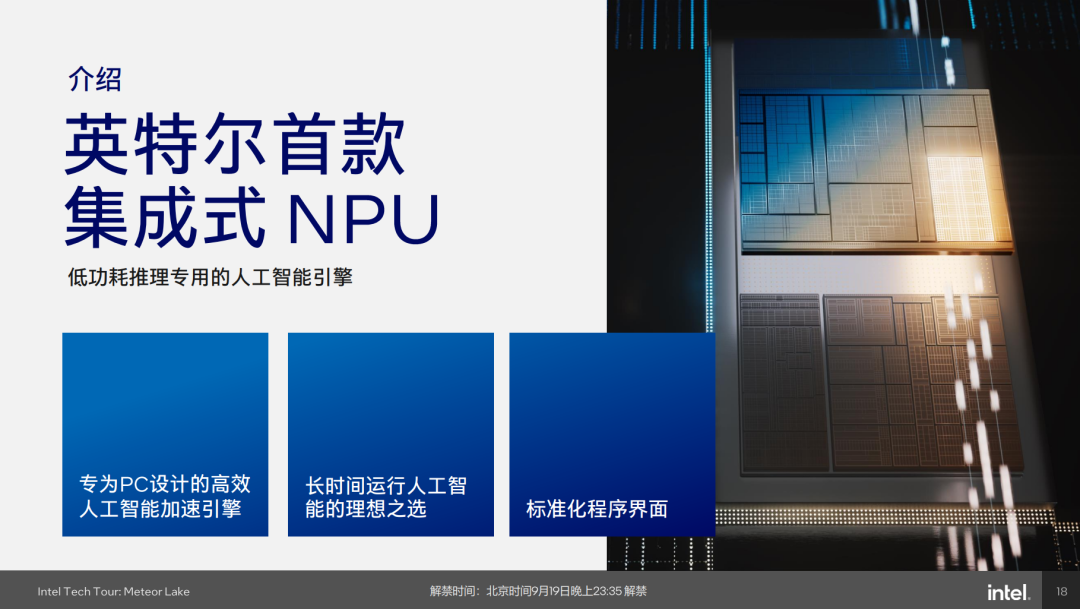
▲Adding the NPU AI computing engine is one of the biggest changes in Meteor Lake, with robust overall functionality.
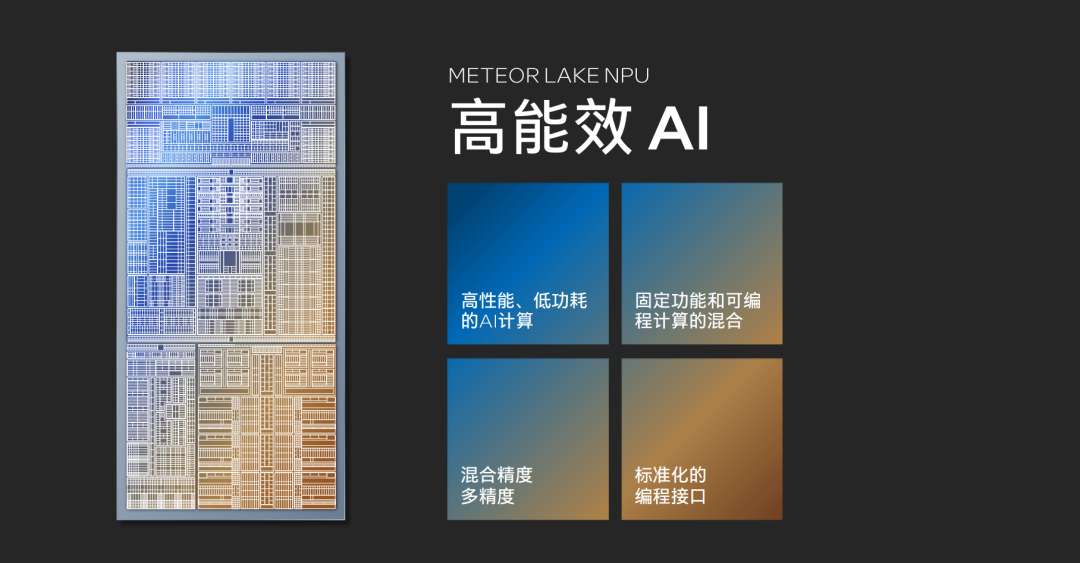
▲The NPU can achieve more efficient AI computing.
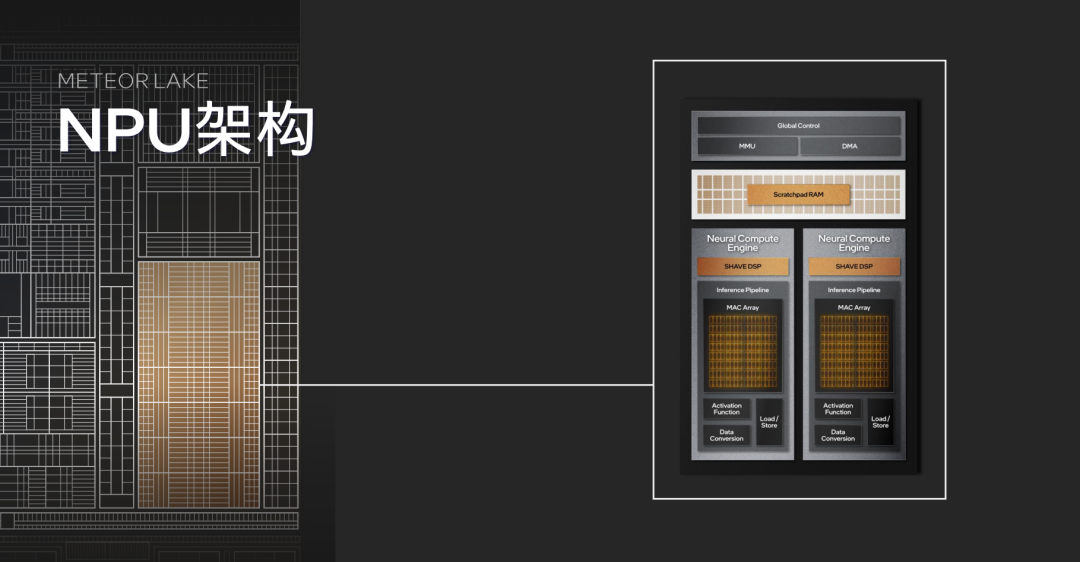
▲Diagram of the NPU architecture in Meteor Lake.
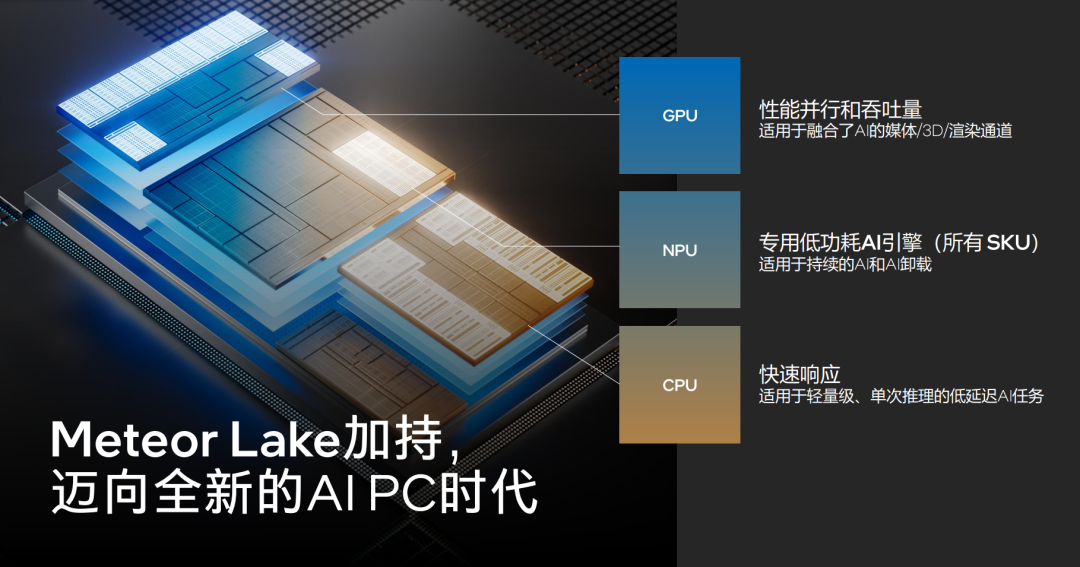
▲The combination of NPU, GPU, and CPU in Meteor Lake will usher Intel processors into a new AI era.
The NPU in Meteor Lake is one of the most significant changes. It includes two neural computing engines, each equipped with matrix multiplication and convolution units, supporting data transformation and activation functions, capable of handling content in generative AI, computer vision, image enhancement, and collaborative AI. With the NPU, many tasks that previously required CPU and GPU calculations can be offloaded to the NPU, potentially increasing overall energy efficiency by up to eight times.
Besides the NPU, the GPU can also perform AI acceleration. The Xe LPG architecture in the GPU module supports the DP4a instruction set, providing 64 INT8 computations in a single cycle and capable of executing 32-bit accumulation with outstanding performance.
On the software side, Intel has already collaborated with several industry enterprises to build a mature ecosystem in hardware and software, supporting popular generative AI engines like Stable Diffusion v1.5, which can significantly enhance the efficiency of current AI applications. In terms of AI computing, Intel claims it will massively introduce AI computing into PCs, and Meteor Lake will usher in a new AI PC era. It is foreseeable that AI will become one of the key features of Meteor Lake and a major direction and technology for Intel’s future development.
Core Ultra Arrives: Intel’s Future Blueprint Unfolds
▲The Core i trademark may no longer appear in the mid-to-high-end market, replaced by Core Ultra.
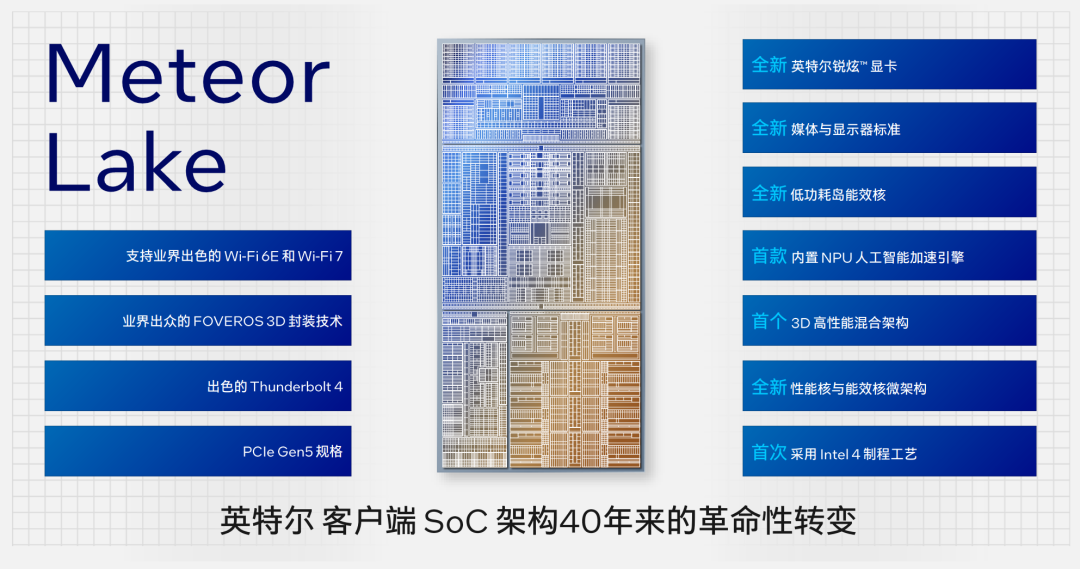
▲Intel claims that Meteor Lake is the most significant change in client products in 40 years.
At the press conference, we also received information about Intel’s next-generation commercial brand, which will be called Core Ultra, with different series such as Core Ultra 5, Core Ultra 7, and Core Ultra 9. Intel’s abandonment of the 14th generation Core i series brand in favor of Core Ultra indicates that the emergence of Meteor Lake will fundamentally change Intel’s future processor development model. Especially with its modular and block design and manufacturing approach, it not only offers greater flexibility in processor design but also allows products to be more closely aligned with customer needs, even enabling custom solutions for clients.
This concludes our brief introduction to Meteor Lake and Core Ultra. In addition to this article, we will also provide in-depth interpretations of Meteor Lake in Microcomputer Magazine. We hope that readers interested in Meteor Lake will purchase our magazine for further insights.