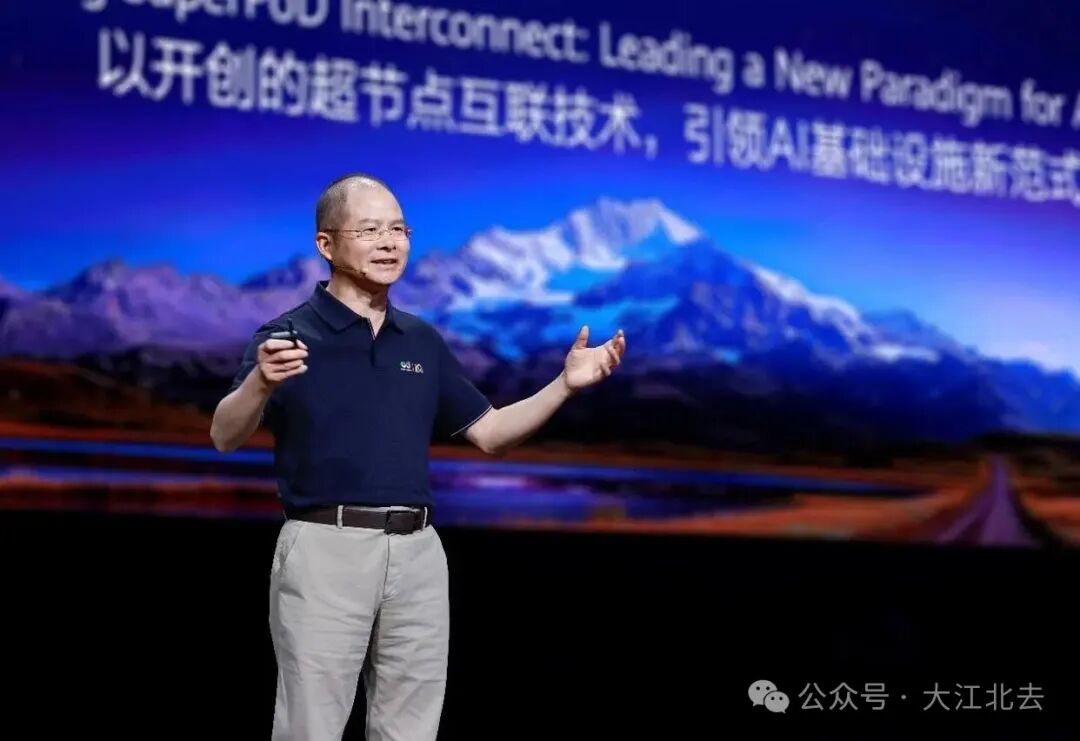
On September 18, at the 2025 Huawei Connect Conference held at the Shanghai Expo Center, Huawei’s Vice Chairman and Rotating Chairman Xu Zhijun delivered a keynote speech, announcing for the first time the clear product iteration roadmap for the Ascend AI chips over the next three years.
This is not only a technology release but also a strategic declaration:
Huawei has officially pressed the “accelerate” button for AI computing power, shifting from “steady iteration” to “high-speed pursuit”.。
1. Three Years, Four Generations: Huawei Ascend’s “Sprint Plan”
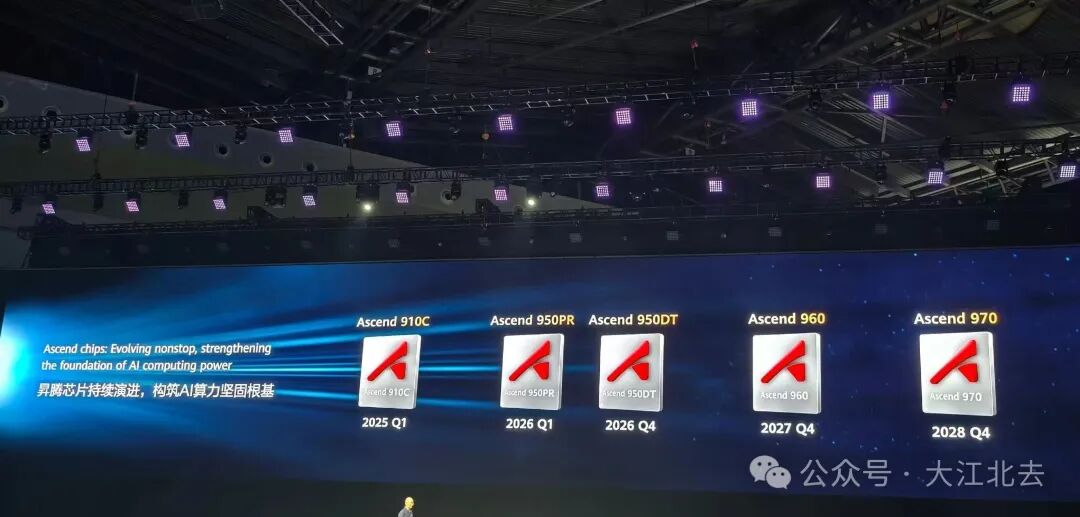
During the speech, Xu Zhijun clearly announced that the Ascend series chips will progress according to a clear timeline:
| Chip Model | Release Date | Positioning and Significance |
|---|---|---|
| Ascend 950PR | Q1 2026 | Successor to 910C, performance leap |
| Ascend 950DT | Q4 2026 | Deep training optimized version |
| Ascend 960 | Q4 2027 | Computing power doubled, aligned with international frontiers |
| Ascend 970 | Q4 2028 | Next-generation flagship, supporting large model evolution |
This plan means that Huawei will achieve a rapid development pace of “one generation per year, doubling computing power”, completely breaking the past market impression of “slow progress”.
More notably, the Ascend 950PR, scheduled for release in Q1 2026, will be the first to feature Huawei’s self-developed HBM (High Bandwidth Memory), marking a key step towards autonomy in core components of AI chips.
2. Six Years of “Slow Development”
Looking back, the development of the Ascend series was once considered “slow-paced”.
Since the release of the first Ascend 910 in 2019, Huawei has successively launched models such as 910B and 910C, all based on the self-developed Da Vinci architecture, focusing on cloud AI training and inference scenarios.
Among them, the Ascend 910C has achieved mass production and commercial use in Q1 2025, providing important support for the current domestic AI computing power ecosystem.
However, at the same time, the global AI chip market is experiencing rapid changes:
- NVIDIA has launched the H100, B200, and even B300 (equivalent to an enhanced version of H300);
- Computing power density, energy efficiency ratio, and interconnect bandwidth are constantly breaking records;
- Domestic large model training heavily relies on imported chips, creating a “bottleneck” risk.
In this context, the six-year era of the 910 series, while technically solid, inevitably earned the label of “slow pace“. As a result, the H20 (the so-called China-specific version, a stripped-down version of H100) became popular in the domestic market.
3. Market Pressure, “Autonomous Breakthrough” Needed
Why did Huawei choose to announce such an aggressive roadmap at this time?
The significance of this roadmap has long exceeded the product planning of a single enterprise; it resembles a declaration of China’s computing power “autonomous breakthrough”.
From the market perspective, domestic AI computing power demand is experiencing explosive growth: by 2025, the demand for large model training in China is expected to increase by 300%, but the supply gap for NVIDIA chips exceeds 50%. The accelerated iteration of Ascend chips can directly fill this gap — this year, the Ascend 910C has captured 20% of the domestic AI training chip market, and with the rollout of the 950 and 960 series, this proportion is likely to continue to rise, ultimately breaking the “NVIDIA dependency”.
From the industry perspective, Huawei’s construction of a “computing power foundation” will drive the entire industry chain upgrade: self-developed HBM requires support from domestic memory companies, chip mass production needs breakthroughs in domestic processes, and a “more user-friendly” design will lower the usage threshold for small and medium-sized tech companies — just as the Kirin chip once drove the domestic smartphone industry chain, the iteration of Ascend chips will also pull up a “self-controllable AI computing power industry chain”.
More importantly, this injects confidence into the domestic tech industry: previously, there were concerns that “domestic computing power would never catch up”, but Huawei has proven with a clear roadmap that as long as the “bottleneck” links are broken, with self-developed architecture and iterative determination, it is entirely possible to keep pace with or even surpass international top levels.

4. Clear Goals: Not Just “Doubling Computing Power”, But Also “Reconstructing Foundations”
Xu Zhijun emphasized:
“Starting from the Ascend 950, we will continue to evolve at a pace of almost one generation per year, doubling computing power.”
However, this is not just a simple stacking of performance. Huawei’s goal is to focus on three major directions,reconstructing the foundation of domestic AI computing power:
- ✅ More User-Friendly: Lowering development thresholds and improving toolchain maturity;
- ✅ More Data Format Support: Adapting to emerging low-precision formats such as FP8, FP4, INT4 to enhance inference efficiency;
- ✅ Higher Bandwidth: Breaking the “memory wall” through self-developed HBM and advanced interconnect technology.
This marks a shift in Huawei’s AI strategy from “catching up on performance” to “building systemic competitiveness”.
For this reason, Huawei’s clear announcement of the chip roadmap for the next three years is seen as a key signal of its determination to catch up. Systematic and predictable technological iterations will not only boost industry confidence but also strongly support China’s AI industry in continuously tackling challenges and aligning with world-class computing power.
The “race” of domestic computing power is finally entering the “acceleration” phase.
Appendix:
I previously expressed dissatisfaction with the “slow development” of Huawei’s AI chips and wrote several critical articles:
1. “Revelations from the Strongest AI Chip” April 1, 2024
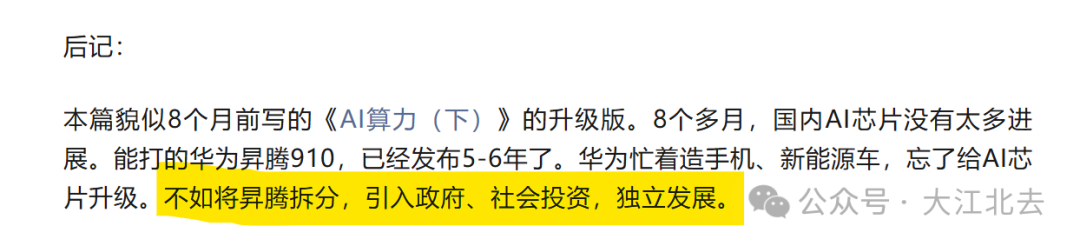
2. “AI, Huawei Needs to Do More” November 1, 2024
3. “It’s Time for Ascend to Stand Alone! ” April 1, 2025 (1 and 3 are a year apart, both written on April Fool’s Day, both proposing the independent development of Ascend, a mere dream)
Seeing Huawei’s clear product iteration roadmap for the Ascend AI chips over the next three years, although a bit late, is still very gratifying, and I look forward to its successful realization.