1. Thermal Conductivity of Common Materials
|
Material Category |
Grade |
Thermal Conductivity (W/m·K) |
|---|---|---|
|
Titanium Alloys |
TA1 |
6-10 |
|
TC4 |
6-10 |
|
|
TA15 |
6-10 |
|
|
Iron-based Alloys |
18Ni300 |
10-15 |
|
420 |
16-20 |
|
|
304L/304 |
16-20 |
|
|
316L |
16-20 |
|
|
17-4PH |
10-15 |
|
|
High-Temperature Alloys |
GH3536 |
6-15 |
|
GH4169 |
6-15 |
|
|
GH3625 |
6-15 |
|
|
Aluminum Alloys |
A1Si10Mg |
110-130 |
|
6061 |
150-200 |
|
|
Pure Metals |
Pure Ni |
90-100 |
|
Pure Cu |
400 |
2. Thermal Conductivity of Metal Powders at Room Temperature and Pressure (Comparison of Different Protective Gases and Powder Bed Thermal Conductivity)
|
Powder Type |
Argon |
Nitrogen |
Helium |
|---|---|---|---|
|
Inconel 718 |
0.085 |
0.092 |
0.210 |
|
17-4 Stainless Steel |
0.102 |
0.115 |
0.240 |
|
Inconel 625 |
0.078 |
0.088 |
0.195 |
|
Ti-6Al-4V |
0.095 |
0.105 |
0.225 |
|
316L Stainless Steel |
0.110 |
0.125 |
0.250 |
Data Source: 2018 AM Magazine “Thermal conductivity of metal powders for powder bed additive manufacturing”, highly cited.
3. Thermal Conductivity of Pure Gases at Room Temperature and Pressure
|
Gas |
Thermal Conductivity (W/m·K) |
Molecular Weight (g/mol) |
Physical Properties |
|---|---|---|---|
|
Helium (He) |
0.1502 |
4.00 |
Monatomic gas, shortest mean free path |
|
Nitrogen (N₂) |
0.0255 |
28.01 |
Diatomic gas, high thermal adaptation coefficient |
|
Argon (Ar) |
0.0176 |
39.95 |
Monatomic gas, high density and low thermal conductivity |
|
Air |
0.0260 |
28.97 |
Mixture gas (mainly N₂/O₂) |
4. Extended Thoughts on Thermal Conductivity in Engineering Practice
4.1 Understanding Heat Dissipation During the Printing Process
The thermal conductivity of the powder bed at room temperature and pressure is approximately 0.1 watts per meter Kelvin. This is equivalent to insulating materials, so the heat dissipation of printed parts in the powder bed is minimal and can only dissipate through the solid support that metallurgically bonds with the substrate.
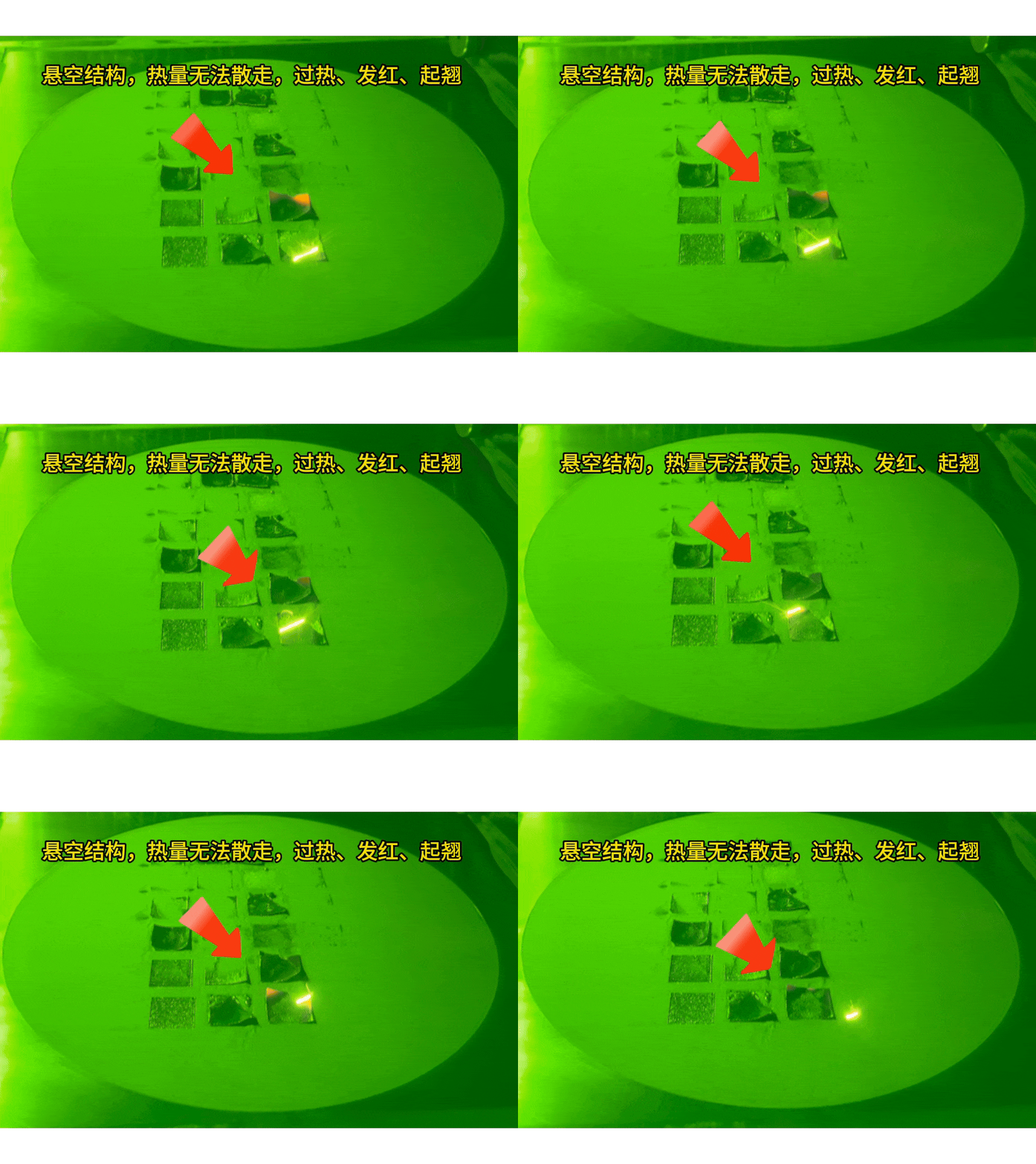
If printing is done suspended above the powder bed without support underneath, the heat cannot escape, leading to overheating, redness, and warping of the printed structure.
4.2 Understanding Heat Dissipation Direction and Columnar Crystals
The LPBF model, which dissipates heat downwards through support structures, has a strong directional characteristic. It cannot be said to be completely equivalent to directional solidification, but the transfer of thermal energy is indeed similar to directional solidification. This is why LPBF printed products generally have a columnar crystal structure, which resembles the polycrystalline blades of directional solidification.
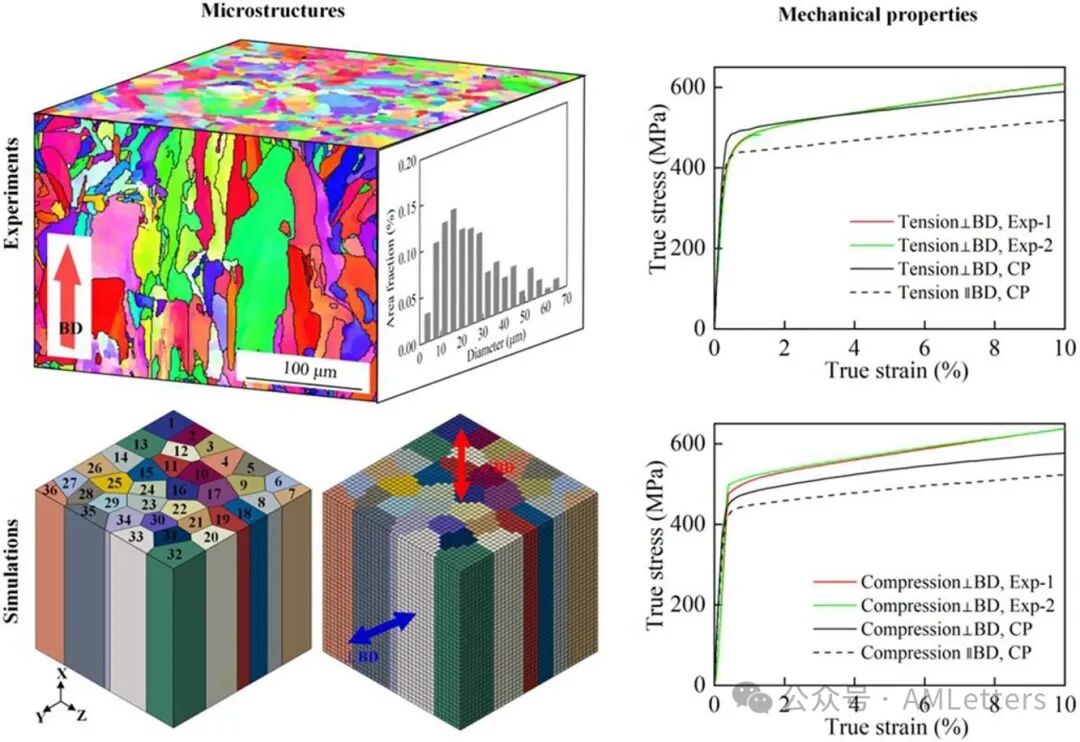
The following image is a graphic abstract of research work on anisotropic tension-compression asymmetry in SLM 316L stainless steel published in 2023 by Dr. Wang Zhanfeng, Associate Professor at the School of Mechanical and Electrical Engineering, Suqian College, in the International Journal of Mechanical Sciences (highly cited).
The upper left image shows a 3D structure of columnar crystals printed in SLM 316L;
The lower left image is a theoretical model of the columnar crystal structure of 316L, which is very intuitive for ordinary readers to understand the columnar crystal structure of SLM printed 316L.
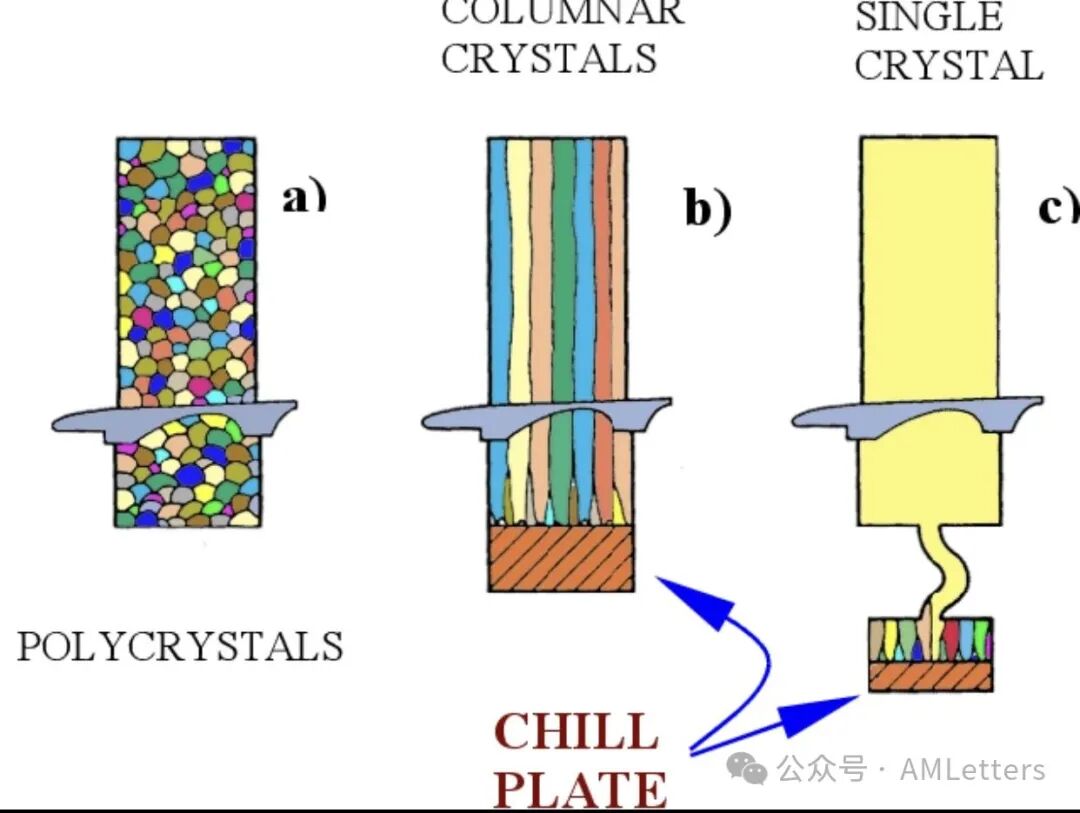
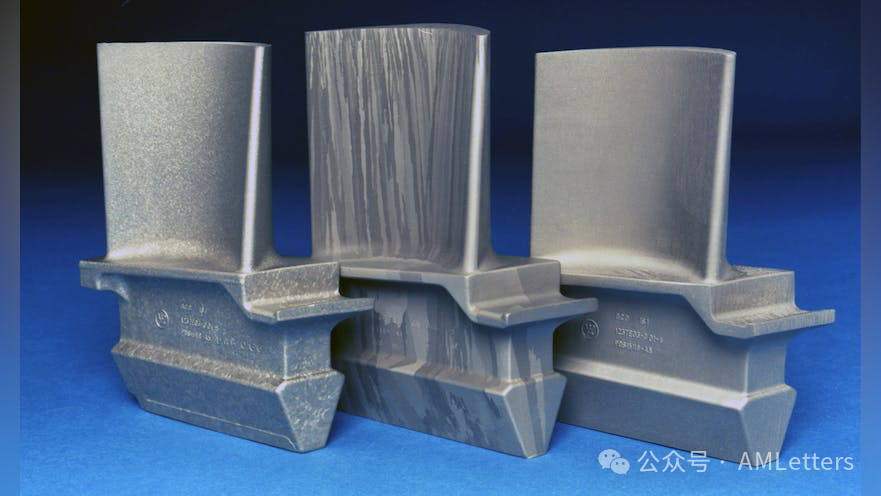
The following image shows the crystal structure models and physical images of three typical high-temperature alloy blades, from left to right: cast equiaxed crystal blade, directionally solidified columnar crystal blade, single crystal blade.
Isn’t the model of the directionally solidified columnar crystal blade very similar to the columnar crystal model of SLM printed 316L?
4.3 About the Water Cooling of the Substrate in SLM Equipment
Some friends may ask, if heat is dissipated downwards through the substrate, will the lifting axis of the equipment get too hot? After all, the lifting axis is supporting the substrate. If it gets too hot, will the equipment be able to handle it? This is not a problem because there is a water cooling structure in the base of the substrate. The water cooling unit outside the SLM equipment, in addition to cooling the laser and galvanometer, mainly provides cooling water circulation to the base of the substrate, removing the internal heat of the parts during the printing process and cooling the parts.

 END
END
Follow the AMLetters public account for more technical insights!
The AMLetters public account is a vertical professional media in the field of additive manufacturing in China, focusing on 3D printing technology, material innovation, and industrial applications, with the core concept of “depth, frontier, and popular science”, dedicated to building a bridge between academia and industry. We are not only observers of technological trends but also practitioners of promoting additive technology.
AMLetters【Academic Group】:We have gathered over 1100 PhDs, Masters, and industry technical experts in the fields of metal materials and additive manufacturing. Everyone is welcome to join the group for communication and networking! In the academic circle, it is important to make friends, exchange ideas, and broaden horizons!
Add the editor’s WeChatNote:School–Major–PhD/Master–Name,to be invited to join the group after editor review.
AMLetters【Printing Service ProviderGroup】:Gathering printing service providers and end-user resources to ensure that printing resources are not scarce! (Only decision-makers from manufacturers are allowed)
Welcome all process supporting companies to join the group for supporting resources! Printing services, testing services, HIP, heat treatment, post-processing (abrasive flow, magnetic polishing, etc.), machining, radiography, CT, welding, anodizing… so that companies or end-users just starting in printing services can find all reliable resources in one group.
AMLetters【ProcessGroup】:Gathering elites and process personnel from the 3D printing industry!!
How to join the group:
For submissions and promotions, please contact the editor!

 Brand Promotion
 Previous RecommendationsRECOMMENDShandong University and New National Institute jointly published in the top journal “IJP”: Research on the Room Temperature to High Temperature Anisotropic Mechanism of Additive Manufacturing High-Temperature AlloysBeihang University top journal “JMA”: Synergistic Optimization of Efficiency-Microstructure-Performance in Arc Additive Manufacturing of AZ31 Magnesium Alloy