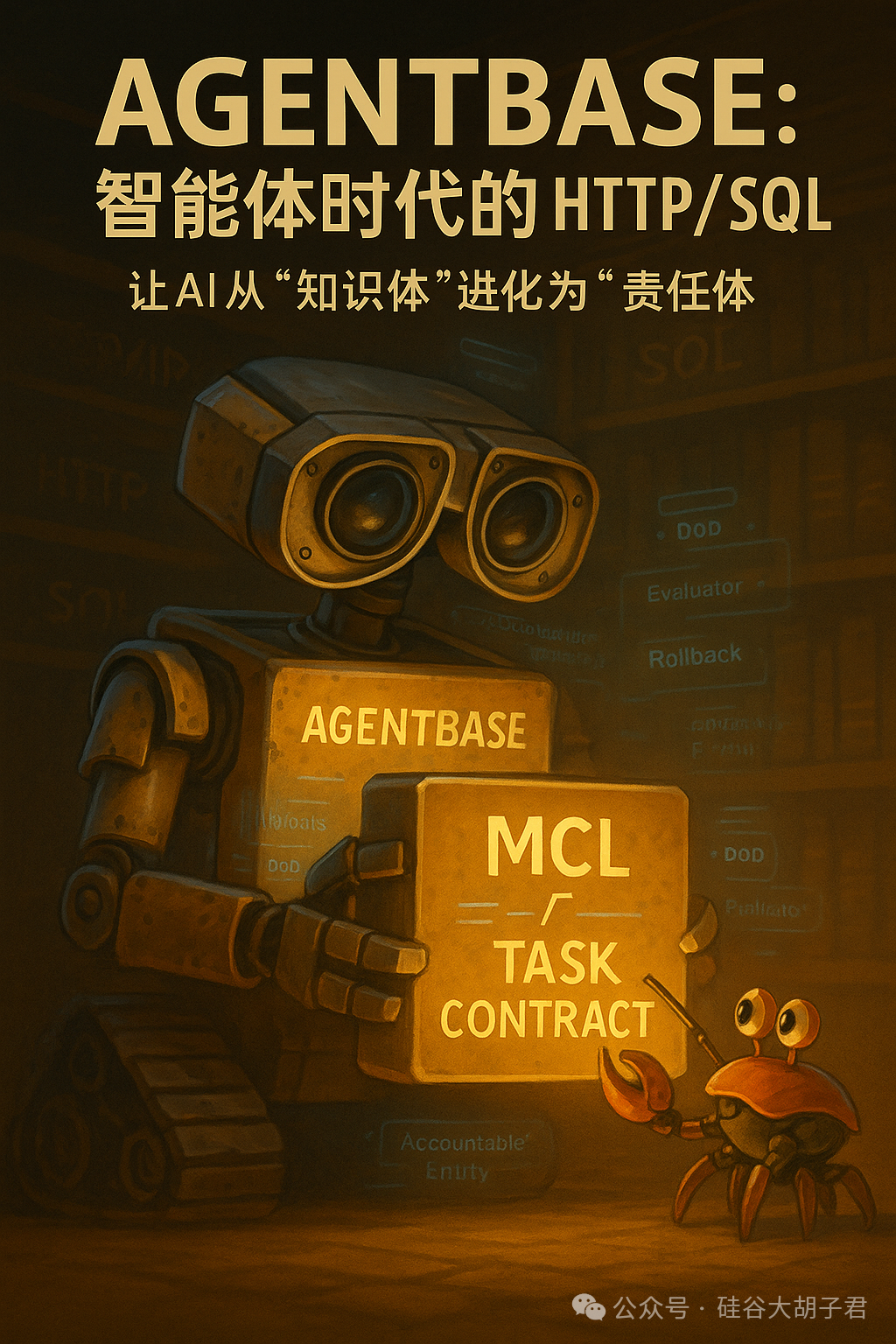
Preview
This article places MCL / Agentbase into the “historical lineage of computation and protocols”, demonstrating why it is bound to emerge.
1
Agents Need to Reach Business Units, Lacking a ‘Task Protocol’
By the end of 2025, agents will be ubiquitous, but those that have truly integrated into business units are still few and far between.
Smart engineers have developed various Agent frameworks, yet there has never been an executable, transferable industry standard.
If there were, what should this standard look like?
From a business perspective, the question is quite simple:
How can I assign tasks to agents in a way that ensures they complete the job without causing chaos, while also being accountable and reversible?
To achieve this, there must be a “Task Language” between humans and agents, and among agents themselves:
-
It should translate business intentions into executable structures;
-
It should clearly define boundaries, success conditions, and rollback mechanisms;
-
It should allow tasks to behave like data: defined, invoked, collaborated on, audited, and inherited.
In “From Database to Agentbase (Part 2): Why Agent Development is Still Stuck in the Old Stack?”, we refer to this task language as MCL (Model Context Language), which is to tasks what SQL is to data.
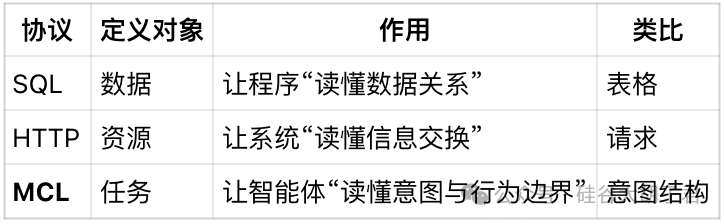
The runtime that carries MCL and enables it to operate effectively within enterprises is what we call Agentbase.
Database records facts; Agentbase records compliance.
MCL is not a programming language, but a protocol language that describes the semantics of agent tasks: it allows large models to understand “what the task is, where the boundaries are, and how to calculate the results”, encapsulating these agreements in a structured semantic container.
With MCL, agents can:
-
Understand intentions;
-
Generate task contracts;
-
Execute autonomously within agreed boundaries;
-
Record the entire process, supporting auditing and rollback.
This is what enterprises truly need: agents that can not only “understand”, but also “act”, and more importantly, “be accountable”.
In terms of the technology stack, it forms a complete chain:
Prompt → Workflow → TaskSchema → MCL Contract → Verifiable Trace → Rollback and Re-execution
Under this standard, the productivity boundary of agents has, for the first time, shifted from “computational power and understanding” to “execution capability and sense of responsibility”.
Once “responsibility” (accountability to business units) enters the main narrative of AI, the entire system transitions fromTool Logic to Collaboration Logic. The core issue of enterprise-level AI naturally shifts from “how smart is the model?” to “who is responsible for the results, and how are they held accountable?”.
This is the core worldview of Agentbase: AI evolves from a Knowledge Entity to an Accountable Entity.
Within this worldview, a simple yet powerful three-layer industry standard is quietly forming:
-
Language (MCL): How to write task contracts and express semantics;
-
Protocol: How the executor and governance parties communicate;
-
SDK: How business lines can input tasks and retrieve results.
2
MCL: From a Prompt to a ‘Task Contract’
For agents, no matter how long the prompt is, it essentially boils down to a single sentence; however, no matter how short the MCL is, it fundamentally represents a contract.
Prompts rely on inference and understanding, while MCL relies on structured semantics and boundaries of responsibility. This is their essential difference.
MCL is not a programming statement, but a task contract—allowing agents to not only “know what to do”, but also “know how to judge whether it has been done”: this is the universal semantic structure of tasks.
MCL Contains Two Layers of Definitions:
1️⃣ Contract Layer (Compliance Semantics)
-
Inputs: Required inputs and dependent data for the task
-
Objectives: Goals and success conditions
-
DoD: Definition of task completion
-
Evaluator: Verification standards and measurement mechanisms
-
Rollback: Logic for failure rollback
2️⃣ Execution Layer (Behavior Semantics)
-
Flow: A task chain composed of finite primitive primitives
-
open_research
-
answer_question
-
take_action
-
route_request
-
Memory: State reading and writing protocols
-
Routing: Triggering and self-loop mechanisms between tasks
This layer is not a “hardcoded workflow”, but a verifiable execution process constrained by the Contract.
In the past, prompts generated “heuristic inference” to describe intentions; in the future, MCL will generate “verifiable execution” that binds responsibility.
Without MCL, agents will always just be “doing tasks for you”; with MCL, agents become “accountable for results”.
Just as SQL is to data retrieval, HTTP is to message transmission, MCL corresponds to task compliance; it is not code, not a DSL, nor a replacement for workflow orchestration.
MCL encapsulates the protocol semantics of “task → verification → rollback” into a behavioral contract language.
In the next section, we will place MCL within a larger computational historical lineage, explaining why it is not just another “framework”, but a new protocol layer abstraction that has emerged from the times.
3
The Evolution of Protocol Layers: From Data to Tasks
Looking back at the past 50 years of computational paradigms, every leap in productivity has been due to the emergence of a higher-level semantic abstraction:
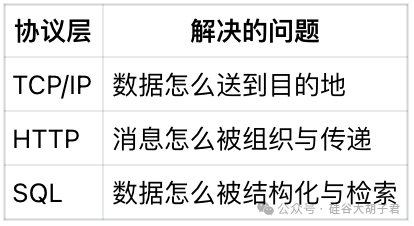
The emergence of each layer does not replace the previous one, but introduces new semantic units (Semantic Units) on top of it:
-
TCP handles “bytes”;
-
HTTP handles “request/response”;
-
SQL handles “data models”;
Thus, HTTP can call TCP, and SQL can call HTTP, because they abstract different dimensions of semantics, not competing relationships at the same level.
Only with the advent of the agent era do we encounter a new core issue: “tasks” themselves have not been structured, do not have semantic standards, and lack verification mechanisms.
This has led to the common symptoms of all agents today:
-
Task descriptions cannot be reused;
-
Tool invocation processes cannot be verified;
-
Results cannot be audited and lack rollback capability;
-
Agents across different business lines cannot collaborate;
-
Let alone inter-organizational agent interoperability.
It is not that agents are not smart enough; it is that the entire computational system has never had a “task semantic layer”.
This is precisely what MCL / Agentbase addresses:
The semantic unit of MCL is not data, nor messages, but tasks. It defines: goals (Goal), inputs (Inputs), outputs (Outputs), verification (Evaluation), and rollback (Rollback).
In other words:
-
SQL allows programs to “understand data”;
-
HTTP allows applications to “understand messages”;
-
MCL allows agents to “understand tasks”;
SQL and HTTP can both be invoked by Agentbase, but they do not solve the same semantic dimension—therefore, they do not form a “replacement relationship”, but rather a “succession relationship”.
The agent era is forcing the computational system to abstract one more layer: from “who owns the information” (knowledge) to “who is responsible for the results” (compliance).
From this perspective, MCL / Agentbase is not a new framework, but the next stop in the protocol lineage:
-
TCP/IP → HTTP → SQL → MCL / Agentbase
-
Bytes → Messages → Data → Tasks
This is the inevitability of paradigm evolution, unrelated to commercial ambitions.
4
Why Agentbase Qualifies as a ‘Protocol’
Whether a system can be called a protocol does not depend on its name, marketing, or ambition, but on whether it meets the “three qualification criteria of a protocol layer”:
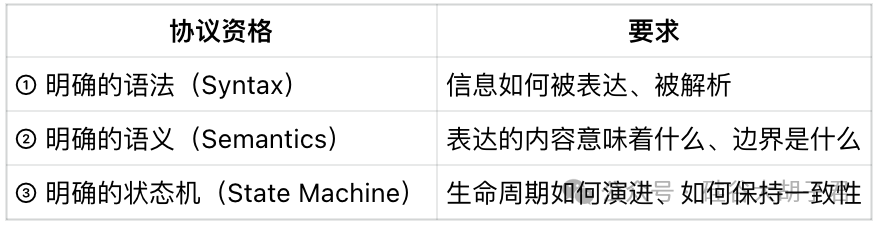
For example:
HTTP is a protocol not because it transmits messages, but because it defines request formats (syntax) / request-response semantics / stateless + session state machine.
SQL becomes data infrastructure not because it can query tables, but because it defines query syntax / data operation semantics / transaction consistency state machine.
Therefore, a system, even if it calls HTTP / SQL / API, is not a protocol as long as it does not have an independent semantic layer and state machine—it is at most an SDK, library, or service encapsulation.
Now let us apply the same qualification standards to Agentbase.

The conclusion is very clear:
The semantic unit of Agentbase is neither “messages” nor “data”, but rather “task contracts and execution states”.
This is the abstract level that protocols handle.
Conversely, we can also clarify several common misconceptions:
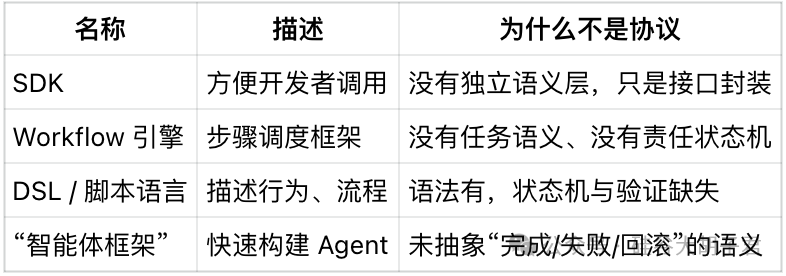
These tools are valuable, but they do not qualify as protocols.
The uniqueness of MCL / Agentbase is not “stronger”, but rather a different abstract dimension:
-
SDK solves invocation
-
Workflow solves sequence
-
DSL solves description
-
Framework solves development convenience
-
Protocol solves collaboration
There can be countless frameworks, but there can only be one set of semantic layers for protocols; otherwise, collaboration cannot be established.
In summary:
Only a system that can define “how task contracts are expressed, how they are executed, how they are verified, and how they are rolled back”, while maintaining consistency throughout its lifecycle—can be called a protocol.
What Agentbase does is precisely this layer, not replacing the existing ecosystem, but defining the entire agent era.
In the next section, we will provide a complete example to clearly show readers: both SQL and HTTP can serve tasks, but what organizes them into “compliant task units” is MCL / Agentbase. The difference between them lies in the semantic level.
5
A Complete Example
Suppose a business assigns an agent a routine request:
“Predict the sales in the East China region for the second quarter of this year and send the conclusion to the company’s Feishu group.”
This request appears to be a single sentence, but it relies on three different levels of abstraction:
🔹(1) SQL Part: Data Retrieval
The agent first needs to access the company’s database (e.g., Alibaba Cloud PolarDB), thus issuing an SQL query:

The task of SQL is very clear:
To obtain the raw data required for training/prediction from structured data sources.
However, these are merely questions of “whether the data exists”, not “whether the task is considered complete”.
🔹(2) HTTP Part: Invoking Models and External Systems
After obtaining the data, the agent needs to:
-
Invoke model services to execute predictions (e.g., PAI or internal model API)
-
Call a Webhook to send the prediction results to the Feishu group
Both are HTTP requests:

HTTP addresses:how to communicate with external systems, how to transmit results, and how to trigger callbacks.
However, HTTP does not answer:“Is the prediction accurate? When is it considered complete? What happens in case of failure?”
🔹(3) MCL / Agentbase Part: Defining the Entire Task’s Semantics. Only in MCL does everything become a complete task unit (Task Contract):
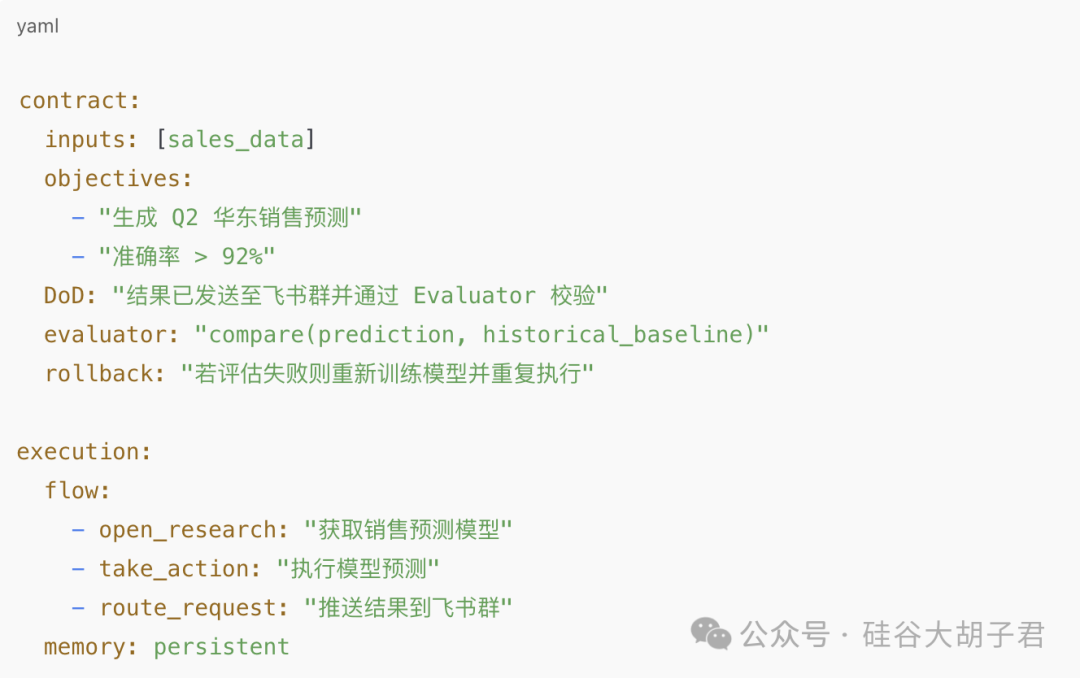
MCL does not merely “invoke tools”, but rather defines whether the task is complete, how to verify success, and how to rollback and re-execute in case of failure.
🔹SQL, HTTP, MCL/Agentbase Each Has Its Role:
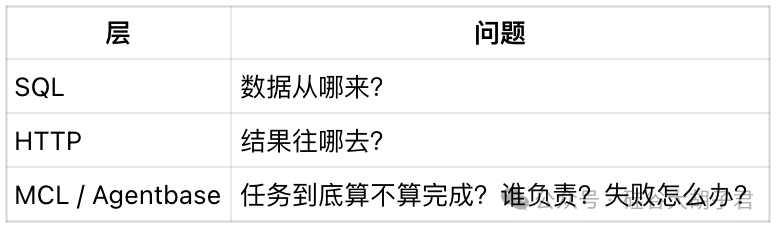
Only the last question determines whether the agent can be integrated into the business unit.
This highlights a key fact:
-
SQL allows agents to “understand data”;
-
HTTP allows agents to “connect to systems”;
-
MCL / Agentbase allows agents to “be accountable for tasks”.
SQL and HTTP are actions being executed;MCL / Agentbase is the contract organizing those actions.
These represent differences in semantic levels, not a dispute of “workflow vs framework vs SDK”.
In the next section, we will clarify these three concepts (protocol / language / SDK) in one go, starting from tool layering rather than technical details:
-
Protocol = Governance Collaboration (how to communicate)
-
Language = Semantic Expression (how to write contracts)
-
SDK = Engineering Integration (how business lines use it)
After this section is revised, all doubts about “are you a protocol, language, or SDK?” will be thoroughly resolved.
6
Protocol, Language, SDK: Distinct Abstract Layers
Before discussing Agentbase, let’s clarify a common confusion: Protocol (Protocol), Language (Language), and SDK (Library) are not three interchangeable things, but three different abstract layers.
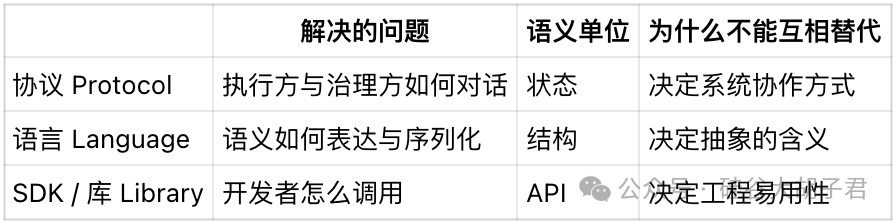
-
SQL is a language, not a protocol. It relies on JDBC/ODBC to complete communication.
-
HTTP is a protocol, not a language. It specifies request formats, semantics, and state machines.
-
HTTP requests, SQL’s sqlalchemy are SDKs/libraries, not protocols or languages. They merely encapsulate invocation methods.
Therefore, being able to invoke a protocol ≠ being a protocol; having a DSL ≠ being a protocol; providing an SDK ≠ being a protocol.
Applying the same definitions to Agentbase:
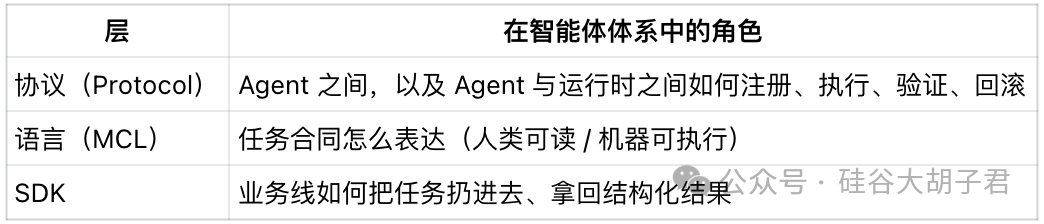
A framework that only has an SDK (easy to invoke), or a DSL (easy to describe), or a workflow (easy to orchestrate), cannot enable agents to collaborate across teams, systems, and tasks—because it lacks the most critical abstraction of the protocol layer: state machines and boundaries of responsibility.
Agentbase does not mix these three aspects together, but clearly separates and combines them:
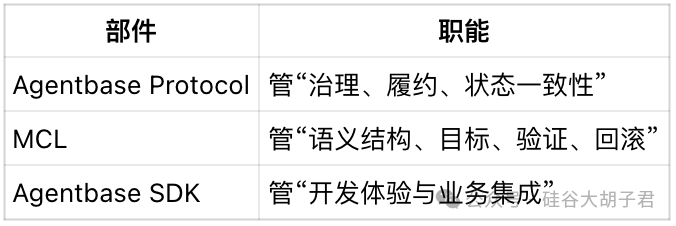
Thus, Agentbase is not an SDK, not a language, not a workflow, not a framework, but a protocol stack (Protocol Stack).
Its purpose is to enable agents to not only communicate APIs but also exchange task contracts and compliance states.
Once this is established, the status of the protocol is no longer debatable, but is automatically determined by the abstract dimension.
7
Conclusion: From Tool Logic to Collaboration Logic
As mentioned, once “compliance” enters the main narrative of AI, everything changes.
In the past, we pursued: how well the model understands, how accurately it infers, and how flexibly it invokes tools.
However, what enterprises truly care about is always just one question: “If I assign a task to you, can you be accountable for the results?”
Verifiable, traceable, and rollback-capable compliance is responsibility.
This is why agents have yet to truly integrate into the business mainstream: what is lacking is governance abstraction.
Returning to the protocol lineage:
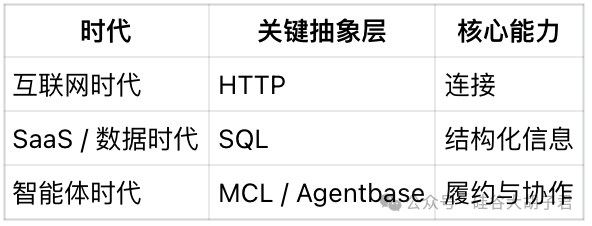
Every leap in technological paradigms is a transition from “what can be done” to “how to collaborate to achieve results”.
Today, models, plugins, tool invocations, RAG, workflows, and SDKs all exist, but they lack a unified task semantic layer as a foundation for collaboration.
Thus, the era poses a question to us:If in the future agents are to collaborate, what unit will they communicate with: Prompt, API, or task contract?
Our answer is definitive: Prompt is intention; API is a means; the contract is the unit of collaboration. MCL / Agentbase elevates AI from a Knowledge Entity to an Accountable Entity. This is the next layer of abstraction in computational history.
Final Thoughts
If the agent era ultimately transitions from “competition of understanding” to “competition of compliance”, then the protocol layer is not optional—it is merely a matter of time before someone names, defines, and implements it.
What Agentbase / MCL does is simply to accelerate the inevitable future by a few years.