Apple’s self-developed N1 wireless network chip has been fully applied to all models of the iPhone 17 series, bringing Apple closer to its goal of an “integrated all-connection function single chip.” Although achieving this vision will take several more years, the current N1 chip first needs to overcome its own self-imposed limitations—such as not yet supporting 320MHz channels.
According to various sources, Apple’s self-developed chip layout is not limited to mobile phones: not only will the entire iPhone 17 series be equipped with the N1 chip, but it also plans to expand this chip to the iPad and Mac product lines by 2026, ultimately achieving full-category coverage from mobile phones to tablets to computers.
So how does the performance of Apple’s self-developed N1 chip measure up? And how will it impact the Wi-Fi industry?
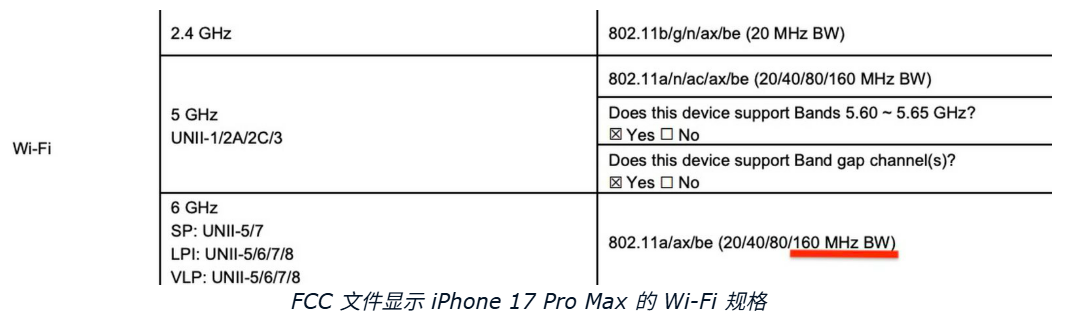
With the technical support of the N1 chip, all models of the iPhone 17 support a maximum channel width of 160MHz. Although this parameter does not fully unleash the speed potential of Wi-Fi 7, there are already bottlenecks in the actual application of this standard. It is worth noting that Apple’s limitation on Wi-Fi 7 performance is not the first time: the Broadcom chip used in the iPhone 16 was also limited to a 160MHz channel. This year, MacRumors discovered through FCC documents that although the entire iPhone 17 series has switched to the self-developed N1 chip, it has continued this channel limitation. However, it should be clarified that the Wi-Fi 7 standard theoretically supports a maximum of 320MHz channels, which can provide unprecedented bandwidth levels.
If the 320MHz channel can indeed bring significant performance improvements, why doesn’t Apple enable this support in the N1 chip? The answer is quite simple: from a practical application perspective, this adjustment is not necessary. The Wi-Fi 7 protocol itself already has extremely fast transmission speeds, and the current global operators’ network services cannot reach its theoretical peak. Apple has always focused more on the practical application value of technology rather than paper parameters, thus retaining this limitation in the design of wireless network chips.
Fortunately, Apple has focused its research and development on other core advantages of the N1 chip. For example, the chip significantly enhances the performance of AirDrop and hotspot functions, allowing users to experience faster and more stable point-to-point transmission. Additionally, thanks to Apple’s technical advantages in hardware and software integration, the energy efficiency of the N1 chip surpasses all previously used third-party chips, further optimizing battery life.
If we talk about who is most affected by the launch of Apple’s N1 chip, Broadcom is undoubtedly the first vendor to be impacted. Apple is Broadcom’s largest customer, with about 20% of Broadcom’s annual revenue (equivalent to $7 billion) coming from Apple orders, and Wi-Fi chips are a core component of this. Based on the 2023 financial report, the mere replacement of the iPhone with a self-developed Wi-Fi chip could lead to a 36% reduction in Broadcom’s revenue from Apple, which undoubtedly has a huge impact on its Wi-Fi business line. Apple’s self-developed Wi-Fi chip is not only a key move to “de-Broadcom” the supply chain but also a direct shake-up of Broadcom’s wireless chip business foundation.
Broadcom no longer has major Wi-Fi chip group customers in the client segment. Synaptics has taken over another major smartphone customer of Broadcom—Google Pixel—through a recent intellectual property licensing agreement, while Qualcomm has become the main supplier of Wi-Fi chips for Samsung phones. Looking ahead, Apple is expected to occupy about 15-20% of the mobile Wi-Fi chip group market.
A pressing question is how Apple, known for its aloofness, plans to interact (or not interact) with other participants in the Wi-Fi ecosystem. Since no one (or company) can stand alone, the success of the N1 largely depends on Apple’s ability to ensure interoperability with the vast networks and other devices produced by hundreds or even thousands of companies in the Wi-Fi industry. Apple will certainly certify its phones through the Wi-Fi Alliance, but even certified products will require more effort to ensure a good quality of experience.
This also means that there will be many questions directed at Apple. To optimize user experience, how much information will Apple release to major (or minor) access points or service providers? It may be fair to say that the benchmark for industry participation among Wi-Fi client chip group suppliers is Intel. Intel has conducted extensive testing of its Wi-Fi solutions for almost all access point providers and even provides client data that cannot be accessed from the network through the Intel Connection Analysis program. Intel also actively interacts with the broader Wi-Fi community through various industry organizations, including WiFi NOW.
In fact, other global Wi-Fi 7 chip manufacturers are also facing concerns. Currently, the leading suppliers in the global Wi-Fi 7 chip market are mainly Broadcom, Qualcomm, and MediaTek.
In addition to the top tier, the global Wi-Fi 7 chip market also includes manufacturers such as Huawei, Unisoc, Intel, and MaxLinear, which acquired Intel’s Wi-Fi business. Analysts believe that Apple’s self-developed actions may have a significant impact and driving effect on manufacturers in the Android camp that have already laid out self-developed chips (such as Samsung and Xiaomi)—these manufacturers are all leading smartphone brands globally. The “system-level optimization” advantage achieved by Apple through self-developed chips may accelerate their move towards “self-developed connection chips.” At that time, traditional Wi-Fi chip manufacturers will need to reassess their R&D strategies and ecological layouts, which is also the core reason we focus on the Wi-Fi 7 track—Apple has initiated the process of self-developing connection chips from the Wi-Fi 7 era.
The launch of Apple’s self-developed Wi-Fi 7 chip N1 is not just a simple supply chain replacement, but a landmark event in reshaping the global Wi-Fi 7 chip market landscape. From the full deployment in the iPhone to the extension to iPad and Mac by 2026, Apple is firmly controlling connection layer technology with a “hardware + chip” closed-loop logic—consolidating high-end market competitiveness through a cost advantage of $15 per device, while leveraging the integrity of the Apple Silicon ecosystem to widen the technological gap with the Android camp, completing a key leap from “hardware manufacturer” to “underlying technology platform.”
The more profound impact is that Apple’s actions are breaking the long-standing “head dependency” pattern in the global Wi-Fi chip market. The current first-tier, dominated by Broadcom, Qualcomm, and MediaTek, may face market diversion due to the imitation of leading manufacturers in the Android camp (such as Samsung and Xiaomi)—after all, Apple has fully demonstrated the efficiency and experience advantages of “self-developed connection chips + system collaboration” with the N1 chip, which poses competitive pressure on Android manufacturers that rely on outsourced chips and also points to future transformation directions.
This article is a comprehensive synthesis of online content, referencing and citing the following sources:
1. Electronic Enthusiasts, The Boot Has Dropped, Broadcom is “Crumbling”! The Global Wi-Fi 7 Chip Market Landscape Has Changed Drastically
2. Semiconductor Industry Observation, Are Chips Like Broadcom Facing a Grim Future?
3. Semiconductor Industry Observation, Is Apple’s New N1 Wi-Fi 7 Chip Performance Limited?
4. Semiconductor Innovation Network, Does the Self-Developed Wi-Fi 7 Chip Hide Fatal Flaws? Why Did Apple’s N1 “Cut Off” the Channel?