Grade 8 Math


The importance of Grade 8 is self-evident. In Grade 8, subjects like physics are introduced, and geography and biology will also have graduation exams, significantly increasing the academic burden on children. To avoid falling behind, both previewing and reviewing work cannot be neglected. Today, Teacher Wang shares a special training on congruent triangles in Grade 8 Math, which is essential content!
Eight
Upper

Grade 8 Math
Congruent Triangles [Hand-in-Hand Model]

[Example 1] As shown in the figure, AC⊥BC, DC⊥EC, AC=BC, DC=EC, and AE intersects BD at point F.
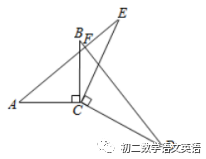
(1) Prove: AE=BD;
Solution:Since AC⊥BC, DC⊥EC, Therefore, ∠ACB=∠DCE=90°, Therefore, ∠ACE=∠BCD, In triangles △ACE and △BCD, AC=BC, ∠ACE=∠BCD, CE=CD Therefore, △ACE≌△BCD (SAS), thus AE=BD;
(2) Find the degree of ∠AFD.
Solution: Since ∠ACB=90°, thus ∠A+∠ANC=90°; Since △ACE≌△BCD, thus ∠A=∠B, Since ∠ANC=∠BNF, thus ∠B+∠BNF=∠A+∠ANC=90°; Therefore, ∠AFD=∠B+∠BNF=90°.
[Example 2] As shown in the figure, point C is any point on segment AB (point C is not coincident with points A or B). An equilateral triangle ACD and an equilateral triangle BCE are constructed on the same side of line AB with sides AC and BC, respectively. AE intersects CD at point M, and BD intersects CE at point N. Connect MN.
Prove: (1) △ACE≌△DCB;
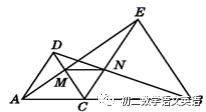
Solution: Since △ACD and △BCE are both equilateral triangles,
Therefore, AC=DC, CE=CB, ∠ACD=∠BCE=60°.
Since ∠ACD+∠DCE+∠ECB=180°,
Therefore, ∠DCE=60°. Thus, ∠ACE=∠DCB=120°.
Therefore, △ACE≌△DCB (SAS).
(2) △ACM≌△DCN;
Solution: From (1), we know that △ACE≌△DCB;
Therefore, ∠EAC=∠BDC.
Moreover, since AC=DC, ∠ACM=∠DCN=60°;
Therefore, △ACM≌△DCN (ASA).
(3) MN∥AB.
Solution: From (2), we know that △ACM≌△DCN, thus CM=CN.
Moreover, since ∠MCN=60°;
Therefore, ∠NMC=∠MNC=60°.
Therefore, ∠NMC=∠ACM. Thus, MN∥AB.
[Example 3] In triangle △ABC, AB=AC, point D is a point on line BC (not coincident with B or C). Using AD as one side, construct triangle △ADE on the right side of AD such that AD=AE, ∠DAE=∠BAC, let ∠BAC=α, ∠BCE=β
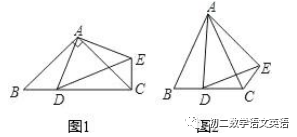
(1) As shown in Figure 1, when point D is on segment BC, if ∠BAC=90, then ∠BCE= 90° degrees;
Solution: Since ∠DAE=∠BAC, ∠BAC=∠BAD+∠DAC,
∠DAE=∠EAC+∠DAC;
Therefore, ∠CAE=∠BAD;
In triangles △ABD and △ACE,
AB=AC, ∠BAD=∠CAE, AD=AE
Therefore, △ABD≌△ACE (SAS);
Therefore, ∠B=∠ACE;
Therefore, ∠BCE=∠BCA+∠ACE=∠BCA+∠B=180°−∠BAC=90°
(2) As shown in Figure 2, what kind of quantitative relationship do you think exists between α and β? Please explain your reasoning.
Solution: From (1), we know that β=180°−α,
Therefore, the quantitative relationship between α and β is α+β=180°;
(3) When point D moves along line BC, what kind of quantitative relationship exists between α and β? Please write down your conclusion directly.
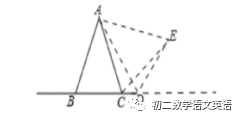
Solution: Connect AD, and create AE such that ∠DAE=∠BAC, AE=AD,
Connect DE and CE, resulting in the following figure:
Since ∠BAD=∠BAC+∠CAD, ∠CAE=∠DAE+∠CAD,
Therefore, ∠BAD=∠CAE; in triangles △ABD and △ACE,
AB=AC, ∠BAD=∠CAE, AD=AE
Therefore, △ABD≌△ACE (SAS);
Therefore, ∠B=∠ACE;
Therefore, ∠BCE=∠BCA+∠ACE=∠BCA+∠B=180°−∠BAC.
Therefore, the quantitative relationship between α and β is α+β=180°;


 PointRead the original textGet More Middle School Learning Materials