For more reading, please follow us
In an industrial automation workshop, have you ever wondered: who precisely commands the robotic arms to complete welding, enables the assembly line to achieve unmanned sorting, and adjusts the motor speed automatically according to production needs? The answer lies in an “industrial brain” — the PLC (Programmable Logic Controller), which has long become the “core password” in the field of electrical control and automation.
If you are new to the electrical industry or a technician looking to upgrade your skills, you must first understand these three key questions: What exactly is a PLC? What role does it play in the professional field? What career development opportunities can learning PLC bring you?

PLC: Not “High-Tech”, but the “Universal Key” to Industrial Control
In simple terms, a PLC is a “programmable electrical control hub”. In the past, the start and stop of motors and the interlocking of equipment in factories relied on hard-wired relays and contactors. The emergence of PLCs directly replaced complex hardware wiring with “software programs”: it can receive signals from sensors (such as temperature, pressure, and photoelectric sensors), perform logical operations through preset programs, and then drive contactors, solenoid valves, robots, and other actuators to work.
For example, the washing machine at home can automatically complete the “water filling – washing – spinning” process, relying on simple control logic; while in an automotive factory, hundreds of devices work together to precisely complete welding, assembly, and inspection, thanks to industrial-grade PLCs. It retains the “hard power” of electrical control (connecting various electrical devices) while possessing the “flexibility” of software programming (changing logic only requires adjusting the program), making it the “universal key” to industrial control.
In the Professional Field: PLC is the Core Role of “Connecting the Upper and Lower”
If we compare an industrial automation system to a “building”, then the PLC is the “load-bearing beam and column” — it is the core control layer between the “perception layer” and the “management layer”, connecting the two and is indispensable.
Downward, it connects to the sensors of the “perception layer” (such as photoelectric switches that detect whether parts are in place, thermocouples that monitor temperature), receiving real-time data from the field;
In the Middle, it performs logical judgments through programs (for example, “if the part is in place + temperature is up to standard, then start the motor”), sending control commands to the contactors, solenoid valves, and robotic arms of the “execution layer”;
Upward, it uploads field data (such as production quantity and equipment failure information) to the “management layer” SCADA system (monitoring system) or MES system (production management system), allowing engineers to remotely monitor and optimize production.
Whether it is electrical engineers designing equipment control, automation engineers building production line systems, or maintenance personnel repairing faulty equipment, they cannot avoid PLCs. It is like the “industrial language” — understanding PLC is essential to truly “take root” in the fields of electrical and automation.
Learning PLC: Your Career Will Have These “Possibilities”
For those looking to enter the industry or upgrade, learning PLC is not an “add-on”, but a “necessity”; it can directly open multiple pathways for your career:
ForElectrical Newcomers: Upgrading from “only knowing how to connect wires” to “being able to independently design control programs” will double your competitiveness when job hunting;
ForEquipment Maintenance Personnel: Previously, encountering PLC failures meant waiting for the manufacturer to repair; now, you can check programs and find problems yourself, improving repair efficiency and becoming a “technical backbone” in the company;
ForAutomation Engineers: You can independently build small automation systems (such as packaging lines, sorting lines) and even participate in large projects (such as automotive production lines, smart warehousing), directly raising your career ceiling;
ForThose Looking to Change Careers: As long as you master PLC programming + basic electrical control, you can enter the industrial automation track — this is a field that becomes more valuable with age, so there’s no need to worry about being eliminated.
In simple terms: understanding PLC is equivalent to holding the “career pass” in the fields of electrical and automation. To systematically master PLC, from basic principles to practical applications, a good set of books can help you avoid many detours — next, I will recommend a set of books that can take you from “novice” to “practical application”, suitable for both beginners and those with a foundation looking to improve.
Siemens S7-1200 PLC
Comprehensive Guide to Programming with TIA Portal
*Click the image to purchase
This book combines project engineering practice, detailing the application and programming techniques of Siemens S7-1200 PLC, while also introducing configuration development techniques, ladder diagram programming techniques, and human-machine interface design techniques in the TIA Portal programming environment. It provides joint control of S7-1200 PLC with frequency converters and PID control technology for industrial automation applications. To facilitate readers’ in-depth understanding of related technologies and rapid mastery of practical operational skills, corresponding programming examples, simulation analysis, and debugging techniques are provided. Additionally, safety measures and fault handling in engineering applications are also explained in detail, helping readers solve practical problems.
This book is suitable for self-study by electrical engineers, automation engineers, and can also be used as a textbook and reference book for related majors in vocational colleges and training schools.
Siemens PLC
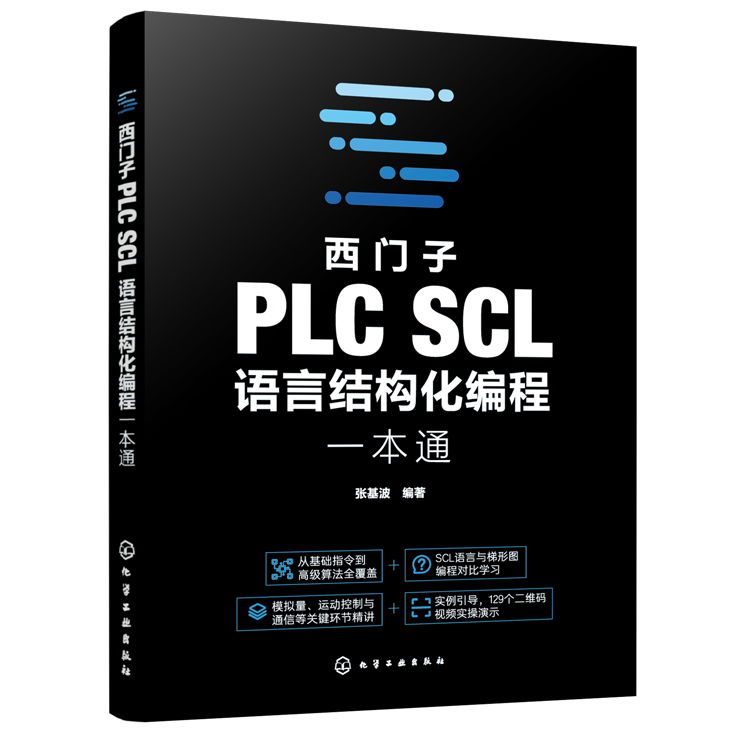
Comprehensive Guide to Structured Programming in SCL Language
*Click the image to purchase
This book starts with the working principles and basic knowledge of PLC, systematically explaining the syntax rules, logical operations, data operations, and the use of various syntax of Siemens PLC SCL language, and helps readers advance through the explanation of key modules such as analog quantity, communication, and motion control. The book also lists numerous typical cases to facilitate practical exercises, allowing readers to deeply master algorithm principles.
The content of this book is comprehensive, progressive, and includes engineering cases, combining theory and practice, which is beneficial for readers to quickly master Siemens PLC SCL structured programming technology. Additionally, it is accompanied by numerous QR code videos, allowing readers to scan and watch practical demonstrations.
This book is suitable for self-study by electrical engineers and PLC technicians, and can also serve as a reference book for related majors in higher education institutions and vocational colleges.
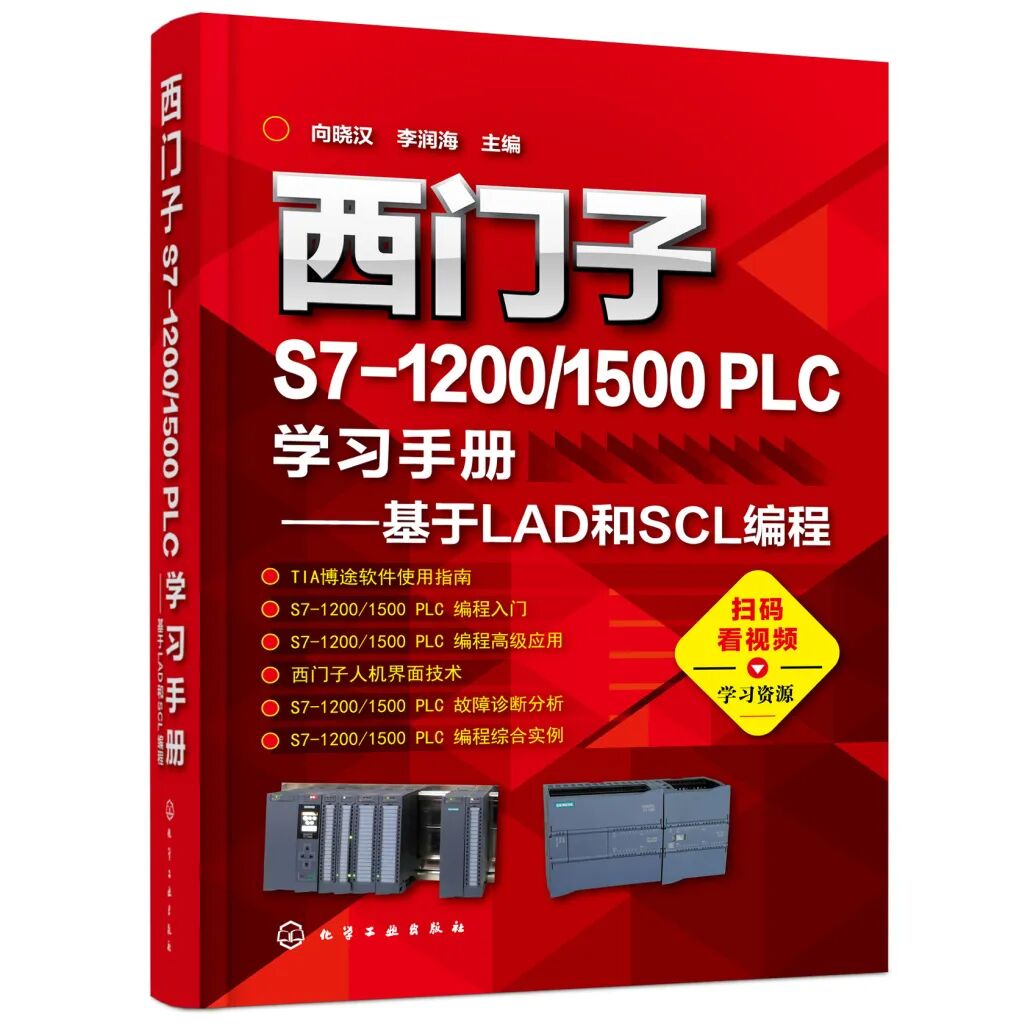
Siemens S7-1200/1500 PLC Learning Manual:
Based on LAD and SCL Programming
*Click the image to purchase
This book starts from the basics and practical applications, providing a comprehensive and detailed introduction to Siemens S7-1200/1500 PLC programming and applications. The book is divided into two parts: the first part is a basic introduction, mainly covering the hardware and wiring of Siemens S7-1200/1500, the use of TIA Portal software, programming languages, programming methods, and debugging; the second part is an advanced application section, including communication and applications of Siemens S7-1200/1500 PLC, process functions and their applications, Siemens human-machine interface (HMI) applications, fault diagnosis techniques, and engineering applications of S7-1200/1500 PLC.
The content of this book is comprehensive and systematic, with a focus on practicality, and to facilitate readers’ deeper understanding and mastery of Siemens S7-1200/1500 PLC programming and applications, it is equipped with numerous practical cases, each instance includes detailed hardware and software configuration lists, wiring diagrams, and programs, allowing readers to learn by imitation.
To facilitate readers’ learning, key content in the book is also accompanied by videos and source files, which readers can access by scanning the QR codes in the book, assisting in learning the book’s content.
This book is suitable for those engaged in learning and applying Siemens PLC technology, and can also be used as a textbook for related majors in higher education institutions.
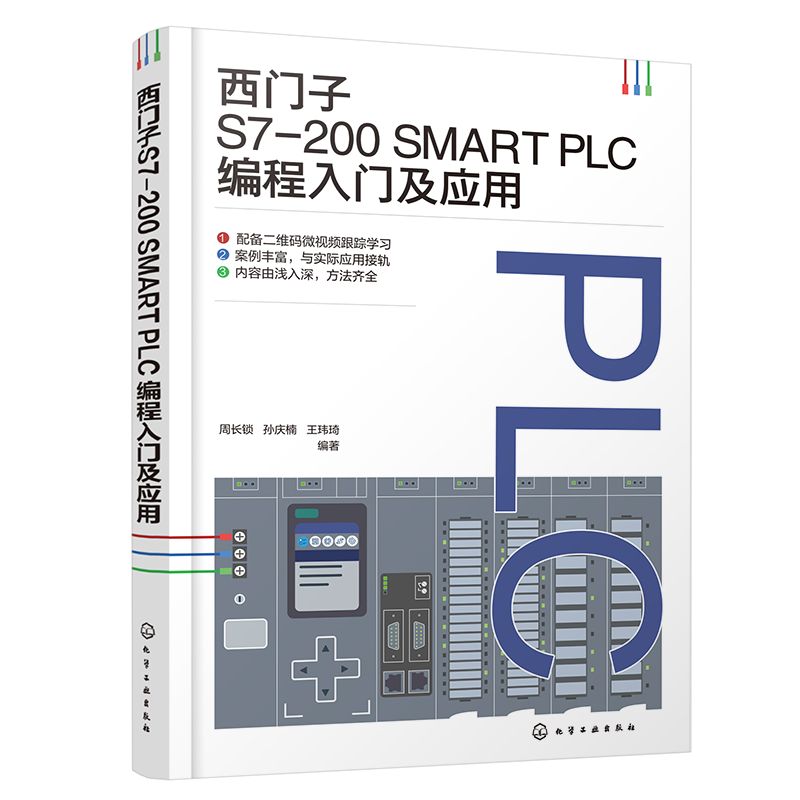
Siemens S7-200 SMART PLC
Introduction to Programming and Applications
*Click the image to purchase
This book is application-oriented, with content progressing from simple to complex, providing a comprehensive explanation of the hardware composition, software applications, instructions, and case studies of Siemens S7-200 SMART PLC. The book introduces the design methods for programs involving digital quantities, analog quantities, communication control, and focuses on PLC communication technology (including RS485 serial communication, Ethernet communication, and IoT remote monitoring technology) and PLC motion control technology (including stepper motors, servo motors, and servo control technology), as well as the design of PLC control systems, comprehensive applications of PLC with touch screens, and configuration software.
This book also covers emerging technologies, using rich programming cases to help readers progress from entry-level to practical application of PLC in solving engineering practice problems.
This book is suitable for engineering and technical personnel in the field of industrial automation, as well as technicians in electrical, instrumentation, and mechatronics professions, and can also serve as a reference for students and teachers in automation-related majors.
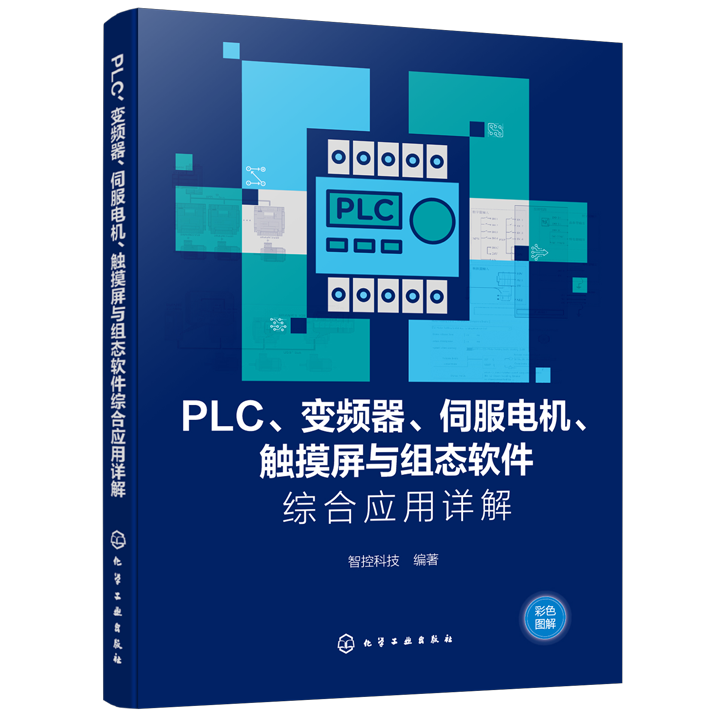
PLC, Frequency Converters, Servo Motors, Touch Screens
Comprehensive Application with Configuration Software
*Click the image to purchase
This book systematically explains the technologies and applications related to control systems centered around PLC, detailing commonly used components in PLC electrical control, frequency converters and frequency control technology, robot control circuits and servo motors, touch screen operation and programming, as well as configuration software and other key technical knowledge. It also deeply analyzes typical cases of comprehensive applications of Siemens PLC and Mitsubishi PLC in various controls. This book aims to help readers deepen their understanding of PLC and electrical control systems and effectively apply the theoretical knowledge learned to practical engineering.
The content system of this book is complete, with a clear knowledge structure, highlighting key points, and rich practical cases. To facilitate readers’ learning, this book is equipped with QR code videos that provide auxiliary explanations for important knowledge points.
This book is suitable for technicians engaged in PLC and control system design, and can also serve as a reference for students and teachers in related majors in colleges and universities.
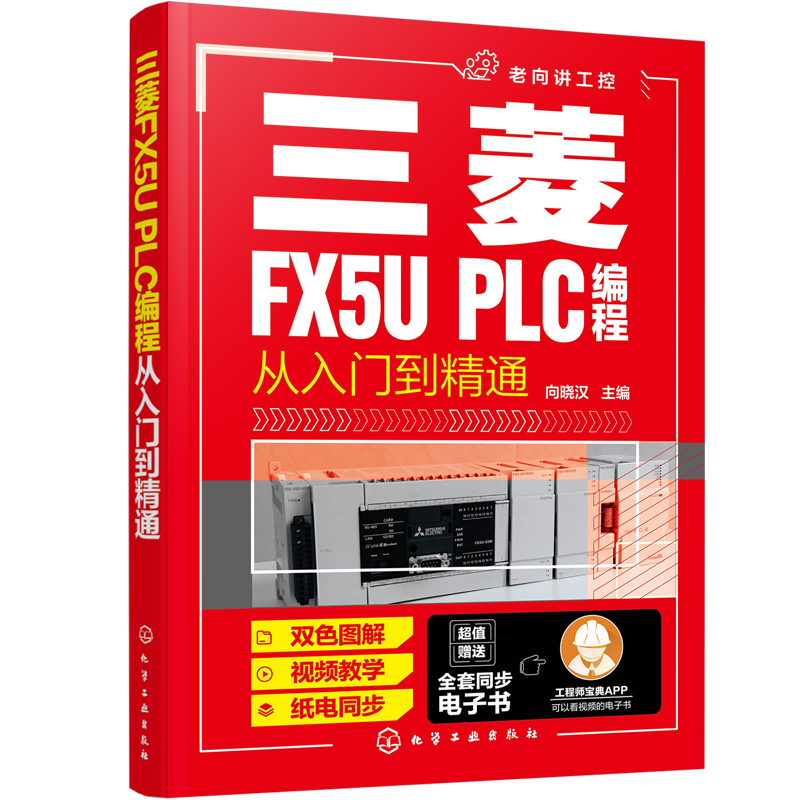
Mitsubishi FX5U PLC Programming from Beginner to Mastery
*Click the image to purchase
This book adopts an instance-guided learning approach, starting from the basics of PLC programming, providing a comprehensive and systematic introduction to the programming and application of Mitsubishi FX5U series PLC. The book is divided into two parts: the first part is a basic introduction, mainly covering PLC basics, FX5U PLC hardware and wiring, the use of GX Works3 programming software, FX5U PLC programming languages, programming methods, and debugging; the second part is an advanced application section, mainly covering FX5U PLC communication and its applications, FX5U PLC applications in motion control, FX5U PLC PID functions and their applications, high-speed counter functions and their applications, as well as engineering application cases.
The content of this book is rich, with a focus on practicality, and almost every chapter includes numerous practical examples, making it easy for readers to learn by imitation, with most examples providing detailed hardware and software configurations, schematics, and programs. Additionally, for key and complex content, this book is accompanied by over 100 micro-course videos, combined with textual explanations to meet readers’ learning needs.
This book is suitable for technicians engaged in PLC programming and applications, and can also serve as a textbook for mechanical and electrical, information technology majors in colleges and universities.
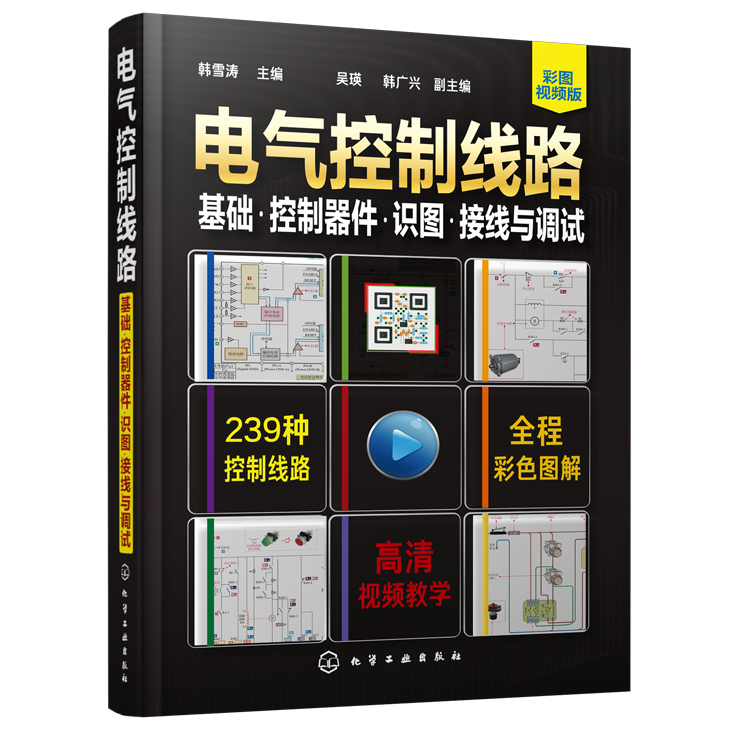
Electrical Control Circuits:
Basics · Control Devices · Circuit Diagrams · Wiring and Debugging
*Click the image to purchase
This book uses colorful illustrations to start from the perspective of industrial control applications, beginning with the basics, guiding readers to easily enter and systematically learn electrical control principles, circuit composition, control devices and sensor applications, various types of motor sequential control circuit principles, control processes, typical electromechanical control circuits, CNC equipment and robot control circuits, agricultural control circuits, PLC and frequency converter control circuits, high and low voltage power distribution control circuits, lighting control circuits, various types of detection control circuits, and various types of electrical safety control circuits. It almost covers all aspects related to electrical control, aiming to help readers learn comprehensively and enhance their skills.
The book provides numerous typical control systems and circuit examples along with video explanations, allowing readers to apply their knowledge directly to electrical control design and solve problems encountered in installation, operation, and control at work.
This book is suitable for electrical technicians, beginners, electricians, and electrical maintenance personnel, and can also serve as a reference for students and teachers in related majors.
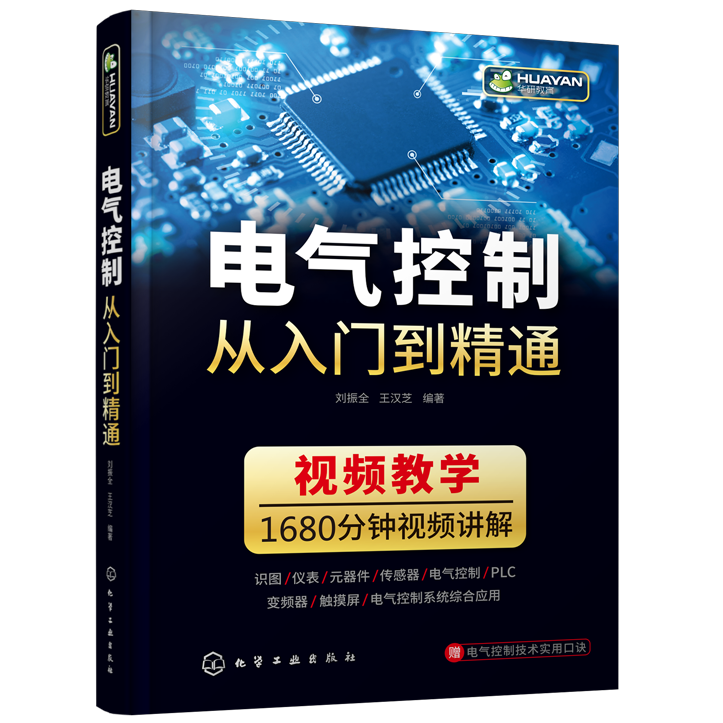
Electrical Control from Beginner to Mastery
*Click the image to purchase
This book is richly illustrated, progressively structured, and filled with practical cases, providing readers with a step-by-step learning path for electrical control technology: basics of electrical diagrams — instruments and tools — power electronic components — low-voltage electrical components — sensors and their wiring methods — motors and transformers — motor relay control — frequency converter speed control motor relay control — machine tool electrical control — programmable controllers — frequency converters — touch screens — electrical control system design — relay control system design methods — PLC control system design methods — comprehensive applications of electrical control systems.
This book can serve as a reference for electrical engineering technicians learning electrical control technology, and can also be used as a teaching or reference book for related majors in higher education institutions and vocational colleges.
END