Yize / Article
[Zhi Yuan Guide] In recent years, as the latest understanding and cutting-edge design of future warfare styles between great powers, the concept of “Multi-Domain Operations” has become a hot topic of research in the US military. To study “Multi-Domain Operations” in depth, it is essential to first define the most basic concepts such as “domain” and “multi-domain”. Although official documents have provided a preliminary definition of “domain”, there is currently no completely unified viewpoint in the theoretical circles of the US military. This article starts by examining the historical and contemporary understanding of the term “domain” in US military theory, and attempts to explore several issues that need to be grasped for an accurate understanding of “domain” in the context of “Multi-Domain Operations”.In recent years, as the latest understanding and cutting-edge design of future warfare styles between great powers, the concept of “Multi-Domain Operations” (Multi-Domain Operation Concept) has become a hot topic of research in the US military. To study “Multi-Domain Operations” in depth, it is essential to first define the most basic concepts such as “domain” and “multi-domain”. Although official documents have provided a preliminary definition of “domain” (Domain), there is currently no completely unified viewpoint in the theoretical circles of the US military. Therefore, it is necessary to examine the current and historical understanding of “domain” by the US military, starting from basic concepts, to explore what “domain” means in “Multi-Domain Operations”.The US Military’s Understanding of “Domain”The current definition of “domain” in the official documents of the US military’s “Multi-Domain Operations” conceptSince it was first proposed at the Army Annual Meeting in 2016, the Army Training and Doctrine Command has issued three official documents on “Multi-Domain Operations”: a white paper, and versions 1.0 and 1.5 of the concept. With the strong promotion of the senior leadership of the Army and the active participation of various military branches and theaters, the concept of “Multi-Domain Operations” is continuously evolving and improving, and there have been some changes in the official definitions of the term “domain”. For example, in the 2016 white paper “Multi-Domain Operations: Combined Arms for the 21st Century”, there was no precise terminology definition for “domain”; it only cited the relevant expressions from “Joint Vision 2020” regarding “air, land, sea, space, and information domains”1. In the 2017 concept version 1.0 “Multi-Domain Operations: Evolution of Combined Arms for the 21st Century 2025-2040” and the 2018 concept version 1.5 “The US Army in Multi-Domain Operations 2028”, both official documents provided the same preliminary terminology definition in the appendix, marked with an asterisk as pending further refinement, stating that “domain” refers to “a certain area involved in organizing and conducting operations within the overall operational environment, including land, maritime, air, space, and cyberspace domains.” Specifically, the definitions of these five operational domains are as follows: the land domain (land domain), the area where the earth’s surface ends at high water lines and overlaps with the coastal sections of the maritime domain; the maritime domain (maritime domain), the ocean, harbors, estuaries, islands, coastal areas, and the airspace above these terrains, including littoral regions; the air domain (air domain), extending from the earth’s surface up to the atmosphere where the impact on operational actions can be negligible; the space domain (space domain), the airspace above a certain altitude where atmospheric effects on flying objects become insignificant; and the cyberspace (cyberspace), a global domain within the information environment composed of various interdependent networks of information technology infrastructure and the data flowing through them, including the internet, telecommunications networks, computer systems, embedded processors, and controllers, etc.2In the preface of version 1.5, it is mentioned that “the concept of ‘Multi-Domain Operations’ aims to contribute solutions for the US in responding to political, military, and economic layered denial posed by peer competitors such as China and Russia.”3 The English expression for “all domains” here is “All 5 domains“, referring to the five operational domains mentioned above: “land, maritime, air, space, and cyberspace”. In fact, it is not difficult to find that all expressions regarding “all domains” or “multi-domain” in the US military’s official documents refer to the five operational domains of “land, sea, air, space, and cyberspace”, while the electromagnetic spectrum (Electromagnetic Spectrum) and information environment (Information Environment) are not included as “domains”, but rather described as part of the overall operational environment (Operational Environment).Historical Understanding of “Domain” in US Military TheoryDuring the research process, I found that the formation of the “five domains” framework in the current concept of “Multi-Domain Operations” is not a one-time achievement. Over the past 20 years, with the continuous changes in the global strategic security environment and the corresponding adjustments in US defense and military strategy, the US military’s understanding of “domain” has been a process of continuous maturation and improvement.The US military places great importance on defining “domain”, believing that: “A ‘domain’ is a boundary that divides the operational functions of various military services, creating a reference framework for defining the preparation and conduct of warfare. Any military service and military organization must base their writing of doctrines or design of operational platforms on their dominant ‘domain’, with few exceptions of preparing for and practicing warfare beyond their ‘domain’.”4 In 1996, against the backdrop of the great success of Operation Desert Storm, the Joint Chiefs of Staff issued the document “Joint Vision 2010”, which served as the theoretical foundation for many subsequent joint operational doctrines. This document emphasized the so-called “full-spectrum dominance” in defeating any opponent or controlling the situation in all types of military operations5. At this time, the US military was confident in its absolute strength to defeat any opponent at any time and in any domain, reflecting a blurred understanding of “domain” in the context of the unipolar hegemonic thinking and overwhelming military power formed in the post-Cold War era. In June 2000, against the backdrop of rapid developments in information technology such as computers and the internet, the US military issued the joint publication “Joint Vision 2020”, further elaborating “full-spectrum dominance” as “the US military should be able to conduct rapid, sustained, and synchronized operations… with the ability to intervene and operate freely in all domains (in all domains)”. This document made two main contributions to the understanding of “domain”: first, it was the first time the term “domain” was included in a joint publication, and second, it added the “information domain” (Information Domain) as an emerging operational domain on the basis of the traditional military operational domains of “land, sea, air, and space” to facilitate discussions and research on issues related to the emerging operational domain of information space. The US military believes that information space will be an important domain for military operations in the 21st century, and the term “domain” itself has inherent meanings in the computer and network fields such as “domain names, file fields, and logical organizational units of operating systems or networks”, making it easier to understand, communicate, and disseminate when discussing military operations in the information age, especially in the realm of cyber operations. Therefore, with the rise of various debates on military preparedness in the information age, the term “domain”, which needs to be defined, gradually spread within the US defense discourse system, and the Department of Defense, various military services, theater commands, and allies gradually accepted this new classification of operational domains.In 2009, the US military promulgated the “Joint Operations Capstone Concept” (version 3.0), formally replacing the term “information domain” (Information Domain) with “cyberspace” (Cyberspace), proposing the division of operational domains into “land, sea, air, space, and cyberspace” (Land, Sea, Air, Space and Cyberspace), emphasizing that “whether in the theater of operations or in the global commons, joint forces will maintain freedom of action in land, sea, air, space, and cyberspace”.6 This ultimately formed the “five domains” framework in the official documents of “Multi-Domain Operations”.In recent years, with adjustments to the national security strategy, after the US military has largely completed its counter-terrorism tasks, it has shifted the focus of military preparedness to deterring and winning potential military conflicts with great powers, giving rise to the concept of “Multi-Domain Operations” aimed at great powers such as China and Russia. As this concept gradually became a hot topic of discussion in the military, the term “domain” has sparked renewed debate. For example, compared to the tangible traditional physical operational domains such as “land, sea, and air”, how will the intangible “cyberspace” and the emerging “space domain” be utilized in future great power conflicts? What is the basis for classifying “domains”? Where are the boundaries between different “domains”? The operational rhythms, styles, and capabilities in different “domains” vary widely; how can true “multi-domain integration” be achieved? What is the relationship between the electromagnetic spectrum, the information environment, and the “five domains”? Some scholars have even proposed the addition of the “human domain” (Human Domain) in “Multi-Domain Operations”, arguing that the essence of war is the contest of wills between people, and the “ultimate measure” of operational effectiveness across domains is the degree of influence on the will to fight of individuals.7 These diverse questions reflect the multifaceted attention and contemplation of the US military’s theoretical community towards the concept of “Multi-Domain Operations”, but they also indirectly indicate that defining “domain” is not an easy task, requiring an in-depth understanding of its definition from multiple angles. Several Key Issues to Grasp for Accurately Understanding “Domain” in Multi-Domain OperationsTracing back, the English word “domain” originates from the Latin noun “Dominus” (lord, ruler), with its root “Dom-” originally meaning “the master of the house”, thus extending to meanings of “domination, control, and taming”. In the authoritative American Webster’s Dictionary, the term “domain” is defined as “complete and absolute ownership of land”, and common synonyms include “field, kingdom, territory, province, and estate”, while the term “dominance” in military terminology also shares the same root as “domain”. It is evident that the term “domain” itself carries a strong inherent meaning of “control and competition”.To accurately understand the official definition of “domain”—”a certain area involved in organizing and conducting operations within the overall operational environment, including land, maritime, air, space, and cyberspace”—the following three key points need to be grasped: first, “domain” is born from warfare, focusing on operations is the fundamental attribute of “domain”; second, the classification of “domains” must match military means; only when there is the capability to organize and conduct military operations in a certain “domain” does the classification and existence of that “domain” have value; finally, “domain” is part of the overall operational environment, and “multi-domain integration” must be understood from the temporal and spatial dimensions of the overall operational environment.Focusing on Operations is the Fundamental Attribute of “Domain”The definition clearly states that “domain” is the activity area for organizing and conducting military operations, and focusing on operations is the fundamental attribute of “domain”. Under the concept of “Multi-Domain Operations”, the future competition between nuclear powers and global counter-terrorism wars are fundamentally different; due to the significant changes in the strength of opponents, the US military’s absolute “multi-domain dominance” no longer exists. The challenges faced by joint forces will shift from the use of “multi-domain” to the competition for “multi-domain”. The Army, Navy, Air Force, Marine Corps, cyber forces, and the newly formed Space Force will engage in fierce competition with peer nuclear powers such as China and Russia across multiple domains including land, sea, air, space, and cyberspace. This competition includes not only non-physical (Non-kinetic effects) soft competition such as intelligence gathering, public opinion guidance, and psychological deterrence, but also physical destruction (Kinetic effects) through armed conflict phases where non-nuclear conventional forces engage based on intelligence reconnaissance, monitoring and striking, long-range precision firepower, and integrated joint air defense systems. Thus, it is clear that focusing on operations is the fundamental attribute of “domain”; only when opposing parties engage in fierce competition for a certain “domain” through violent or non-violent means does the necessity arise to classify and study that “domain” militarily. Terms such as “human domain, psychological domain, and cognitive domain” are not directly related to the organization and implementation of military operations; rather, they indirectly exert influence through the cumulative operational effects within the domains of “land, sea, air, space, and cyberspace”, so they should not be considered as “domains” defined in the US military’s concept of “Multi-Domain Operations”.Military Means are the Material Basis for Classifying “Domains”The definition emphasizes the organization and implementation of military operations within “domains”, which is closely linked to specific military means. The military means supported by certain technologies and equipment are an important material basis for classifying “domains”. Historically, the changes in the field of military confrontation have often accompanied waves of technological revolution throughout thousands of years of human civilization conflicts: after the agricultural revolution, weapons such as stone axes, swords, bows, and catapults dominated the “land domain” warfare period for over 2000 years; with the emergence of ships and the birth of navies, warfare began to extend to rivers, lakes, and seas, and the advent of firearms such as matchlocks and artillery, as well as more advanced weapons like rifled guns after the 16th century, changed naval warfare tactics from “boarding battles” and “ramming battles” to “close-range fire attacks” and “long-range bombardments”, making the impact of maritime military actions on the outcome of wars increasingly significant.7 After the 18th century, the industrial revolution, marked by the internal combustion engine and electricity, replaced muzzle-loading artillery with breech-loading artillery, smokeless powder with black powder, and utilized railroads for military transportation, as well as telegraphs and telephones for military communication, while steam-powered armored ships roamed the seas. The invention of airplanes in the early 20th century marked a historical leap in human warfare—transitioning from the “land and sea domains” to the “air domain”, with fighter jets, bombers, and transport planes playing significant roles in both World Wars, expanding warfare from the flat planes of “land and sea” to the three-dimensional realms of “land, sea, and air”. In 1946, under military commission, the University of Pennsylvania completed the world’s first programmable electronic digital computer, ENIAC, which greatly enhanced the US military’s ballistic calculation capabilities. In 1969, to ensure that network communications could withstand the nuclear strike threats from the Soviet Union, DARPA collaborated with universities to develop the precursor to the internet, ARPANET. Since then, the rapid development of computer and internet technology has led major military powers to establish cyber forces that engage in fierce competition in the invisible battlefield of cyberspace through electronic spectrum interference, intelligence gathering, cyber offense and defense, electronic countermeasures, and public opinion guidance; thus, cyberspace has gradually become a key domain of military confrontation. As for the “space domain” mentioned in the concept of “Multi-Domain Operations”, given the current technological level and possible developments, reconnaissance, early warning, navigation, and communication satellite equipment and technologies have become relatively mature, while advanced space warfare equipment such as anti-satellite missiles, space bombers, space aircraft carriers, kinetic and directed energy anti-satellite weapons, and spaceplanes are still in experimental stages. However, it is foreseeable that as related technologies continue to mature and be deployed, the space domain will inevitably become a “high frontier” for great power competition.In summary, with the development of military technology and equipment, the means by which humans engage in warfare have become more diversified, and the field of military confrontation has shown a pattern of expansion from “singular to plural, from flat to three-dimensional, from tangible to intangible”. Thus, it is not difficult to understand that in order to explore how to upgrade from “joint service collaboration” to “multi-domain integration”, the US military’s concept of “Multi-Domain Operations” classifies the fields of competition, armed conflict, and renewed competition between great powers into “five domains”, each supported by corresponding military forces from the Army, Navy, Air Force, Marine Corps, cyber forces, and Space Force. Material determines consciousness; separating the classification of “domains” from specific military means is akin to asking a medieval knight to understand network-centric warfare, which is absurd and easily leads to a lack of foundation.Understanding “Multi-Domain Integration” from the Temporal and Spatial Dimensions of the Overall Operational EnvironmentThe definition clearly states that “domain” is part of the overall operational environment. To clarify the relationship between the electromagnetic spectrum, information environment, and the “five domains”, and to comprehensively understand the complex interactions of various operational domains in time and space within “Multi-Domain Operations”, it is necessary to break away from the traditional thinking framework where a certain military service dominates a specific operational domain, and to recognize and understand the five operational domains within the context of an overall operational environment.
According to the 2017 definition in “Joint Publication 3-0: Joint Operations”, the overall operational environment (Operational Environment) is composed of various variable factors, situations, and influences that affect the use of joint capabilities and decision-making by commanders, including physical domains such as air, land, sea, and space, information environment (including cyberspace), electromagnetic spectrum, and other systems related to specific joint operations, including hostile, friendly, and neutral political, military, economic, social, information, and infrastructure systems. The nature and interactions of these systems will influence how commanders plan, organize, and conduct joint operations.
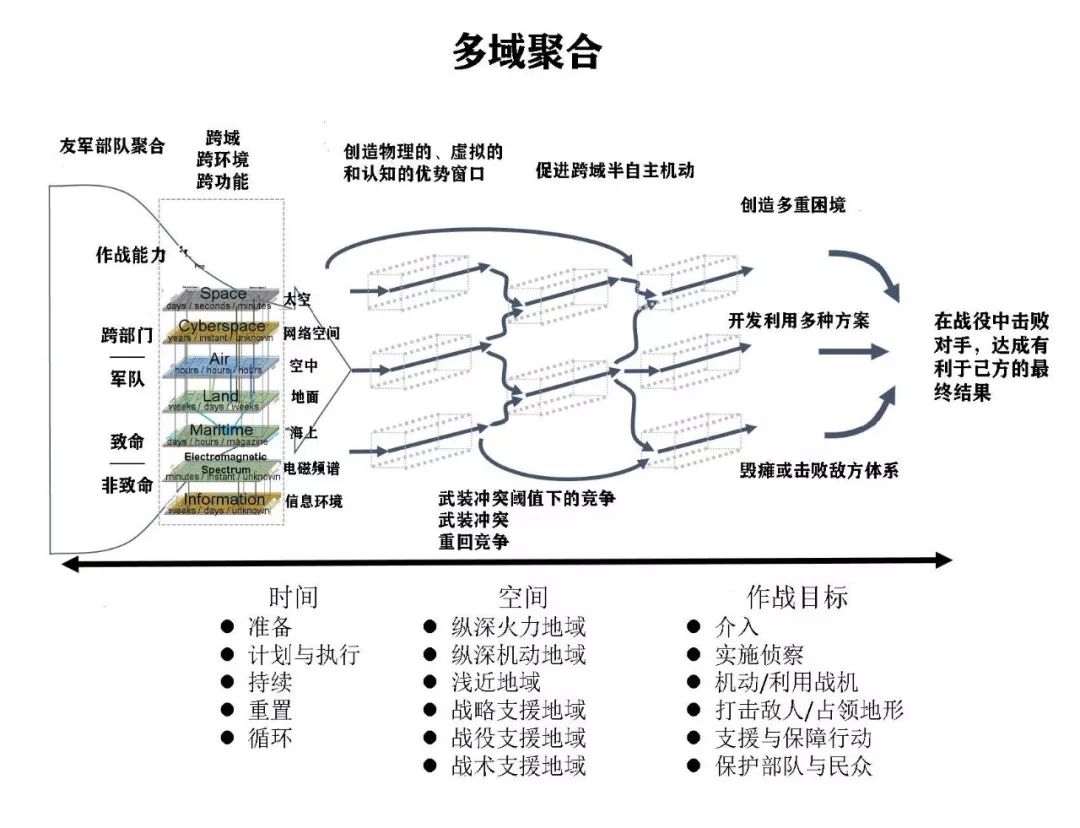
Figure 1: Description of the Overall Operational Environment in US Military Joint Publications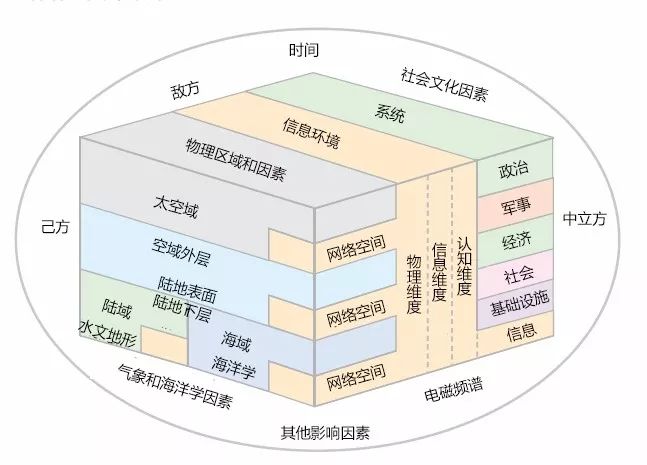 First, the US military does not classify the “electromagnetic spectrum” and “information environment” as “electromagnetic domains” or “information domains”, but understands them as important components of the overall operational environment, mainly for two reasons: first, the US military believes that the “information environment” is a collective of individuals, organizations, and systems that collect, process, disseminate, or influence information8, composed of three interrelated dimensions: physical, information, and cognitive. The physical dimension, made up of communication networks, command systems, radio wave transmission towers, computers, smartphones, etc., forms the material basis; the information dimension emphasizes the collection, processing, storage, distribution, and maintenance of data and information, while the cognitive dimension reflects the ability of individuals to process, perceive, judge, and make decisions under the influence of information flow. If we compare the information environment to a complex system machine, then the cyberspace is like the external interface of this machine, embedded within the physical domains of “land, sea, air, and space”. Ground-based, sea-based, air-based, and space-based operational platforms are interconnected through networks, and a large amount of battlefield situational awareness information in cyberspace connects with the information environment through physical dimension terminal devices; thus, cyberspace is merely a part of the information environment, which encompasses a broader scope and cannot be defined as a specific operational domain. Second, the US military believes that the “electromagnetic spectrum” is “the range of electromagnetic radiation from zero to infinity, which can be subdivided into 26 bandwidths such as microwaves, millimeter waves, and X-rays”9. As a strategic resource existing throughout the universe, the US military focuses on how to effectively manage and utilize specific military electromagnetic frequency bands under intense electronic countermeasures, namely how to maintain unimpeded access and use of the electromagnetic spectrum to meet military needs, rather than organizing and conducting electromagnetic spectrum operations; therefore, the “electromagnetic spectrum” cannot be defined as an independent operational domain.Furthermore, due to the varying operational rhythms, styles, and capabilities across different “domains”, their temporal and spatial characteristics also differ significantly—temporally, ground special forces may engage at a speed of about 5 kilometers per hour, while naval carrier battle groups can navigate at speeds of up to 30 knots, air combat F-22s can fly at a supersonic speed of Mach 2.25, and satellites in space travel at the first cosmic speed of 7.9 kilometers per second; spatially, in future “Multi-Domain Operations”, the weapon systems of military powers have far exceeded the limitations of regional geographical space in terms of strike rates, precision, and distance, spanning from the surface of the ocean to the depths of the ocean, from land heights to the atmospheric and outer space, and from terrain features affecting localized operations to the “curvature of the earth” that impacts long-range precision firepower. The entire earth and even parts of the outer space may become military spaces.To help commanders better understand the “multi-domain integration” in terms of time and space, the US military’s concept of “Multi-Domain Operations” proposes two cognitive tools: the “operational framework” and the “temporal elements”. As shown in Figure 2, in terms of time, the concept of “Multi-Domain Operations” proposes five temporal elements: “preparation time, planning and execution time, duration, reset time, and cycle time”. Among them, preparation time refers to the time needed to create conditions for employing a certain capability; planning and execution time refers to the time for maneuvering and exerting influence on targets; duration refers to the time for achieving expected effects using a certain capability; reset time refers to the time required to regenerate sufficient capability between two deployments; and cycle time refers to the iterative time from planning to reset. Some time elements closely related to physical effects (such as missile attack time) can be accurately predicted, while some time elements related to cognition (such as the duration of effects of public opinion guidance in cyberspace) can only be roughly estimated based on specific situations.10 In terms of space, the concept of “Multi-Domain Operations” introduces the “operational framework” (Operational Framework) as a visual cognitive tool to organize and integrate diverse operational elements distributed in different times and spaces, dividing the “multi-domain battlefield” into “deep fire zones, deep maneuver zones, shallow areas, and support areas” to enable joint forces to better integrate cross-domain, cross-environment, and cross-functional physical, virtual, and cognitive capabilities, to discover, open, and utilize “windows of advantage”11, thus enabling joint forces to maneuver freely in a denied environment.12
Figure 2: Multi-Domain Integration in the US Military’s Concept of Multi-Domain Operations
Conclusion
Rigorous conceptual definitions are the logical starting point for academic research. When interpreting US military-related literature, attention should be paid to the differences in the defense language system, and one should adhere to a historical perspective to carefully examine the connotations and extensions of military terminology, striving to base interpretations of US military frontier combat theories on authoritative official documents, rich and detailed materials, and accurate and idiomatic translations, avoiding “mirror thinking”, especially refraining from generalizing interpretations of another party’s concepts based on one party’s discourse system. In the study of “Multi-Domain Operations”, seemingly simple terms like “domain” are just the “tip of the iceberg”; behind them may lie many complex issues. International military studies require rigorous academic reflection rather than assumptions. [1]Army Training and Doctrine Command, United States Army White Paper, Multi-Domain Battle: Combined Arms for the 21st Century, Oct 2016, p.6.[2]Army Training and Doctrine Command, Version 1.0, Multi-Domain Battle: Evolution of Combined Arms for the 21st Century 2025-2040, Oct 2017[3]Army Training and Doctrine Command, Version 1.5, Pamphlet 525-3-1, The US Army in Multi-Domain Operations 2028, Dec 2018[4]Small Wars Journal. Hoffman, F. G. & Davies, M. C. “Joint Force 2020 and the Human Domain: Time for a New Conceptual Framework?” http://smallwarsjournal.com/jrnl/art/joint-force-2020-and-the-human-domain-time-for-a-new-conceptual-framework June, 2013[5]Joint Chiefs of Staff, Joint Vision 2020. June, 2000. P. 6.[6]Over The Horizon, Tom Flounders, Multi-Domain Thinking and the Human Domain, [EB/OD] https://ot-hjournal.com/2017/07/03/md-thinking-human-domain/, July, 2017[7]Zhang Zhanjun, “The Emergence and Development of Joint Operations”, Military Studies, 2012, Issue 6.[8]Department of Defense, Dictionary of Military and Associated Terms, February 2019, p.122[9]Department of Defense, JP3-13.1, Electronic Warfare, 8 February 2012[10]Army Training and Doctrine Command, Version 1.0, Multi-Domain Battle: Evolution of Combined Arms for the 21st Century 2025-2040, October 2017, p.26.[11]Window of Advantage refers to the integration and concentration of various operational capabilities under specific time, space, and operational domains or environments, helping commanders seize local control and create a physical, virtual, and cognitive advantage, thus creating favorable conditions for the maneuver of US joint forces. The window of advantage transcends a simple comparison of resources between opposing parties, emphasizing decisive strikes against critical enemy points at key moments in warfare to create an “immediate winning advantage”.[12]In the US military’s concept, maneuver refers to the use of forces, achieving a positional advantage relative to the enemy through the combination of movement and firepower to accomplish tasks, which can be divided into operational maneuver, tactical maneuver, and close combat.
(Platform Editor: Huang Xiaoxiao)