When you are still struggling with the “while(1)” loop in microcontroller programming, the absence of a Real-Time Operating System (RTOS) has become the biggest obstacle to advancing your project. The ESP32-freeRTOS open-source project provides over 20 practical examples, allowing you to easily implement task scheduling, resource synchronization, and interrupt management in C, completely bidding farewell to the chaotic era of “bare-metal programming”.
Let ESP32 Unleash Real-Time Computing Power
ESP32-freeRTOS transforms complex RTOS concepts into directly executable code examples. This project is open-sourced under the MIT license, integrating the ESP-IDF framework with the FreeRTOS kernel, covering all scenarios from basic task creation to advanced interrupt management, helping developers bridge the learning gap from “bare-metal” to “multi-tasking”.
-
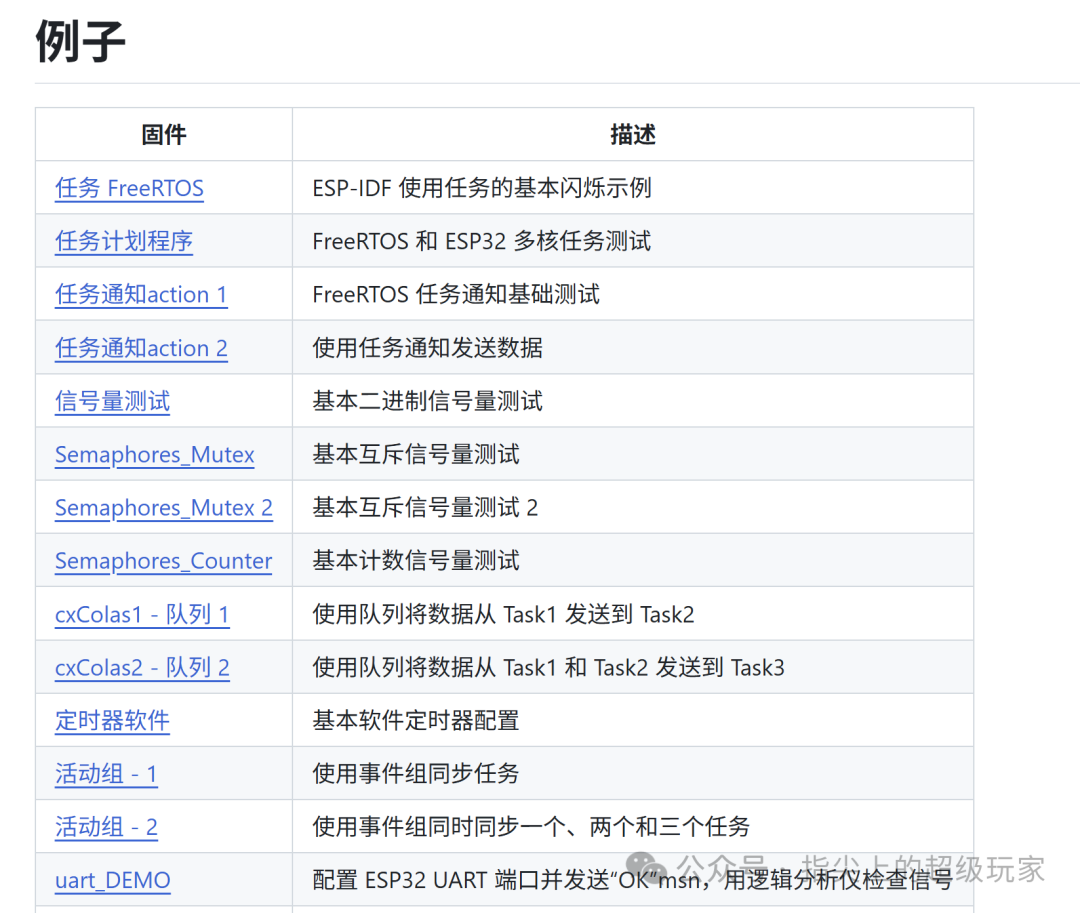
• Coverage of Examples: Includes 12 core functionality examples such as task scheduling, semaphores, mutexes, message queues, software timers, and event groups
-
• Hardware Compatibility: Perfectly supports the entire range of ESP32 development boards (such as ESP32-DevKitC, NodeMCU-32S), compatible with ESP-IDF v4.4+ versions
-
• Improved Development Efficiency: Provides standardized task templates and communication interfaces, reducing multi-task system setup time from “weeks” to “hours”
“Using FreeRTOS on ESP32 no longer requires chewing through a 500-page manual—this project teaches you 90% of the commonly used features with 20 examples.” — Embedded Developer @Electronic Forest
Real-Time Task Scheduling on a Dual-Core Processor
The advantages of the ESP32 dual-core combined with FreeRTOS are reflected in three aspects:
-
• Task Allocation: Supports binding high-priority tasks to CPU0 (PRO CPU) and low-priority tasks to CPU1 (APP CPU) for load balancing
-
• Memory Management: Achieves thread-safe dynamic memory allocation through
<span>pvPortMalloc()</span>, combined with<span>vPortFree()</span>to avoid memory leaks -
• Interrupt Nesting: Supports 16 levels of interrupt priority, with FreeRTOS kernel interrupts (PendSV, SysTick) fixed at the lowest priority to ensure task scheduling is not preempted
Analysis of Inter-Task Communication Mechanisms
The four major synchronization primitives provided by FreeRTOS are fully implemented in the project:
-
• Semaphores: Used for resource contention control, such as
<span>xSemaphoreTake()</span>and<span>xSemaphoreGive()</span>to achieve mutual access to the UART port -
• Message Queues: Pass data between temperature and humidity collection tasks and WiFi upload tasks through
<span>xQueueSend()</span>and<span>xQueueReceive()</span>(supports struct transmission) -
• Event Groups: Use
<span>xEventGroupSetBits()</span>to achieve multi-task collaboration, such as triggering data upload only when both “sensor ready” and “network connected” conditions are met -
• Task Notifications: Replaces lightweight semaphores, achieving low-latency task wake-up through
<span>xTaskNotifyGive()</span>(30% more efficient than queues)
Core Code Examples
Basic Task Creation
#include "freertos/FreeRTOS.h"
#include "freertos/task.h"

// Task 1: LED Blinking (Low Priority)
void vTaskBlink(void *pvParameters) {
    pinMode(2, OUTPUT);
    while(1) {
        digitalWrite(2, HIGH);
        vTaskDelay(pdMS_TO_TICKS(500));  // Delay 500ms, release CPU
        digitalWrite(2, LOW);
        vTaskDelay(pdMS_TO_TICKS(500));
        // Task stack size: 2048 bytes, priority: 1
    }
}

// Task 2: Serial Printing (High Priority)
void vTaskSerial(void *pvParameters) {
    int count = 0;
    while(1) {
        printf("Count: %d\n", count++);
        vTaskDelay(pdMS_TO_TICKS(1000));  // Print once every second
        // Task stack size: 4096 bytes, priority: 2
    }
}

void app_main() {
    // Create two tasks, automatically allocated to different CPU cores
    xTaskCreatePinnedToCore(
        vTaskBlink,    // Task function
        "BlinkTask",   // Task name
        2048,          // Stack size
        NULL,          // Parameters
        1,             // Priority
        NULL,          // Task handle
        0              // Bind to CPU0
    );

    xTaskCreatePinnedToCore(vTaskSerial, "SerialTask", 4096, NULL, 2, NULL, 1);
}
Advantages and Disadvantages of the Tool
| Advantages | Disadvantages |
| Examples cover core functionalities of FreeRTOS | Lacks graphical configuration tools |
| Supports ESP32 dual-core task binding | Requires manual configuration of FreeRTOSConfig.h |
| Detailed code comments, suitable for beginners | Does not integrate advanced BLE/MQTT examples |
| Compatible with the latest version of ESP-IDF | Higher memory usage (minimum 6KB) |
Limitations of Applicable Scenarios: Not recommended for 8-bit AVR microcontrollers (such as Arduino Uno), more suitable for high-performance 32-bit platforms like ESP32/ESP8266. For extremely resource-constrained scenarios (such as RAM < 4KB), it is recommended to use lightweight RTOS (such as RIOT OS).
Conclusion
ESP32-freeRTOS encapsulates the complexity of real-time operating systems in intuitive examples—whether controlling RGB lights with multi-color gradients or managing concurrent tasks for industrial devices, this project can save you three months of detours. The 440 stars on GitHub reflect developers’ best interpretation of “simple is powerful”.
Project Address: https://github.com/DiegoPaezA/ESP32-freeRTOSQuick Start: After cloning the repository, configure the target chip using <span>idf.py set-target esp32</span>, select example projects to compile and upload from the <span>examples</span> directory, and use ESP-IDF Monitor to view task running status.
▼▼▼
If you found this tutorial useful, please give it a thumbs up.
For more information on Home Assistantlow-cost modifications, hardware DIY and ESP32 software tutorials, feel free to follow this public account.