What does agent mean in artificial intelligence? Imagine your phone’s weather app automatically pushing storm warnings and reminding you to take an umbrella; the recommendation system of an e-commerce platform seems to understand your thoughts, accurately pushing products you are interested in; even the robotic arms in factories can autonomously identify product defects and sort them. Behind these seemingly simple functions lies a core entity of artificial intelligence—Agent (intelligent agent or proxy). It is not exclusive to science fiction movies but is the “action cornerstone” of modern AI systems, responsible for autonomous perception, decision-making, and execution. Understanding Agents is the key to understanding how current AI transitions from passive responses to proactive actions. This article will systematically break down the core elements, operational logic, diverse forms, and the potential and challenges of Agents shaping the future.

01 Dissecting the Agent: Core Elements and Operational Loop
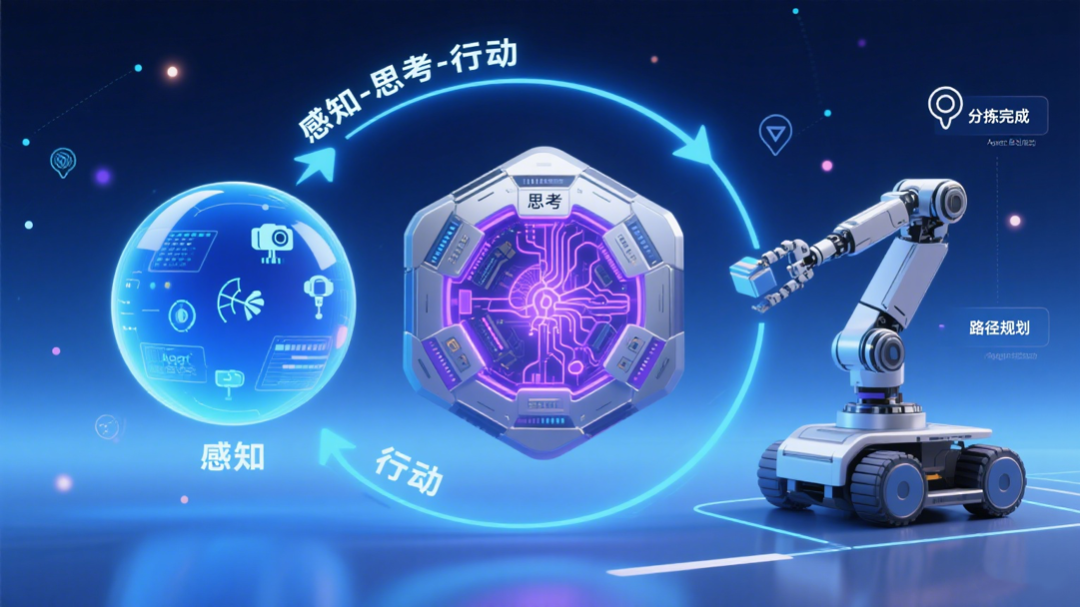
What exactly is an Agent? Setting aside complex academic definitions, we can understand it as a computational entity residing in a specific environment, capable of continuously perceiving environmental information, independently analyzing decisions, and taking actions to achieve preset goals. This definition outlines the core loop of Agent operation:
Perception is the starting point: Agents capture environmental states through built-in or external “senses” (sensors, data interfaces, API calls, text inputs, etc.). For a vacuum cleaning robot, this might be a laser radar scanned room map and its own battery level; for a chatbot, it is the user’s input statements and context.
Decision Making is the core: Based on the perceived information, its internal state (such as memory, current task progress), and preset goals or utility functions, the Agent uses its “brain”—which may be pre-programmed rules, complex machine learning models (like neural networks), or reinforcement learning strategies—to perform computational analysis and select the optimal action plan. The decision-making process must weigh immediate responses against long-term goals.
Actuation is the implementation: Once a decision is made, the Agent uses “actuators” (sending commands, controlling devices, outputting text/voice, calling services, etc.) to apply actions to the environment, attempting to change the environmental state to approach the goal. The vacuum cleaning robot moves according to the planned path and activates the suction device, while the chatbot generates and returns reply text.
This “perception-thinking-action” cycle continues to operate, allowing the Agent to exhibit goal-oriented autonomous behavior in a dynamic environment.
02 The Essence of Intelligence: Key Attributes Beyond Code
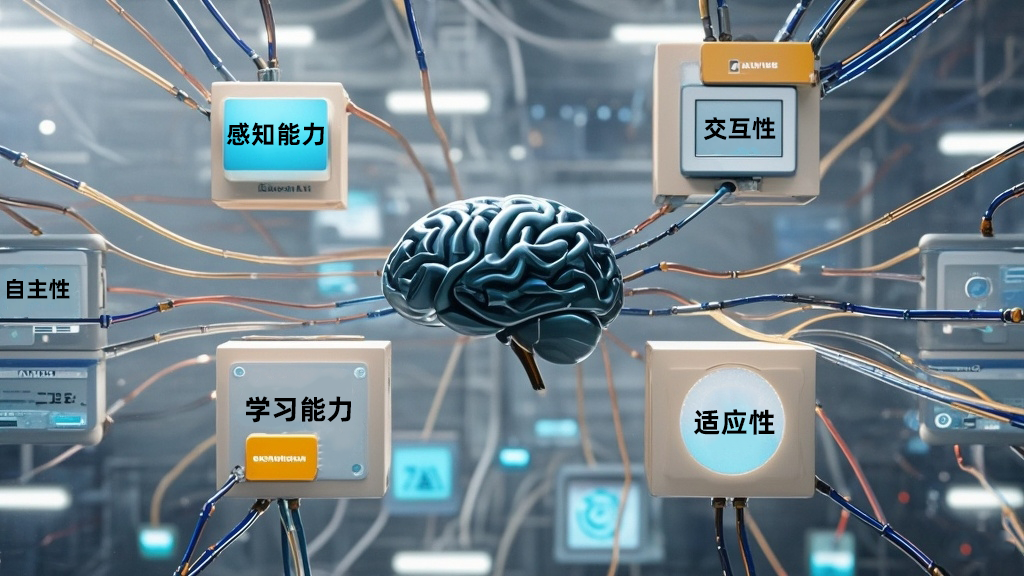
Not all software programs that run can be called Agents. A true intelligent agent exhibits a series of key attributes that elevate it beyond simple automation scripts:
Autonomy is the soul of the Agent. It means that once goals and basic rules are set, the Agent can independently control its behavior and internal state with little or no real-time human intervention, continuing to operate. A quality inspection Agent on an industrial assembly line can complete inspection tasks without an engineer constantly monitoring the screen.
Situational awareness and reactivity are the foundation of its existence. Agents are “embedded” in specific environments and must be able to keenly perceive changes in the environment (such as sensor data updates, new user commands, fluctuations in network status) and respond appropriately and timely. An autonomous driving module must react with emergency braking to suddenly appearing pedestrians.
Goal-oriented and proactiveness elevate it to a higher level. Excellent Agents are not just passive responders to the environment but can proactively take actions to drive the environment towards achieving their goals. They possess a certain degree of foresight and planning ability. An intelligent scheduling Agent not only reminds you of meeting times but may also proactively suggest you leave early based on traffic conditions and even attempt to book a vehicle for you.
Continuity and adaptability ensure its vitality. Agents are typically designed to operate continuously over a period rather than executing a one-time task. More advanced Agents can learn from their interactions with the environment through machine learning (such as reinforcement learning), continuously adjusting and optimizing their strategies to adapt to new situations or achieve goals more efficiently. A recommendation system Agent continuously adjusts its recommendation model based on the user’s changing click and purchase behaviors.
03 The Family of Intelligent Agents: Diverse Actors
The world of AI Agents is not uniform but a rich and colorful ecosystem. Based on their design philosophy, internal architecture, and application scenarios, a diverse typology can be depicted:
Architecture determines thinking patterns: Reactive Agents are the most basic form, following a direct mapping of “perception-action,” relying on preset rules to respond quickly to specific stimuli, akin to reflex actions, lacking complex planning and state memory (like simple web crawlers). Deliberative Agents possess complex internal world models and symbolic reasoning capabilities, enabling goal setting and action sequence planning, resembling a “thinker” (like early rule-based expert systems). Hybrid Agents combine the speed of reactive agents with the depth of deliberative agents, becoming the current mainstream, where the underlying rapid response ensures safety while the upper layer conducts strategic planning (like modern autonomous driving systems).
Capabilities define application boundaries: Narrow/Domain-Specific Agents specialize in solving a specific type of problem, with clear capability boundaries, and are currently the most widely used form (like quantitative Agents focused on stock trading, medical imaging diagnostic Agents). Broader Scope Agents pursue the ability to demonstrate capabilities across a wider range of tasks and environments, which is a long-term challenge and frontier direction in AI research, with the rise of large language models (LLMs) rapidly advancing this field.
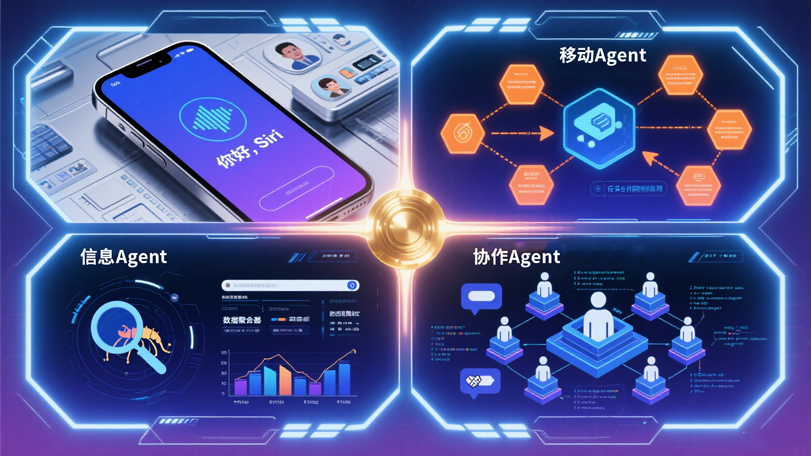
Roles shape functional forms: From a functional role perspective, Interface Agents (like voice assistants Siri, Alexa) focus on human-computer interaction; Mobile Agents (like task schedulers in distributed systems) can migrate execution between network nodes; Information Agents (like advanced search engine crawlers, data aggregators) are responsible for information retrieval, filtering, and integration; Collaborative Agents are members of multi-agent systems (MAS), adept at communicating, negotiating, and cooperating with other Agents or humans to solve complex problems (like supply chain collaboration optimization systems).
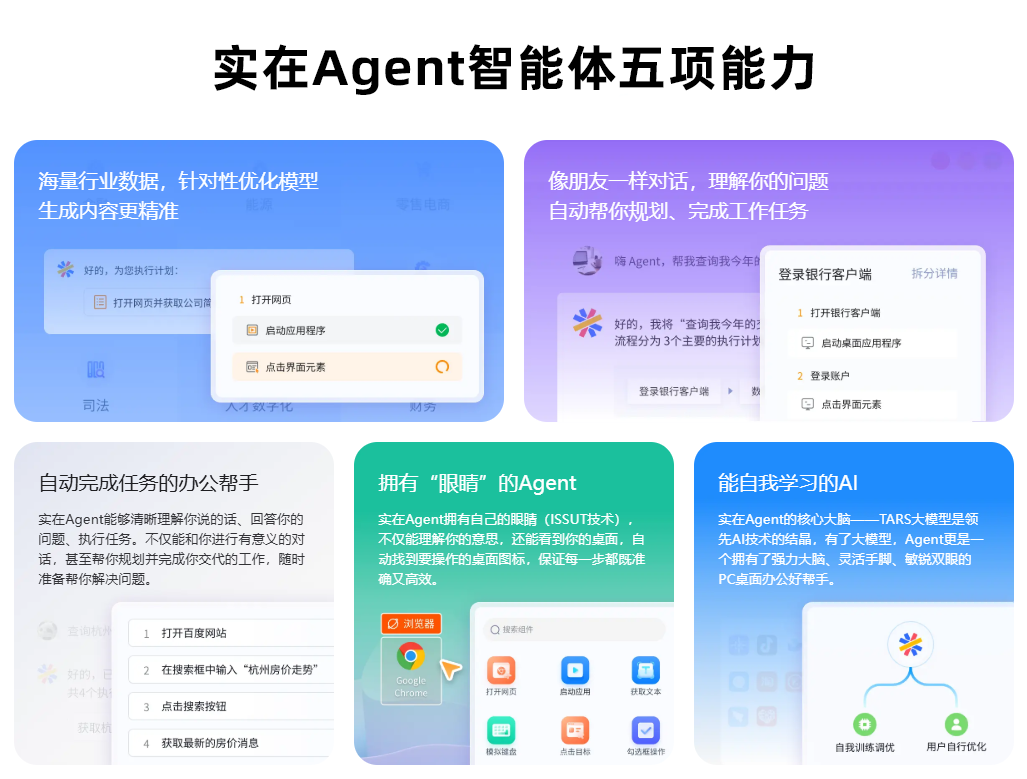
In the pursuit of higher generality and environmental adaptability, an innovative path called Real Agents deserves attention. Traditional Agents often face limitations when executing tasks involving different software, depending on whether these software provide dedicated programming interfaces (APIs). The core breakthrough of Real Agents lies in their ability to “see” and operate various software graphical user interfaces (GUIs) like real users. They utilize computer vision and precise control technologies to simulate human mouse clicks, keyboard inputs, and other operations, thus not relying on any specific software’s API.
This means that Real Agents can transcend the limitations of different applications, executing end-to-end complex task flows involving multiple software without open APIs. For example, it can automatically open a browser to search for specified information, copy and paste the results into Excel for preliminary organization, and then fill in a professional analysis software interface to generate a report—the entire process completely simulates manual user operations, achieving unprecedented cross-application automation flexibility. This “what you see is what you get” operational capability is a key feature that distinguishes it from the vast majority of Agents that rely on APIs or are limited to a single platform, opening up new possibilities for deploying intelligent agents in real, complex digital work environments.
04 The Future Driven by Intelligent Agents: Transformation, Challenges, and Infinite Possibilities
Agent technology is profoundly reshaping our world, with its influence permeating every corner:
Empowering various industries: In smart homes, Agents coordinate lighting, temperature control, and security; on industrial automation assembly lines, Agent-controlled robotic arms operate precisely and efficiently; behind traffic management and energy distribution in smart cities, countless Agents are working in coordination; financial trading Agents capture market opportunities at millisecond speeds; in healthcare, Agents assist doctors in image interpretation and drug development; even in entertainment games, NPCs (non-player characters) have become more intelligent and vivid due to Agent technology. They are the core engine of the automation and intelligence wave.
Facing severe challenges: However, the road to smarter Agents is not smooth. Core challenges include maintaining decision robustness and safety in highly complex, uncertain dynamic environments; overcoming bottlenecks in knowledge representation and complex reasoning, especially in common-sense reasoning in open worlds; addressing the explainability (XAI – Explainable AI) dilemma to establish trust between humans and machines—people need to understand why an Agent made a particular key decision; tackling increasingly prominent ethical and security risks, such as discrimination from algorithmic bias, privacy breaches, and the potential harm of Agents being maliciously exploited; in large-scale multi-agent systems (MAS), efficiently coordinating individual goals, resolving conflicts, and achieving global optimization remains a significant challenge.
Embracing future trends: Looking ahead, Agent technology is merging with several cutting-edge fields to spark new innovations: the explosive development of large language models (LLMs) injects powerful natural language understanding, generation, and world knowledge into Agents, greatly enhancing their cognitive and interactive capabilities; embodied AI research aims to enable Agents to acquire more realistic intelligence through interactive learning in the physical world (via robotic carriers) or simulation environments; meta-learning and transfer learning technologies allow Agents to adapt more quickly to new tasks and environments; building trustworthy AI frameworks is essential for addressing ethical and security challenges. All these explorations ultimately point to an exciting long-term vision: as one of the key pathways, Agents drive artificial intelligence towards a more general and powerful direction, namely artificial general intelligence (AGI).

Intelligent Agents are by no means a distant abstract concept; they have become an indispensable “action-oriented” part of our digital lives. From understanding their perception-decision-execution core loop to recognizing their key attributes such as autonomy, reactivity, and goal orientation, and understanding their diverse forms from reactive to deliberative, from specialized to general, and from individual operation to collaborative efforts, we glimpse the underlying logic of how AI transitions from passive responses to proactive actions.
Despite facing daunting challenges in robustness, explainability, and ethical security, the deep integration of Agent technology with large models, embodied intelligence, and other cutting-edge fields continues to expand its capability boundaries and application scenarios. As a core paradigm for building smarter, more autonomous systems, Agents will continue to play a key role, becoming an important bridge connecting current AI applications with the future vision of general intelligence.