The technological dividend is sweeping the globe, and Chinese AI companies are embarking on a grand maritime era.
As we reach 2025, while the domestic AI community is still debating technical parameters and financing scales, a group of Chinese companies has quietly made a fortune overseas. From cars equipped with Chinese AI voice systems on the streets of Europe, to AI office tools in the hands of Japanese white-collar workers, and AI teaching systems in Southeast Asian classrooms, Chinese AI applications are conquering the global market at an astonishing speed.
Today, we will take a look at five representative Chinese AI companies that have gone global and see how they are quietly “making a fortune” overseas.

Kunlun Wanwei: The AI Giant with 94% of Revenue from Overseas
If we were to select the king of Chinese AI going global in 2025, Kunlun Wanwei would undoubtedly be the winner. This company delivered an astonishing report card in the first quarter of 2025: revenue of 1.76 billion yuan, a year-on-year increase of 46%, with overseas revenue accounting for a staggering 94%, making it a benchmark for Chinese AI going global.
Kunlun Wanwei’s business model is quite unique: it is not limited to a single field but has built an end-to-end ecosystem that includes AI short dramas, AI games, AI music, and AI social networking.
Among these, the short drama platform Dramawave has an annual revenue of 120 million USD, and the AI music business has an ARR exceeding 12 million USD.
Its success lies in the clever adoption of a “high-value market monetization + emerging market expansion” strategy. It achieves efficient monetization in developed markets such as the US, Japan, and the UK, while building user growth engines in emerging markets like Indonesia, Brazil, and India. This strategy is reminiscent of TikTok’s globalization path, but applied in the AI field.
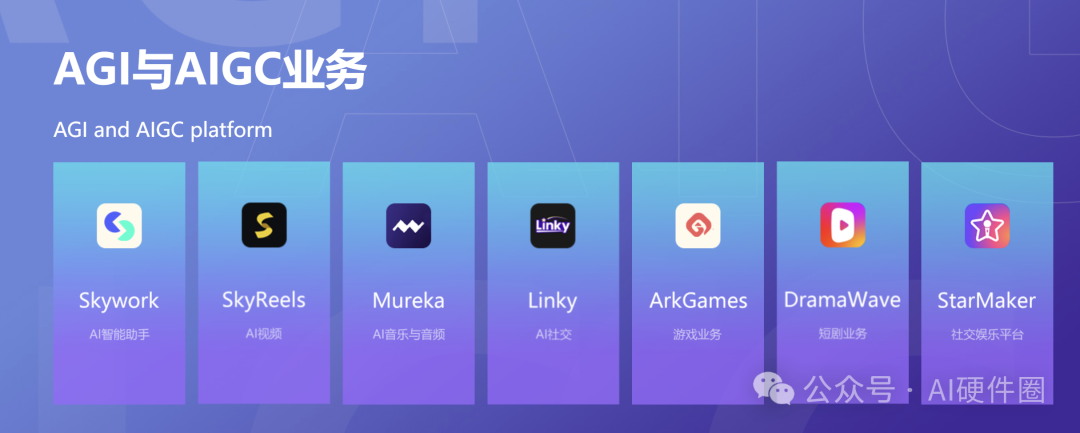 Image source: Kunlun Wanwei official website (AI business)
iFlytek: A Model for AI Hardware Going Global
While most people still equate AI applications with software, iFlytek has opened up a new landscape in the overseas market through AI hardware. In the first half of 2025, iFlytek’s overseas AI hardware grew more than threefold, and its AI office tool became the top-selling tablet on Japan’s largest crowdfunding platform Makuake just two months after its launch.
What sets iFlytek apart is its “national team” approach to going global. It not only sells products but also transforms China’s AI “sovereign capabilities” into global industrial discourse power through technology, standards, and ecosystem output.
Its success in the Japanese market is no coincidence but the result of deep localization: in response to the stringent requirements for product detail in the Japanese market, iFlytek made extensive product adaptations and cultural compatibilities, achieving a breakthrough in the challenging Japanese market.
 Image source: Internet
iFlytek: Global Layout of Intelligent Voice
On the streets of the UK, a driver of a Chinese brand car is having a smooth conversation in English with the in-car system; in the Southeast Asian market, a Chinese robot vacuum is interacting with users in fluent local languages—these vivid scenes are solid footprints of iFlytek’s AI technology going global.
In the intelligent voice sector, iFlytek has carved out a global path. To date, in the smart car field, iFlytek has partnered with over 60 well-known automotive brands, and its AI voice interaction system has been installed in over 15 million vehicles.
iFlytek’s going global strategy adopts a unique “dual-wheel drive” model: on one hand, it is “follow the global expansion”—providing reliable intelligent voice technology support alongside the globalization of Chinese brands; on the other hand, it is “independent brand expansion”—pushing its own branded products into international markets.
This strategy not only effectively diversifies single market risks but also achieves a leap from “technology output” to “brand output.”
 Image source: Internet
DeepSeek: Global Advance of Open Source Models
In the field of AI large models, DeepSeek represents the global influence of Chinese open source. According to a16z’s report on the “Top 100 Generative AI Consumer Applications,” among the top 50 mobile applications, 22 are developed by Chinese teams, with only 3 primarily targeting the domestic market, while the rest are all overseas products.
DeepSeek’s success confirms the global potential of the open source strategy. By providing high-quality open source models, DeepSeek quickly established a global developer ecosystem, laying a solid foundation for subsequent commercialization.
Even more surprisingly, these open source models have not only gained recognition in the tech community but have also demonstrated dominance in the global consumer market. This “open source first, then commercialization” path provides a replicable channel for Chinese AI companies to go global.
 Image source: Internet
Haiyi AI: Exploring the Blue Ocean of Multilingual Ecosystems
In the field of AI image generation, Haiyi AI has explored a unique path for going global. Unlike other AI applications that focus on the English market, Haiyi AI has taken the lead in “avoiding the red ocean and exploring the blue ocean”, deeply promoting multilingual localization.
Currently, the overseas version of Haiyi AI supports 12 languages, with over 30 million monthly active users, covering major emerging markets worldwide.
Haiyi AI’s strategic positioning is to— “build the Walmart of AI”. Unlike single model developers, Haiyi AI integrates and distributes the capabilities of top global AI models to its own web and mini-program platforms, achieving “one-click” services.
This model not only makes AI technology more accessible but also promotes the widespread implementation of high-quality model capabilities globally. As Haiyi AI CEO Ma Fei stated, “Apart from English, there is still 80% of market space.” Haiyi AI’s multilingual ecosystem is the key channel to this 80% market space.
 Image source: Internet
Challenges of Going Global: Computing Power, Compliance, and Localization
Going global with AI is not a smooth path; even successful companies face numerous challenges.Data compliance is one major challenge. Different countries and regions have strict regulations on cross-border data transmission, and companies must understand relevant laws before going global.
Refined localization is also a key to success. Successful companies have not only translated languages but have deeply understood local cultures.
An industry insider pointed out the key: “User consumption habits and cultures differ in every market, requiring localization.” For example, companies that succeed in the Japanese market often do their homework in recruiting localized employees, compliant operations, leveraging their advantages, and effective brand promotion.
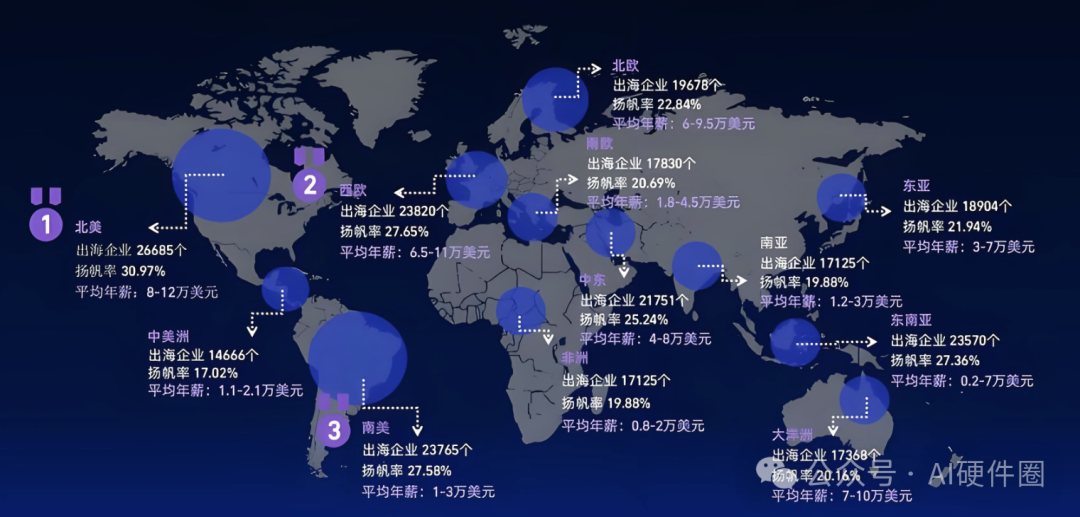 Image source: Internet
The Key to Success: A Globalized Mindset from Birth
Looking at these successful AI companies going global, one common trait stands out:the “globalized from birth” mindset. These teams have targeted the global market from the outset, with overseas revenue often exceeding domestic revenue.
Specifically, the success of these companies is based on three pillars:technological strength, user insights, and localized operations.
Technologically, Chinese AI companies have achieved global competitiveness in certain fields; in terms of user insights, they deeply understand the pain points of users in different regions; and in localized operations, they have established marketing and service systems that align with local cultural habits.
Jinsha River partner Zhu Xiaohu pointed out that Chinese AI startups have “almost no competitors” in Japan, Southeast Asia, and the Middle East. He suggests that startups should first refine their products and teams domestically before earning profits in overseas markets.
What Should Be the Next Steps?
For more AI hardware companies looking to go global, the experiences of these software applications are equally valuable. Several key insights are worth noting:
First, choice is more important than effort. Companies going global should prioritize vertical fields with strong willingness to pay, such as AI programming, AI design, or popular demands like emotional companionship and content creation.
Second, the business model should be flexible. Especially in the hardware sector, combining equipment sales with value-added services often creates more stable revenue streams.
Finally, localization is a must. Successful companies have achieved “when in Rome, do as the Romans do,” not only aligning product design with local habits but also deeply localizing marketing, services, and compliance.
The wave of Chinese AI applications going global has just begun, and greater opportunities lie ahead. Will you be the next?
~END~
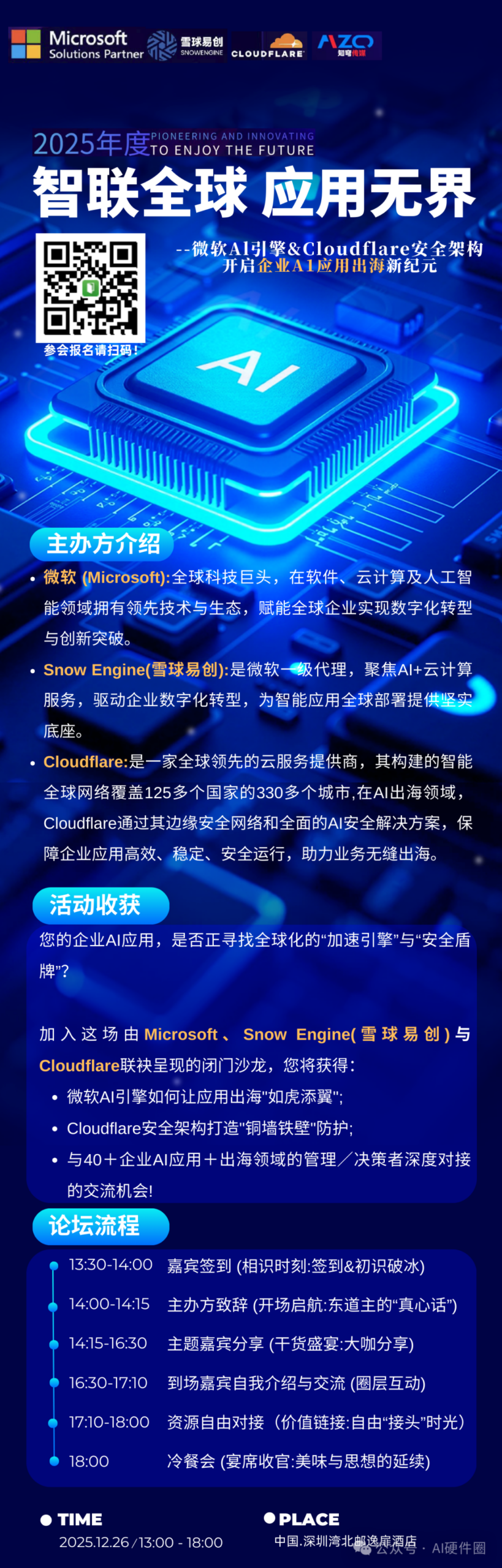
[2025 China AI Application Companies Going Global Forum]