With EtherCAT G, we aim to help our customers create the best and highest-performing machinery in the world.

EtherCAT G operates on the principles of the successful EtherCAT technology, while increasing the data rates to 1 Gbit/s and 10 Gbit/s.The EtherCAT protocol itself remains unchanged, and as before, all devices in the network receive messages sent by the EtherCAT master.Each EtherCAT slave reads the addressed data on the fly and inserts the data it needs to exchange into the frames that continue to be sent downstream;now, all of this occurs at rates of 1 Gbit/s or 10 Gbit/s.The only factor contributing to message processing delay is the latency generated by the hardware.When the last device or terminal branch in the subnet identifies an open port, it utilizes the full-duplex characteristics of the Ethernet physical layer to send the message back to the master.EtherCAT G and EtherCAT G10 still retain all the features of EtherCAT.Devices with three or four ports (branch couplers) allow users to flexibly configure network topologies and fully meet the structural needs of the devices.Optional machine modules can be connected to or removed from the system through hot-plug functionality.Network diagnostic features can minimize device downtime and improve availability.The built-in distributed clock still ensures high-precision synchronization performance of less than 100 ns.
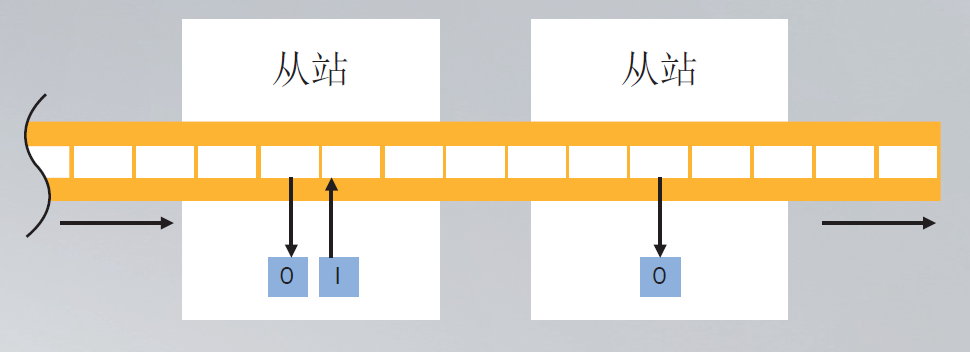
“On the fly” Processing Method
Common Features:
– Real-time Ethernet directly to the I/O layer
– Flexible topology
– Excellent diagnostic capabilities
– Precision synchronization of less than 100 ns
– Very simple configuration
– Low system costs
– Maximized performance
– Integrated functional safety features
– Compliant with IEEE-802.3 standards
EtherCAT G: Designed for high-performance devices and highly complex applications
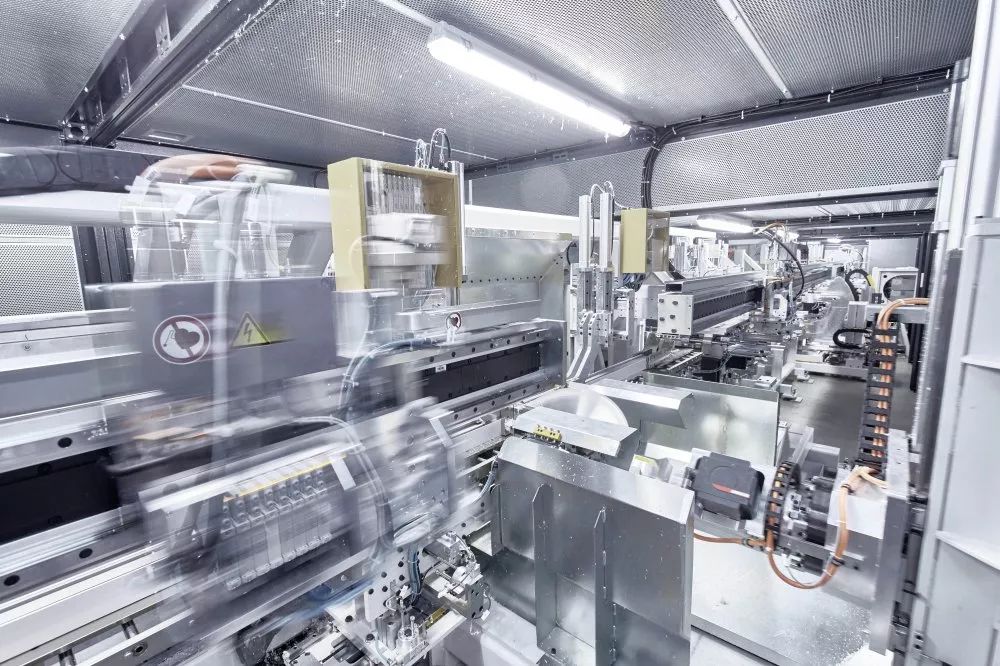
The EtherCAT technology was first introduced to the market in 2003, and its outstanding performance meets the various industrial communication needs of users across almost all industries.From high-dynamic machine tools and complex packaging systems to logistics centers.Machine vision, condition monitoring, and innovative transport systems like XTS and XPlanar rely on reliably transmitting hundreds of bytes of process data generated by each node in each cycle, which requires a cycle time of less than or equal to 1 microsecond and high data bandwidth.With EtherCAT G, systems and applications like the ones mentioned above only require a single EtherCAT G master to control, while simultaneously collaborating with other automation devices and drives.The latest branch controller model developed for EtherCAT G can meet the growing demand for shorter cycle times in expanded systems that integrate a large number of devices.Today, even larger systems can be synchronized and operated by a single central master.
EtherCAT G: Expands the application scope of EtherCAT technology
– High-resolution machine vision
– High sampling rate high-end measurement testing technology
– Complex motion control applications
– Requirements for higher data transmission rates and shorter refresh cycles in XTS and XPlanar
EtherCAT G: Branch Controller
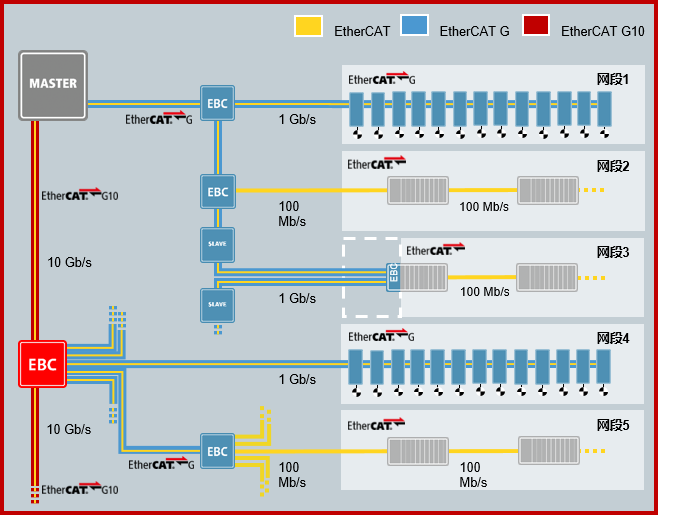 EtherCAT is the leading communication standard in the industrial automation sector, meaning that today’s equipment manufacturers can choose compatible devices from a wide range of thousands of products at different levels.The compatibility of devices is at the core of the EtherCAT G/G10 technology extension.The new branch model designed for this purpose can integrate 100-megabit Ethernet segments into the EtherCAT G network.Traffic forwarding in these segments is based on priority and/or time-driven.Since each branch is treated as a separate EtherCAT segment, messages do not need to pass through all segments in order.Instead, these segments are processed in parallel, significantly reducing latency in large networks.Similarly, the combination of EtherCAT G and EtherCAT G branches provides convenience for applications.Like EtherCAT, branch controllers can be configured via the EtherCAT master without the need for other configuration tools.Branch controllers support diagnostic and distributed clock synchronization functions and transparently forward data to the connected segments.

Fight Against the Pandemic
Protection

#Virus Survival Time Outside the Body#
Survival does not necessarily mean infectious.Based on the biological characteristics of the SARS virus, it can be inferred:
On surfaces such as plastic, glass, mosaic, metal, fabric, and copy paper, it can survive for 2 to 3 days;
In urine at room temperature of 24 °C, it can survive for at least 10 days.
If droplets containing a high concentration of the virus fall on absorbent materials (such as dry paper, cotton cloth), they will no longer be infectious after 5 minutes;if they fall on non-absorbent materials (such as plastic, waterproof coats), it takes 1 hour.
1
-END-