The EtherCAT ESI communication description file serves as the device description file for slaves in the EtherCAT master station:
-
From the perspective of data communication and synchronization,it comprehensively describes the EtherCAT communication interface between the slave device and the master station.
-
On one hand, it is directly burned into the EtherCAT/ESI-EEPROM of the IO device:– When the device is scanned by the master station, it can automatically report basic information such as process data length (PDO), configurable parameters (CoE), etc.– It also includes basic settings related to functionality that are read by the microcontroller or other control units when the IO device is powered on.
-
On the other hand, it needs to be provided to the EtherCAT master station in file form:– Even if the master station has not yet established an electrical connection with the device, it can still “recognize” the slave, allowing users tocomplete offline bus configuration (without online scanning).– The master station learns how to address the slave via EtherCAT and all the functions provided by the slave. For example, the master station can pre-determine the cyclic process data and CoE directory of the slave. Without ESI, the master station knows nothing about the device.– To integrate the EtherCAT slave into TwinCAT’s NC (motion control),the corresponding ESI description must be available.
-
Note: Some EtherCAT master stations obtain information from slaves solely through scanning, without requiring an ESI file. TwinCAT can also operate “online” without ESI when necessary, but it is stillstrongly recommended to provide the correct ESI, for the following reasons:– Modern EtherCAT devices have a wide range of functions and complex settings, and the generated ESI files are often too large to be fully stored in the local EtherCAT/ESI-EEPROM. The simplified information that remains in the EEPROM can ensure basic operation, butcannot provide all the functions and diagnostic capabilities of the device.– Only with the ESI file canoffline configuration be performed.
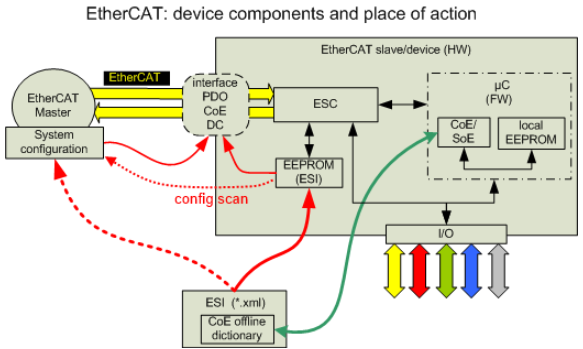 Therefore, the role of ESI is as follows:ESI is written into the internal EtherCAT/ESI-EEPROM of the device, defining the “EtherCAT interface as seen from the µC perspective”; while the actual EtherCAT real-time communication is completed by ESC (EtherCAT Slave Controller). The EtherCAT master station requires this ESI to include the device in the system configuration. The master station can read the ESI from the EtherCAT/ESI-EEPROM online; if the ESI is already available in the master station software, it supportsoffline configuration.Thus, the master station and the slave/device have a consistent definition of the EtherCAT interface, enabling communication between both parties.