Set the public account as a star so you won’t miss the highlights
 !
!
In the last issue, we discussed the definition of EtherCAT, market nodes, and specific plans. In this issue, we will discuss: EtherCAT and EtherNet.
EtherNet
In the 1980s, Ethernet was a relatively specialized computer connection technology managed by experienced masters in highly controlled office environments.
Since then, technology and performance have made incredible progress, and many people around the world use wired and wireless (Wi-Fi) Ethernet in their daily lives.
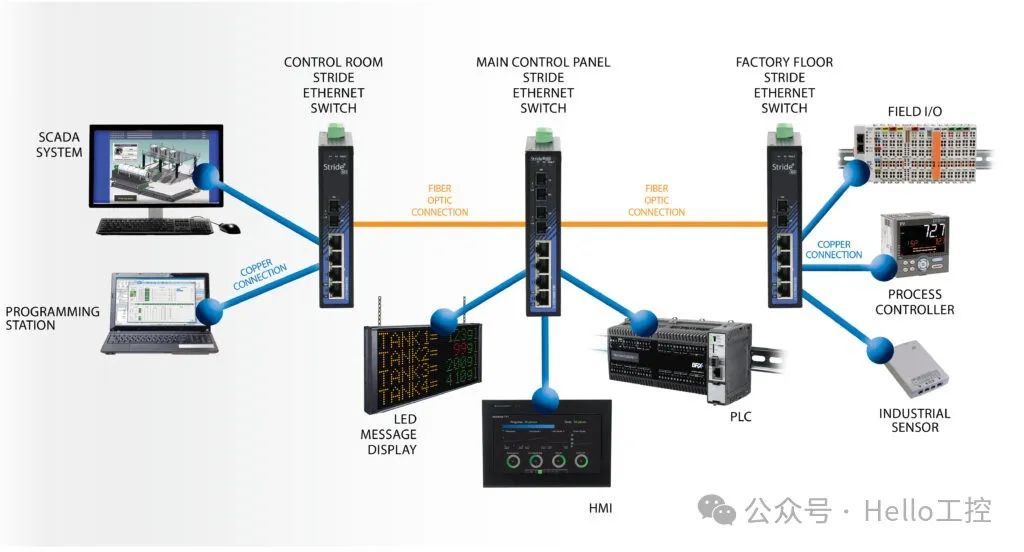
Of course, networking is equally crucial for industrial automation, but the technology used for this service must always meet several requirements:
-
Form factors and installation methods suitable for field environments (easy to install, capable of withstanding environmental temperature/dirt/moisture/physical conditions)
-
Strong resistance to electrical noise from power sources, motors, contactors, and other sources
-
Sufficient bandwidth and responsiveness
The earliest digital communication and network operation technologies (OT) were specialized and sometimes proprietary, and were limited (with only a few versions being viable). However, ultimately, economies of scale allowed Ethernet information technology (IT) to dominate industrial automation communication at all levels.

EtherNet vs EtherCAT
Ethernet-based bus solutions have become the dominant method for motion and industrial control communication. TCP, UDP, ModbusTCP, EtherNet/IP, ProfiNet, and EtherCAT are several Ethernet protocols that achieve high-speed, robust communication.
Since EtherCAT and Ethernet use the same physical hardware and are often used together, it is challenging to distinguish between them. However, control system designers can make informed choices by understanding several key factors, such as application scenarios, synchrony, and costs.
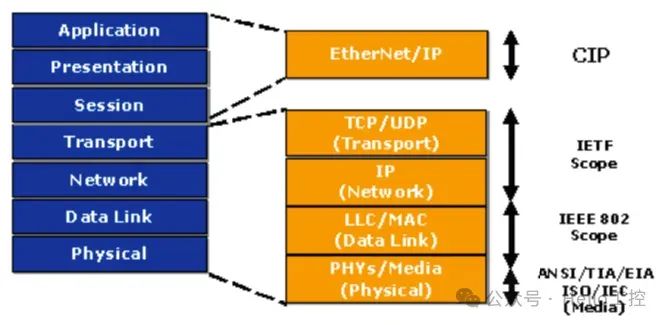
In general, Ethernet follows the standard OSI 7-layer network protocol as shown in the figure below:
In contrast, EtherCAT innovates and improves upon Ethernet, having fewer layers, only using the 1st and 2nd layers to transmit data.
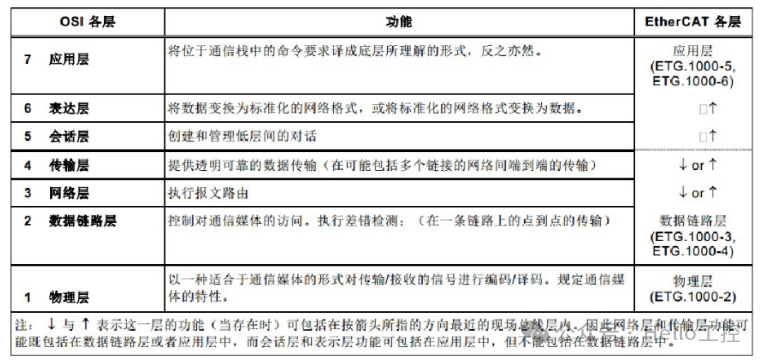
Thus, based on this, the speed of data transmission is faster, and the risk and uncertainty of data transmission between layers are reduced.

Speed Comparison
We illustrate the speed of EtherCAT bus communication through the following example:
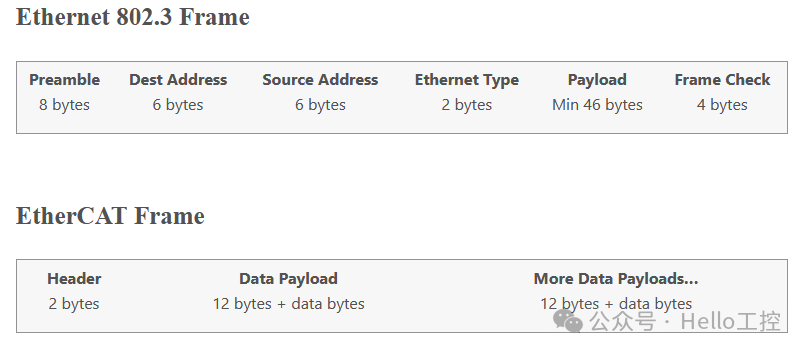 According to the above communication frame, if transmitting a DINT type (4 bytes) of data, then:
Ethernet needs to transmit a total of: 8+6+6+2+46+4 = 72 bytes of data length
EtherCAT needs to transmit a total of: 2+12+4 = 18 bytes of data length
Thus, under the same communication medium, the time required for EtherCAT communication is merely one-fourth of that for Ethernet communication.

Motion Control Comparison
If using Ethernet for motion control, it generally refers to the communication of commands and data between the host and the motion controller via TCP, utilizing the controller to achieve motion control. However, Ethernet itself does not have high real-time performance, making it unsuitable for synchronously strong motion control solutions. 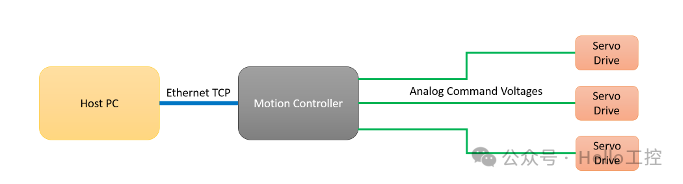
In contrast to the above solution, the EtherCAT bus control solution includes an EtherCAT Master, with all slave devices (I/O or servos) communicating in real-time via EtherCAT, with a minimum level of microseconds.

Of course, EtherCAT requires more costs; first, it needs software configuration for master and slave stations, and each slave needs a specific protocol data packet, which cannot be network compatible with traditional routers or switches. Finally, each slave also requires a dedicated EtherCAT bus ASIC chip.

Conclusion
For scenarios requiring lower costs but not high real-time performance, general Ethernet communication can be considered, as this technology has been developed for nearly 50 years, is relatively mature, and is quicker to implement. For motion control scenarios, especially for synchronous control within 1ms, EtherCAT is the preferred choice. Of course, with the current development of digitization and intelligence, we should combine the advantages of both to make comprehensive considerations and ultimately provide a satisfactory solution for customers.

- 【Video Course】Codesys V3.5 Series Introductory Course
- 【Video Course】Codesys SoftMotion Basics Course
- 【Video Course】Codesys SoftMotion Electronic Gear Course
- 【Video Course】Codesys SoftMotion Electronic Cam Course
- 【Video Course】Codesys Library Custom Library Creation
-
Codesys V3.5 Series Complete Free Public Data Collection
-
Top 10 Common Filter Algorithms (ST Language)
-
What Does a PLC Integrated with Chat GPT Look Like?
-
2023 Annual TOP 10 PLC Programming Books Sharing
-
Customize Your Own CODESYS Motion Controller
-
MC_Power.status = FALSE, Can the Axis Still Move?
-
ST Language Learning Material Collection

——–END——–
If you like this article, please share and hit the “like” button in the bottom right corner