

Statement: [Fluorescent Supramolecular Science] aims to share the latest news and research progress in the fields of fluorescence and supramolecular science for learning and communication. This is for exchange purposes only. If there are copyright issues, please contact for deletion. For submissions, recommendations, reprints, collaborations, or article issues, please contact the editor through the backend. Thank you for your attention!

Original Link:10.1021/acs.nanolett.4c04949
Covalent Organic Frameworks (COFs) are dynamic covalent porous organic materials composed of luminescent molecular organic building blocks. However, due to intramolecular rotation and vibration, as well as strong π–π interactions, most two-dimensional (2D) COFs do not emit light or have weak luminescence in the solid state. Recently, Yang Xinyi’s team from Jilin University reported a pressure strategy that achieves bright multicolor luminescence from yellow to red in 2D triazine triphenylamine COF (TTI-COF). Interestingly, compared to the initial state, TTI-COF experienced a 24-fold enhancement under a mild pressure of 2.7 GPa. Experimental and theoretical combined results indicate that the restricted intramolecular chemical bond vibrations and the weakened π–π interactions due to the offset stacking pattern lead to significant emission enhancement induced by pressure. Additionally, this pressure-induced color change behavior may be attributed to a decrease in the energy gap and an enhancement of intermolecular interactions. Our research provides constructive guidance for designing 2D COF materials with high photoluminescent performance.Related research results were published in Nano Lett..
Illustrative Analysis
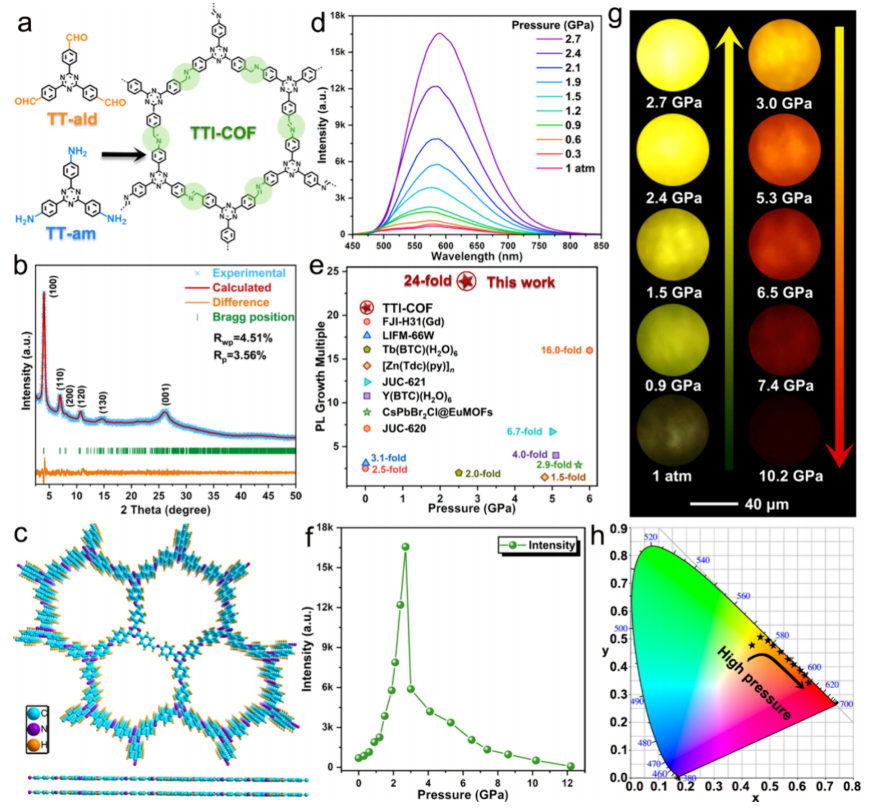
Figure 1. Crystalline structure and PL characteristics of TTI-COF under high pressure. (a) Schematic diagram of the formation of TTI-COF by TT-ald and TT-am. (b) Powder X-ray diffraction pattern of TTI-COF, with the corresponding Pawley refinement (red) and Bragg positions (green) fitting the experimental data (blue), with minimal differences (orange). (c) Structural model views along the c-axis and a-axis directions. (d) Pressure-dependent PL spectra of TTI-COF. (e) Performance of crystalline porous materials with PIEE behavior reported in literature and this paper. (f) Relationship between PL intensity of TTI-COF and pressure. (g) PL images at selected pressures measured with a 355 nm laser. (h) Variation of chromatic coordinates as pressure increases from 1 atm to 10.2 GPa.
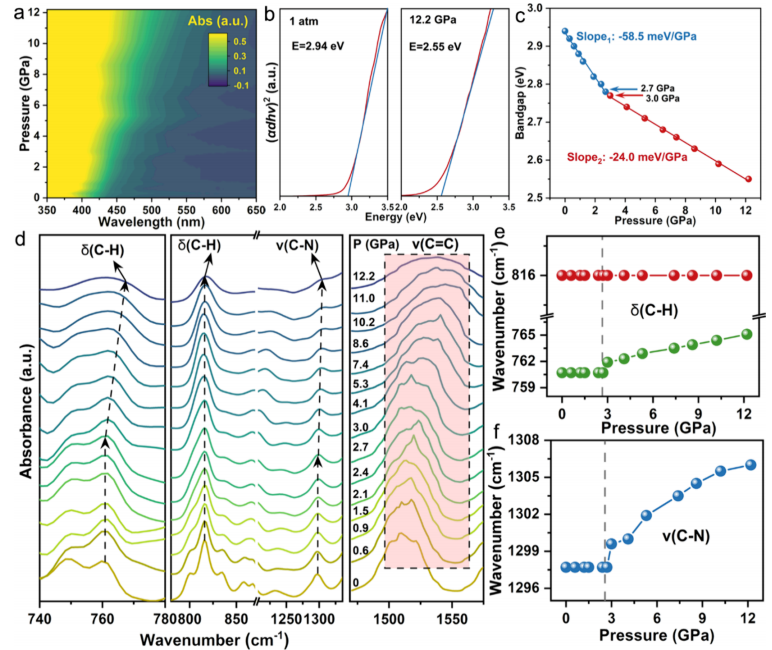
Figure 2. Evolution of band gap and intermolecular interactions in TTI-COF under pressure. (a) Absorption spectra of TTI-COF in the pressure range from 1 atm to 12.2 GPa. (b) Tauc plot of TTI-COF at 1 atm and 12.2 GPa. (c) Variation of the band gap of TTI-COF with pressure. (d) Amplified in-situ infrared spectra from 740 to 1575 cm−1 under different pressures. (e and f) Wavenumber changes of δ(C−H) (out-of-plane bending vibration of C−H on the benzene ring) and ν(C−N) (C−N stretching vibration) with pressure.
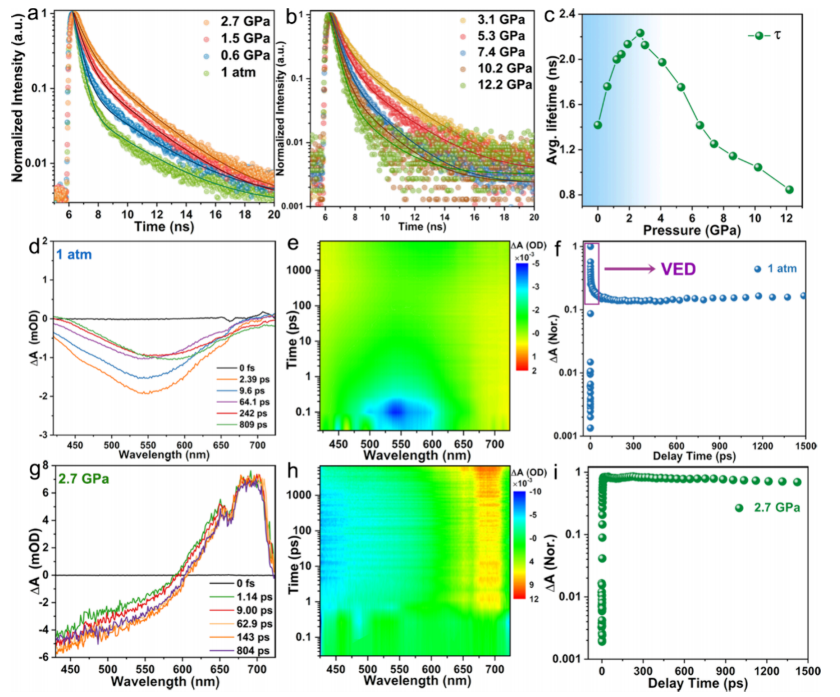
Figure 3. Photophysical properties of TTI-COF under pressure. (a and b) TRPL measurements of TTI-COF at 1 atm and at 0.6, 1.5, 2.7, 3.1, 5.3, 7.4, 10.2, and 12.2 GPa. (c) Pressure-related average lifetime of TTI-COF. (d and g) TA spectra of TTI-COF excited at 400 nm and at specified delay times at 1 atm and 2.7 GPa. (e and h) Pseudocolor TA images of TTI-COF at 1 atm and 2.7 GPa. (f and i) Normalized TA kinetics curves of TTI-COF detected at 1 atm and 2.7 GPa. VED indicates vibrational energy dissipation.
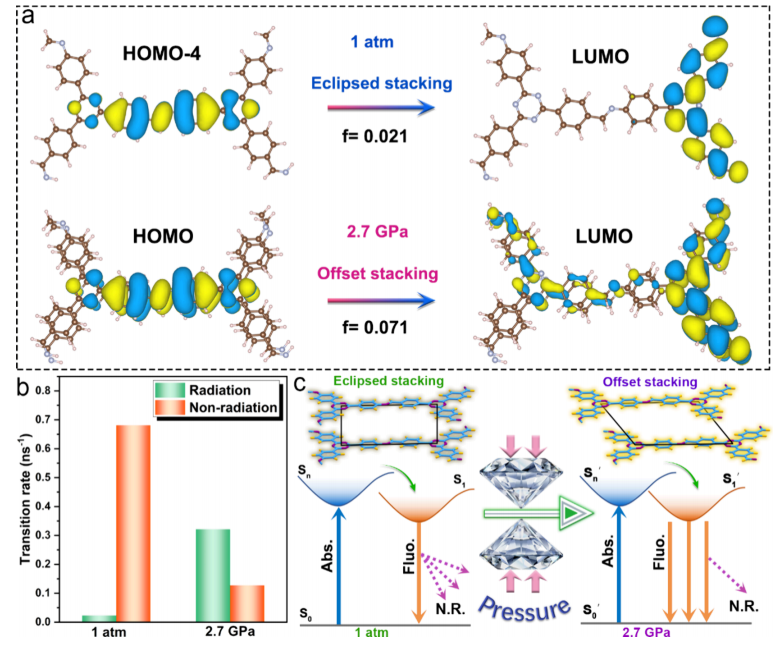
Figure 4. Emission mechanism of TTI-COF under high pressure. (a) Molecular orbital distribution of optimized structure in TTI-COF at 1 atm and 2.7 GPa. f indicates oscillator strength. (b) kr and knr of TTI-COF at 1 atm and 2.7 GPa. (c) Schematic diagram of the PL enhancement mechanism of TTI-COF. S0 indicates the ground state singlet, S1 indicates the first excited singlet (Abs.: absorption; Fluo.: fluorescence; N.R.: non-radiative).
Research Services