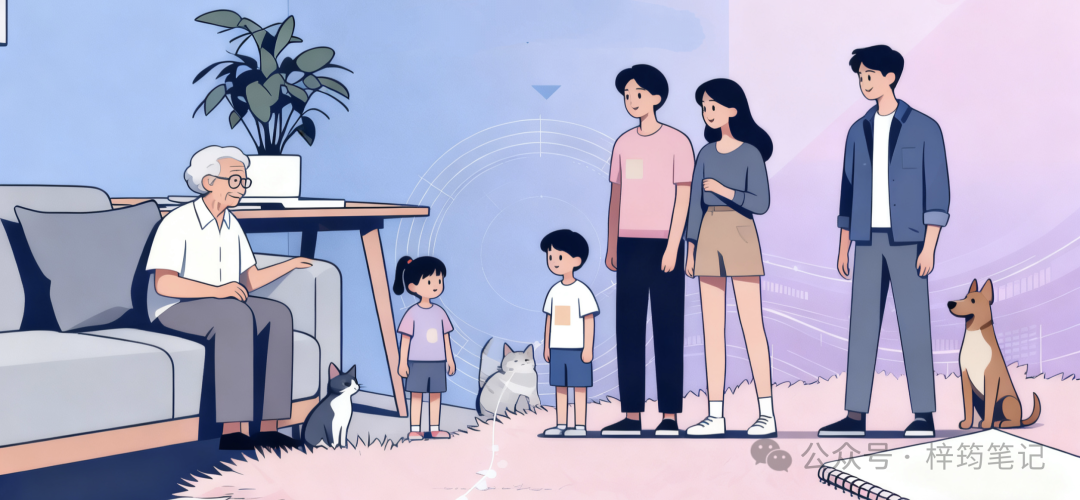
 With advancements in technology and changes in social perceptions, AI pet robot products are emerging rapidly. The most likely target audience includes those who experience strong feelings of loneliness and desire emotional connections but are constrained by real-world conditions, particularly the elderly, children, and urban dwellers living alone, ultimately forming a product model of “full lifecycle companionship” and becoming an important emotional carrier in the modern “loneliness economy.”
1. Core User Groups
1. Elderly Population 45%
Core Needs:Alleviation of loneliness, health monitoring, cognitive stimulation, replacement of traditional pet ownership
Typical Users:
1) Empty Nesters: Especially widowed elderly women (who desire emotional companionship more)
2) Alzheimer’s Disease/Cognitive Impairment Patients: AI pets can reduce agitation and provide memory stimulation
3) Physically Frail Elderly: Seniors who cannot care for real pets but need companionship
Iteration Direction:No need for feeding or walking, can provide 24-hour companionship, remind to take medication, monitor heart rate
2. Children and Adolescents 30%
Core Needs:Educational assistance, emotional companionship, responsibility cultivation, social development
Typical Users:
1) Preschool Children Aged 2-8: Language learning, enlightenment education
2) School-Aged Children: English learning, knowledge Q&A, creativity stimulation
3) Adolescents: Emotional management, stress relief, personalized companionship
Iteration Direction:Personalized teaching, zero-pressure learning environment, non-judgmental communication space
3. Urban Singles and Individuals 25%
Core Needs:Filling emotional voids, low-burden companionship, alleviating loneliness (over 300 million people living alone globally)
Typical Users:
1) Single white-collar workers aged 25-35: Busy work schedules, limited living space, unable to keep real pets
2) Young people who “want companionship but do not want to be disturbed”: need “zero-responsibility” companionship
3) Allergy sufferers: Allergic to pet hair but desire pet companionship
Iteration Direction:No shedding, no care required (autonomous, self-recharging), always on standby, customizable interaction methods
2. High-Potential Niche Markets
1. Individuals with Special Health Needs
1) Autism Spectrum Disorder Patients: Social training through AI pets to establish non-threatening emotional connections
2) Anxiety/Depression Patients: AI pets provide unconditional acceptance, reduce social pressure, improve emotional state
3) Post-Traumatic Stress Disorder (PTSD) Patients: Stable companionship from AI pets aids in trauma recovery
2. Assistance for Disabled Individuals
1) Visually Impaired Individuals: AI guide dogs provide navigation, obstacle avoidance, and visual assistance
2) Hearing Impaired Individuals: AI pets provide information exchange through visual and tactile feedback
3) Individuals with Limited Mobility: Customized AI pets can provide item retrieval, medication reminders, and other daily assistance
3. Transition Period for Pet Ownership
1) Families waiting to adopt real pets: Cultivating caregiving abilities in advance
2) Owners who have lost pets: Emotional transition, alleviating grief (AI pet resurrection services)
3) Individuals in rental or temporary housing who cannot keep real pets
3. User Group Characteristics Comparison
| Group | Core Needs | AI Pet Advantages | Expected Functions |
|
Elderly |
Alleviation of loneliness, health monitoring |
Low maintenance, long-lasting companionship, health reminders |
Voice interaction, health monitoring, child voice simulation (voice cloning) |
|
Children |
Educational entertainment, emotional cultivation |
Personalized learning, safe interaction, responsibility cultivation |
Intelligent Q&A, gamified learning, emotional recognition |
|
Singles |
Low-burden companionship, emotional support |
No responsibility, companionship at any time, non-intrusive |
Personalized interaction, intelligent reminders, stress relief functions |
|
Disabled Individuals |
Life assistance, independence |
Customized services, mobility assistance, information access |
Navigation, environmental recognition, life assistance, emergency calls |
|
Mental Health Needs |
Non-judgmental companionship, emotional management |
Stable responses, continuous support, privacy protection |
Emotional recognition, stress relief, psychological counseling |
4. Unique Value of AI Pets
1) Zero Burden:No need for feeding, cleaning, or medical care, resolving the conflict of “wanting a pet but lacking time/energy”
2) Controllability:Adjustable interaction intensity, can pause at any time, adapts to different life rhythms
3) Safety:No risk of biting, avoids allergies, suitable for individuals with special health conditions
4) Personalization:Can be customized in appearance, personality, and interaction methods according to user preferences
5) Durability:No lifespan limitations, providing consistent emotional support
5. Market Trends
1. Expanding User Groups
Initially focused on the elderly and children, expanding to all age groups; singles and young families are becoming new main consumer groups.
2. Diversified Function Positioning
From single companionship to multifunctional development of “companionship + health management + education + life assistance”; targeting Gen Z users, AI pets are extending towards virtual identities and digital collectibles.
3. Increased Market Acceptance
Medical-grade AI pet companies report that 72% of their users are family members of Alzheimer’s patients, and 26% are from autism treatment institutions; a certain AI pet product initially targeted at dementia patients unexpectedly attracted 70% of users outside the circle (lonely adults, parents of autistic children).
6. On Promoting Oxytocin Secretion: Real Cats and Dogs vs. AI Pets
Multiple clinical and laboratory studies have verified the core differences between real cats and dogs and AI pet robots in promoting oxytocin secretion, focusing on key data in terms of “secretion intensity, duration, and emotional relevance”:
| Comparison Dimension | Real Cats and Dogs | AI Pets |
|
Secretion Peak and Baseline Increase |
After 10-15 minutes of interaction between humans and pets, oxytocin levels increase by an average of 20%-40% (in some studies, “deep companions” such as those who have kept pets for over 3 years can reach peaks of over 50%), and can maintain levels above baseline for 2-3 hours. |
With similar interaction duration, oxytocin increase is only 5%-12%, with peaks less than one-third of real cats and dogs, and quickly drops back to baseline within 30 minutes after interaction ends. |
|
Emotion-Driven Secretion Specificity |
When humans are under stress (elevated cortisol levels), the increase in oxytocin secretion during interaction with pets doubles, forming a precise match of “stress relief – oxytocin secretion”. |
For humans under stress, the increase in oxytocin levels shows no significant change, and some subjects even exhibit slight resistance due to “perceived simulation,” leading to no significant increase in secretion levels. |
|
Long-Term Interaction Secretion Stability |
Long-term pet owners (≥1 year) have baseline oxytocin levels 15%-25% higher than those without pets, and the secretion response during interaction shows no “adaptation decay” (i.e., it does not decrease due to familiarity). |
After 3 months of use, the increase in oxytocin during interaction drops to 30%-40% of the initial value, due to “algorithm predictability” leading to gradual desensitization of the brain’s reward circuit. |
7. What Do AI Pets Lack?
1. The Uncertainty of Real Life Interactions
The behaviors of real cats and dogs (sudden nudges, random affection, occasional tantrums) are natural responses driven by biological instincts, full of unpredictable vitality; whereas AI pet robots’ interactions are model-generated or program-set (such as wagging tails, fixed responses to touch), making it difficult to activate the human brain’s reward circuits and deep trust.
2. The Physiological Basis of Bidirectional Emotional Resonance
Real cats and dogs can sense human emotions (such as quietly accompanying their owner when they are down) and convey a sense of “life connection” through their physiological responses (such as heartbeat, body temperature, and real fur texture); whereas AI pets’ “responses” are simulations of sensors + algorithms, lacking real emotional fluctuations and the biological “warmth, natural breathing” sensory stimuli, making it impossible for humans to develop a deep emotional connection of “being understood and relied upon”.
3. Adaptation to Human Pro-Social Instincts Evolution
Real cats and dogs have been domesticated over thousands of years, with their appearance (juvenile traits) and behavior (gentleness, loyalty) precisely matching human caregiving desires and social needs; whereas AI pets’ “humanization” is artificially designed, making it difficult to fully simulate the “naturalness” of biological beings (such as occasional “disobedience” or “tantrums”), and this perfect simulation can instead create a sense of “alienation”, failing to trigger real emotional projection.
8. Development Directions for AI Pets
1. Dynamic Algorithms: Breaking “predictability” to simulate biological “uncertainty interactions”
Introduce reinforcement learning + emotional perception feedback loops, allowing AI robots to adjust their behavior based on real-time human emotions (captured through facial recognition, voice tone, physiological sensors) rather than executing fixed programs.
When the owner is feeling down, the robot does not just “wag its tail” but may exhibit “quiet cuddling + occasional gentle nudges” (rather than repeating the same action every time); when the owner is happy, it may randomly trigger “active play” or “affectionate requests for petting,” simulating the “improvised responses” of real pets.
2. Multimodal Sensory Simulation: Filling the physiological stimulation of “biological realism”
Integrate flexible electronic skin (simulating fur texture and body temperature), microfluidic breathing simulation (slight abdominal rise and fall), and myoelectric-driven joints (natural stiffness/softness changes).
Currently, laboratories have developed electronic skin with “37°C constant temperature + fur texture error < 0.5mm”; in the future, combined with pressure sensors, it could achieve biological-level sensory feedback such as “muscle relaxation when being petted” and “slight arching when being neglected,” triggering human tactile-emotional connections.
3. Emotional Modeling: From “simulated responses” to “real emotional linkage”
Based on cross-species emotional databases (data linking real cats and dogs’ behaviors and emotions) + neuromorphic computing, enabling AI robots to exhibit “emotional fluctuations” (such as occasional “impatience” or “increased sense of dependence”), rather than always providing “perfect responses”.
Breaking the alienation of “mechanical perfection,” simulating the “imperfections” of real pets (such as occasionally ignoring the owner’s commands) can instead trigger human “caregiving desires” and deep emotional projections, thereby activating the oxytocin secretion loop.
4. Long-Term Domestication Adaptation: Allowing AI to “personalize evolution”
Combining user behavior big data + transfer learning, enabling robots to continuously optimize behavior patterns based on the owner’s interaction habits (such as liking to be petted, disliking noise), forming “exclusive companionship memories”.
Simulating the thousands of years of domestication of real cats and dogs, allowing AI robots to evolve from “general companionship” to “personalized adaptation”—for example, remembering the owner’s stress-triggering scenarios (such as late returns from work) and proactively adjusting interaction methods (quiet cuddling instead of playful antics), achieving “precise emotional adaptation”.