 Click the blue text above“ioncologyGI” to follow us, then click the “…” menu in the upper right corner and select “Set as Favorite”Neoadjuvant concurrent chemoradiotherapy remains the standard treatment for locally advanced esophageal squamous cell carcinoma (ESCC). Recent studies have also shown survival advantages from neoadjuvant chemotherapy alone, but the improvement in pathological complete response (pCR) rates is limited. A multicenter, randomized, double-blind phase II study led by Li Yong from the Thoracic Surgery Department of the Cancer Hospital of the Chinese Academy of Medical Sciences evaluated the safety and efficacy of a novel PD-L1 inhibitor, Socazolimab (also known as Si Ke Zhu Li), as neoadjuvant therapy combined with albumin-bound paclitaxel/cisplatin for locally advanced ESCC. The results were presented in poster form at the 2022 European Society for Medical Oncology (ESMO 2022) annual meeting (Abstract 1207P) (First author: Li Yong, Corresponding author: Gao Shugang).
 Patients with cT2N+M0 or cT3-4aN+/-M0 ESCC were included in the study. After the phase IB safety assessment, patients were randomly assigned in a 1:1 ratio in phase II to receive either Socazolimab (5 mg/kg IV, Day 1, S group) or placebo (P group), along with albumin-bound paclitaxel (125 mg/m2 IV, Days 1/8) and cisplatin (75 mg/m2 IV, Day 1), repeated every 21 days for a total of 4 cycles. Patients in the S group with pathological residuals post-surgery continued Socazolimab treatment for 12 cycles. The primary endpoint was major pathological response (MPR), and secondary endpoints included pCR, R0 resection rate, event-free survival (EFS), overall survival (OS), and safety.
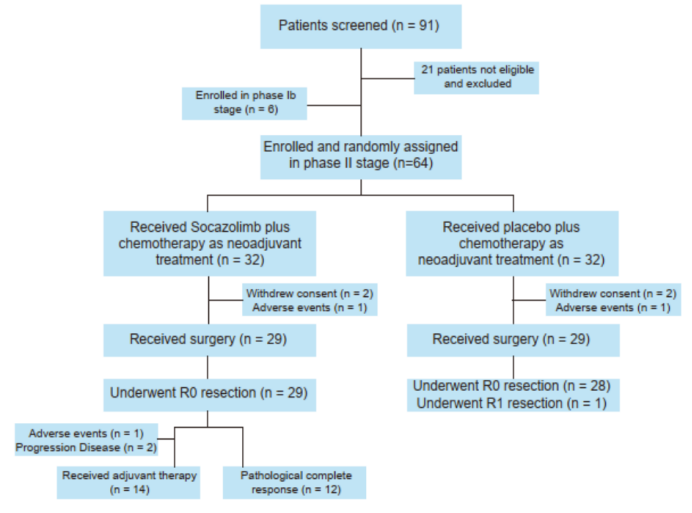
Figure 1. Study Flowchart(Source: ESMO 2022 Conference Poster)Results showed that in phase IB, no dose-limiting toxicities were observed in the first 6 patients. In phase II, 64 patients were assigned to the S group (n=32) and P group (n=32). The pathological response of patients in the S and P groups is shown in Figure 2.
-
As of January 5, 2022, 29 patients (90.6%) in both groups underwent surgery, with 29 patients (100%) in the S group and 28 patients (98.6%) in the P group undergoing R0 resection.
-
The MPR rates for the S and P groups were 68.97% and 62.07% (P=0.509), respectively, while the pCR rates were 41.4% and 27.6% (P=0.311).
-
The incidence of ypT0 observed in the S group was significantly higher (37.93% vs. 3.45%; P=0.001). The downstaging of T and N stages for patients in the S and P groups after neoadjuvant treatment is shown in Figure 3.
-
The data for EFS and OS are still immature.
-
The incidence of treatment-related adverse events (AEs) of grade 3 or higher was 65.5% and 62.5%, respectively. The most common AEs were neutropenia (59.4% vs. 56.3%), leukopenia (43.8% vs. 25.0%), and hypokalemia (18.8% vs. 0). Each group had 2 patients with severe surgical complications.
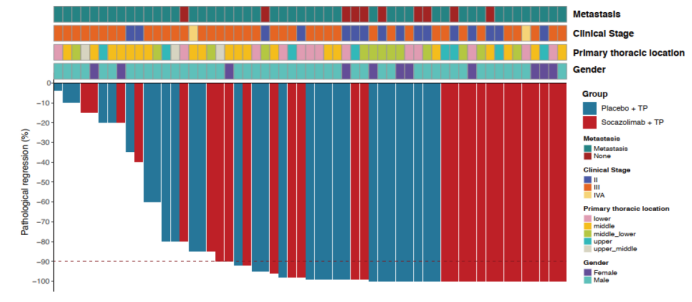
Figure 2. Comparison of Pathological Responses between Socazolimab+TP Group and Placebo+TP Group (TP: Albumin-bound Paclitaxel/Cisplatin)(Source: ESMO 2022 Conference Poster)
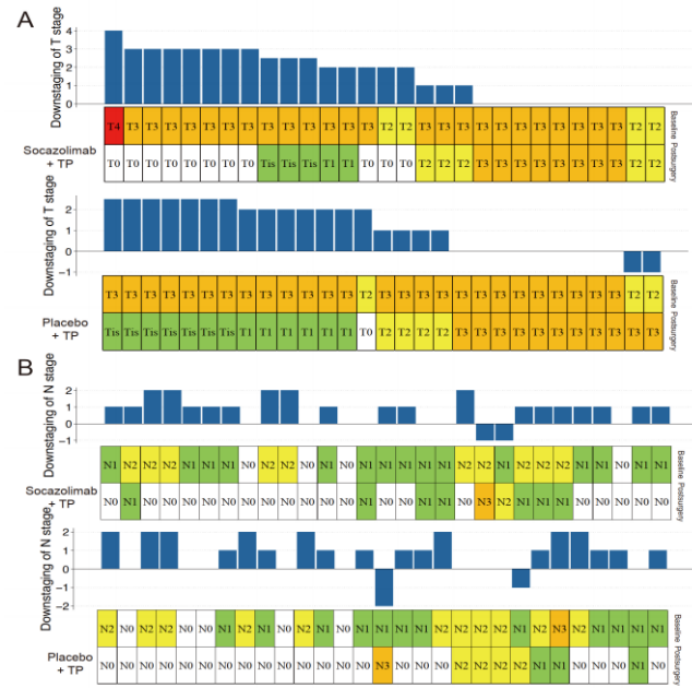
Figure 3. Downstaging of T (A) and N (B) Stages after Neoadjuvant Treatment in Socazolimab+TP Group and Placebo+TP Group (TP: Albumin-bound Paclitaxel/Cisplatin)
(Source: ESMO 2022 Conference Poster)The study concluded that although there were no statistical differences between the two groups, neoadjuvant Socazolimab combined with chemotherapy showed higher MPR and pCR rates in locally advanced ESCC without increasing perioperative complications. This strategy requires further validation in phase III trials.
Source
Yong Li, et al. Neoadjuvant PD-L1 inhibitor (socazolimab) plus chemotherapy in patients with locally advanced esophageal squamous cell carcinoma (ESCC): A multicenter, randomized, double-blind phase II study. Presented at: the European Society for Medical Oncology (ESMO) World Congress on Oesophagogastric cancer in Paris, 9-13 September 2022. Abstract 1207P.
END


“Tumor Outlook – Digestive News” reader exclusive WeChat group has been established, hurry and join. Scan the “Tumor Outlook – Digestive News” assistant QR code (WeChat ID: xhsx2021), reply “Tumor Outlook – Digestive News reader”, and you will be added to the group soon!

Source: Tumor Outlook – Digestive News
Copyright Statement
All original articles are copyrighted by “Tumor Outlook – Digestive News”. Personal forwarding and sharing are welcome. Any other media or websites wishing to reproduce or quote content owned by this website must prominently indicate that it is sourced from “Tumor Outlook – Digestive News”


Click to Share

Click to Save

Click to Like

Click to View