Over the past two decades, the sales scale of the Chinese home appliance market has achieved leapfrog growth. According to data from RUNTO Technology, the overall market sales increased from over 300 billion yuan in 2000 to over 800 billion yuan in 2024.
During this period, the market experienced several growth cycles, including the “Home Appliances Going to the Countryside” initiative from 2009 to 2013, and the green smart appliance subsidies launched through consumption vouchers in various regions in 2022-2023. Notably, the old-for-new policy for consumer goods implemented in September 2024 (national subsidy) has driven the home appliance industry from a low point at the beginning of the year to a rapid recovery, ultimately achieving a turnaround by the end of the year; and in the first half of 2025, a year-on-year growth of 11.3% was maintained, with total retail sales reaching 415.3 billion yuan.
White Goods Market: Scale Expansion, but Products Face the“Pseudo-Smart”Embarrassment
White goods are a pillar category in the home appliance industry. In the first half of 2025, the retail sales scale of three typical white goods products—air conditioners, refrigerators, and washing machines—were 114.2 billion, 60 billion, and 43.1 billion yuan respectively, accounting for nearly half of the home appliance market.
2020-2025Retail Sales Scale of Typical White Goods Products in China
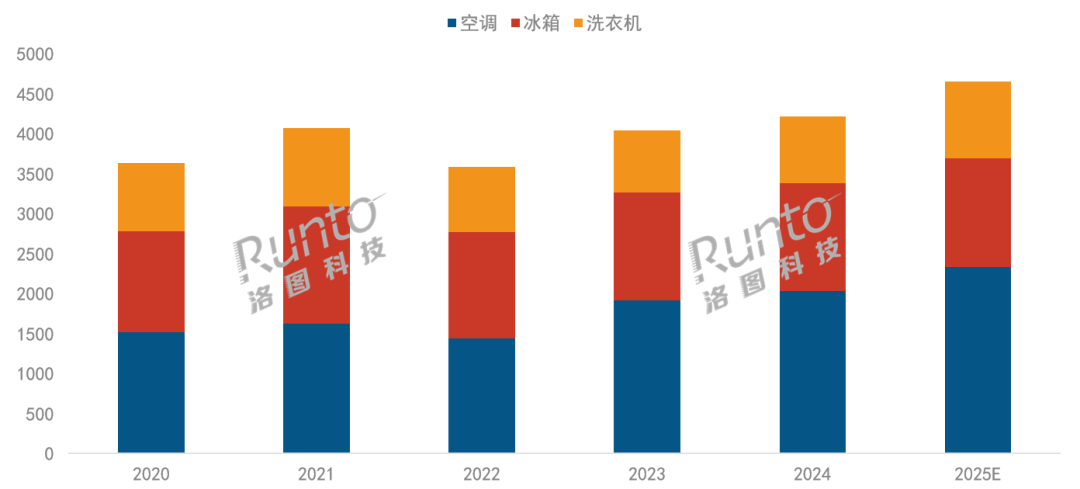
Data Source: RUNTO Technology, Unit: Billion Yuan
However, despite the continuous expansion of the market scale, the intelligence process of white goods has clearly lagged behind that of consumer electronics. According to monitoring data from RUNTO Technology, in 2024, the smart penetration rates in the Chinese air conditioning market were 69%, 35% for refrigerators, and 17% for washing machines; this level still shows a significant gap compared to the over 95% penetration rate of televisions.
Moreover, the level of intelligence in white goods is relatively low. Firstly, many functions are merely superficial, with many products only achieving basic connectivity and failing to realize deep AI applications. This sharply contrasts with the interactive ecosystems of smart TVs and the voice control of smart speakers, leading to a somewhat marginalized role for white goods in smart homes.
Secondly, the control logic of white goods often remains at the command level, such as fixed temperature settings or timed modes, lacking advanced dynamic perception and self-adjustment to the environment. This prevents devices from optimizing operations based on real-time changes (such as indoor humidity or user behavior), affecting overall efficiency and user experience.
Thirdly, inefficient control leads to high energy consumption. According to data from the National Energy Administration of China, in July and August 2025, domestic electricity consumption exceeded one trillion kilowatt-hours for two consecutive months, marking the first time globally. This was primarily due to the concentrated use of air conditioning and other white goods during high-temperature weather, but it also highlights the energy waste issues under traditional operating modes.
Finally, the fragmentation of user interaction and data isolation further exacerbates experience pain points. Different brands of white goods often cannot interconnect, with data such as temperature and humidity becoming isolated, requiring users to operate through multiple apps or remote controls, leading to sluggish responses. These pain points urgently need to be addressed through technologies like edge AI, achieving a shift from passive responses to proactive adjustments.
Edge AI + MCU: Edge Intelligence Reshapes the Core of White Goods
The reasons for the above phenomena are, on one hand, that white goods, as durable consumer products, have an average lifespan of 8-10 years, leading to low replacement frequency and a greater focus on functionality, which causes manufacturers to invest cautiously in intelligence and lack motivation for product iteration.
On the other hand, traditional MCUs, which play a core role in the control process of white goods, responsible for sensor data processing, motor control, and logical judgment, have limited computing power and cannot support complex AI algorithms, resulting in superficial intelligence.
The introduction of edge AI is changing this situation by moving computation to the device side, avoiding cloud delays, and enabling real-time decision-making.
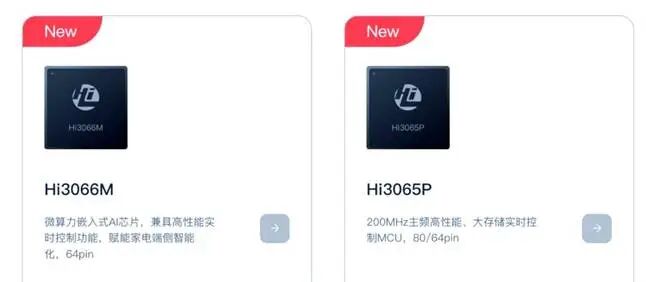
The eAI engine from Shanghai HiSilicon is a lightweight, embedded AI solution that has launched two embedded AI chips. The Hi3066M is a micro-power embedded AI MCU designed for the smart needs of home appliances, featuring an integrated eAI engine and supporting AI energy-saving for air conditioners, AI noise reduction and energy-saving for refrigerators, and AI weighing and imbalance detection for washing machines, while also providing larger storage space; the Hi3065P, as a high-performance real-time control MCU, is mainly used in industrial scenarios such as digital motor control and switch power management.
The air conditioning MCU is expected to achieve commercial use in leading brands in 2024, with an estimated shipment of over 1 million units in 2025; while in the refrigerator and washing machine markets, it is still in the verification stage.
In the air conditioning scenario, devices equipped with the Hi3066M + Hi3065P dual-chip solution can use the built-in eAI engine to collect real-time data on indoor and outdoor temperatures, compressor power, expansion valve opening, and more than 10 dimensions, combined with reinforcement learning models to achieve energy-saving effects. Experimental data shows that a 1.5-horsepower variable frequency air conditioner, after adopting the eAI solution, has reduced average energy consumption in summer by 15%-20%, with annual electricity savings of about 200 kWh per household. In fact, the new national standard for air conditioning energy efficiency, officially initiated by the National Standards Committee, will add dynamic energy efficiency verification, raising higher requirements for the accuracy and adaptability of air conditioning temperature control algorithms.
In the refrigerator scenario, the eAI engine establishes a collaborative control model for three temperature zones, achieving precise independent control of the refrigeration compartment, variable temperature compartment, and freezing compartment. Data shows that refrigerators using the eAI solution have improved temperature stability by 50% and achieved energy-saving effects exceeding 10%.
In the washing machine field, the eAI model accurately identifies clothing weight and imbalance load (OOB/DOOB) through PCA dimensionality reduction and lightweight neural networks, compressing weighing errors from ±100 grams to ±40 grams while reducing vibration noise.
In addition to energy savings, the advantages of HiSilicon’s embedded AI engine also lie in interaction and cross-device collaboration. In terms of interaction, the eAI engine provides a technical foundation for multimodal interaction, allowing natural interaction with devices through gestures, voice, and other means, combined with the precise positioning capabilities of star flash technology; in terms of collaboration, it is compatible with the HarmonyOS ecosystem, enabling more interconnectivity among home appliances.
Future Trends: AI + MCU Opens the All-Sensory Era and Cross-Domain Applications
Just as star flash technology redefined remote control interaction, edge AI + MCU is reshaping the technical foundation of the entire home appliance industry and will usher in the “all-sensory” era. From energy conservation and environmental protection to user experience, from product design to business models, this transformation driven by embedded AI has just begun.
With the advancement of the “dual carbon” goals and the continuous upgrading of consumption, white goods products with true intelligent capabilities will gain significant competitive advantages. RUNTO Technology predicts that by 2025, the global market size of embedded AI chips will exceed 20 billion US dollars. In this trend, AI + MCU not only addresses the current pain points of the white goods industry but also opens up new growth spaces.
Furthermore, the value of AI + MCU can also extend to other industries. In the digital power sector, HiSilicon’s MCU possesses both high-speed hardware loop control capabilities and powerful CPU cores, along with rich storage and peripheral resources, providing the flexibility of soft loops, which will also bring new driving forces to the industry.