The public security organs hereby remind that
units and individuals flying unmanned aerial vehicles,
should fly in accordance with the law,
and must not endanger public safety.
For illegal flying,
the public security organs will impose penalties in accordance with
the “Public Security Administration Punishment Law of the People’s Republic of China”
and the “Interim Regulations on the Flight Management of Unmanned Aerial Vehicles”
and other laws and regulations;
those who commit crimes will be held criminally liable according to law.
The “Interim Regulations on the Flight Management of Unmanned Aerial Vehicles” (State Order No. 761) issued by the State Council of the People’s Republic of China and the Central Military Commission of the People’s Republic of China will officially take effect on January 1, 2024.
01
Classification of Civil Unmanned Aerial Vehicles
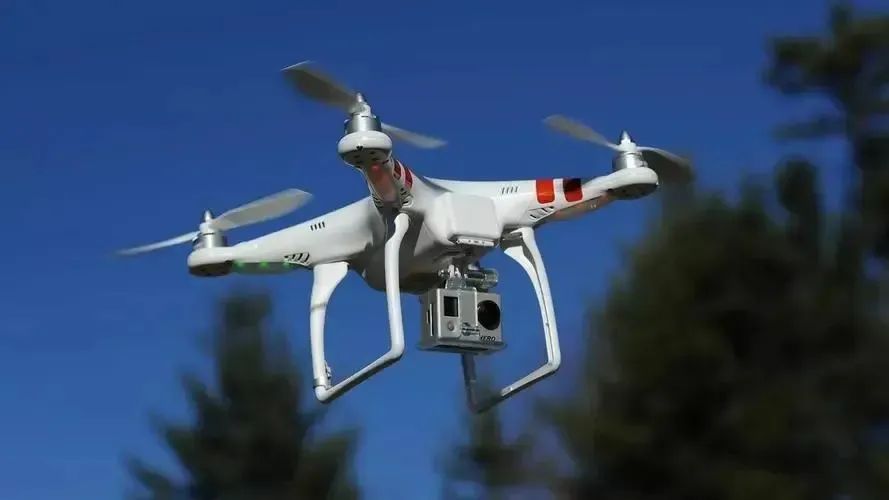
An unmanned aerial vehicle, commonly known as a drone, is defined as an aircraft without an onboard pilot and equipped with its own power system. It is classified based on performance indicators such as empty weight, takeoff weight, and flight speed into: micro, light, small, medium, and large.
1
Micro unmanned aerial vehicles refer to those with an empty weight of less than 0.25 kilograms, a maximum flight altitude not exceeding 50 meters, a maximum cruising speed not exceeding 40 kilometers/hour, radio transmission equipment that meets the requirements for low-power short-distance technology, and can be manually controlled at any time during the flight.
2
Light unmanned aerial vehicles refer to those with an empty weight not exceeding 4 kilograms and a maximum takeoff weight not exceeding 7 kilograms, a maximum cruising speed not exceeding 100 kilometers/hour, and the ability to maintain airspace in compliance with airspace management requirements, and can be manually controlled at any time during the flight, but do not include micro unmanned aerial vehicles.
3
Small unmanned aerial vehicles refer to those with an empty weight not exceeding 15 kilograms and a maximum takeoff weight not exceeding 25 kilograms, capable of maintaining airspace in compliance with airspace management requirements, and can be manually controlled at any time during the flight, but do not include micro and light unmanned aerial vehicles.
4
Medium unmanned aerial vehicles refer to those with a maximum takeoff weight not exceeding 150 kilograms, but do not include micro, light, and small unmanned aerial vehicles.
5
Large unmanned aerial vehicles refer to those with a maximum takeoff weight exceeding 150 kilograms.
02
Real-name Registration
According to the “Regulations”, regardless of type and weight, the owners of civil unmanned aerial vehicles must register their real names on the UOM platform as required. Those who violate the provisions of this “Regulation” and conduct flight activities without real-name registration of civil unmanned aerial vehicles will be ordered to correct by the public security organs and may be fined up to 200 yuan; for serious cases, fines ranging from 2000 yuan to 20,000 yuan may be imposed. The real-name registration process is as follows:
(1) Access the civil unmanned aerial vehicle comprehensive management platform (UOM) at: https://uas.caac.gov.cn
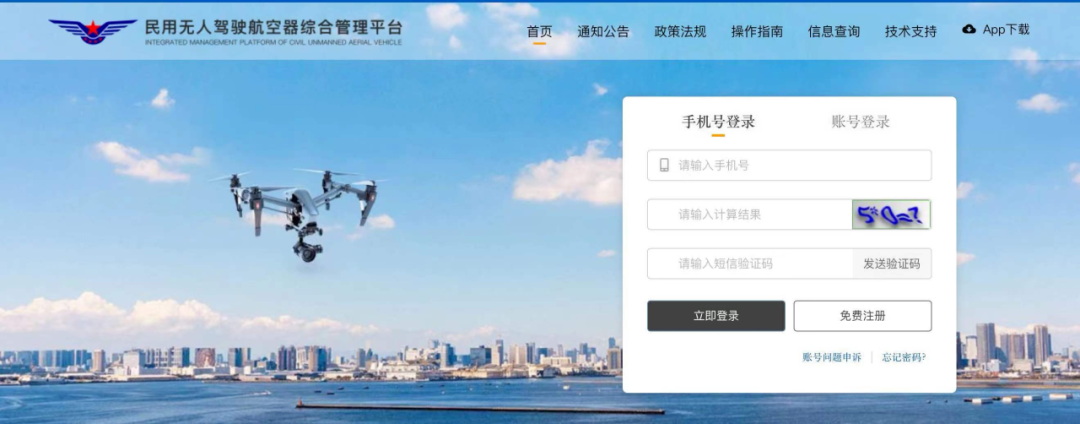
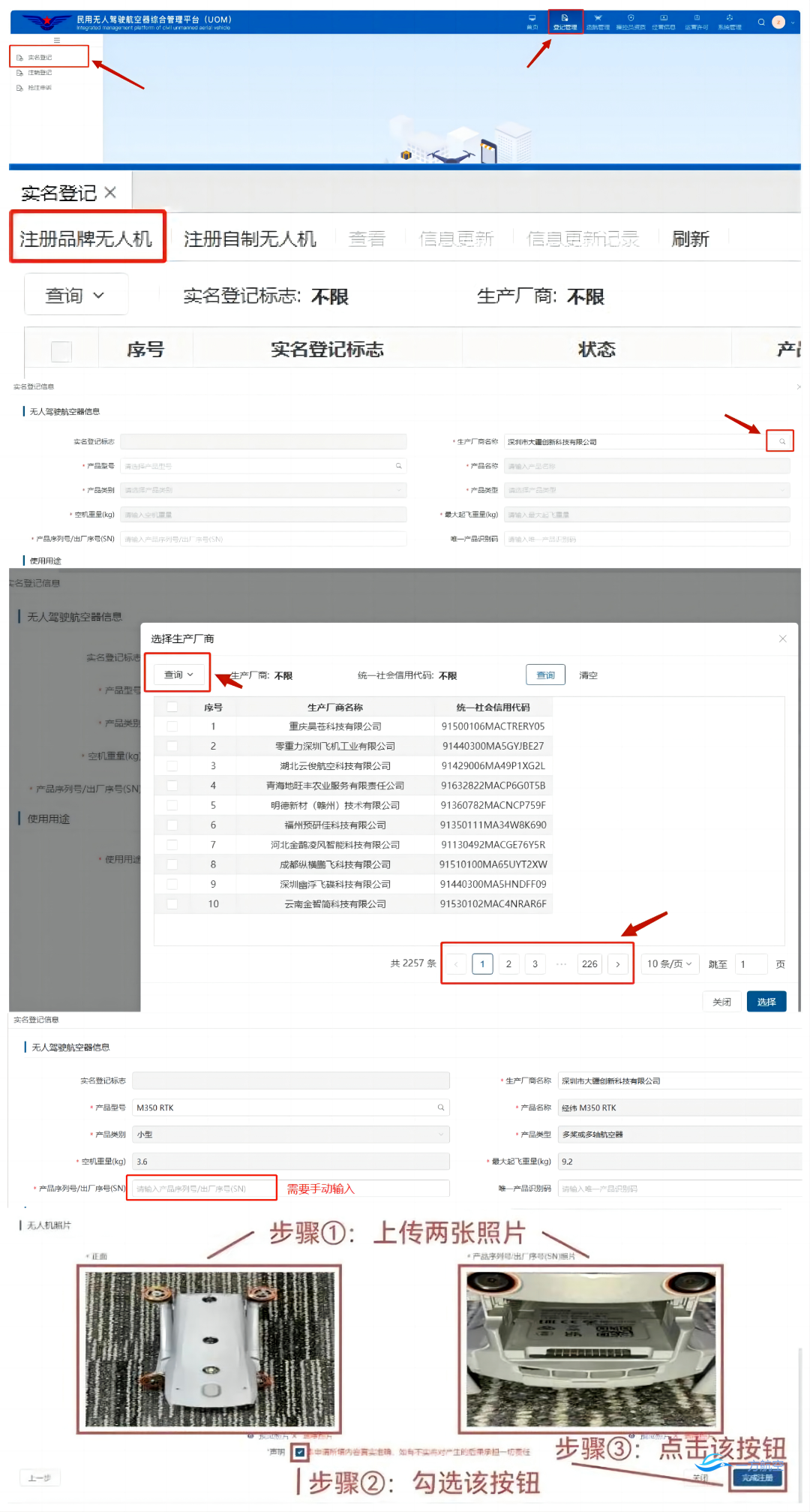
(2) Real-name register the drone. Log in to the homepage — click on the registration management in the upper right corner — real-name registration — register brand drones — verify owner information — scan face verification via mobile — select manufacturer name — select model and other relevant information (serial number must be manually entered) — upload photos as required — complete registration.
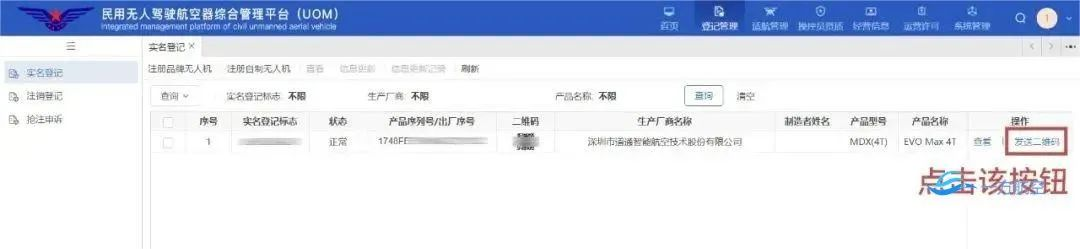
(3) After completing the registration, you can query the registered drones on the real-name registration page, click the “send QR code” button on the right, fill in the email, download the attachment and print it, and paste the QR code on the drone’s body.
03
Flight Declaration
Article 19 of the “Regulations” stipulates: airspace above a true height of 120 meters, airspace prohibited zones, airspace restricted areas and surrounding airspace, military aviation low-altitude flight airspace, airport and surrounding areas, military prohibited zones, important revolutionary memorial sites, etc. are designated as controlled airspace. If you need to fly within the controlled airspace, you must submit a flight application to the air traffic control agency of the corresponding flight control sector in advance and obtain permission before flying. Controlled airspace includes:
1
Airports and surrounding areas;
2
Areas on our side of the national border line, actual control line, and border line;
3
Military prohibited zones, military management areas, and surrounding areas of confidential units;
4
Protection areas for important military industrial facilities, nuclear facility control areas, production and storage areas for flammable and explosive hazardous materials, and large storage areas for combustible important materials;
5
Public infrastructure and surrounding areas such as power plants, substations, refueling (gas) stations, water supply plants, public transportation hubs, aviation electronic hubs, major water conservancy facilities, ports, highways, and electrified railway lines;
6
Facilities requiring special electromagnetic environment protection such as radio astronomy observatories, satellite measurement and control (navigation) stations, aviation radio navigation stations, and radar stations and surrounding areas;
7
Important revolutionary memorial sites, important immovable cultural relics, and surrounding areas;
8
Other areas specified by the national air traffic management leadership agency.
For micro, light, and small unmanned aerial vehicles, the “Regulations” have specially designated suitable flying airspace: True height below 120 meters (excluding controlled airspace) is suitable for flying, which can fly freely without submitting a flight activity application.
It should be noted that organizing micro, light, and small unmanned aerial vehicles to conduct flight activities in suitable flying airspace, if there are five situations such as conducting relay flights through communication base stations or the internet, carrying hazardous materials or dropping items (excluding routine agricultural unmanned aerial vehicle operations), flying over crowds, controlling unmanned aerial vehicles in moving traffic, and implementing distributed operations or swarms, a flight activity application should also be submitted.
Violating the provisions of the “Regulations” by operating micro, light, and small civil unmanned aerial vehicles in controlled airspace without approval, or operating model aircraft outside the airspace designated by the air traffic management agency will result in the public security organs ordering the cessation of flight and may impose a fine of up to 500 yuan; for serious cases, the unmanned aerial vehicle used in the illegal flight will be confiscated, and a fine ranging from 1000 yuan to 10,000 yuan may be imposed.
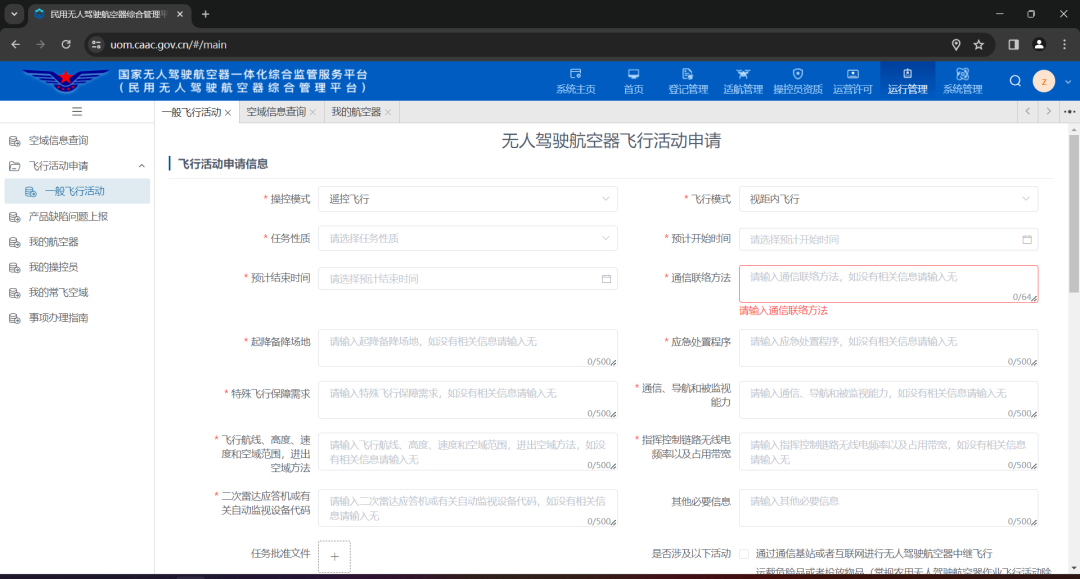
Flight declaration guidelines: The Civil Aviation Administration of China released an announcement on December 31, 2023, regarding matters related to the supervision and service of civil unmanned aerial vehicles, requiring units or individuals organizing unmanned aerial vehicle flight activities to submit a flight activity application through the civil unmanned aerial vehicle comprehensive management platform (UOM) at least 12 hours before the intended flight. Log in to the homepage — click on the upper right corner operation management — flight activity application — general flight activity.
04
Controlling Small, Medium, and Large Unmanned Aerial Vehicles
Requires Obtaining a License
According to Article 16 of the “Regulations”, personnel operating small, medium, and large civil unmanned aerial vehicles must meet the following conditions and apply to the civil aviation authority of the State Council for the corresponding unmanned aerial vehicle operator license (hereinafter referred to as the operator license):
1
Must have full civil capacity;
2
Must have undergone safety operation training and passed the assessment of the civil aviation management department;
3
Must not have a medical history of diseases that may affect the operation of civil unmanned aerial vehicles, nor any record of drug abuse;
4
Must not have been criminally punished for intentional crimes that jeopardize national security, public safety, or infringe on the personal rights of citizens, or disturb public order within the last five years.
Personnel engaged in routine agricultural unmanned aerial vehicle operations do not need to obtain an operator license, but must be trained and assessed by the agricultural unmanned aerial vehicle system manufacturer according to the requirements of the civil aviation and agricultural rural management departments of the State Council, and obtain an operating certificate upon passing.
Violating the provisions of the “Regulations” by operating civil unmanned aerial vehicles without an operator license will result in penalties imposed by the civil aviation management department according to law.
05
Attention for Minors Flying
Individuals without civil capacity can only operate micro civil unmanned aerial vehicles, while individuals with limited civil capacity can only operate micro and light civil unmanned aerial vehicles. Individuals without civil capacity operating micro civil unmanned aerial vehicles or individuals with limited civil capacity operating light civil unmanned aerial vehicles must be guided on-site by individuals with full civil capacity (who must meet the conditions for obtaining an operator license).
If individuals without civil capacity or individuals with limited civil capacity violate the provisions of the “Regulations” by operating civil unmanned aerial vehicles, the public security organs will impose fines on their guardians ranging from 500 to 5000 yuan; for serious cases, the unmanned aerial vehicles used in the illegal flight will be confiscated.
(Note: Minors over eight years old are considered individuals with limited civil capacity; minors under eight years old, individuals who cannot recognize their own actions, or minors over eight years old are considered individuals without civil capacity)
06
Attention for Foreign Drones and Personnel Flying
Violating the provisions of the “Regulations”, foreign unmanned aerial vehicles or unmanned aerial vehicles operated by foreign personnel conducting surveying and mapping flight activities within China will be ordered to cease illegal activities by the surveying and mapping geographic information authorities at the county level or above, and illegal gains, surveying and mapping results, and unmanned aerial vehicles used in illegal flights will be confiscated, with fines ranging from 100,000 to 500,000 yuan; for serious cases, fines ranging from 500,000 to 1,000,000 yuan may be imposed, and the public security organs and national security organs will decide on the time limit for exit or expulsion according to their responsibilities.
Note: Drones held locally in Zhuhai or conducting flight activities in Zhuhai must complete real-name registration on the “Civil Unmanned Aerial Vehicle Comprehensive Management Platform” while filling in the unmanned aerial vehicle and relevant owner information through the “Zhuhai Drone Information Collection QR Code”.


Editor: Qin Yingqi
Initial Review: Chen Yunhua, Guo Shiqi
Re-examination: Wang Biao
Source Material: Zhuhai Public Security