
1. Organization: In the first half of the year, global high-end smartphone market sales grew by 8%, with Apple, Samsung, and Huawei ranking in the top three.
2. Arm’s new Lumex CSS platform achieves double-digit performance improvements, driving consumer electronics to be “smarter, more efficient, and more personalized”.
3. With a total investment of 3.5 billion yuan, Aosheng Semiconductor’s 8-inch MEMS specialty chip IDM base project has commenced production.
4. Rockchip Technology empowers all-scenario AI audio applications.
5. Arm was invited to attend GMIF2025 to interpret the new storage architecture innovation for AI.
6. Over the past five years, China’s manufacturing industry has become more robust, with its added value accounting for nearly 30% of the global total.
7. Ankai Micro: By the end of last year, six engineering samples of tape-out chips had been returned.

1. Organization: In the first half of the year, global high-end smartphone market sales grew by 8%, with Apple, Samsung, and Huawei ranking in the top three.
Recently, market research firm Counterpoint Research reported that in the first half of 2025, global high-end smartphone market sales increased by 8% year-on-year, setting a historical high for the first half of the year. This growth rate far exceeds the overall smartphone market’s 4% year-on-year growth during the same period, with the high-end market contributing over 60% of global smartphone revenue. In terms of manufacturer rankings, Apple, Samsung, and Huawei are in the top three.
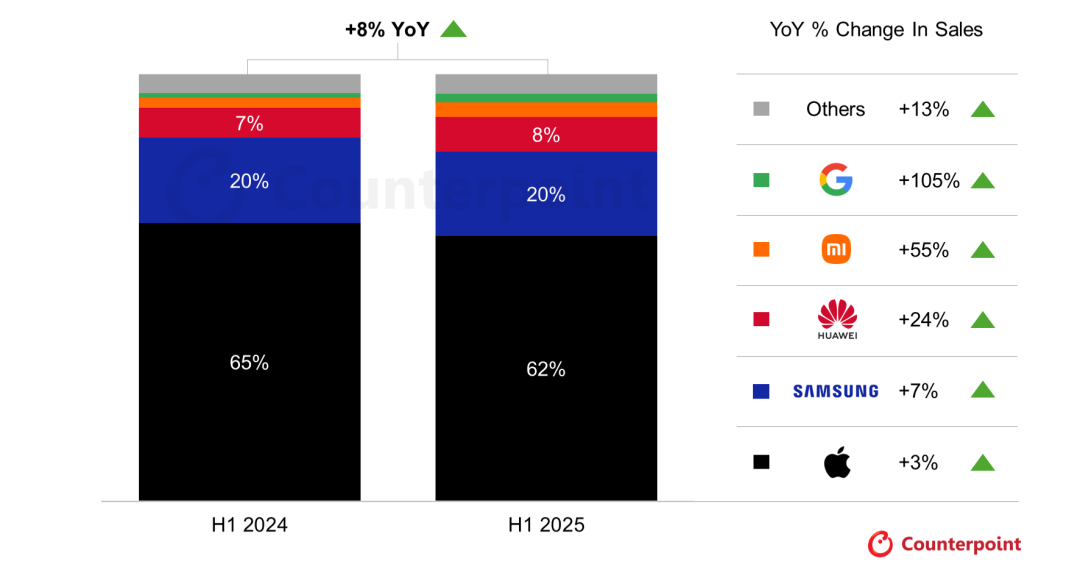
From the manufacturers’ performance, Apple remains the largest brand in the first half of the year, with a year-on-year growth of 3%, holding 62% of the high-end market share. However, as other OEM manufacturers grow faster, its share has declined. Apple has seen growth in emerging markets, but in the Chinese market, it has lost market share to Huawei and Xiaomi. Huawei remains a popular choice in the Chinese market due to its loyal user base and strong offline business. The brand is continuously reclaiming lost market share from Apple by launching uniquely designed devices (such as the foldable Mate XT) to enhance its market share.
From a national perspective, the top ten high-end markets contributed nearly 80% of sales in this segment, with India (growing by 37% year-on-year) being the fastest-growing market. India’s growth is attributed to Apple’s strong performance and convenient financing channels, which have expanded the potential market for high-end devices. However, in terms of absolute sales, China, the world’s largest high-end market, is the biggest contributor to growth.

2. Arm’s new Lumex CSS platform achieves double-digit performance improvements, driving consumer electronics to be “smarter, more efficient, and more personalized”.
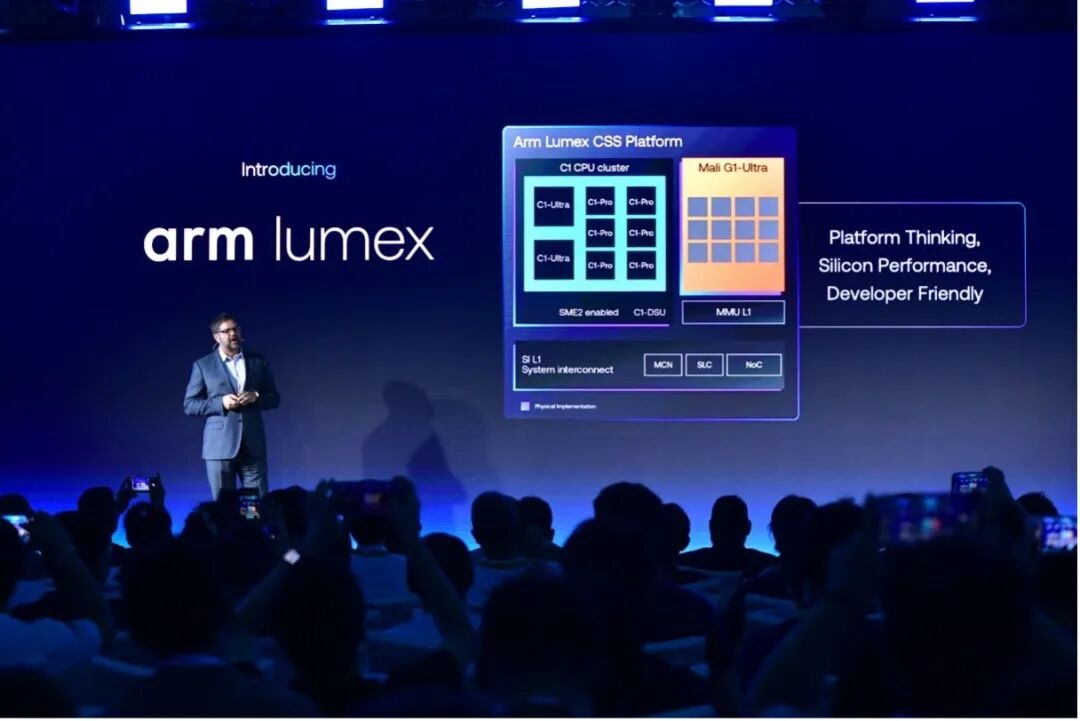
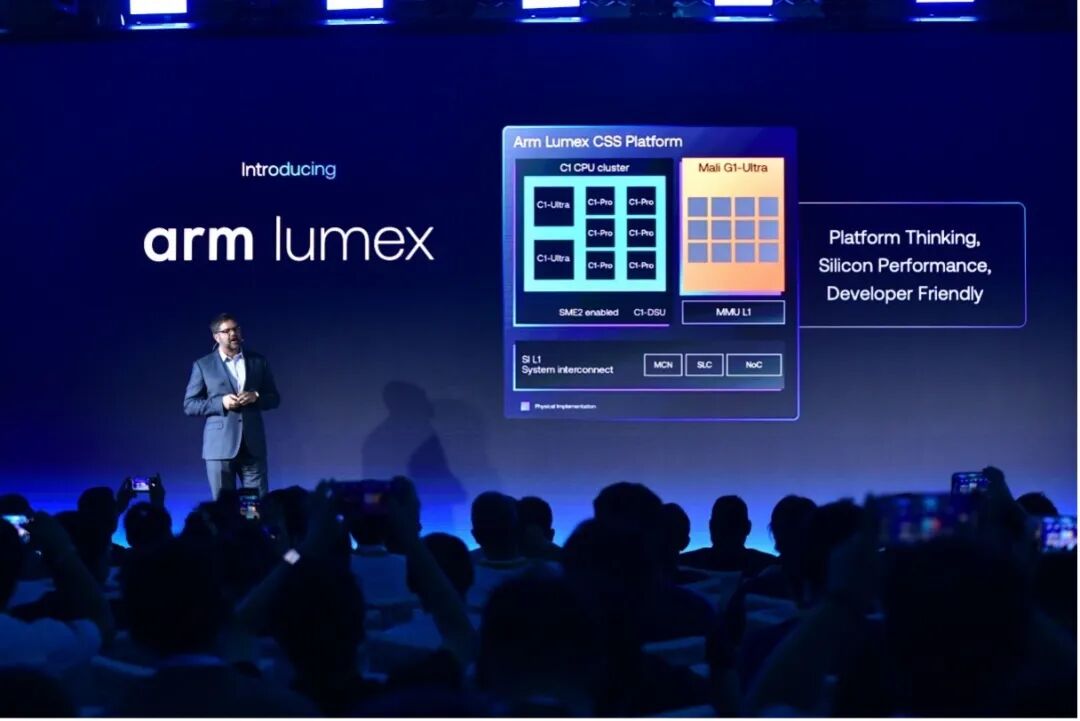
On September 10, Arm Holdings Limited (NASDAQ: ARM, hereinafter referred to as Arm) announced the launch of the new Arm® Lumex™ Compute Subsystem (CSS) platform, an advanced computing platform designed to accelerate AI (Artificial Intelligence) experiences for flagship smartphones and next-generation personal computers. The Lumex CSS platform integrates the highest performance Arm CPUs, GPUs, and system IP equipped with second-generation Scalable Matrix Extension (SME2) technology, enabling ecosystem partners to bring AI devices to market faster while supporting desktop-level mobile gaming, real-time translation, smart assistants, and personalized applications.
Chris Bergey, Arm’s Senior Vice President and General Manager of the Client Line of Business, stated: “AI is no longer just a technical feature; it has become the foundation for the next generation of mobile and consumer technology. With the Arm Lumex platform, we continuously enhance edge AI experiences to meet the growing demands and expectations of users. To this end, we are actively extending SME2 technology to every CPU platform. By 2030, SME and SME2 technologies are expected to add over 10 billion TOPS of computing power to more than 3 billion devices, bringing exponential leaps in edge AI performance.”
Partners can flexibly choose how to use Arm Lumex to create their system-on-chips (SoCs). For example, they can directly adopt the platform delivered by Arm and leverage advanced physical implementation solutions customized for their needs, thus gaining the dual advantages of shortened time-to-market and rapid performance realization; alternatively, partners can configure the platform’s register transfer level (RTL) design according to their target market and complete the hardening of core modules themselves.
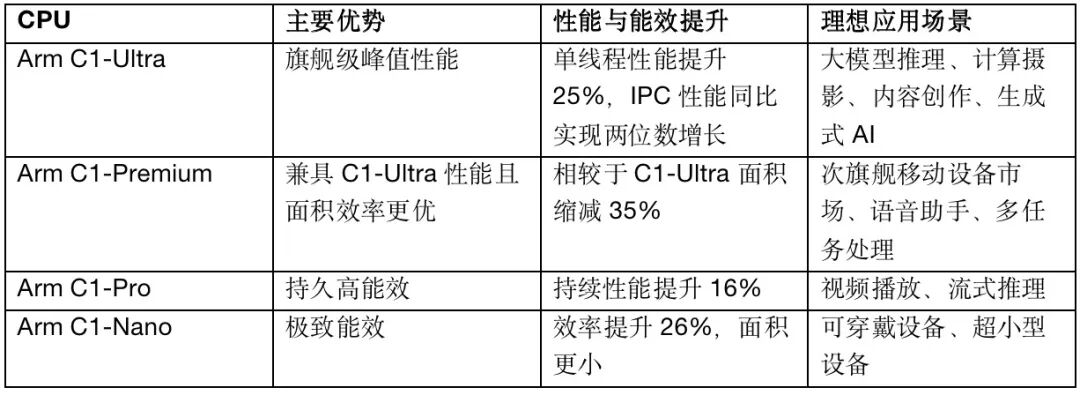
The new Arm Lumex platform includes the following core components:
-
Next-generation Armv9.3 CPU cluster equipped with SME2 technology: including Arm C1-Ultra and Arm C1-Pro, supporting flagship devices.
-
Arm C1-Premium: designed for the upper mid-range market, offering top-notch area efficiency.
-
Arm Mali™ G1-Ultra GPU: equipped with next-generation ray tracing technology, providing advanced graphics and gaming experiences while enhancing overall AI performance.
-
Arm C1-DSU: Arm’s most flexible, energy-efficient, and multi-power mode DynamIQ Shared Unit (DSU) to date.
-
Physical implementation optimized for the 3nm process node.
-
Deep integration across the software stack, providing developers using the KleidiAI software library with a seamless AI acceleration experience.
CPUs equipped with SME2 technology: enabling all-scenario AI acceleration.
The Arm C1 CPU cluster equipped with SME2 brings significant AI performance improvements for AI-driven tasks in real-world scenarios, including:
-
AI performance improvements of up to five times.
-
Voice workload latency reduced by 4.7 times.
-
Audio generation speed increased by 2.8 times.
The leap in AI computing capability of the new Arm CPUs makes real-time edge AI inference a reality, providing users with smoother and faster experiences in various interactive scenarios such as audio generation, computer vision, and contextual assistants.
In practical scenarios, SME2 technology elevates response speed and operational efficiency to a new level. For example, in the “Smart Yoga Coach” demonstration application, thanks to SME2 technology, the text-to-speech generation speed has increased by 2.4 times, meaning users can receive posture feedback and guidance instantly without worrying about battery life. Additionally, through a tripartite collaboration between Arm, Alipay, and Vivo, the interaction response time of large language models (LLMs) has been reduced by up to 40%, fully demonstrating that SME2 can provide terminal devices with a faster real-time generative AI experience.
The value of SME2 technology lies not only in speed improvements but also in unleashing AI-driven functionalities that traditional CPUs cannot achieve. For instance, running a neural camera denoising function on a single core equipped with SME2 can achieve frame rates exceeding 120 frames per second (fps) at 1080P resolution or 30 fps at 4K resolution. This allows smartphone users to capture sharper and clearer images even in the darkest environments, resulting in smoother operational interactions and richer user experiences on everyday devices.
Unlike cloud-first AI, which faces challenges such as latency, cost, and privacy issues, Lumex brings intelligence to the device side, enabling faster, safer, and always-available smart experiences locally. SME2 has already been widely adopted by leading ecosystem partners in the industry, including Alibaba, Alipay, Samsung System LSI, Tencent, and Vivo.
Empowering architectural freedom across product tiers.
Arm Lumex provides partners with ample freedom to achieve a flexible balance between peak performance, sustained energy efficiency, and chip area across various products, from high-end smartphones and PCs to emerging AI-first devices.
Mali GPU: Achieving desktop-level gaming experiences and faster AI inference.
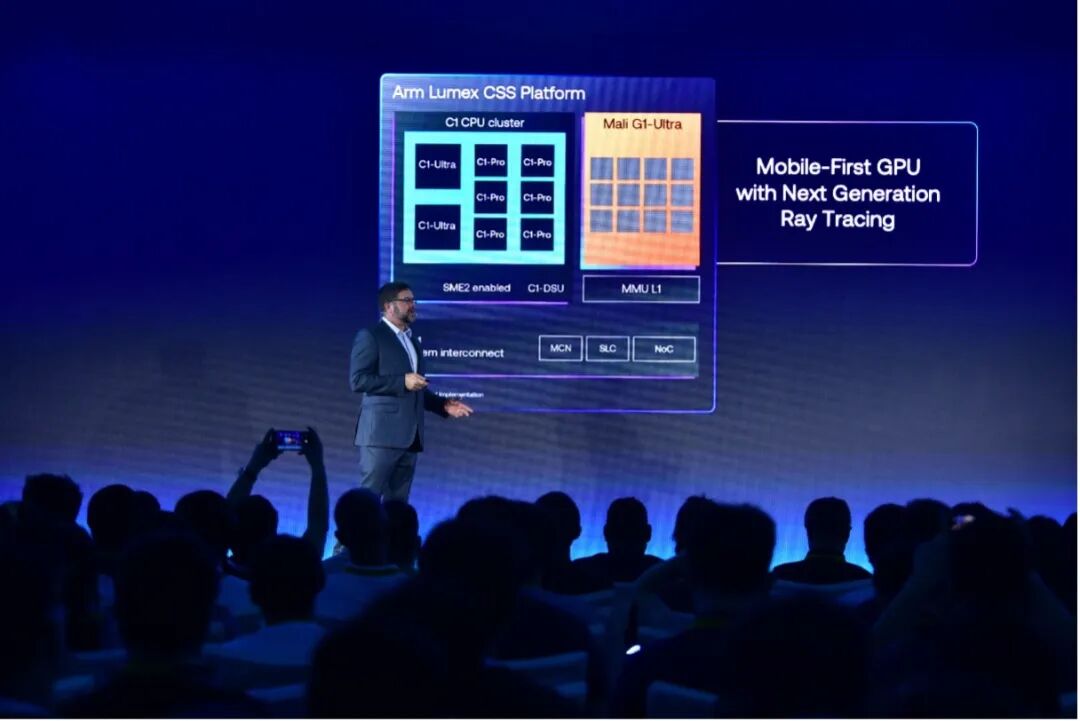
With the cumulative shipment of chips equipped with Arm GPUs exceeding 12 billion units, Arm continues to maintain a core position in the mobile gaming experience. The new Arm Mali G1-Ultra GPU further breaks through the performance boundaries of mobile gaming, providing mobile gamers with high-fidelity, console-level graphics. This breakthrough is attributed to the new second-generation ray tracing (Ray Tracing Unit v2, RTUv2) technology, which significantly enhances lighting, shadow, and reflection effects, doubling the ray tracing performance compared to the previous generation. In terms of AI workloads, Mali G1-Ultra can improve inference performance by up to 20%, significantly enhancing the responsiveness of various real-time applications.
In various graphics benchmark tests, Mali G1-Ultra achieved a 20% performance improvement over previous generation products, providing comprehensive performance enhancements for mainstream games such as “Escape from Tarkov: Infinite”, “Fortnite”, “Genshin Impact”, and “Honkai: Star Rail”. Meanwhile, Mali G1-Premium and Mali G1-Pro GPUs also offer better performance and energy efficiency for resource-constrained devices.
Developer-friendly edge AI solutions.
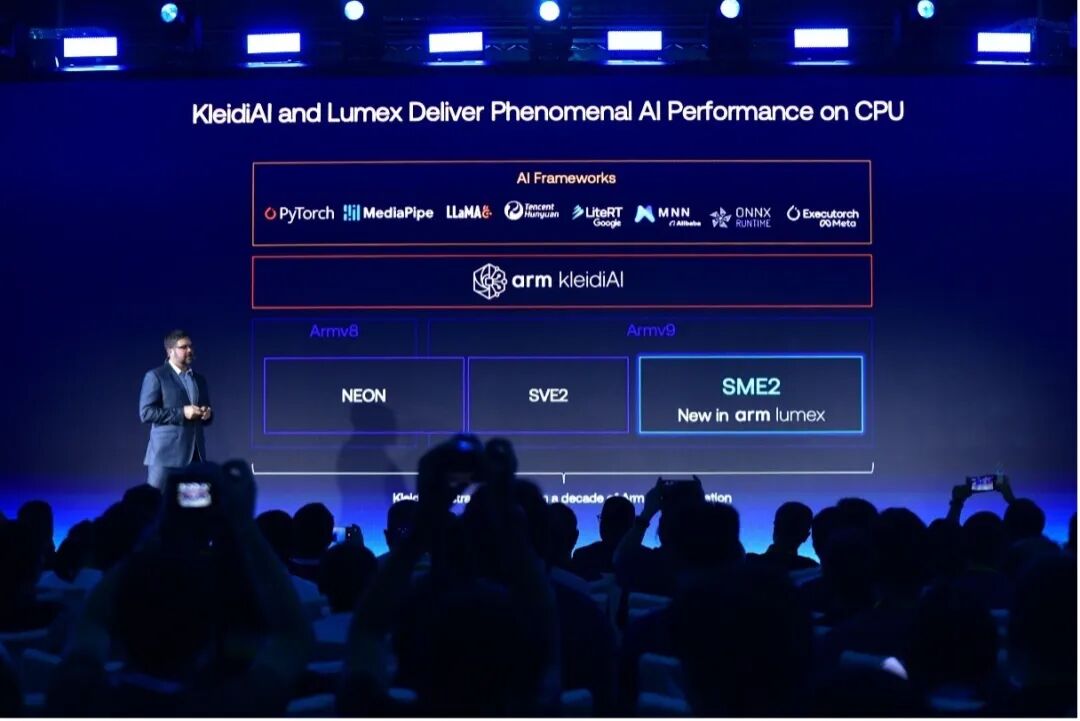
Developers can access an out-of-the-box AI development experience on the Arm Lumex platform. Through integration with KleidiAI and major mainstream frameworks, including PyTorch ExecuTorch, Google LiteRT, Alibaba MNN, and Microsoft ONNX Runtime, developers can automatically obtain SME2’s acceleration capabilities without modifying any code.
For developers needing to build cross-platform applications, Lumex brings new portability:
-
Google applications such as Gmail, YouTube, and Google Photos now fully support SME2, allowing devices equipped with Lumex to run seamlessly upon launch.
-
Cross-platform portability means that optimization features built for Android can seamlessly extend to Windows and other operating systems using Arm architecture.
-
Partners such as Alipay have successfully verified that, relying on SME2 technology, large language models (LLMs) can run efficiently on terminal devices.
Leading tech companies such as Apple, Samsung, and MediaTek are actively integrating AI acceleration capabilities to drive edge AI towards faster and more efficient directions. Among them, Apple is leveraging this capability to provide core support for “Apple Intelligence”; Samsung and MediaTek are enhancing the responsiveness and operational efficiency of real-time AI applications such as translation, summarization, and personal assistants through Google Gemini.
Arm Lumex: Platform-level intelligence for the AI era.
Arm Lumex is not only Arm’s most advanced CSS platform for the consumer computing market but also the cornerstone for unlocking a new era of intelligent AI experiences. Whether for OEM manufacturers or developers, Lumex can provide the necessary tools to help achieve personalized, privacy-protected, and high-performance AI experiences in key edge scenarios. As a platform designed for the AI era, Arm Lumex will become a new starting point for future mobile innovation.
Partner Testimonials:
Jiang Xiaotang, Head of MNN at Alibaba Taotian Group, stated: “Through deep integration with SME2, MNN can now provide low-latency quantization inference capabilities for large models with billions of parameters, such as Tongyi Qianwen, on smartphones. This achievement fully demonstrates the innovative strength of Arm and Alibaba in jointly promoting the development of next-generation scalable mobile AI technology.”
Weng Xindan, Head of Terminal Technology at Alipay, stated: “Through close collaboration between Arm, Alipay, and Vivo, Alipay has completed the verification of large language model inference based on Arm SME2 technology on Vivo’s new generation flagship smartphone. The results show performance improvements of over 40% and 25% during the prefill and decode stages, respectively. This marks a significant breakthrough in CPU backend capabilities. We are encouraged by the results achieved so far. We believe that with the continuous evolution of xNN and deep integration with SME2, Alipay is expected to further unleash the potential of AI in more scenarios, building a smarter, safer, and more personalized service ecosystem.”
Iliyan Malchev, Distinguished Software Engineer at Google Android Platform, stated: “Thanks to the enhanced hardware with SME2 technology, more advanced AI models like Gemma 3 can run directly on various devices. As SME2 continues to expand, mobile developers will be able to seamlessly deploy next-generation AI features across the entire ecosystem, ultimately allowing end users to enjoy low-latency AI experiences on their smartphones at any time.”
Sy Choudhury, Director of AI Partnerships at Meta, stated: “AI is reshaping how we interact with devices and the world around us, and the Arm ecosystem is driving key technological breakthroughs in this field. At Meta, we are excited about the integration of Arm Kleidi with the ExecuTorch tool under the PyTorch framework, which will allow our applications to run seamlessly on next-generation technology platforms, significantly accelerating the experience for end users.”
Nak Hee Seong, Vice President and Head of SOC IP Development Team at Samsung Electronics, stated: “At Samsung, we are pleased to continue our collaboration with Arm to develop the next-generation flagship mobile products based on the Arm Lumex CSS platform. This collaboration enables us to continuously push the boundaries of edge AI, delivering smarter, faster, and more efficient experiences for users.”
Yang Xiaofeng, Expert at Tencent Machine Learning Platform, stated: “SME2 technology effectively helps large language models land on mobile devices by breaking through key performance bottlenecks, such as Tencent’s mixed Yuan large model, providing strong acceleration for edge large language models and ultimately delivering a better user experience.”

3. With a total investment of 3.5 billion yuan, Aosheng Semiconductor’s 8-inch MEMS specialty chip IDM base project has commenced production.
According to the Chongqing High-tech Zone Media Center, on September 9, Aosheng Semiconductor’s 8-inch MEMS specialty chip IDM industrial base phase one project has commenced production, marking Chongqing’s first full industrial chain project for 8-inch MEMS specialty chips, indicating that Chongqing has the capability to produce sensors across all stages from chip R&D, design, manufacturing, packaging, testing, modules, calibration, to terminal applications.
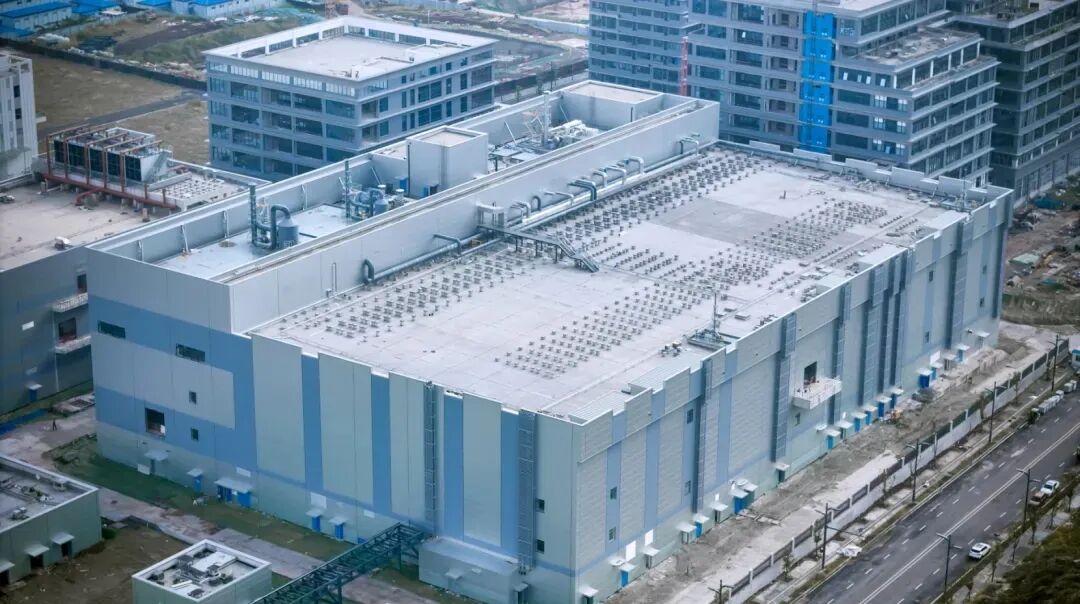
It is reported that the project is located in the Western (Chongqing) Science City, with a total planned investment of 3.5 billion yuan, including the construction of an 8-inch MEMS specialty sensor chip mass production line, an 8-inch MEMS specialty wafer rapid R&D line, an intelligent sensor innovation R&D center, a vehicle-grade sensor reliability testing center, an industry-university-research research center, and Aosheng Semiconductor’s R&D office building.
Aosheng Semiconductor’s project leader stated, “After the phase one project is put into production, it will form a capacity of 10,000 wafers per month, and the entire project is expected to reach full production by December 2026.”

4. Rockchip Technology empowers all-scenario AI audio applications.
Currently, the wave of artificial intelligence (AI) is surging, and smart devices are transitioning from “passive response” to “active perception”. AI is predicted to become a core hub connecting the physical and digital worlds and is expected to be one of the important infrastructures of the future. As a professional audio chip brand with a global vision, Rockchip Technology has been deeply engaged in the audio field for over twenty years, always standing at the forefront of technological evolution, actively embracing the AI era with profound technical accumulation and forward-looking strategic layout. Now, Rockchip Technology has achieved breakthroughs in the audio field with its comprehensively upgraded edge AI chip platform, pushing auditory experiences into a new era and serving as a cornerstone for massive application imaginations in the trillion-level AIoT market.
Deeply cultivating audio technology, twenty years in the making.
Audio technology is the core gene of Rockchip Technology and has been the core field of focus for over twenty years. From high-quality audio codec in the digital multimedia era to Bluetooth audio wireless interconnection in the IoT era, and now to edge AI audio intelligent interaction in the AI era, Rockchip Technology has always been committed to creating low-power, low-latency, high-quality smart wireless audio chip solutions. Throughout this journey, Rockchip Technology has accumulated a full-stack core technology covering high-performance audio ADC/DAC, low-latency wireless communication, low-power design, high-quality audio algorithms, AI acceleration engines, SoC design, and system integration, establishing a strong technical barrier in the field of smart wireless audio chips. This accumulation is not just a simple stacking of technical modules but a profound understanding and continuous optimization of the dynamic relationship between “human-sound-environment”.
However, with the rapid development of AI technology, traditional audio chip processing architectures are facing bottlenecks, struggling to meet the increasing demands for AI computing power and multi-scenario applications. Rockchip Technology deeply realizes that only by deeply integrating edge AI capabilities into the entire audio processing chain can we promote the AI transformation of audio from “chip” to “end” and align with the trend of the times.
Edge AI empowers all-scenario AI audio.
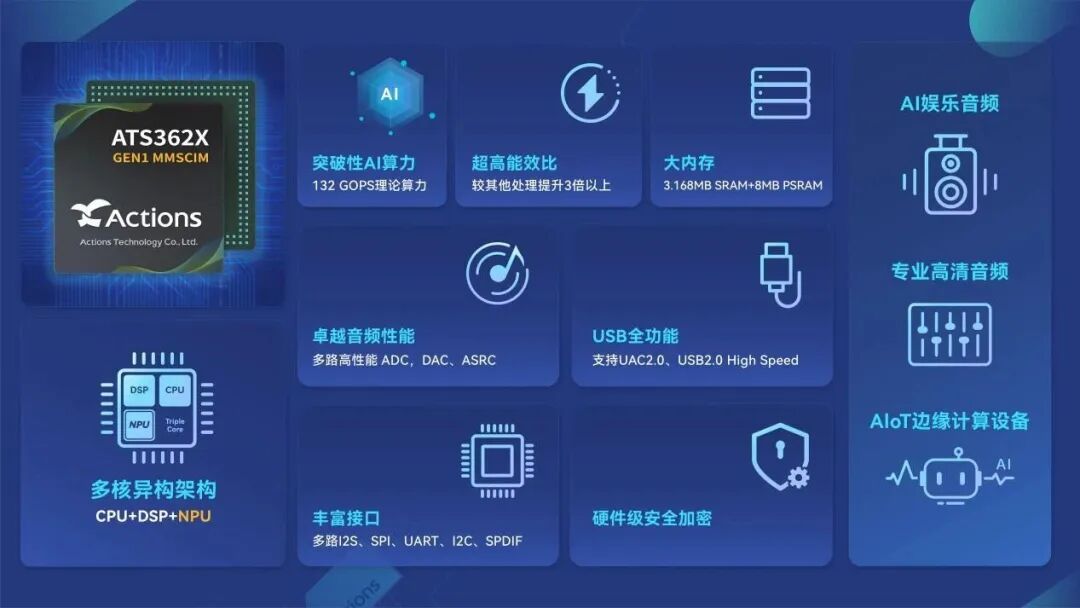
The edge AI audio chip platform launched by Rockchip Technology is a culmination of over twenty years of audio core technology accumulation, incorporating cutting-edge algorithms and AI computing power optimization results. Unlike solutions that merely connect to AI apps, rely on DSP acceleration instructions, or directly adopt third-party external NPU IP, Rockchip Technology’s edge AI series chips do not simply “hang” AI modules on top of the chip but are based on self-developed Computing-in-Memory (CIM) technology, re-engineering the architecture to build a tri-core heterogeneous architecture of CPU + DSP + NPU, achieving innovative deep integration of dedicated AI acceleration engines and DSP, thus creating a high energy efficiency computing platform. This combination brings multiple advantages:
First, it significantly reduces the transmission overhead of data between storage and computation, thereby greatly improving energy efficiency and computing power density;
Second, it achieves lower inference latency and higher real-time performance, meeting the edge inference needs of real-time perception and complex models;
Third, it ensures the autonomy and controllability of core algorithms and IP, facilitating customized development and long-term evolution.
In the context of accelerated AI transformation, Rockchip Technology’s proposed “Actions Intelligence Strategy” aims to integrate the core advantages of edge AI into the AIoT product system, with the first phase focusing on comprehensively reshaping the application boundaries of audio technology. This allows audio capabilities to break through the limitations of single devices, achieving seamless coverage and precise response of all-scenario audio applications, including “around people, around home (TV), and around office (computer)”. This evolution is not only a technical upgrade but also marks a fundamental leap in audio interaction from “function realization” to “scene adaptation”, providing key support for the landing of all-scenario AI audio.
Three major application scenarios.

Around people.

Around home (TV).

Around office (computer).
High computing power support, empowering multi-dimensional acoustic perception.
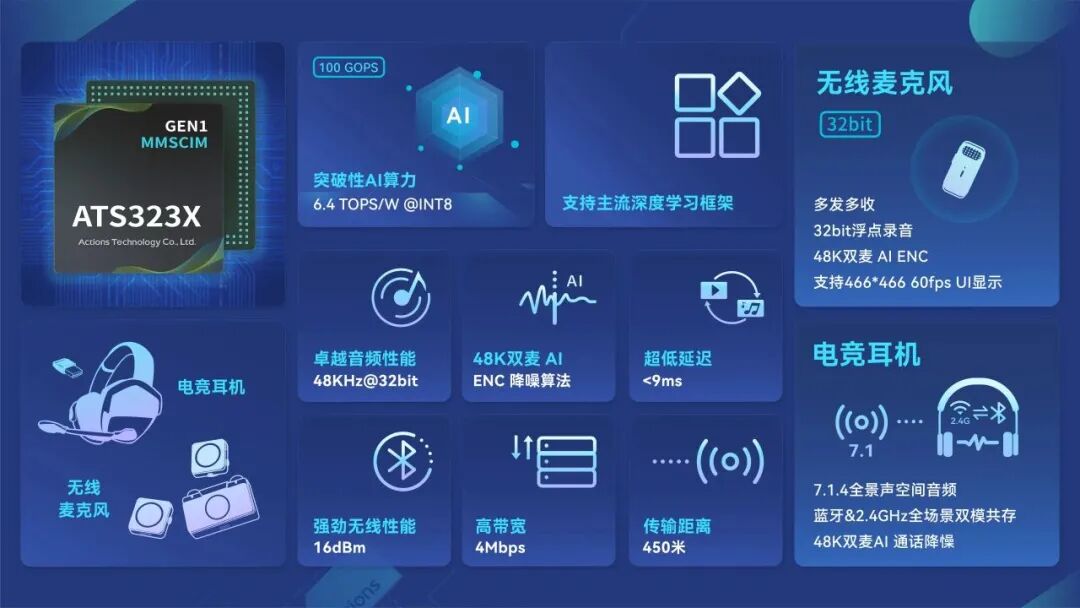
With powerful AI capabilities and advanced acoustic processing technology, Rockchip® edge AI audio chip ATS323X has successfully completed the commercial landing of flagship terminal products for brand customers, efficiently supporting high-performance AI noise reduction while ensuring high vocal fidelity, achieving outstanding multi-scenario AI adaptive noise reduction effects. It is widely applicable to various products such as professional wireless microphones, wireless gaming headsets, wireless call center headsets, multi-link high-definition conference systems, and wireless transceivers, providing a smooth and natural interactive experience for various devices.
Ultimate energy efficiency, creating a lasting battery experience.
Rockchip® edge AI audio chip ATS362X has been launched in brand customer audio products, deeply integrating the profound accumulation of low-power design with innovative edge AI technology. With an ultra-high energy efficiency ratio of 6.4 TOPS/W, it can support real-time inference of complex models such as voiceprint recognition and environmental sound classification on the edge. This feature allows audio devices to maintain ultra-long battery life while being equipped with powerful AI capabilities, easily meeting all-day usage needs and providing stable and reliable performance support for various battery-powered devices.
From the heights of audio, the infinite possibilities of Rockchip edge AI.
In the context of the continuous expansion of the audio market and product applications, AI is becoming the core driving force for upgrading audio processing, driving the application demands of billions in the audio market. Rockchip Technology is using audio as the first important fulcrum for the landing of edge AI technology, pushing its experience to new heights in all-scenario AI audio. This means that the value of the Rockchip edge AI platform extends far beyond the current mainstream product forms and is expanding into more imaginative audio applications.
Whether for smart hearing aids and wearable audio devices aimed at hearing health, real-time communication translation headsets across languages, or immersive spatial audio experiences in AR/VR/MR scenarios, the Rockchip edge AI platform can inject low-power yet efficient computing support. At the same time, in smart education and children’s companionship, in-vehicle voice interaction and smart cockpit, as well as emerging tools for creators such as podcasts and recorded broadcasts, the Rockchip platform also demonstrates strong landing potential. It can be said that from daily life to cutting-edge technology, from personal health to immersive entertainment, Rockchip is continuously expanding the broad boundaries of audio applications with its innovative capabilities in “all-scenario AI audio”.
With the accelerated popularization of AIoT devices, the intelligent world of interconnected things will give rise to massive, fragmented, and highly demanding edge AI applications in terms of real-time performance, privacy, and power consumption. Rockchip Technology will continue to forge a globally visionary professional audio chip brand, leveraging profound audio technology, advanced wireless communication technology, and innovative edge AI technology integration to gain deep insights into future trends, creating a highly integrated, high energy efficiency, and secure edge AI audio chip platform that precisely meets the demands of this era, building a truly all-scenario AI audio future.

5. Arm was invited to attend GMIF2025 to interpret the new storage architecture innovation for AI.
AI is sinking from data centers to edge devices, continuously empowering key areas such as scientific research, healthcare, and educational innovation, allowing intelligence to truly integrate into daily life. As computing power demands surge, storage, as the core carrier of data, directly determines the effectiveness of AI applications in terms of latency, capacity, durability, and cost.
To fully unleash the potential of edge AI, edge AI models are undergoing innovative upgrades through lightweight and specialization, while the development of edge devices is evolving towards integrating more suitable computing resources, relying on intelligent layering, near-storage computing, and other new architectures to significantly enhance bandwidth utilization and energy efficiency. Meanwhile, seamless integration of software optimization and system-level security has also become crucial. Clearly, single-dimensional technological breakthroughs can no longer meet the demands; only through system-level innovations that coordinate computing power, memory, storage media, and software design can we build an efficient, reliable, and sustainable edge AI ecosystem.
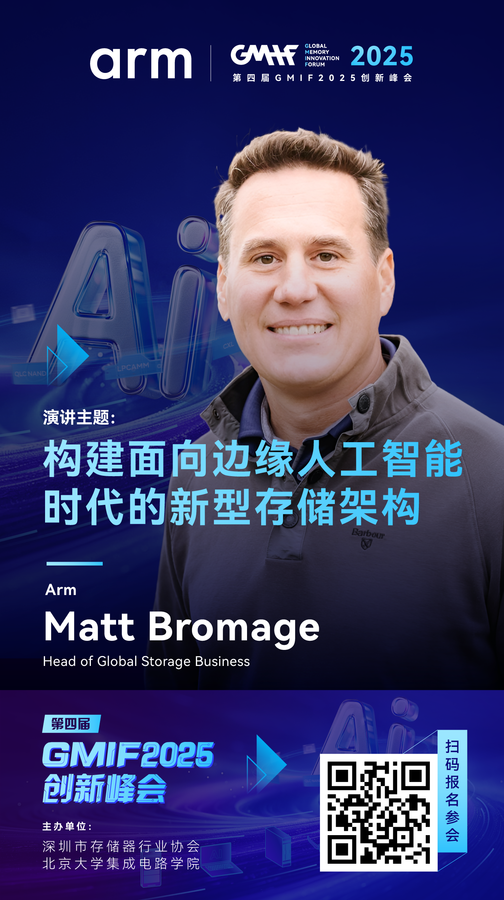
At the upcoming GMIF2025 Innovation Summit, Matt Bromage, Head of Global Storage Business at Arm, will deliver a keynote speech titled “Building a New Storage Architecture for the Era of Edge Artificial Intelligence”, deeply analyzing the core challenges and future paths of edge AI development, sharing how Arm can explore the potential of memory and storage technologies through dedicated models, intelligent layering, and secure and efficient edge-side architectures to drive a new wave of AI.
Summit registration link
Speaker introduction:
Matt Bromage, Head of Global Storage Business, Arm
Matt Bromage is the Head of Global Storage Business at Arm, leading the planning and development strategy and product direction for storage applications, and promoting ecosystem collaboration with controller manufacturers, OEMs, and chip suppliers. Currently, the annual shipment of storage devices based on Arm technology exceeds 4 billion units and is widely used in consumer, client, and enterprise markets. Matt has held leadership positions in product departments at companies such as Samsung, SandForce, PNY, Pliops, Seagate, and Western Digital, possessing deep industry insights in the storage stack field.
About Arm
Arm is the industry’s most powerful and energy-efficient computing platform, covering 100% of the connected population globally at an unparalleled scale. Arm provides advanced solutions to meet the endless demand for computing, empowering leading technology companies worldwide to unleash unprecedented AI experiences and performance. Arm collaborates with the world’s broadest computing ecosystem and 22 million software developers to build the future of AI on the Arm platform.
About GMIF
GMIF is the most important annual event of the Shenzhen Memory Industry Association (SMIA), aimed at building an international and professional communication platform for the global memory industry to discuss new technologies, new applications, new collaborations, and new opportunities.The fourth GMIF2025 Innovation Summit will be held on September 24-25, 2025, at the Renaissance Hotel in Shenzhen Bay, with the theme “AI Applications, Innovation Empowerment”, dedicated to building a bridge for communication and cooperation between the upstream and downstream of the storage industry chain, strengthening collaboration and complementary development among industry partners, connecting supply and demand interfaces, and constructing a safe, efficient, and globally competitive innovative ecosystem.

6. Over the past five years, China’s manufacturing industry has become more robust, with its added value accounting for nearly 30% of the global total.
Among the 504 major industrial products globally, most of China’s products rank first in output, with 64 manufacturing enterprises selected for the Fortune Global 500 in 2024, and the industrialization rate of enterprise invention patents has increased by 8.4 percentage points compared to the end of the 13th Five-Year Plan… On September 9, the State Council Information Office held a press conference where Minister of Industry and Information Technology Li Lecheng and others introduced the “14th Five-Year Plan” period’s achievements in China’s industrial and information technology development.
The overall scale of manufacturing has maintained the world’s first position for 15 consecutive years.
Manufacturing is the foundation of a nation and the basis for a strong country. Over the past five years, China’s “national foundation” has become stronger, and its “family assets” have become thicker. Li Lecheng introduced that currently, China’s manufacturing added value accounts for nearly 30% of the global total, and its overall scale has maintained the world’s first position for 15 consecutive years.
Advanced manufacturing is accelerating its growth. The production of new energy vehicles is expected to exceed 13 million units in 2024, maintaining the world’s first position in production and sales for ten consecutive years; the shipbuilding industry continues to lead the international market share. The industry’s “green” content continues to improve, with 6,430 national-level green factories, and energy consumption per unit of added value in industrial enterprises above designated size continues to decrease.
Innovation momentum is more vigorous. Over the past five years, China’s innovation investment has steadily increased, with R&D expenditure of manufacturing enterprises above designated size accounting for over 1.6% of operating income, and more than 570 industrial enterprises entering the global top 2500 in R&D investment. The “Chang’e” lunar lander, “Tianhe” space station, and “Beidou” satellite network have all achieved significant milestones, and the CR450 trainset prototype has successfully rolled off the production line, filling domestic gaps in the field of extracorporeal membrane oxygenation (ECMO).
Real numbers are merging to expand efficiency. Over the past five years, China has built the world’s largest and most extensive network infrastructure, with 4.598 million 5G base stations, and the number of connected devices on key industrial internet platforms exceeding 100 million units. In the production field, there are over 20,000 national “5G + industrial internet” construction projects; in the consumer field, new information consumption products and models such as e-commerce live streaming, immersive shopping, and digital cultural tourism are thriving; in the public service field, all primary and secondary schools nationwide have achieved 100% internet access rate,” said Zhang Yunming, Vice Minister of Industry and Information Technology.
Large, medium, and small enterprises are developing together. As of July this year, the number of industrial enterprises above designated size has increased by 138,000 compared to the end of 2020. The quality and efficiency of small and medium-sized enterprises have significantly improved, with over 60 million registered small and medium-sized enterprises nationwide, and the number of high-tech enterprises within their valid period reaching 504,000. More than 140,000 specialized and innovative small and medium-sized enterprises have been cultivated, with 14,600 “little giant” enterprises and 1,557 manufacturing single champions.
There are now 33 national-level manufacturing innovation centers.
“In recent years, we have strengthened supply, built platforms, enhanced main bodies, and promoted transformation, significantly improving the technological innovation capabilities of the industry and effectively driving industrial leapfrogging and upgrading,” Li Lecheng said.
The subject position of enterprise technological innovation has achieved a “new leap”. In terms of investment, policies such as the additional deduction of R&D expenses have been implemented to encourage enterprises to increase R&D investment, with enterprise R&D expenditure accounting for over three-quarters of the total R&D expenditure in society. In terms of output, the number of invention patent applications by industrial enterprises has increased from 907,000 at the end of the 13th Five-Year Plan to 1.244 million in 2024, with the proportion of invention patent applications in the total number of applications rising from 60% to 65% in that year.
The construction of high-energy innovation and service platforms has formed a “new pattern”. “During the 14th Five-Year Plan period, 16 new national-level manufacturing innovation centers have been laid out, bringing the total to 33, breaking through nearly 700 key common technologies and addressing the bottleneck from basic research to industrial application. A total of 187 key laboratories of the Ministry of Industry and Information Technology have been recognized, and the first batch of 241 key pilot platforms of the Ministry of Industry and Information Technology have been selected, bridging the gap from “laboratory” to “production line” for products.
The development of national high-tech zones has made new strides in producing new quality productivity. In 2024, 178 national high-tech zones achieved a total production value of 19.3 trillion yuan, accounting for 14.3% of the national GDP; the labor productivity per capita reached 718,000 yuan, doubling compared to the end of the 13th Five-Year Plan. During the 14th Five-Year Plan period, the world’s first superconducting quantum computer and the world’s first general-purpose artificial intelligence system prototype were born in national high-tech zones.
Major technical equipment is an important support for industrial upgrading. During the 14th Five-Year Plan period, the C919 large passenger aircraft has safely transported over 3 million passengers, the Long March 7 Yao 10 rocket completed the delivery of supplies to the Tianzhou 9 spacecraft in just 3 hours, and the “Deep Earth Tower 1 Well” successfully completed drilling at a depth of 10,910 meters… “We will accelerate the construction of a supply-demand matching, high-quality, efficient major technical equipment system, promoting the high-end, intelligent, green, and international development of major technical equipment,” said Xin Guobin, Vice Minister of Industry and Information Technology.
Industrial robots account for over 50% of new installations globally.
“Since the 14th Five-Year Plan, we have strengthened policy guidance and element guarantees, promoting the transformation and upgrading of traditional industries, the cultivation and expansion of emerging industries, and the forward-looking layout of future industries,” Li Lecheng said.
Traditional industries are accelerating their “renewal”. “Traditional industries are the main body of China’s manufacturing industry, accounting for about 80% of the main indicators such as added value and number of employees in the entire manufacturing industry,” Li Lecheng stated. “Since the 14th Five-Year Plan, the Ministry of Industry and Information Technology has supported 46 cities to carry out pilot projects for new technology transformation, resulting in the establishment of over 230 excellent smart factories and 1,260 5G factories, with the new installation of industrial robots accounting for over 50% of the global total. The comprehensive energy consumption per unit of products such as steel and cement clinker has reached the world’s advanced level.
Emerging industries are accelerating their “lead”. A number of internationally competitive advantageous industries such as new energy vehicles, photovoltaics, lithium batteries, and marine engineering equipment are being cultivated and expanded, with a large number of new business models and new formats such as flexible customization, shared manufacturing, smart logistics, and intelligent security emerging rapidly. In 2024, the production and sales of new energy vehicles in China are expected to be about 9.5 times that of 2020, with the production of photovoltaic and wind power equipment ranking among the world’s top.
Future industries are strengthening their “roots”. Superconducting quantum computers and optical quantum computers have achieved verification of quantum superiority, laser manufacturing technology has entered the international first echelon, humanoid robots have the manufacturing capabilities of the entire industry chain from key chips and components to complete machines, brain-computer interface applications are expanding from the medical field to education, industry, and other fields, and biological manufacturing technology is widely applied in industries such as healthcare, daily chemicals, and green energy.
Li Lecheng stated that the Ministry of Industry and Information Technology will accelerate the construction of a modern industrial system with advanced manufacturing as the backbone, deeply promote industrial technology transformation and equipment updates, implement actions to create new momentum, adhere to high-level opening up, and promote industrial upgrading towards “new” layouts and steady development.
Journalist’s Note
Since the 14th Five-Year Plan, China’s manufacturing added value has exceeded 30 trillion yuan annually, maintaining the world’s first position in overall scale. This heavy achievement report confirms the new progress and results in promoting new industrialization.
Stabilizing growth, adjusting structure, promoting transformation, and solidly advancing. On one hand, the added value has achieved growth, and the industrial economy’s “ballast stone” role is increasingly prominent, making people feel “steady and assured”. On the other hand, during the 14th Five-Year Plan period, the incremental added value of manufacturing is expected to exceed 800 billion yuan. Such a large “incremental added value” means that our industrial structure is upgrading towards high technology and high added value, creating more new value, which will continuously provide ample momentum for economic development.
New technologies, new business formats, and new industries are thriving. The CR450 trainset will achieve an operating speed of 400 kilometers per hour; from 2020 to 2024, the market scale of new energy vehicles has tripled; domestic large models such as DeepSeek and Tongyi Qianwen are leading the global open-source innovation ecosystem… Key areas of China’s industrial technology innovation have entered a new stage of “catching up” accelerating, “running together” increasing, and “leading” emerging, with fewer things that cannot be made and better things that can be made, creating a fertile ground for cultivating new quality productivity, and more “countable” and “recognizable” innovative achievements are expected in the future.
Currently, the external environment is complex and changeable, but China’s industrial foundation is stable, its industrial resilience is strong, and its development potential is great, with a solid foundation, ample momentum, and rock-solid confidence. We will surely gather strong forces to promote new industrialization together.
7. Ankai Micro: By the end of last year, six engineering samples of tape-out chips had been returned.

On September 10, Ankai Micro stated in its investor relations activity record that the current order situation is still relatively normal. Since November of last year, six engineering samples of tape-out chips that have been successively trial-produced have been returned. New products using these new chips have begun to enter the trial production stage, and it is expected to help boost sales from the fourth quarter.
According to reports, in the first half of the year, Ankai Micro had three new IoT camera chip engineering samples, KM01A, KM01W, and AK3918AV130 series, which have returned and entered the trial production stage. The variety of IoT camera chip models is gradually increasing, and application scenarios are continuously expanding.
Among them, the low-power smart vision chips KM01A and KM01W support AOV technology, with overall power consumption under 30mW (1 frame per second) in AOV mode, addressing battery life pain points; the maximum image resolution for photos reaches 12MP; multi-lens zoom products can achieve up to 16x digital zoom; they can connect to four CIS, and the multi-channel synchronization mechanism enhances the coordination of multi-camera systems. KM01A adopts QFN88, 9x9mm packaging, targeting low-power AOV cameras, 4G solar-powered low-power IoT ball cameras, battery-powered IoT cameras, peephole locks, and visual doorbells; KM01W integrates Wi-Fi/BLE, providing targeted visual solutions for AI glasses. From smart security to smart wearables, it provides a development platform and complete solutions with “chip-level low power + high-definition quality”, which is expected to contribute to performance in 2025.
Ankai Micro also stated that the shipment volume of its computing power chips is increasing, and the main line of future chip product development is to develop high-performance NPU for large model applications, empowering more intelligent terminals.
Financial reports show that in the first half of the year, Ankai Micro achieved operating revenue of 234.3071 million yuan, a year-on-year decrease of 3.02%; the net profit attributable to shareholders of the listed company was -49.2507 million yuan, a year-on-year decrease of 43.3936 million yuan; the net profit after deducting non-recurring gains and losses was -49.3277 million yuan, a year-on-year decrease of 38.7312 million yuan.
Hot Topics:
1.U.S. agencies initiate the revocation of qualifications for seven Chinese testing laboratories;
2.Tech giants lay off in China! Affected departments in Shanghai and Xiamen.
3.Launching with tens of millions! Another semiconductor giant enters Apple’s wearables.
4.China invests hundreds of billions to accelerate the localization of chip equipment!
5.Qualcomm CEO bluntly states “Intel is not an option”!
6.Latest progress of two domestic GPU chips exposed!
7.Heavyweight! The U.S. revokes TSMC’s equipment exemption for the Nanjing plant.
8.A company that stopped at Series C financing ultimately faces bankruptcy review.


Share

Like

Watching