The storage industry continues to thrive with the increasing demand for computing power. GigaDevice, as a flagship in the domestic storage sector, continues to strengthen its product strength moat.
GigaDevice Semiconductor (hereinafter referred to as “GigaDevice”) is a leading semiconductor design company in China, focusing on the research and development and sales of core products such as memory, microcontrollers (MCUs), and sensors.
1. Company Industry Position and Strategic Positioning
1.1 Leading Position in Storage and MCU Dual Main Businesses
Since its establishment, GigaDevice has consistently focused on the development of its two core businesses: storage and MCUs.
The company initially centered on NOR Flash as its core product and gradually expanded into multiple segments such as MCUs and SRAM, forming a relatively complete product matrix for storage and microcontrollers. In recent years, with continuous investment in the 32-bit MCU field, GigaDevice has established a leading position in the domestic market, especially in the automotive-grade MCU sector. The company is actively positioning itself through collaborations with several vehicle manufacturers and Tier 1 suppliers to promote the application of its products in automotive electronic control systems.
NOR Flash Market: GigaDevice’s market share in the global NOR Flash market continues to rise, becoming one of the major players globally. According to the latest data, GigaDevice’s global market share in the NOR Flash sector has entered the forefront and shows a steady growth trend. This achievement is attributed to the company’s technological accumulation in memory chip design and manufacturing, as well as its rapid response capability to market demand changes.
MCU Market: GigaDevice has become one of the leading MCU suppliers in China, thanks to its high-performance and low-power product characteristics. Especially in the automotive-grade MCU field, the company has accelerated product development and customer onboarding to meet the urgent demand for domestic alternatives and supply chain autonomy in the automotive industry.
1.2 Product Matrix and Technology Roadmap Analysis
GigaDevice demonstrates strong multi-scenario coverage capabilities through its differentiated technology layout across three major storage product lines: NOR Flash, NAND Flash, and DRAM.
NOR Flash: With its high-speed read capabilities and stability, it is widely used in industrial control, automotive electronics, AIoT, and other fields. GigaDevice’s NOR Flash products have achieved a maximum clock frequency of 200MHz, with an erase/write life of 100,000 cycles, and introduced ECC error correction functionality in products with a capacity of 64Mb and above.
NAND Flash: Primarily aimed at scenarios requiring large-capacity data storage, such as solid-state drives and embedded storage. GigaDevice’s SLC NAND Flash achieves full-category coverage in industrial control and automotive electronics.
DRAM: Focused on low-power and high-stability application scenarios, such as consumer electronics, industrial control devices, and network communications. The company has launched DDR4, DDR3L, and other products, filling part of the gap in the domestic high-end storage chip market.
In the MCU field, GigaDevice’s GD32 series MCUs, known for their high performance and reliability, have become leaders in the domestic 32-bit general-purpose MCU market.
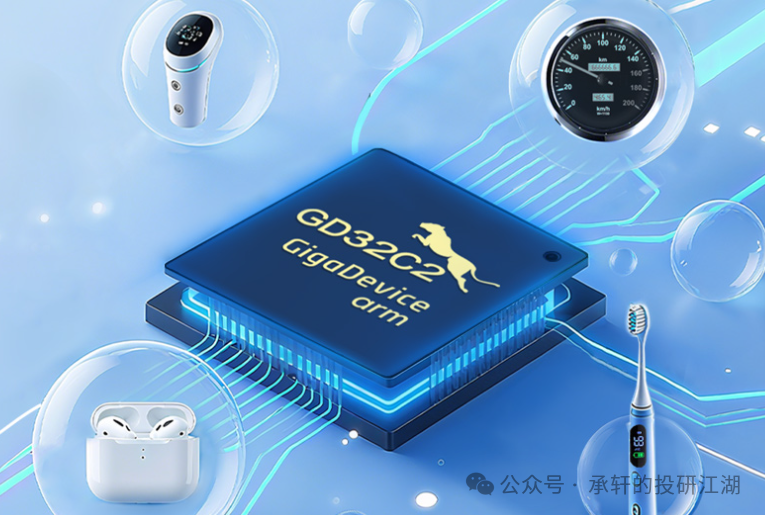
Data Source: GigaDevice Official Website
The company’s products are widely used in various fields such as industrial control, automotive electronics, and consumer electronics, and it continues to launch new products to meet market demand.
1.3 Technological Accumulation and Patent Reserves
With years of deep cultivation in the semiconductor industry, GigaDevice has accumulated a solid core technology foundation in the storage and MCU fields.
The company continues to increase R&D investment, building an independent intellectual property system covering multiple key technology nodes. Particularly in NOR Flash and MCU E-Flash, the company has formed unique advantages. Additionally, GigaDevice’s R&D team includes several world-class experts, supported by the capital market, achieving a technological leap from “0 to 1” and pushing products into mass production.
In terms of patent reserves, GigaDevice also performs excellently. According to the 2024 patent strength ranking of semiconductor manufacturing companies in mainland China, GigaDevice ranks among the top in both the number and value of patents. Some of the company’s products have passed strict automotive-grade certifications, such as the automotive-grade MCU chip passing AEC-Q100 certification, with dynamic power consumption reduced by 30% compared to international competitors.
2. Financial Performance and Growth Assessment
2.1 Revenue and Profit Growth Rate
GigaDevice has shown outstanding compound growth rates in revenue and net profit over the past three years, far exceeding the industry average.
From 2022 to 2024, the company’s revenue growth rate reached 27.68% year-on-year, while the net profit attributable to the parent company grew by 584% year-on-year. Although in 2023, due to the overall market downturn, the company’s revenue decreased by 29.14% year-on-year, and net profit also fell by 92.15%, a significant rebound has been achieved in 2024, with annual revenue of 7.355 billion yuan and net profit of 1.101 billion yuan.
2.2 Gross Margin and Net Margin
GigaDevice’s gross margin structure shows certain business differences but remains relatively stable overall.
Data for 2024 shows that the gross margin for the company’s memory chip sales is 40.27%, ranking first in the industry, while the gross margin for the MCU business is 36.7%. This difference mainly stems from the high added value of memory chips, especially NOR Flash and niche DRAM. Despite the global semiconductor market being in a downturn in 2024, GigaDevice’s memory business gross margin remains at a high level.
The company’s net margin is significantly affected by a high proportion of R&D investment, but it has room for improvement in the medium to long term.
In the first quarter of 2025, the company’s R&D expenses were 292 million yuan, accounting for 15.27% of total revenue. Although high R&D investment puts pressure on net margin in the short term, there is significant potential for future net margin growth with product structure optimization and industry recovery.
2.3 Operating Expenses and Cash Flow
In recent years, GigaDevice has shown a continuous trend of optimizing expense management, particularly in the structural adjustment of sales expense ratio, management expense ratio, and R&D expense ratio.
The company has effectively reduced operating costs through internal management optimization and controlling marketing expenditures. At the same time, the company’s operating cash flow is in good condition, providing solid support for future capital expenditures and R&D investments.
3. Business Structure and Technological Evolution
3.1 Development of Storage Business
In recent years, GigaDevice has shown strong endogenous momentum and external synergy capabilities in the technological evolution of its storage business.
The company has fully entered the large-scale production phase of the 45nm node in its NOR Flash business, marking a further solidification of its technological reserves in embedded storage. At the same time, the company has completed the process upgrade from 38nm to 24nm in the SLC NAND Flash field, enhancing data access efficiency and system stability.
3.2 Competitiveness of MCU Products
GigaDevice has in-depth layouts in both ARM Cortex and RISC-V mainstream core architectures, forming a diversified technological path to meet different market demands.
The company’s GD32R series MCUs integrate NPU, achieving an energy efficiency ratio of 8TOPS/W, supporting large model edge inference with up to 70 billion parameters. Additionally, the company has launched the GD32V series MCUs based on the RISC-V architecture, becoming the first A-share listed company to introduce RISC-V core MCUs.
3.3 Business Expansion Direction
In recent years, GigaDevice’s adjustments in business structure have shown significant transformation characteristics, especially as the revenue proportion from consumer electronics declines while revenue from industrial control and automotive sectors continues to rise.
The company is deepening cooperation with leading domestic customers, and its expansion in overseas markets is also beginning to show results. Furthermore, with the rapid development of 5G and IoT technologies, the demand for low-power, high-performance chips continues to grow, and GigaDevice is actively launching multiple high-performance products that meet market needs.
4. Investment Value and Growth Logic
4.1 Domestic Substitution Process and Technological Breakthroughs
In recent years, GigaDevice has deeply benefited from the continuous strengthening of national integrated circuit industry policies, especially against the backdrop of accelerated domestic substitution processes and technological breakthroughs. As a leading enterprise in the domestic storage and MCU fields, it demonstrates strong growth momentum.
The company ranks second globally in the NOR Flash market share, with its MCU product line covering 63 major series and over 700 models, steadily increasing the localization rate in automotive-grade MCUs and high-end storage fields.
4.2 Foundry Cooperation and Supply Chain Assurance
GigaDevice has established stable cooperative relationships with leading domestic foundries such as SMIC and Hua Hong Wuxi, effectively ensuring its production capacity supply in the niche DRAM market.
This deeply bound foundry model not only enhances the company’s bargaining power and stability in the supply chain but also provides a buffer against fluctuations in the global semiconductor industry.
4.3 R&D Investment and Patent Layout
In recent years, GigaDevice has continuously increased R&D investment, promoting rapid iteration of core technologies and continuous improvement of product performance.
In 2024, the company’s R&D investment reached 1.256 billion yuan, accounting for 15.26% of that year’s revenue. In terms of patent layout, GigaDevice demonstrates strong technological accumulation and awareness of intellectual property protection, further consolidating its leading position in the industry.
5. Competitor Analysis
5.1 Hua Hong Semiconductor
Hua Hong Semiconductor, as a global leader in specialty process wafer foundry, continues to consolidate its core position in the domestic semiconductor industry chain, leveraging its deep accumulation in embedded storage and power devices.
The company has established solid cooperative relationships with multiple long-term customers in the storage chip foundry field, particularly excelling in embedded non-volatile memory (eNVM).
5.2 Zhongying Electronics
Zhongying Electronics, as a direct competitor of GigaDevice in the home appliance MCU field, occupies a leading position in the domestic market due to its long-term focus on home appliance control chips.
However, despite Zhongying Electronics’ strong competitiveness in the traditional home appliance MCU market, there is a significant gap in the 32-bit MCU product line. Additionally, Zhongying Electronics’ product line appears relatively singular compared to GigaDevice, mainly concentrated in the home appliance control chip field, lacking diversification in storage, sensors, and other directions.
5.3 Beijing Junzheng
Beijing Junzheng Integrated Circuit Co., Ltd. has a certain competitive relationship with GigaDevice in the automotive storage chip market. The company’s main business includes the research and development and sales of storage chips, microprocessor chips, smart video chips, and other ASIC chip products and overall solutions.
Beijing Junzheng has formed a sustainable product layout with globally leading 32-bit embedded CPU technology and low-power technology, particularly excelling in the storage chip field.
6. Related Risks
6.1 Technology Iteration and Market Competition Risks
The storage and MCU industry experiences rapid technological updates and iterations. If the company fails to maintain its technological leadership or adjust its technological roadmap in a timely manner, it may lead to a decline in product competitiveness.
At the same time, intensified industry competition may result in market share loss, especially under pressure from competitors like Hua Hong Semiconductor and Zhongying Electronics.
6.2 Supply Chain and Foundry Cooperation Risks
The company relies on a foundry cooperation model. If the production capacity of foundry partners is limited or the cooperative relationship fluctuates, it may affect the stability of product supply.
The ongoing tension in the global semiconductor supply chain, along with rising raw material prices or supply shortages, may further exacerbate cost pressures.
6.3 Domestic Substitution and Technological Breakthroughs Falling Short of Expectations
Although domestic substitution provides growth space for the company, if the pace of technological breakthroughs falls short of expectations or customer acceptance is low, it may hinder market expansion. Upgrades in the storage business process or architectural innovations in MCU products that fail to meet customer needs may weaken product competitiveness.
Conclusion
As a leading semiconductor design company in China, GigaDevice demonstrates strong growth momentum through its deep accumulation and technological advantages in memory, MCUs, and sensors. The company continuously enhances its competitiveness through ongoing technological innovation, optimizing business structure, and strengthening supply chain management. In the future, with the acceleration of domestic substitution processes and continuous technological breakthroughs, GigaDevice is expected to benefit continuously in multiple fields, achieving sustainable development.
Note: This article is for informational sharing only and does not constitute investment advice. The market has risks, and decisions should be made cautiously. Specific data should be based on company announcements.