Recently, many students have asked about the differences between PT threads and BSPT threads in water conveyance. Therefore, I am sharing some materials I have collected: First, NPT is the American standard thread, BSPT is the British standard thread, and PT is also a British standard thread, specifically the Japanese JIS standard. In fact, BSPT and PT are the same.
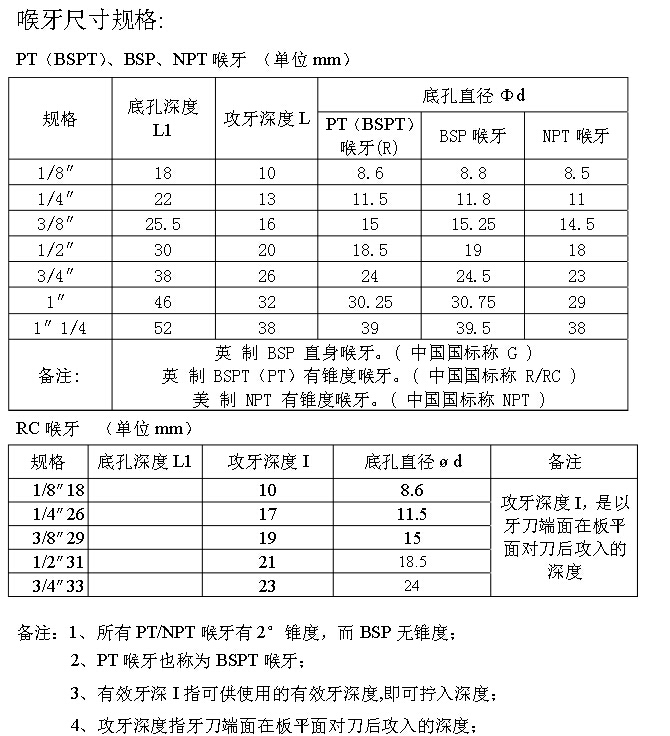
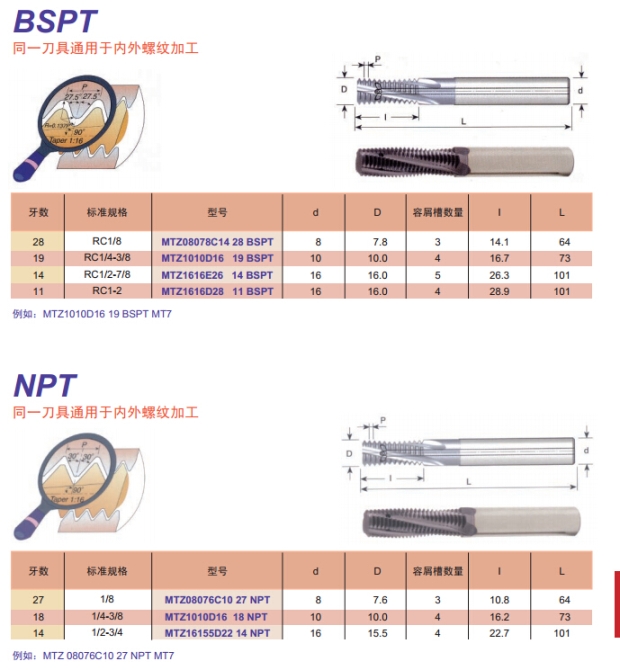
BSPT/NPT
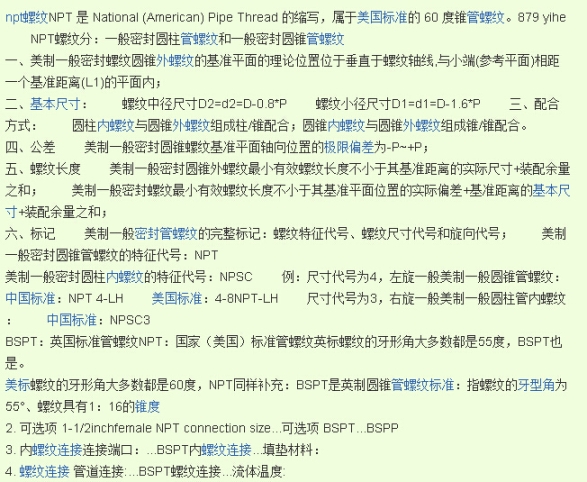
BSPT is a British standard for tapered pipe threads: it refers to a thread angle of 55° and has a taper of 1:16. BSP is British standard pipe thread. However, there are distinctions between BSP.Tr., BSP.PI., and BSP.F.
BSP.Tr. is a tapered pipe thread used for sealing joints. BSP.PI. is a parallel pipe thread used for sealing joints, having only internal threads that fit with the external threads of BSP.Tr. BSP.F. is a parallel pipe thread used for general connections.
Just knowing BSP is not enough; one must not process it carelessly. It is best to confirm in detail. Otherwise, if there are oil or gas leaks, it would be a big problem.
2. The G thread and the BSPP thread are both British standard cylindrical pipe threads with a thread angle of 55°. 3. How many types of British threads are there? What are the characteristics and notations of BSP threads? There are two types: BSPP (pipe thread) and BSPT (55° tapered pipe thread, which is not compatible with the American 60° tapered pipe thread NPT). 4. Comparing G threads and Rp threads, what are the similarities and differences? Do they differ in usage and can they be used interchangeably? G threads and Rp threads are both 55° cylindrical pipe threads. The different codes arise from different countries (organizations). G is the code for China, France, the former Soviet Union, and Japan; PF is Japan’s code; BSP, BSPP are codes from the UK; R and K are codes from Germany (R is for internal threads, K is for external threads); TPYБ is the code from the former Soviet Union; Rp is the ISO code.
—————————
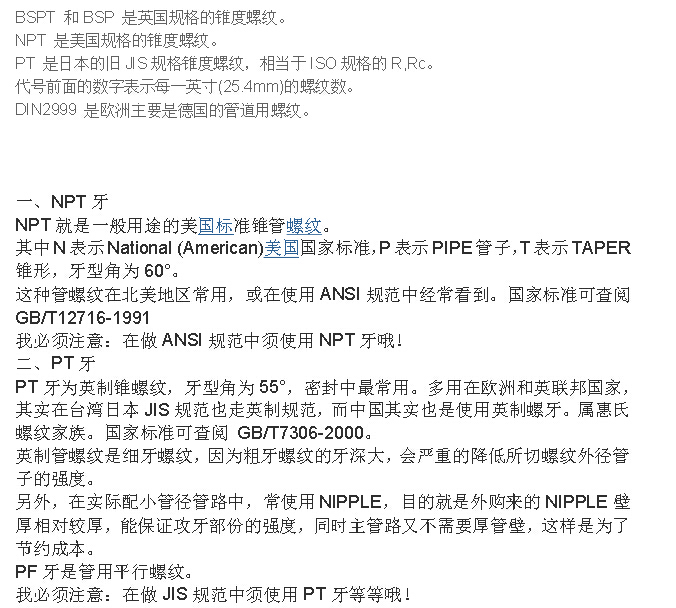
BSPT and BSP are British standard tapered threads. NPT is the American standard tapered thread. PT is the old JIS standard tapered thread from Japan, equivalent to the ISO standard R and Rc.
The number before the code indicates the number of threads per inch (25.4 mm).
DIN2999 is the European standard for pipe threads, mainly in Germany. 1. NPT Threads
NPT is the general-purpose American standard tapered pipe thread.
Here, N stands for National (American), P stands for Pipe, and T stands for Taper, with a thread angle of 60°.
This type of pipe thread is commonly used in North America or frequently seen in ANSI standards. The national standard can be referenced as GB/T12716-1991.
I must emphasize: when working with ANSI standards, one must use NPT threads! 2. PT Threads PT threads are British standard tapered threads with a thread angle of 55°, commonly used for sealing. They are mostly used in Europe and Commonwealth countries. In fact, Taiwan’s JIS standard also follows British standards, and China also uses British screw threads. They belong to the Whitworth thread family. The national standard can be referenced as GB/T7306-2000.
British pipe threads are fine threads because coarse threads have deep roots that significantly reduce the strength of the outer diameter of the threaded pipe. Additionally, in practical applications involving small diameter pipelines, NIPPLEs are often used, where the purpose is that the externally purchased NIPPLE has a relatively thick wall, which ensures the strength of the threaded part while the main pipeline does not require a thick wall, thus saving costs. PF threads are parallel threads for pipes.
I must emphasize: when working with JIS standards, one must use PT threads, etc.! 3. Others
G is a 55-degree non-thread sealing pipe thread, belonging to the Whitworth thread family. Marked as G, it represents cylindrical threads. The national standard can be referenced as GB/T7307-2001. G is a general term for pipe threads (Guan), with the division of 55 and 60 degrees being functional, commonly referred to as pipe round. That is, the threads are machined from a cylindrical surface. ZG is commonly referred to as pipe taper, meaning the threads are machined from a conical surface. Most common water pipe fittings are like this. The old national standard is marked as Rc for metric threads, while British and American threads are indicated by the number of threads per inch, which is the biggest difference. Metric threads are 60-degree equilateral threads, while British threads are isosceles 55-degree threads, and American threads are 60 degrees.
Metric threads use metric units, while British and American threads use imperial units. Pipe threads are mainly used for connecting pipes, with tight fits between internal and external threads, and there are both straight pipe and tapered pipe types. The nominal diameter refers to the diameter of the connected pipe, and clearly, the major diameter is larger than the nominal diameter. 1/4, 1/2, and 1/8 are the nominal diameters of British threads, measured in inches. 4. Let’s add some more information to fill up.
1. Identification of Unified Inch Threads
Unified inch threads are widely used in inch-based countries. This type of thread is divided into three series: coarse thread series UNC, fine thread series UNF, and extra fine thread series UNFF, plus a constant pitch series UN. Marking method: thread diameter—number of threads per inch series code—accuracy level. Example: Coarse thread series 3/8—16 UNC—2A
Fine thread series 3/8—24 UNF—2A
Extra fine thread series 3/8—32 UNFF—2A
Constant pitch series 3/8—20 UN—2A
The first number 3/8 indicates the thread outer diameter, measured in inches. To convert to metric units in mm, multiply by 25.4, i.e., 3/8×25.4=9.525mm; the second and third numbers 16, 24, 32, 20 indicate the number of threads per inch (the number of threads over a length of 25.4mm); the text code after the third number indicates the series code, and the last two digits 2A indicate the accuracy level. 2. Conversion of 55° cylindrical pipe threads
55° cylindrical pipe threads originate from the inch series but are widely adopted in both metric and inch-based countries, used for connecting pipe fittings for liquid, gas transport, and electrical installations. However, the codes differ by country, and should be converted according to the table below (comparison table) to our national codes. Below is a list of the 55° cylindrical pipe thread codes from various countries.
Country Code
China G
Japan G, PF
UK BSP, BSPP
France G
Germany R (internal thread), K (external thread)
Former Soviet Union G, TPУБ
ISO Rp 3. Conversion of 55° tapered pipe threads
55° tapered pipe threads refer to a thread angle of 55° and a taper of 1:16. This series of threads is widely used globally, and each country has different regulations regarding its codes. Refer to the table below to convert the foreign codes to our national codes.
Country Code
China ZG, R (external thread)
UK BSPT, R (external thread), Rc (internal thread)
France G (external thread), R (external thread)
Germany R (external thread)
Japan PT, R
ISO R (external thread), Rc (internal thread) 4. Conversion of 60° tapered pipe threads
60° tapered pipe threads refer to a thread angle of 60° and a taper of 1:16. This series of threads is used in China’s machine tool industry and in the USA and former Soviet Union. Its code, which was previously designated as K in our country, has now been changed to NPT. The thread code comparison table is as follows.
Country Code
China Z (old) NPT (new)
USA NPT
Soviet Union B5 5° trapezoidal thread conversion
Trapezoidal threads refer to a thread angle of 30° for metric trapezoidal threads. This series of threads is relatively unified both domestically and internationally, and their codes are quite consistent. Refer to the table below for thread codes.
Country Code
China T (old) Tr (new)
ISO Tr
Germany Tr
Former Soviet Union Tr 5. More thread types, possibly with repetitions above, but let’s gather them first! Threads can be categorized by their uses as follows: 1. International Metric Standard Thread (International Metric Thread System):
This is the thread adopted by our national standard CNS. The thread crest is flat, making it easy to machine, while the thread root is rounded to increase thread strength. The thread angle is 60 degrees, and the specification is indicated with M. Metric threads can be divided into coarse and fine threads. The notation is like M8x1.25. (M: code, 8: nominal diameter, 1.25: pitch). 2. American Standard Thread (American Standard Thread):
Both the crest and root of the threads are flat, providing better strength. The thread angle is also 60 degrees, and the specification is indicated by the number of teeth per inch. This type of thread can be divided into coarse (NC), fine (NF), and extra fine (NEF) threads. The notation is like 1/2-10NC. (1/2: outer diameter; 10: number of teeth per inch; NC code). 3. Unified Standard Thread (Unified Thread):
Formulated by the USA, UK, and Canada, this is the commonly used British standard thread.
The thread angle is also 60 degrees, and the specification is indicated by the number of teeth per inch. This type of thread can be divided into coarse (UNC), fine (UNF), and extra fine (UNEF). The notation is like 1/2-10UNC. (1/2: outer diameter; 10: number of teeth per inch; UNC code) 4. V-shaped Thread (Sharp V Thread):
Both the crest and root are pointed, resulting in weaker strength, and it is not commonly used. The thread angle is 60 degrees. 5. Whitworth Thread (Whitworth Thread):
This is the thread adopted by British national standards. The thread angle is 55 degrees, and the symbol is “W”.
It is suitable for rolling manufacturing. The notation is like W1/2-10. (1/2: outer diameter; 10: number of teeth per inch; W code). 6. Round Thread (Knuckle Thread):
This is the standard thread set by Germany’s DIN. It is suitable for connecting light bulbs and rubber hoses. The symbol is “Rd”. 7. Pipe Thread (Pipe Thread):
This is a thread used to prevent leakage, often used for connecting gas or liquid fittings. The thread angle is 55 degrees and can be divided into straight pipe threads designated as “P.S., N.P.S.” and tapered pipe threads designated as “N.P.T.”, with a taper of 1:16, i.e., 3/4 inch per foot. 8. Square Thread (Square Thread):
This is the thread with the best transmission efficiency, second only to ball threads, but its disadvantage is that it cannot be adjusted with a nut after wear. It is generally used for screws in vises and threads in cranes. 9. Trapezoidal Thread (Trapezoidal Thread):
Also known as Acme thread. Its transmission efficiency is slightly lower than that of square threads, but it can be adjusted with a nut after wear. The metric thread angle is 30 degrees, while the British thread angle is 29 degrees. It is generally used for lead screws in lathes. The symbol is “Tr”. 10. Buttress Thread (Buttress Thread):
Also known as sloped thread, it is suitable only for unidirectional transmission, such as screw jacks and press machines. The symbol is “Bu”. 11. Ball Thread:
This is the thread with the best transmission efficiency, but it is difficult to manufacture and has a very high cost, used in precision machinery, such as lead screws in CNC machines.
Notation for British standard bolts:
LH 2N 5/8 × 3 – 13 UNC-2A
(1) LH indicates left-handed thread (RH indicates right-handed thread and can be omitted). (2) 2N indicates double-threaded. (3) 5/8 indicates British thread with an outer diameter of 5/8”. (4) 3 indicates a bolt length of 3”. (5) 13 indicates the number of threads per inch is 13. (6) UNC indicates unified standard coarse thread. (7) 2 indicates the fit level, external thread (3: tight fit; 2: medium fit; 1: loose fit) A: external thread (can be omitted) B: internal thread.
British threads are usually indicated by the number of threads per inch over a length of one inch, referred to as “threads per inch,” which is equal to the reciprocal of the pitch. For example, a thread with 8 teeth per inch has a pitch of 1/8 inch.
1. British Threads (Thread Angle 55°) Thread of British standard (Thread pitch shape angle 55°) BSW----British Standard Whitworth Thread (Coarse) BSF----British Standard Whitworth Thread (Fine) G----Straight pipe thread (outside thread divided into A, B levels; taps divided into G, G-D) R----Tapered external pipe thread (old code ZG; KG) RC----Tapered internal pipe thread (old code ZG; KG) 2. American Threads (Thread Angle 60°) Thread of American standard (Thread pitch shape angle 60°) UNC----Unified coarse pitch thread (replacing NC) UNF----Unified fine pitch thread (replacing NF) UNEF----Unified superfine pitch thread UN-----Unified thread with constant pitch UNS----Unified special thread NPT----General purpose tapered pipe thread (old code Z; K) NPSC----Internal straight pipe thread for connection NPSM----Straight pipe thread for general purpose NPTF----Dry seal tapered pipe thread NPSF----Dry seal fuel internal pipe thread NGT----Special thread for gas cylinder 3. Metric Threads Metric thread ZM-----Metric tapered pipe thread
4. Other Threads Other threads SM----Thread for sewing machine PZ----Special thread for gas cylinder 5V1-20V1-Tyre valve thread
Explanation of thread code example: e.g.
1/4-20UNC
1/4-Nominal diameter 1/4″ nominal dia. 1/4″
20-Twenty teeth per inch
UNC-Unified coarse pitch thread
——————————
Classification of thread uses
1. British Threads (Thread Angle 55°)
BSW――――British Standard Whitworth Thread (Coarse)
BSF ―――British Standard Whitworth Thread (Fine)
BA ―――British Association Thread
G―――――Straight pipe thread (outside thread divided into A, B levels; taps divided into G, G-D)
R―――――Tapered external pipe thread (old code ZG; KG)
RC――――Tapered internal pipe thread (old code ZG; KG)
RP――――Straight internal pipe thread (connecting with tapered external pipe thread R)
2. American Threads (Thread Angle 60°)
UNC―――――Unified coarse pitch thread (replacing NC)
UNF―――――Unified fine pitch thread (replacing NF)
UNEF――――Unified superfine pitch thread
UN―――――Unified thread with constant pitch
UNS―――――Unified special thread
NBUTT――――Buttress thread
NPT―――――General purpose tapered pipe thread (old code Z; K)
NPSC――――Internal straight pipe thread for connection
NPTR――――Tapered pipe thread for lead connection
NPSM――――Straight pipe thread for general purpose
NPSL―――――Straight pipe thread for mechanical connection with locking nut
NPSH―――――Hose connection thread
NH――――――Fire hose connection thread
NPTF―――――Dry seal tapered pipe thread
NPSF―――――Dry seal fuel internal thread
NPSI―――――Dry seal general internal pipe thread
ANPT―――――Aviation American tapered pipe thread
F-PTF Dry seal (fine) tapered pipe thread
PTF-SAE SHORT――Dry seal SAE short tapered pipe thread
NGO―――――Gas cylinder outlet thread
NGT―――――Gas cylinder tapered thread
NGS―――――Gas cylinder straight thread
SGT―――――Gas cylinder special tapered thread
0.650-19UNS Safety device thread
ACME―――――Trapezoidal thread (thread angle 29°)
G―――――――General purpose trapezoidal thread
C―――――――Centrally aligned trapezoidal thread
STUB ACME――Standard short tooth trapezoidal thread 3. Metric Threads
M―――――――Metric thread
ZM――――――Metric tapered pipe thread
Tr―――――――Trapezoidal tapered thread (old code T) 4. Other Threads
SM―――――――Sewing machine thread
PZ―――――――Gas cylinder tapered thread
PG―――――――Gas cylinder straight thread
TBG――――――Oil pipe thread
5V1 to 20V1―――Tyre valve thread