Abstract: In order to achieve effective scheduling, coordinated control, and management of various vehicles, and to improve the efficiency and safety of logistics transportation, a Beidou navigation and communication integrated intelligent vehicle network terminal was designed and developed based on the STM32 microcontroller for the logistics system application environment. The terminal is centered around the STM32F103ZET6 microcontroller and consists of the Beidou positioning module UM220, the GPRS module SIM900A, and the ZigBee wireless network module. Among them, the UM220 module is responsible for receiving Beidou satellite signal positioning; the SIM900A module communicates with the logistics center; and the wireless ZigBee module is used to transmit vehicle logistics-related information. Experiments show that the terminal can automatically complete functions such as data collection, processing, and transmission of the vehicle network, meeting the application requirements in the logistics environment.
1 Introduction
With the rapid development of the logistics industry in China, intelligent logistics management systems have received widespread attention, and the demand for precise monitoring and scheduling of vehicles has become increasingly urgent. Many vehicle monitoring research institutions and companies at home and abroad have made embedded vehicle monitoring systems a key focus of research and development.
Currently, the vehicle terminal products on the market are limited by different vehicle models and application scenarios, with poor universality. Some only support vehicle positioning and have single functions; terminal devices cannot easily form a vehicle network, making it difficult to flexibly collect various in-vehicle information, and applications are hard to expand; there is no unified standard for communication between various terminals and devices, making interconnection difficult.
In response to the problems existing in current vehicle terminals and applications, this paper developed an intelligent vehicle network terminal based on STM32 for Beidou positioning and communication integration. The terminal centers around the STM32F103ZET6 microcontroller and controls the UM220, SIM900A, and ZigBee modules through three serial ports on the chip. The UM220 module is responsible for receiving Beidou satellite signals for real-time vehicle positioning and tracking. Utilizing domestic Beidou positioning technology can eliminate potential hazards of relying on foreign navigation, and technology is no longer constrained by others. Both SIM900A and ZigBee are wireless communication modules. The SIM900A module uses existing GPRS mobile communication network infrastructure to achieve the transmission and interaction of positioning, tracking, control information, and IoT information between terminal devices and the vehicle platform central station; ZigBee connects with various application sensors (such as barcode scanners, RFID, cameras, temperature sensors, etc.) and handheld application terminals through short-range wireless interfaces, forming a vehicle information network to achieve the perception and collection of various application information.
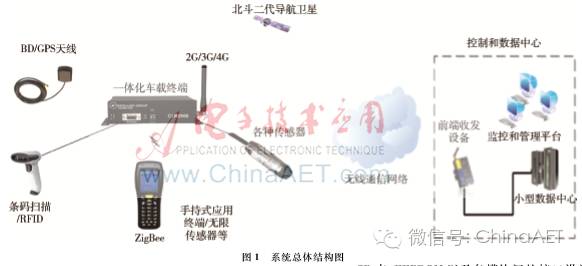
1.1 System Structure and Overall Scheme Design The system mainly consists of an integrated terminal for positioning and communication, as well as a logistics control and data center. The overall structure of the system is shown in Figure 1. The Beidou navigation system sends satellite positioning signals to the ground in all weather conditions. The integrated terminal receives satellite signals to obtain positioning information and sends it back to the control and data center through the GPRS wireless communication network in accordance with the protocol along with other collected information. The control and data center is the core of the system for control, communication, and applications, mainly consisting of front-end data wireless transceiver devices, databases, and monitoring and management platforms. The front-end data wireless transceiver devices are used to complete various communication operations wirelessly with the integrated terminal; the database stores and processes the received data; and the monitoring and management platform controls and manages the integrated terminal as well as the database.
2 Terminal Hardware Design
2.1 Terminal Hardware Structure
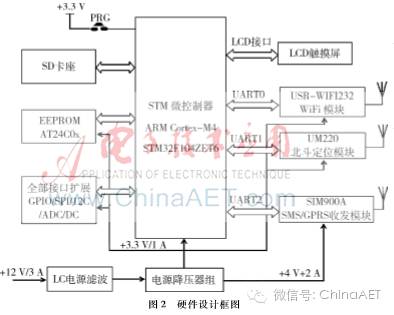
The vehicle terminal is centered around the STM32 microcontroller, and the overall architecture is shown in Figure 2, including the STM32 processing control module, power supply module, BD positioning reception module, SMS/GPRS module, ZigBee transceiver module, and LCD display module. The main power supply of the terminal is the vehicle power supply, and the terminal should have a rechargeable battery. When the terminal loses the main power supply, the backup battery should be able to work long enough for the terminal to alert the monitoring center or transmit necessary data. The terminal involves many communication modules, requiring specially designed power supplies for each communication module. The STM32 processor is responsible for data processing and scheduling among various communication modules. The SIM900A module is responsible for sending messages received from the STM32 back to the monitoring and management platform. Using the widely covered GPRS mobile communication network infrastructure, stable and reliable communication between the terminal and the center can be achieved. The information return is primarily through GPRS, while important information like alarms is sent via short messages.
In addition, the vehicle terminal hardware also includes some peripheral circuits, such as SD cards, EEPROM, and interface designs between various modules. The made character library or image information is stored in the SD card, allowing the LCD touchscreen to display the required Chinese characters and images. In practical applications, the terminal should have power-off protection: when the terminal loses power, the system automatically enters a protection state. Some important terminal parameter initialization configuration information (such as heartbeat interval, server TCP port, and center-set listening number, etc.) is stored in the EEPROM storage chip. The hardware system based on STM32 needs to design interfaces for power supply, LCD, USB, and serial ports, with the serial port baud rate set at 9600 b/s, and the display screen connected to the system circuit board via a 34PIN soft ribbon cable.
2.2 Key Hardware Module Selection and Design Points
2.2.1 STM32 Core Microcontroller The STM32 processor communicates with various modules and processes the received data, making it the core component of the entire terminal. The STM32F103xx series MCU is used as the core, with the STM32F103ZET6 featuring an ARM Cortex-M3 core, integrating 512 KB Flash, 64 KB SRAM, 1 USB, 2 basic timers, 4 general-purpose timers, 2 advanced timers, 5 USARTs, 3 12-bit ADCs, 2 DACs, 3 SPIs, 2 I2Cs, 2 I2Ss, 1 SDIO interface, 1 CAN, and 1 FSMC bus (supporting NOR, NAND, SRAM), as well as 112 general-purpose I/O ports. The CPU operates at a frequency of 72 MHz and uses LQFP144 packaging. This chip has a powerful configuration and is very cost-effective. The external bus FSMC can be used to expand SRAM and connect to LCDs, significantly improving the screen refresh speed when driving the LCD through FSMC.
2.2.2 UM220 Positioning Module The Beidou positioning reception module is responsible for receiving Beidou satellite signals, using the UM220 Beidou/GPS dual-system module from HeXinXingTong Company, which is characterized by its small size, high integration, and low power consumption, meeting various positioning needs. The UM220 series is a Beidou/GPS dual-system module launched by HeXinXingTong for vehicle monitoring/navigation, handheld devices, and other applications. The UM220-III is the third generation product of the UM220 series, capable of simultaneously supporting BD2 B1 and GPS L1 frequency points. The UM220-III uses the “Hummingbird” low-power GNSS SoC chip, which is fully independently developed by HeXinXingTong Company, making it the smallest fully domestically produced Beidou/GPS module currently on the market. This module has high integration and low power consumption, making it very suitable for integration into compact Beidou terminals.
2.2.3 SIM900A Communication Module The SIM900A is a compact GSM/GPRS communication module launched by SIMCOM, using SMT packaging and based on STE’s single-chip, adopting ARM926EJ-S architecture, with powerful performance, allowing customers to embed applications, widely used in vehicle tracking, fleet management, wireless POS, handheld PDAs, smart metering, and power monitoring in many directions. This chip has stable performance, a compact appearance, and high cost-effectiveness. The SIM900A uses an industrial standard interface, operating frequencies from 900 MHz to 1800 MHz, and embeds TCP/UDP protocols, enabling low-power transmission of voice, SMS, data, and fax information; it supports point-to-point short messages and GPRS data transmission, suitable for 2G communication networks. The module provides serial and SPI interfaces and supports AT commands. The SIM900A has low power consumption, small size, and low cost, making it suitable for compact product design and development.
2.2.4 Wireless ZigBee Module The short-range communication module uses a 2.4 GHz IEEE 802.15.4 wireless ZigBee module (model REX3DP), with the RF module adopting an external antenna. The module uses the STM32W108xx series chip, featuring an ARM Cortex-M3 core, excellent RF and low-power microcontroller performance, configured with I/O, analog-to-digital converters, timers, SPI, I2C, and UART, and supports RF4CE and IEEE 802.15.4 MAC software libraries, with devices featuring 64-256 KB onboard Flash memory and 16 KB SRAM, using VFQFN40, UFQFN48, and VFQFN48 packaging. The REX3DP is a compact, high-sensitivity, low-power ZigBee module compliant with the IEEE 802.15.4 ZigBee protocol stack, supporting self-healing and self-organizing mesh networks, thereby optimizing network traffic and reducing power consumption, making it very suitable for applications in wireless sensing, control, and data collection.
2.2.5 LCD Touch Screen The terminal LCD display is the interactive interface between the driver and the vehicle terminal, allowing the driver to interact with the monitoring center. It can display relevant information during communication and can input dynamic IP addresses directly for TCP connections through the touch display. The LCD model used is a 2.8-inch ALIENTEK TFT LCD, supporting 65K color display with a resolution of 320×240, and a 16-bit 80 parallel interface with a built-in touch screen.
3 Terminal Software Design3.1 Software Workflow
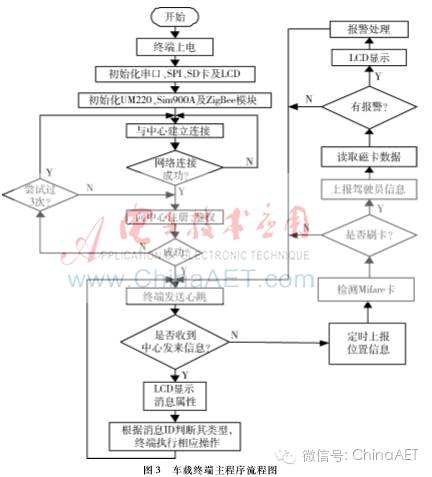
The terminal’s software mainly includes: main control program, Beidou data processing module, SIM900A communication module, and ZigBee communication module. The specific software workflow is shown in Figure 3.
3.2 Key Software Module Design Points
3.2.1 Beidou Data Reception and Processing Module In the hardware circuit, the UM220 module is connected to the STM32’s UART2, sending instructions every second, so using the STM32’s UART2 interrupt function to handle the received data is more convenient. Each NMEA instruction from UM220 is a string starting with “MYM” and ending with “*”, with different instruction data lengths. Correctly storing BDGGA and BDRMC instructions is a prerequisite for accurately parsing the required latitude, longitude, height, speed, and angle information.
3.2.2 SIM900A Communication Module The SIM900A module embeds TCP/IP and UDP protocols. To ensure the stability and reliability of the returned information, the TCP/IP protocol is chosen for transmission. This module allows for easy GPRS data communication. The SIM900A module communicates with the processor via a serial port, sending corresponding AT commands to complete the relevant configuration. After establishing a TCP connection with the center, information can be sent using the command “AT+CIPSEND”. Information reception is automatically returned through the serial port, allowing for real-time communication between both parties.
3.2.3 ZigBee Communication Module The ZigBee module communicates with the processor using the UART serial port as well. After configuring the corresponding serial port, the ZigBee module is initialized. Since each message from the ZigBee module has the same ending flag as that of the UM220 module, the interrupt handling function for the ZigBee module can refer to that of the UM220 module. Like the SIM900A module, the ZigBee module can also be controlled via AT commands for its initialization. The vehicle terminal uses the COO node, while the handheld terminal is the routing node. It is crucial to ensure that the COO node and the routing node are on the same network PANID and the same network channel for normal communication.
3.3 Data Communication Protocol To ensure the integrity and universality of communication between this vehicle terminal and the backend center, and to improve error detection capabilities, a standardized protocol that both parties must adhere to is necessary. For this terminal, the communication protocol strictly follows the “Technical Specification for Beidou Compatible Vehicle Terminal Communication Protocol for Road Transport Vehicle Satellite Positioning Systems.” It stipulates the format, content of communication, and response requirements for different messages, providing a standard information structure specification for communication between the vehicle terminal and the logistics center.
4 Terminal Verification and Testing First, power on the terminal and burn the pre-written program for port configuration and initialization of each module. At the same time, start the Visual Basic.Net vehicle location service platform on the host computer and set up the network environment to provide the terminal with a stable public IP address. When the terminal successfully connects to the data center, the service platform can communicate with the terminal and monitor its operations in real time. Various communication data are stored in the MySQL database through the platform for easy backend management. The vehicle location service .Net platform communication interface is shown in Figure 4.
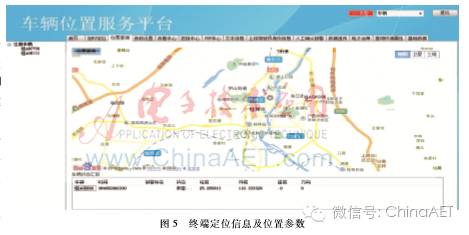
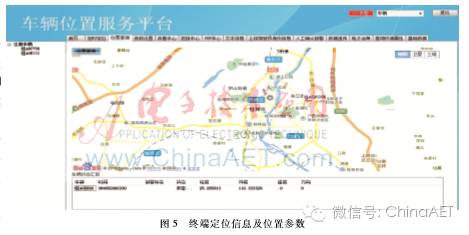
Through the interface shown in Figure 5, the position query section on the platform allows users to see the position icons reported by the terminal on the electronic map over time, along with the corresponding position parameters. As shown in Figure 5, the registered vehicle with license plate number 桂AGK898 is currently parked near Guilin University of Electronic Technology.
5 Conclusion The intelligent vehicle network terminal uses the STM32F103ZET6 processor with a Cortex-M3 core, combined with the positioning module UM220 and SIM900A, ZigBee wireless communication modules, to achieve integrated applications of positioning and communication in the logistics environment. By adopting modular design, the terminal’s power consumption is effectively reduced, and the terminal’s size is minimized. Field tests show that positioning information is accurate, communication is stable and reliable, and it is easy to expand applications.
References [1] Hui Xiaowei, Liu Yanmei. Design of Logistics Vehicle Terminal System Based on GPS/GPRS [J]. Computer Applications and Software, 2015, 32(6):79-82. [2] Ma Lifang. Design and Research of Vehicle Terminal Based on Beidou and GPRS [D]. Xi’an: Xi’an University of Science and Technology, 2013. [3] Gong Lingxiang, Ye Zhihui, Feng Qi, et al. Design of Beidou/RFID Combined Positioning System Based on STM32 [J]. Electronic Measurement Technology, 2014, 37(4):76-82. [4] Pan Weizhuang, Chen Shiping. Design and Implementation of Vehicle Monitoring Terminal Using Beidou Module [J]. Electronic Testing, 2013(16):45-47. [5] Han Yuexia, Li Xiongwei, Zhang Yang, et al. Design and Implementation of Logistics Vehicle Terminal System Based on Internet of Things [J]. Sensors and Microsystems, 2015, 34(5):69-71. [6] Huang Jicong, Zhao Li, Fang Xiaoke. Design of Logistics Positioning Tracking Communication Terminal Based on Multi-mode [J]. Electronic Technology Application, 2014, 40(2):8-11.