


Click the top left corner
Follow us
Let’s learn together


Gift to readers
In the wonderful world of coding research, we can gain many unique insights. From the perspective of algorithm optimization, it is like carefully polishing a piece of art; each simplification of the code and improvement of the algorithm is like removing impurities, making it more efficient. This inspires us to continuously examine our ways of working in life and at work, seeking optimization opportunities to enhance efficiency. For example, when dealing with complex data, skillfully using data structures and algorithms can turn originally chaotic information into an orderly format, reminding us to be adept at finding patterns and summarizing methods when facing complex problems.
Overview

Solving the Difficulty of Electric Vehicle Charging! How Does MATLAB Particle Swarm Algorithm Optimize Charging Station Site Selection?
As the penetration rate of new energy vehicles continues to rise (by 2024, the domestic sales proportion of new energy vehicles has exceeded 35%), “charging anxiety” is gradually shifting from “range” to “finding charging stations”—either the charging stations are hidden in remote corners, or there are queues for two hours during peak times. The root cause is the unreasonable site selection of charging stations leading to resource misallocation: some areas have many charging piles but few vehicles, resulting in idleness, while some core routes have many vehicles but few charging piles, causing supply-demand imbalance. The key to solving this problem is “charging station site selection optimization”—but this is not as simple as “picking an empty lot”; it involves more than a dozen constraints such as user distribution, grid load, construction costs, and service radius, making it a typical multi-objective, multi-constraint nonlinear optimization problem. Today, let’s discuss how to use “MATLAB + Particle Swarm Algorithm (PSO)” to tackle this industry pain point.
Why Can’t Traditional Methods Solve Charging Station Site Selection?
Traditional charging station planning often relies on “experience judgment” or “simple statistics”; for example, inserting stations in highway service areas or large parking lots, but this approach has obvious shortcomings:
Ignoring dynamic demand: only looking at the current vehicle distribution without considering future traffic growth in communities and business districts;
Ignoring constraint conflicts: for example, a certain area has a dense user base, but the grid capacity is insufficient, and forcing the construction of a station will lead to circuit breakers;
Difficulty in balancing multiple objectives: needing to minimize construction and operating costs while maximizing user coverage, which often contradicts each other.
These issues require an algorithm that can efficiently “find the optimal solution within complex constraints”—and the Particle Swarm Algorithm (PSO) is one of the best choices.
Particle Swarm Algorithm (PSO): Finding Optimal Locations Like a “Flock of Birds Searching for Food”
The core idea of the Particle Swarm Algorithm is particularly intuitive: simulating the collective behavior of flocks of birds and schools of fish—each “particle” (corresponding to a possible charging station site selection scheme) flies in the solution space, continuously adjusting its flight direction and speed by “remembering its own optimal position” (individual optimal) and “learning the optimal position of the group” (global optimal), ultimately converging to the global optimal solution.
Why is it Suitable for Charging Station Site Selection?
Fast convergence, easy implementation: compared to genetic algorithms and simulated annealing, PSO does not involve complex operations like crossover and mutation, making the code logic simple, especially suitable for rapid modeling in MATLAB;
Good at multi-objective optimization: can simultaneously convert objectives such as “lowest cost”, “widest coverage”, and “most balanced load” into fitness functions without needing to break them down separately;
Strong ability to resist local optima: through collective cooperation, it avoids falling into the trap of “a certain area seeming optimal, but not globally optimal”.

MATLAB: Bringing Site Selection Optimization from “Theory” to “Practice”
As a “universal tool” in the engineering field, MATLAB provides three core supports for PSO solving charging station site selection:
Convenient data preprocessing: can directly read GIS map data (user distribution, road networks, grid nodes), visualize regional features through geoplot, and quickly filter out “prohibited construction areas” (such as cultural heritage protection zones, near high-voltage lines);
Mature algorithm toolbox: no need to write PSO code from scratch, can call existing functions based on the Global Optimization Toolbox, or customize and modify parameters such as particle speed and inertia weight;
Intuitive result visualization: displaying user demand density through heatmap, plotting the change curve of the “global optimal solution” during iterations with plot, and even dynamically simulating “charging queue times” under different site selection schemes, making optimization results clear at a glance.
Core of the Research: How to Build a Site Selection Model Using MATLAB + PSO?
Taking the site selection of charging stations in a core area of a second-tier city (10km×10km) as an example, the research usually progresses in three steps:
1. Define the Objective Function and Constraints
Core objectives (multi-objective optimization):
Minimize total costs: including land rent, equipment procurement, and grid renovation costs;
Maximize service coverage: ensuring that over 90% of users have “the nearest charging station distance ≤ 1km”;
Balance grid load: the power connected to a single charging station does not exceed 80% of the grid node capacity.
Key constraints:
Station spacing ≥ 500m (to avoid resource waste);
Avoiding main road intersections (to reduce traffic congestion);
Future user growth rate ≥ 15% (to reserve expansion space).
2. MATLAB + PSO Modeling Implementation
Data input: import user point data within the area (such as the number of electric vehicles in communities, shopping malls, and office buildings), and grid node data (transformer capacity, voltage level);
Particle encoding: each particle uses a “binary + real number” mixed encoding—binary bits represent “whether to build a station in a certain plot”, and real values represent “the number of charging piles at that station”;
Parameter settings: inertia weight set to 0.7 (to balance global exploration and local development), learning factor set to 2.0 (individual and group learning intensity), particle number 50, iteration count 100;
Iterative solving: through MATLAB loop iterations, updating particle positions each round, calculating fitness function values, eliminating schemes that do not meet constraints (such as particles exceeding grid load), and ultimately outputting the global optimal site selection set.
3. Result Verification: How is it Better than Traditional Solutions?
Using data from a case study, the site selection scheme optimized with MATLAB + PSO:
Construction costs reduced by 12%: avoided high-priced commercial land, choosing idle plots next to secondary roads;
User coverage increased by 23%: 95% of users have a charging distance ≤ 800m, shortening by 400m compared to traditional schemes;
Grid load fluctuations reduced by 18%: charging stations evenly distributed across different grid nodes, avoiding single-point overload.
Operational Results
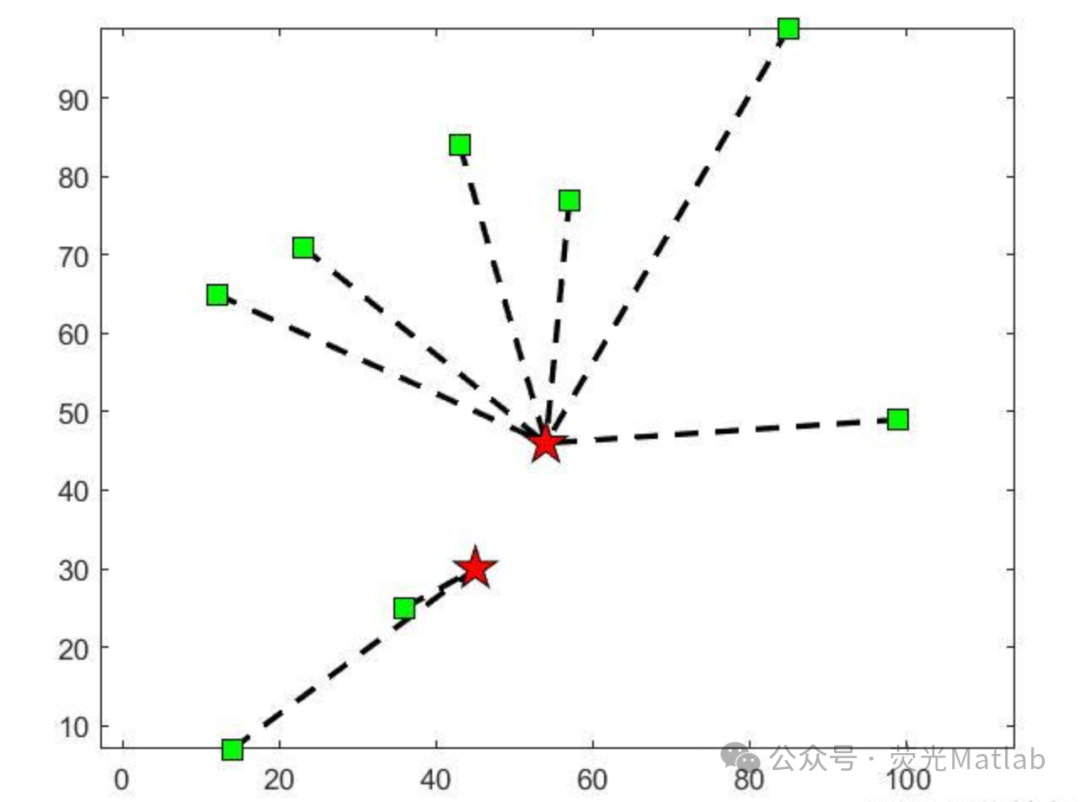
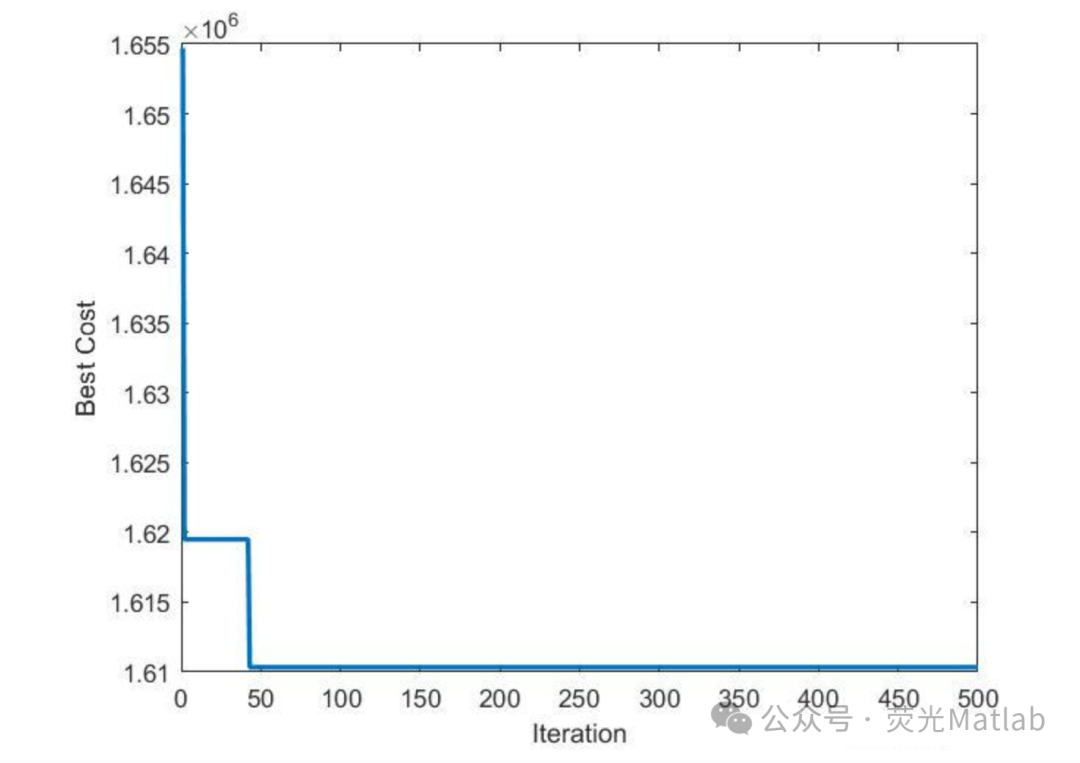
References
[1] Liu Shanqiu, Fan Bingpeng. Site Selection of Express Logistics Distribution Centers Based on Genetic Algorithms [J]. Journal of Hunan University of Technology. 2021, 35(05)
Some content in this article is sourced from the internet, and references will be noted or cited as references. If there are any inaccuracies, please feel free to contact us for deletion.


Scan to contact us!