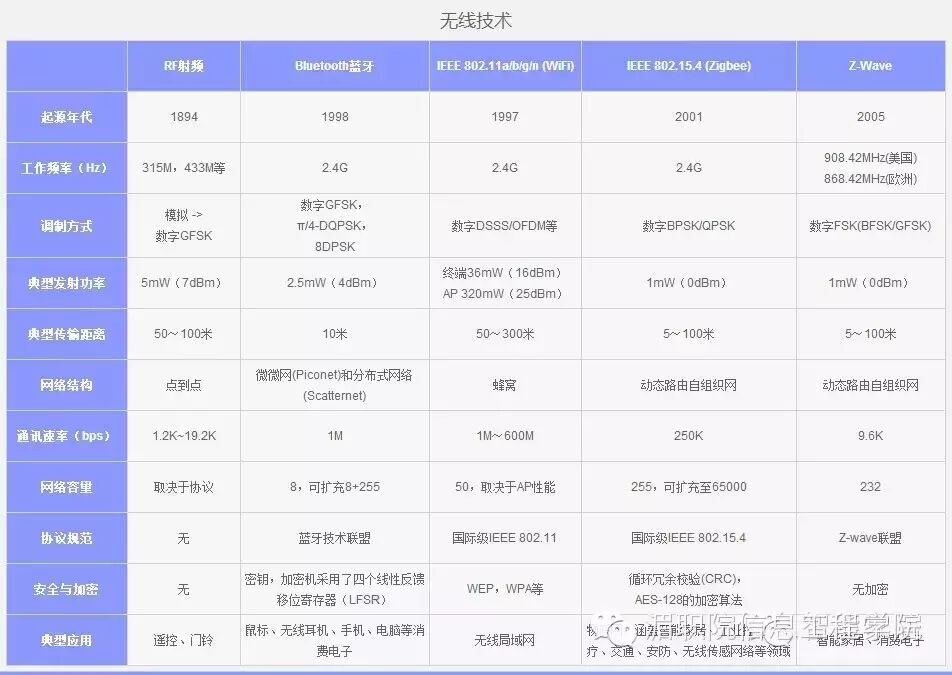
Wireless Technologies
Wireless Technologies
1. RF (Radio Frequency), such as RF433, RF315
RF technology introduction: RF is the abbreviation for Radio Frequency. The dictionary definition of Radio is: n. radio communication, radio receiving device, radio broadcasting equipment; v. to send via radio. The dictionary definition of Frequency is: n. frequency, periodicity, occurrence count. In electronic theory, when current flows through a conductor, a magnetic field is formed around the conductor; when alternating current passes through a conductor, an alternating electromagnetic field is formed around the conductor, known as electromagnetic waves. When the frequency of electromagnetic waves is below 100 kHz, they are absorbed by the earth’s surface and cannot form effective transmission. However, when the frequency exceeds 100 kHz, electromagnetic waves can propagate through the air and reflect off the ionosphere at the edge of the atmosphere, enabling long-distance transmission capabilities. High-frequency electromagnetic waves with long-distance transmission capabilities are referred to as RF. Some common applications include: RF technology is widely used in wireless communication. Many wireless devices utilize RF fields. Cordless phones, mobile phones, radio and television broadcasting stations, satellite communication systems, and walkie-talkie services all operate within the RF spectrum. Additionally, some wireless devices operate at IR or visible light frequencies, which have shorter electromagnetic wavelengths than RF fields. Examples include most TV remote controls, some wireless computer keyboards and mice, and some wireless hi-fi stereo headphones.
2. Bluetooth
Bluetooth technology is a short-range radio technology that effectively simplifies communication between mobile communication terminal devices such as PDAs, laptops, and mobile phones, as well as between these devices and the Internet, making data transmission between modern communication devices and the Internet faster and more efficient. In simpler terms, Bluetooth technology allows modern portable mobile communication devices and computers to connect to the Internet without the need for cables, and it can also be applied to various household appliances, consumer electronics, and automotive information appliances, forming a vast wireless communication network. Bluetooth technology is a short-range, low-cost wireless connection technology that enables voice and data wireless transmission, and it has already attracted significant attention from the global communication industry and users.
3. IEEE 802.11a/b/g/n (WiFi)
Wi-Fi is a technology that allows personal computers, handheld devices (such as PDAs and mobile phones), and other terminals to connect wirelessly. Wi-Fi is a brand of wireless networking technology owned by the Wi-Fi Alliance, aimed at improving interoperability between wireless networking products based on the IEEE 802.11 standard. Nowadays, people often confuse Wi-Fi with IEEE 802.11, and even equate Wi-Fi with wireless Internet. Originally, Wi-Fi was an abbreviation for Wireless Fidelity. In the context of wireless local area networks, it refers to “wireless compatibility certification,” which is essentially a commercial certification and a wireless networking technology. Previously, computers were connected via cables, but now they connect via radio waves; a common example is a wireless router, which allows devices within its effective coverage area to connect via Wi-Fi. If the wireless router is connected to an ADSL line or another Internet connection, it is referred to as a “hotspot.” Wi-Fi is an industry term published by an organization called the Wireless Ethernet Compatibility Alliance (WECA). It is a short-range wireless transmission technology that supports wireless Internet access within a range of hundreds of feet. With technological advancements and the emergence of standards such as IEEE 802.11a and IEEE 802.11g, the IEEE 802.11 standard is now collectively referred to as Wi-Fi. From an application perspective, to use Wi-Fi, users must have Wi-Fi-compatible client devices. Wi-Fi is a technology that helps users access email, the web, and streaming media. It provides users with wireless broadband Internet access and is a fast and convenient way to go online at home, in the office, or while traveling. Places that can access Wi-Fi networks are called hotspots. Wi-Fi or 802.11G operates in the 2.4 GHz frequency band, supporting speeds of up to 54 Mbps (802.11N operates in 2.4 GHz or 5.0 GHz, with a maximum speed of 600 Mbps). There are also two other protocols in the 802.11 space, including (a) and (b). They are also publicly used, but 802.11G/N is the most commonly used worldwide.
4. IEEE 802.15.4 (Zigbee)
Zigbee is a low-power personal area network protocol based on the IEEE 802.15.4 standard. The technology defined by this protocol is a short-range, low-power wireless communication technology. The name comes from the zigzag dance of bees, as bees communicate the location of pollen to their companions through their flight and buzzing (zig) movements. Its characteristics include short-range, low complexity, self-organization, low power consumption, low data rate, and low cost. It is mainly suitable for automatic control and remote control applications and can be embedded in various devices. In short, Zigbee is a cheap, low-power, short-range wireless networking communication technology. Simply put, Zigbee is a highly reliable wireless data transmission network, similar to CDMA and GSM networks. The communication distance ranges from a standard 75 meters to several hundred meters or kilometers, and it supports unlimited expansion. Zigbee is a wireless data transmission network platform composed of up to 65,000 wireless data transmission modules, where each Zigbee network data transmission module can communicate with each other, and the distance between each network node can be expanded infinitely from the standard 75 meters. Unlike mobile communication CDMA or GSM networks, Zigbee networks are primarily established for industrial automation control data transmission, thus requiring simplicity, ease of use, reliability, and low cost. In contrast, mobile communication networks are primarily established for voice communication, with each base station typically costing over one million RMB, while each Zigbee “base station” costs less than 1,000 RMB. Each Zigbee network node can not only serve as a monitoring object, such as directly collecting and monitoring data from connected sensors, but can also automatically relay data from other network nodes. Additionally, each Zigbee network node (FFD) can wirelessly connect with multiple isolated sub-nodes (RFD) that do not undertake network information relay tasks within its signal coverage range.
5. Z-Wave
Z-Wave is a wireless networking specification primarily led by the Danish company Zensys. Although the Z-Wave Alliance is not as powerful as the Zigbee Alliance, its members are manufacturers with existing products in the smart home field. Currently, the alliance has over 160 internationally renowned companies, covering various countries and regions worldwide. The inclusion of major companies like Cisco and Intel has strengthened Z-Wave’s position in the home automation field. In terms of market share, Z-Wave is more prevalent in Europe and the United States, with well-known manufacturers such as NWD, Wintop, Leviton, and Control4. Why does Z-Wave hold a strong position in smart homes? This is mainly due to Z-Wave’s attributes. Z-Wave is an emerging, low-cost, low-power, highly reliable, and network-friendly short-range wireless communication technology. It operates in the frequency band of 908.42 MHz (USA) to 868.42 MHz (Europe), using FSK (BFSK/GFSK) modulation, with a data transmission rate of 9.6 kbps. The effective coverage range is 30 meters indoors and can exceed 100 meters outdoors, making it suitable for narrowband applications. As communication distance increases, the complexity, power consumption, and system costs of devices also increase. Compared to various existing wireless communication technologies, Z-Wave technology is the lowest power consumption and lowest cost technology, effectively promoting low-rate wireless personal area networks. Z-Wave technology is designed for residential, lighting commercial control, and status reading applications, such as metering, lighting and appliance control, HVAC, access control, and security and fire detection. Z-Wave can convert any standalone device into a smart network device, enabling control and wireless monitoring. Z-Wave technology was initially designed for the wireless control field of smart homes, using small data format transmission, with a transmission rate of 40 kb/s sufficient for early applications that even used a rate of 9.6 kb/s. Compared to other similar wireless technologies, it has relatively low transmission frequency, relatively long transmission distance, and certain price advantages. Z-Wave technology is specifically targeted at narrowband applications and employs innovative software solutions to replace costly hardware, allowing for the establishment of high-quality wireless networks at a fraction of the cost of other similar technologies.