Previous Reviews
Recommended Reading: Mechanisms for Credible Analysis of Intelligence Facing Deep Forgery
Recommended Reading: Key Models and Technologies of Open Source Intelligence Credible Analysis Systems
This article was published in “Command Information Systems and Technology” 2023, Issue 1Authors:Zhang Pei,Wang Zhiguo,Wang Zhen Citation format:Zhang Pei,Wang Zhiguo,Wang Zhen. Current Status and Development Direction of the US Air Force Data Link System[J]. Command Information Systems and Technology,2023,14(1):18-14.
Abstract
First, this paper traces the development history of the US Air Force data link system and organizes the current development status of typical active equipment based on the traditional three-link classification of tactical data links, broadband intelligence data links, and weapon coordination data links; then clarifies the construction direction of the US Air Force data link system, which is to move from single-link single-use to multi-link systematic use, from specialized to universal multi-platform use, from independent development to capability demand combination, and from hardware installation to software service loading; finally, it introduces the integrated application of technologies such as distributed mobile networks, air-based adaptive gateways, and big data in the US Air Force data link system.
0
Introduction
The data link system connects battlefield command and control (C2) systems, intelligence systems, and weapon platforms through digital means, achieving real-time information exchange, sharing, and distribution under standardized message formats and communication protocols, providing communication capabilities for operational tasks such as command, situational sharing, reconnaissance, surveillance, and fire coordination. Since the beginning of the 21st century, the US military has proposed concepts such as distributed lethality, mosaic warfare, and decision center warfare, which have put forward new requirements for the construction of data link systems, especially emphasizing real-time and mobility in the air combat environment. This paper traces the development history of the US Air Force data link system and organizes the current status of active equipment from the perspective of traditional three-link classification (C2 link, weapon coordination link, and intelligence link), clarifying the future development direction and key technologies of the US Air Force data link system, aiming to provide references for our military’s data link system research.
1
Development History
The US military defines a data link as follows: it links two or more command systems and/or weapon systems through single or multiple network structures and communication media, serving as a communication link suitable for transmitting standardized digital information. The main difference between data link systems serving military needs and conventional digital communication systems is: 1) Service target: Digital communication systems focus on humans, emphasizing information exchange between individuals; data link systems serve systems/platforms, emphasizing seamless links between command systems, sensors, and weapons; 2) Transmission method: Digital communication systems aim to achieve transparent information exchange, completely entrusting the processing authority of information content to both parties of the communication; data link systems standardize the extraction, integration, and processing of information through formatting methods to reduce manual operations as much as possible for improved timeliness, while also focusing more on additional information related to communication behavior (such as the spatial and temporal coordinates of both parties).
NATO was the first to develop the tactical data link Link series, with representative systems including Link 4, Link 11, and Link 16. Subsequently, based on differences in service targets and transmission formatted information structures, various dedicated data links gradually emerged outside of comprehensive tactical data links, such as dedicated data links for air defense missile systems and precision-guided weapon systems equipped by the US military in the 1980s. At this point, data link systems were mainly divided into two categories: tactical data links and dedicated data links.
As the demand for intelligence, surveillance, and reconnaissance (ISR) information in modern warfare increased, narrowband tactical data links could no longer meet operational requirements. In the 1980s, the US Department of Defense began developing broadband intelligence data links specifically for transmitting ISR information, equipping the common data link (CDL) series in the 1990s. The CDL series operates in full-duplex mode in the microwave frequency band (X/Ku) and includes advanced CDL (A-CDL), networking CDL (N-CDL), extended (satellite) CDL (SE-CDL), and multi-platform CDL (MP-CDL). During this period, data link systems were mainly divided into three categories: tactical data links, broadband intelligence data links, and dedicated data links. Tactical data links primarily focus on platform control for situational sharing and tactical coordination, but are limited by latency and networking systems, making it difficult to meet modern battlefield fire control requirements. Against this background, the weapon coordination data link, which enables collaborative targeting and engagement between weapon platform terminals and maximizes the combat effectiveness of weapon systems, emerged independently from dedicated airborne data links, represented by the US Navy’s Cooperative Engagement Capability (CEC) and the US Air Force’s Inter-Fighter Data Link (IFDL). The classification development history of the US military’s data link system is shown in Figure 1, where SADL represents the Situational Awareness Data Link, MADL represents the Multifunctional Advanced Data Link, TTNT represents Tactical Targeting Network Technology, and Std-CDL represents the Standard Common Data Link.
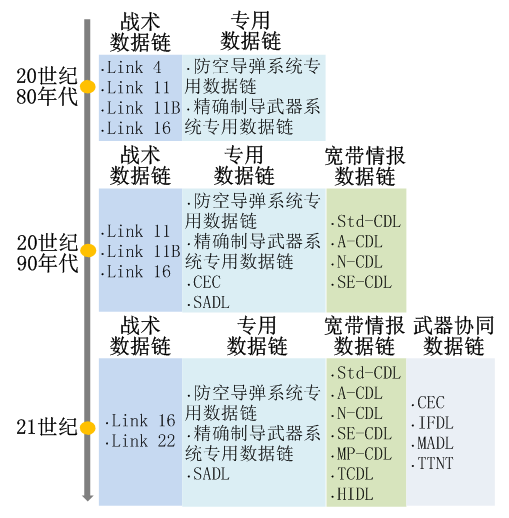
Figure 1: Development History of the US Military Data Link System Classification
2
Current Capabilities
2.1 Command Link
The US and NATO countries were the first to develop and equip data links, with the US military referring to the command link as the Tactical Digital Information Link (TADIL), which was also known as the Situational Sharing Data Link in its early days. The primary command link currently equipped by the US Air Force is Link 16.
Link 16 is the main link of the joint tactical information distribution system for the US and NATO armed forces, and is a general integrated data link that has the functions of Link 4A/4C/11. It supports airborne operations, aircraft air defense and air combat, low-altitude missile air defense operations, aerial reconnaissance and surveillance, airspace control, aerial blockade and strike against enemy forces, anti-submarine operations, close air support, fire support, and ground operations. Link 16 features communication, navigation, and identification capabilities, and is a secure, anti-jamming, and decentralized data link. Link 16 is currently the most widely equipped and maturely utilized joint tactical data link system in the US military, primarily outfitted on various early warning aircraft, bombers, reconnaissance aircraft, and tankers, as well as fixed-wing/rotorcraft fighters, aircraft carriers, cruisers, and destroyers, combat vehicles, operational teams, and airborne weapons, along with ground command posts, mobile control teams, tactical air control groups, and air combat support centers. As a system that was put into service in the 1980s, Link 16 has limitations in networking range and data bandwidth; however, due to the universality of its technical system, its equipment range has been continuously expanding in recent years through the implementation of distance extension and frequency extension plans.
2.2 Intelligence Link
The development and application of various radars and sensors have led to a surge in intelligence data acquired by reconnaissance platforms, highlighting the bottleneck issues of tactical data links in terms of bandwidth and transmission rates. In the 1980s, the US military began developing broadband data links for real-time distribution and sharing of large-capacity intelligence, resulting in the common data link (CDL) series, which subsequently extended to various interoperable models based on platform differences.
The CDL series is the data link standard designated by the US Department of Defense for large-capacity signal and image intelligence distribution, encompassing a series of point-to-point, broadband, anti-jamming, and line-of-sight information exchange systems designed for collecting image and signal intelligence and for commanding and controlling airborne sensors, mandatorily promoted for use by all branches of the US military. Unlike tactical data links that transmit formatted messages, CDL supports the direct transmission of unprocessed and high-capacity data obtained from sensors to ground (sea) processing stations, enabling detailed reconnaissance and surveillance of battlefield areas by various airborne platforms, thus providing support for deep battlefield operations and subsequent troop attacks. CDL defines five standard waveforms: Std-CDL, A-CDL, N-CDL, SE-CDL, and MP-CDL, to adapt to heterogeneous platforms in land, sea, air, and space.
MP-CDL is a new type of broadband intelligence reconnaissance data link that the US Air Force began developing around 2003. It is capable of transmitting intelligence reconnaissance data between air-to-air, air-to-ground, and air-to-space, facilitating intelligence information exchange in a networked combat environment and specifically addressing interoperability issues between CDL terminals. Compared to most CDL data link models that only support point-to-point operational modes, MP-CDL has broadcasting capabilities. The US Air Force positions it as a broadband intelligence data link system designed to meet the future network-centric warfare needs of the Air Force.
The Tactical Common Data Link (TCDL) is a broadband intelligence data link designed to address air-to-ground and air-to-ship intelligence transmission for small aircraft and unmanned aerial vehicle platforms, with a focus on interoperability with CDL. TCDL is an open, modular data link that is small and lightweight, meeting military affordability. The US Air Force validated TCDL equipment through portable ground support equipment (PGSE) in 2000 to support the battlefield CDL application of the Air Force’s U2 project. In recent years, TCDL has primarily been equipped on small to medium-sized unmanned aerial vehicles of the US Army and anti-submarine helicopters and patrol aircraft of the Navy, with plans to further enhance TCDL’s transmission rate to achieve full compatibility with the CDL series, enabling intelligence transmission interaction between manned and unmanned platforms.
2.3 Weapon Coordination Link
The weapon coordination link refers to the weapon coordination data link, which evolved from point-to-point airborne data links in dedicated data links and features high bandwidth, strong real-time capabilities, high dynamics, and high reliability. The core goal of the weapon coordination link is to achieve lateral networking of weapon platforms and direct links between sensors and weapons, thereby supporting precise positioning, tracking, and low-latency collaborative strikes at the fire control level. Currently, the weapon coordination data links in development or service with the US Air Force mainly include IFDL, MADL, and TTNT.
IFDL is a collaborative data link developed by the US Air Force for combat aircraft formations, later becoming the dedicated data link for the F-22 stealth fighter during its finalization process. IFDL employs Q-band ultra-narrow microwave beams for precise directional control, providing real-time point-to-point exchanges of targeting status, fuel status, and weapon inventory information between F-22 fighters flying at high speeds. IFDL ensures strong anti-jamming, anti-detection, and survivability capabilities for the aircraft based on low detection, low interception technologies such as directional ultra-narrow beams, fast hopping frequencies, and power control. In practical applications, IFDL has the following drawbacks: 1) Despite operating in the microwave frequency band, its bandwidth is insufficient and capacity is limited, failing to meet the requirements for transmitting large-capacity data such as images and videos; 2) It is limited to point-to-point data transmission between F-22 formations and lacks networking capabilities and cross-platform information exchange capabilities.
MADL is a high-speed, low-detection, and low-interception collaborative data link designed for the F-35 stealth fighter, aimed at achieving high-speed covert communication between aircraft in high-speed flight conditions. MADL utilizes active phased array technology to shape and control the antenna beam, employing a daisy-chain link system to transmit narrowband waveforms. MADL is highly covert, with six antennas forming an array distributed across the aircraft body, capable of covering a 360° range for sending and receiving. Although MADL and IFDL are developed based on the same technology, they face interoperability issues. In recent years, the US Air Force has been working to modify the MADL message standards to make them compatible with the J series messages of Link 16, gradually expanding MADL’s equipment range to various stealth fighters, reconnaissance aircraft, and early warning aircraft platforms, with expectations to completely replace IFDL in the future.
TTNT originated from a research project implemented by the US Department of Defense’s Advanced Research Projects Agency (DARPA) to verify target targeting network technology. It is a new type of networked weapon coordination data link suitable for highly maneuverable aerial platforms and multi-sensor collaborative targeting. TTNT employs an Ad Hoc network system for high-speed dynamic decentralized omnidirectional networking, and is dynamically reconstructed based on Internet Protocol (IP); it is fully compatible with Link 16 message standards to achieve cross-platform interoperability, software integrated into the Multifunctional Information Distribution System-Joint Tactical Radio System (MIDS-JTRS) terminal, without interference with Link 16. Compared to Link 16, TTNT has shorter task planning time, lower network latency, and higher channel utilization, allowing aerial platforms or ground units within the effective area to dynamically form a collaborative strike network according to mission needs and target attributes, enabling rapid locating, targeting, striking, and assessing of time-sensitive targets. In comparison to IFDL and MADL, TTNT adopts an omnidirectional communication mode, sacrificing some stealth for better multi-platform compatibility and network robustness.
2.4 Summary
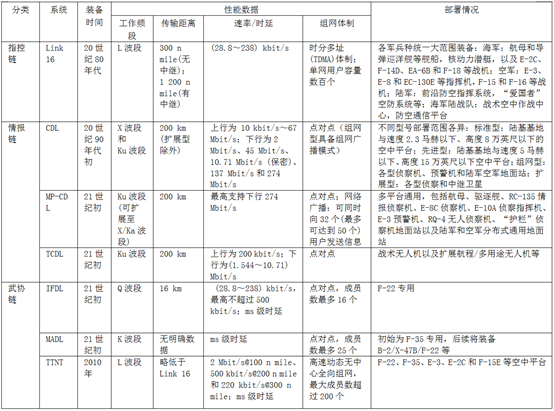
The concept diagram of the US Air Force data link application system is shown in Figure 2. The tactical data link Link 16 covers various types of Air Force fighters, bombers, early warning aircraft, reconnaissance aircraft, and special aircraft, providing tactical information exchange such as command and situational sharing through ultra-shortwave omnidirectional networking, and enabling communication interconnection with other branches of the US military and even with other weapon platforms of NATO countries. Stealth fighter platforms represented by the F-22 and F-35 utilize IFDL and MADL for directional covert communication between formations, while the networked fire control coordination capability that cannot be accommodated by low-interception communication is achieved through the omnidirectional networking of TTNT. The intelligence data link CDL series provides broadband large-capacity intelligence transmission capabilities for reconnaissance aircraft, early warning aircraft, and reconnaissance satellites, supporting intelligence transmission modes such as air-to-air, air-to-space, and air-to-ground. By equipping some sensor platforms with TCDL, intelligence exchange with small and medium-sized unmanned aerial vehicles of the Army and anti-submarine helicopters of the Navy is realized. The performance overview of the US Air Force’s active data link systems is shown in Table 1, where 1 n mile = 1,852 m.
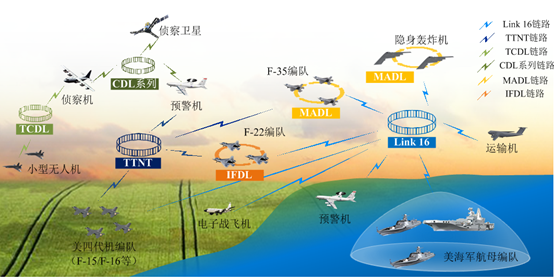
Figure 2: Concept Diagram of the US Air Force Data Link Application System
Table 1: Performance Overview of the Active Data Link Systems of the US Air Force
3
Development Directions
3.1 Moving from Single Link Single Use to Multi-Link Systematic Use
The command link, intelligence link, and weapon coordination link are developed with differentiated focuses on tactical command and situational sharing, broadband intelligence transmission, and weapon platform coordination for operational needs. Since a single type of data link cannot fully adapt to the wide area, high real-time, high mobility, and strong countermeasure characteristics of the air combat environment, systematic comprehensive use of different data links is required to enhance operational effectiveness. Specific content includes: 1) Relying on the Link series command links to achieve joint all-domain command and control and situational sharing across countries and military branches; 2) Integrating the Link series command links with weapon coordination links such as IFDL, MADL, and TTNT to achieve precise control and coordination of fire control-level sensors/weapons across military branches and platforms in complex battlefield environments, completing mobile target tracking and collaborative strike tasks; 3) Utilizing the point-to-point and point-to-multipoint broadband transmission capabilities of the CDL series intelligence links, combined with the regional networking and information sharing capabilities of command links, to achieve horizontal interconnection of various airborne reconnaissance platforms, constructing an all-weather reconnaissance and surveillance system; 4) Integrating command links, intelligence links, and weapon coordination links to build a complete air-based Observe-Orient-Decide-Act (OODA) loop, realizing the combat concept of “detect and strike”; 5) Collaboratively utilizing intelligence links such as TCDL and weapon coordination links such as TTNT to achieve interconnection between manned and unmanned aircraft, completing collaborative control of unmanned aircraft by manned aircraft and directing unmanned aircraft to carry out reconnaissance intelligence sharing and fire coordination strikes in joint manned/unmanned formation operations.
3.2 Moving from Specialized and Dedicated to Universal Multi-Platform Use
The development of the US military’s data link equipment system has long been constrained by a siloed bottleneck, where dedicated data links individually developed for various weapon systems have formed a mature yet isolated technical system. Major military enterprises are unable to form unified standards at the commercial and technical levels, leading to the inability to conduct collaborative operations with numerous data link equipment systems that have been built at great expense. To address this issue, the US military has recently focused on building a universal data link system that is applicable across land, sea, air, and space. In terms of command links, it continues to promote the equipment range of Link 16, emphasizing compatibility and adaptation of Link 22 based on the J series message standards of Link 16. According to the “Joint Tactical Data Link Management Plan,” by 2005, about 80% of the approximately 21,000 platforms installed with data links in the US military used J series message families, and this ratio increased to 95% by 2010. In terms of broadband intelligence links, universal standard waveforms have been defined, and the US Air Force is focusing on developing the multi-platform compatible MP-CDL, ensuring interoperability between different CDL terminal equipment and guaranteeing integrated distribution and sharing of air-to-air and air-to-ground reconnaissance intelligence. Meanwhile, to enhance intelligence information exchange between manned and unmanned equipment, the TCDL developed for small unmanned reconnaissance and surveillance platforms is also compatible with the CDL series standards. In terms of weapon coordination links, the US military plans to expand the application range of MADL from the F-35 to include stealth aircraft platforms such as the F-22, B-2, and XB-47.
3.3 Moving from Independent Development to Capability Combination Based on Demand
In recent years, the US Air Force has been working to weaken the inherent definitions of the purposes of various data links, contrasting with the capability combination of data link systems based on Joint All-Domain Operations (JADO) needs. For example, the weapon coordination link system TTNT is developed entirely based on the working frequency band, technical system, and message standards of the command link Link 16, and is embedded in the MIDS terminal of Link 16 in a software format. In joint long-range force testing exercises, the US military has also tested the use of Link 16 and TTNT for functions such as image intelligence transmission, reconnaissance sensor control, and Global Information Grid (GIG) access.
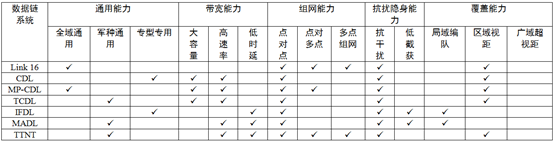
Recent analyses of the US Air Force’s modifications to fighter data link equipment systems indicate a gradual transition from the independent installation of various types to a selection process based on equipment costs and platform payload capabilities, focusing on capability elements composed of general capabilities, bandwidth capabilities, networking capabilities, anti-jamming stealth capabilities, and coverage capabilities. Among these, general capabilities mainly measure the coverage extent of data link systems across platforms of various military branches in Joint All-Domain Operations, classified as general and specialized; bandwidth capabilities represent the bandwidth performance of data link systems, reflected in data transmission rates and information sharing delays, used for large-capacity intelligence information distribution, fire control-level target tracking, positioning, and weapon coordination; networking capabilities mainly measure the operational modes and networking systems of data link systems, such as point-to-point, point-to-multipoint (broadcast), and multipoint interconnection networking, to meet differentiated operational needs for wide-area situational sharing, command, and covert communication between regional formations; anti-jamming stealth capabilities include anti-jamming performance and low-detection, low-interception stealth communication performance; coverage capabilities are used to characterize the distance coverage range and relay capabilities of data link systems, such as microwave frequency bands generally covering local short-range communications within 20 km, ultra-high frequency/very high frequency (UHF/VHF) bands covering medium-range area line-of-sight communications without relays within 300 nautical miles, and HF bands supporting long-range over-the-horizon communications over 1,000 km. The capability comparison of the active data link systems of the US Air Force is shown in Table 2.
Table 2: Capability Comparison of the Active Data Link Systems of the US Air Force
For the US Air Force, choosing the standards for integrating multiple data link systems into aircraft platforms is a challenging decision. Taking the F-22 as an example, the US military currently tends to base capability combinations on operational needs while considering the costs of equipment installation and physical feasibility: 1) In non-denial spaces, it may choose to install the TTNT module in the MIDS terminal, using Link 16 for situational sharing with active fighters such as the F-15 and F-16, and using TTNT for networking communication with new aircraft platforms such as the F-35. 2) In denial spaces, it may choose IFDL for communication between F-22 formations or MADL for low-interception covert communication with other stealth aircraft platforms in electronic warfare environments. 3) It may install MP-CDL to achieve intelligence information feedback and distribution, based on compatibility with TCDL to enable intelligence interaction between manned and unmanned platforms.
3.4 Moving from Hardware Installation to Software Service Loading
Space and weight resources are tight on airborne platforms, and the independent installation and modification of various types of data links will lead to an accumulation of equipment quantity and weight, putting significant pressure on platform spatial layout, effective payload, equipment power consumption, electromagnetic compatibility, and even equipment costs. Under the premise of miniaturization, multifunctionality, and conformal development of terminal equipment, software-defined radio (SDR) technology can be introduced to load the hardware functions of various data links in a software format based on standardized software platforms, developing integrated terminals across frequency bands and channels. The US military has adopted the software communication architecture (SCA) of JTRS as the embedded system standard software structure, providing a standard, open, and interoperable radio communication software platform to ensure that various data link systems can be modularly and software-loaded on platforms. In the SCA, the Common Object Request Broker Architecture (CORBA) as a communication middleware shields the impact of heterogeneous hardware and operating system platforms on upper-layer data link waveform application software, enhancing the extensibility, extendibility, and compatibility of communication equipment.
4
Key Technologies
4.1 Dynamic Decentralized Networking Technology
In recent years, the US military has continuously updated combat concepts, aiming to evolve from network-centric warfare to decision-centric warfare, constructing adaptive kill webs that flexibly switch between different node roles of perception, decision-making, and strike through resource decoupling and on-demand aggregation. Traditional centralized and static fully connected network structures are inadequate to meet these needs; data link networks must possess dynamic reconfiguration, scalable capacity, and system resilience capabilities. Consequently, a distributed and decentralized networking mechanism for mobile networks—Ad Hoc networks—has garnered significant attention. Ad Hoc networks form temporary multi-hop autonomous systems through mobile terminals, with each terminal possessing routing capabilities, allowing for any topology of network structure through data link wireless links, and enabling access to the Internet/cellular communication networks. Ad Hoc networks do not rely on pre-existing central nodes and infrastructure; nodes within the network serve dual roles as hosts and routers, dynamically selecting multi-hop optimal routing based on routing scale mechanisms in real time. The air force data link’s networking based on Ad Hoc mechanisms will face technical challenges due to heterogeneous weak connections, as the equipment capabilities of airborne platforms are limited, making it difficult to create a fully decentralized and equally connected network topology. Therefore, for the air force data link network, key nodes can be paired with access nodes to form a hybrid network structure combining central and decentralized structures. Furthermore, given the current limited single-hop distance and singular link methods of Ad Hoc networks, future efforts need to address the multi-link comprehensive networking issues of air force data links.
4.2 Air-based Gateways and Dynamic Adaptive Networks
To address the low interception data link communication issues between the F-22 and F-35, high-altitude long-endurance unmanned aerial vehicles can serve as air-based gateways, providing cross-link forwarding and information format conversion for heterogeneous stealth platforms, enabling information exchange paths without altering aircraft hardware platforms and waveform systems. Northrop Grumman’s Battlefield Airborne Communication Node (BACN) program aims to provide the US Air Force with IP-based communication relay and information service systems. Currently, BACN has been deployed on platforms such as the Global Hawk reconnaissance aircraft and is gradually becoming a key support equipment for US military airborne missions and battlefield core equipment, providing high-altitude uninterrupted gateway services for the Joint Airborne Layer Network (JALN). In recent years, the US military has validated the use of platforms such as the XQ-58A drone and U-2 high-altitude reconnaissance aircraft as air-based gateways for data link communication between the F-22 and F-35. For instance, Lockheed Martin’s Skunk Works has collaborated with the US Air Force to develop the “Hydra Project,” aiming to achieve bidirectional stealth communication between fifth-generation fighters through the U-2 high-altitude reconnaissance aircraft, sharing operational and sensor data with ground operators and reducing tactical decision-making time from minutes to seconds.
Moreover, the network’s adaptive optimization capabilities of air-based gateways have also received continuous attention from the US Air Force. In 2015, DARPA launched the Dynamic Adaptive Network Optimization for Missions (DyNAMO) project, aimed at addressing communication and information sharing issues of various aerial tactical data links in highly contested environments, supporting distributed combat communication networking. DyNAMO employs a dual-layer dynamic communication model, dividing nodes into information gateways and network optimizers. The information gateway connects with applications to provide system interoperability; the network optimizer connects with data links to form a coverage network that adapts to changes in underlying links. The interface management between the information gateway and the network optimizer ensures service quality, allowing the information gateway to shape the provided data for optimal resource adaptation. In 2019, Raytheon released prototype architecture implementation methods for DyNAMO, including system architecture composition, dynamic communication models, and evaluation results in real-time simulation environments, marking the gradual maturation of this technology.
4.3 Big Data and Cloud Computing
With the widespread deployment of various data link systems in the US military, massive data link operational data along with system operation and maintenance data have become a vast and potentially valuable resource awaiting development. In recent years, DARPA has increasingly focused on applying data mining to intelligence reconnaissance, drone control, and weapon fault diagnosis, leading multiple research and development project plans. By standardizing the connection, preprocessing, and service storage of massive heterogeneous data from multiple sources, a systematic big data platform is built, creating a distributed and full-process data analysis and processing architecture, introducing artificial intelligence and machine learning technologies for correlation analysis, clustering analysis, predictive modeling, and anomaly detection, aiming to achieve real-time battlefield auxiliary decision-making based on visualized big data models, thus establishing a collaborative system where computers control and assist while humans command and make decisions.
Based on a service-oriented architecture (SOA), combined with cloud computing, edge computing, and data mining technologies, the goal is to create a secure, reliable, flexible, lightweight, and interoperable distributed service cloud platform for the air force data link system, adapting to the high mobility and high real-time needs of air combat. Compared to traditional commercial cloud architectures, the key technical points of the air force data link distributed cloud architecture are as follows: 1) Building tactical edge computing capabilities under wireless, narrowband, and weak connection environments, emphasizing the real-time response capabilities of edge nodes; 2) Virtualization of resources for various heterogeneous links, requiring parameterized representation of physical resources based on a standardized system to construct a virtual resource pool, achieving unified registration, publication, and centralized scheduling management of resources within the network.
5
Conclusion
This paper explores the classification development status and construction direction of the US Air Force data link system, providing insights and references for the development of China’s Air Force data link systems. As military needs and combat concepts continue to evolve, the isolated siloed development of various data link systems has reached a bottleneck, necessitating the breaking down of barriers between military branches, technological barriers, and conceptual barriers, with a dual traction approach driven by demand and technology to create a data link equipment system that integrates multi-link systems, tactical capability combinations, and resource decoupling and on-demand aggregation.
Recommended Related Literature:
-
Zhang Zilong, Tian Shaopeng, Kong Lingtang. Application of Aerial Computing in Command Control Data Links [J]. Command Information Systems and Technology, 2022, 13(6): 55-62.
-
Huang Ying, Duan Jikun. Assessment of Blue Army Aerial Formation Similarity Based on Improved Analytic Hierarchy Process [J]. Command Information Systems and Technology, 2022, 13(4): 58-62.
-
Zhang Zilong, Wan Fei, Fan Xianlin. Analysis of Close Air Support and Close Combat Attacks Based on Tactical Data Links [J]. Command Information Systems and Technology, 2022, 13(1): 79-83.
-
Zhang Zilong, Chen Juan, Shen Xiaoping. Development Ideas for Data Link Systems Driven by 5G/6G [J]. Command Information Systems and Technology, 2021, 12(5): 98-104.
-
He Jiafan, Wang Man, Fang Feng, et al. Application of Deep Reinforcement Learning Technology in Intelligent Aerial Combat [J]. Command Information Systems and Technology, 2021, 12(5): 6-13.
-
Chen Jinliang, Wan Lujun, Xu Xinyu, et al. Thoughts on Airborne Unmanned Combat Platform Airspace Control [J]. Command Information Systems and Technology, 2021, 12(4): 1-9.
-
Zhang Zilong, Chen Juan, Zhou Chunfu. Capability-Based Design Method for Command Control Data Link Architecture [J]. Command Information Systems and Technology, 2021, 12(3): 67-71.
-
Rao Jiaren, Sun Shiqing, Li Tingting. Rule-Based Identification of Aerial Combat Formations [J]. Command Information Systems and Technology, 2021, 12(3): 19-22.
-
Chen Xiliang, Li Qingwei, Sun Yu. Key Technologies for Intelligent Decision-Making in Aerial Combat Based on Game Theory [J]. Command Information Systems and Technology, 2021, 12(2): 1-6.
-
Zhang Zilong, Wan Fei, Wang Xing, et al. Evolution and Trends of Close Air Support: From Tactical Data Links and Tactical Clouds to Mosaic Warfare [J]. Command Information Systems and Technology, 2021, 12(1): 8-15.

Reply with the following keywords to view a series of articles:
|
Hot Topics:ABMS|Autonomous Systems|Joint All-Domain Command|Urban Warfare |
|
Strategic Planning:Development Plans|Regulations|Think Tank Reports |
|
Combat Concepts:Mosaic Warfare|Multi-Domain Operations|Distributed Lethality |
|
Cutting-Edge Technologies:Artificial Intelligence|Cloud Computing|Big Data|Internet of Things|Blockchain|5G |
|
System Equipment:Army|Navy|Air Force|Space Force|Cyber Space|NC3|Air Defense and Missile Defense|Logistics Support |
|
Aerial Traffic:NextGen|SESAR|Drones |



For more information, long press the QR code to follow.