CIP (Core Independent Peripheral, independent of the core peripherals) functionality has been discussed in previous articles. CIP can alleviate some of the workload of the interrupt system, but it cannot completely replace it. Both have their own advantages and disadvantages in terms of operational characteristics, and this article provides an analysis of their pros and cons.
1. Disadvantages of Interrupts
Interrupts are the cornerstone of microcontroller response to asynchronous events, but they are not perfect and have several significant drawbacks:
1. Interrupt Latency and Response Time Uncertainty
◆ Source of Delay: There is a delay from the occurrence of the interrupt event to the CPU starting to execute the Interrupt Service Routine (ISR). This includes the time to complete the current instruction, hardware detection, and context saving (stacking).
◆ Uncertainty: The worst-case delay is difficult to predict. If a higher-priority interrupt is currently being executed, or if global interrupts are disabled, lower-priority interrupts must wait, leading to significant fluctuations in response time. This is fatal for real-time hardware applications.
2. Software Overhead and Resource Contention
◆ Context Saving and Restoration: Each time the CPU enters and exits an ISR, it must spend clock cycles to push and pop working registers (such as ACC, PSW, R0-R7, etc.) onto and off the stack, which is purely overhead.
◆ Stack Space Usage: Deeply nested interrupts can consume a large amount of stack space, and if not planned properly, can easily lead to stack overflow, corrupting program data.
◆ Resource Contention (Shared Data Issues): This is one of the trickiest problems. When the main loop (background) and ISR (foreground) need to access the same global variable or hardware register, critical sections (such as disabling interrupts) must be used to protect them, which increases interrupt latency and can easily lead to race conditions due to programming oversights, resulting in abnormal program behavior that is difficult to debug.
3. System Complexity and Maintainability
◆ “Spaghetti Code”: When a system has dozens or more interrupt sources (more on-chip peripherals), the program flow becomes extremely complex and difficult to trace. ISRs are scattered everywhere, and interactions with the main program occur through global variables, drastically reducing code readability and maintainability.
◆ Debugging Difficulty: Interrupt behavior is asynchronous, making it difficult to reproduce a bug triggered by specific interrupt timing in a debugger.
4. Power Consumption Issues
◆ Frequent Wake-ups: In low-power applications, the CPU is usually in sleep mode. Any interrupt will wake the CPU, putting it into a high-power active mode. If the interrupt source is very frequent (such as high-frequency sampling), the CPU will be continuously awakened, unable to enter deep sleep, leading to increased average power consumption.
5. CPU Bandwidth Consumption:
◆ For simple but high-frequency tasks (such as generating PWM, reading encoders, processing communication protocol bits), even if the ISR itself is short, frequent entry and exit from interrupts, context saving, and other operations can consume a large amount of CPU bandwidth, preventing the CPU from focusing on more complex algorithms and control logic.
2. Solutions Offered by CIP
CIP is a concept proposed by Microchip (in its PIC® MCU), but its ideas have been adopted by many modern microcontroller manufacturers (such as STM8 or STM32 with STM32Cube.AI, TI’s Hercules, etc.). The core idea is to allow peripherals to autonomously and collaboratively complete complex tasks with little or no CPU intervention.
How does CIP work?
CIP achieves this by increasing the “intelligence” of the peripherals themselves and interconnecting networks:
◆ Hardware Logic: Peripherals contain hardware logic such as state machines, counters, and comparators.
◆ Peripheral Interconnection: Peripherals are directly connected through the input and output of hardware modules, and signal transmission does not go through the CPU.
◆ Autonomous Operation: Peripherals can be configured to make judgments and actions based on preset conditions.
Comparison of CIP vs Interrupt Method:
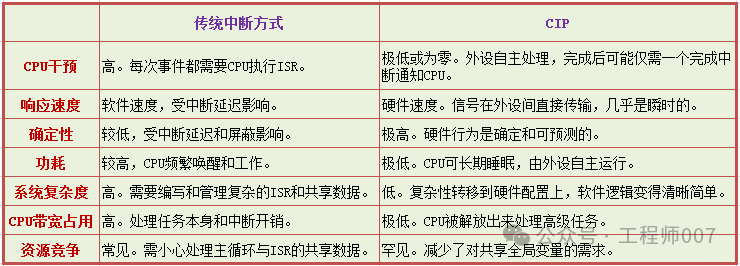
3. Specific Case Comparison: Measuring Pulse Width
Interrupt Method:
1. Rising edge interrupt triggers, enabling the timer and recording time T1 in the ISR.
2. Falling edge interrupt triggers, reading the timer value T2 in the ISR, calculating the width T2 – T1.
Disadvantages: Two interrupts, high CPU involvement; low-frequency pulses have little impact, but under high-frequency pulses, the burden is heavy, and timing measurement accuracy is greatly affected by interrupt latency.
CIP Method (using PIC microcontroller as an example):
1. Configure the input capture (CIP) peripheral in “measure pulse width” mode.
2. Configure another timer (another CIP) as a time base.
3. Directly supply the input pin signal to the input capture and timer through peripheral interconnection.
4. When the pulse arrives, the hardware automatically records the timer value; when the pulse ends, the hardware records it again.
5. The entire measurement process is completed entirely by hardware. After the measurement is complete, the input capture peripheral generates an interrupt, and the CPU only needs to read the final width result in the ISR.
Advantages: The CPU is only awakened once to read the final result, with precise response, low power consumption, and extremely simple software.
Visual Comparison:

In summary, the interrupt mechanism is indispensable for handling asynchronous and complex events. However, for a large number of repetitive, time-critical low-level tasks, the traditional interrupt method has obvious drawbacks in terms of efficiency, determinism, and power consumption. CIP represents the direction of microcontroller design development, significantly reducing the burden on the CPU by offloading complexity to hardware, improving system determinism, real-time performance, and energy efficiency, while simplifying software design. Developers should prioritize whether they can utilize CIP to replace traditional interrupt handling methods when designing new systems, thereby building more robust and efficient systems.