elexcon 2025
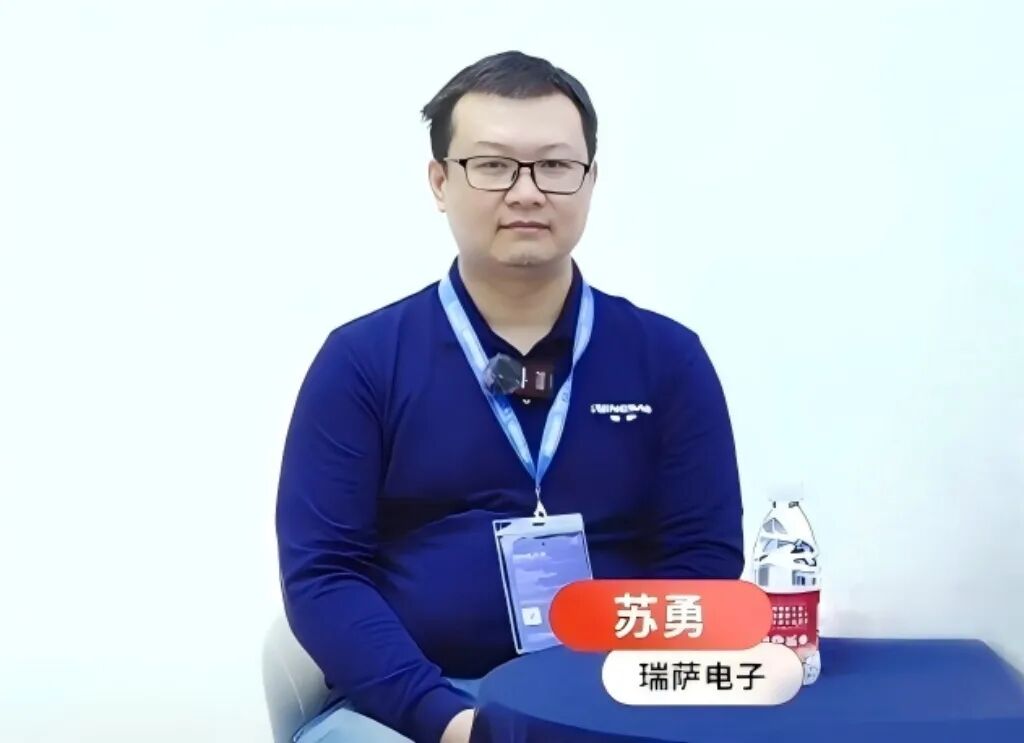
As artificial intelligence technology continues to extend to the edge, lightweight and low-power edge AI is becoming a focal point in the industry. During elexcon 2025, Huaqiang Electronic Network hosted a special live broadcast titled “Electronic Integration + Intelligence Empowering the AI Revolution“. Su Yong, a senior expert from Renesas Embedded Processor Division, was invited as a guest to share insights on the development trends, technological breakthroughs, and ecosystem construction of edge intelligence.
Question
How does Renesas position its core value in the edge intelligence ecosystem?
Renesas leverages its advantageous MCU and MPU products, focusing on providing chip platforms for running AI software and related adaptation tools to help developers lower the development threshold. We collaborate closely with partners and solution providers to deliver AI product solutions tailored to specific application scenarios. At the same time, we are actively promoting the construction of the edge AI product ecosystem and technology ecosystem, committed to fostering the prosperous development of the edge AI market.
Su Yong
Question
What is the market outlook for lightweight edge AI with less than 1 TOPS compared to high-performance AI accelerators integrated on the edge? How is the market size for such scenarios expected to grow?
With the full development of semiconductor design technology and process technology, the computing power of edge computing platforms is continuously improving. These platforms gradually share the computational load of the computing center, reducing communication load and enhancing privacy security. Especially in offline scenarios, edge devices can independently complete some computation tasks reliant on AI algorithms.
Lightweight edge AI devices have enormous market potential. Currently, high-performance platforms often require greater power consumption, more complex auxiliary circuits, and higher costs. In fact, in many application scenarios, slightly lower computing power is sufficient to meet the needs. More importantly, low-power application algorithms can be loaded onto conventional MCU products, which means that existing products can gain new AI capabilities without hardware replacement, achieving true “AI empowerment”.
The stock of computing platforms for lightweight edge AI is larger, and the application range is broader. From smart homes to industrial IoT, from consumer electronics to new energy sectors, such solutions are rapidly being implemented across various verticals, and their market size is expected to maintain a high growth trend.
Su Yong
Question
What breakthroughs has Renesas made in the hardware architecture and software algorithms of MCU products to meet the technical demands of lightweight edge AI? How are these breakthroughs reflected in specific products?
In terms of hardware architecture, we have adopted a multi-core hybrid heterogeneous chip architecture, integrating dedicated hardware engines to accelerate AI computation. This design balances traditional development methods while providing high-performance AI computing capabilities. Specifically, the DRP-AI integrated in the RZ/V series MPU can provide up to 8 TOPS of computing power for the entire chip; while the NPU ETHOS-U55 integrated in the second-generation RA8 MCU and RZG3E MPU can provide 0.25 TOPS and 0.5 TOPS of AI computing power, respectively.
In terms of software tools, to fully leverage the functionality of hardware AI acceleration engines, Renesas has developed corresponding model conversion tools for each engine. The conversion tool for DRP-AI is DRP TVM, and the conversion tool for Ethos-U55 is our newly launched RUHMI. These tools can directly generate code from models, greatly facilitating developer usage.
In practical tests, enabling hardware acceleration units can increase the execution speed of AI inference tasks by dozens of times compared to using only the CPU. This performance improvement is fully reflected in our specific products, helping customers significantly enhance AI computing capabilities while maintaining low power consumption.
Su Yong
Question
What practical applications has Renesas achieved in the field of lightweight edge AI? What real problems have AI technologies solved in these cases?
We have successfully implemented lightweight edge AI technology in multiple fields. In air conditioning applications, our AI solutions have achieved energy savings while enhancing user comfort; in washing machine applications, we have implemented motor anomaly detection through AI technology, improving product reliability and lifespan; in the new energy sector, we have successfully applied AI technology to arc detection and power quality analysis, ensuring system safety and operational efficiency.
These cases demonstrate that lightweight AI technology can solve real problems in resource-constrained environments, creating actual value for users. It can not only enhance product performance but also reduce operational costs, achieving a win-win situation of economic benefits and technological innovation.
Su Yong
Question
In the construction of the lightweight edge AI ecosystem, how does Renesas collaborate with upstream and downstream partners to lower technical barriers? How does it balance technological openness and intellectual property protection?
Completing AI products from concept to realization requires collaboration among developers from different fields and professional backgrounds. In this ecosystem, Renesas, based on its advantages and product characteristics, mainly plays the role of providing chip platforms and related model conversion tools as the technical foundation.
To connect the entire industry chain, we actively collaborate with algorithm suppliers, device suppliers, and even universities and research institutions to implement innovative functions using advanced AI algorithm models. Our partners have their own expertise in their respective fields, and through collaboration, we can fully leverage each party’s technological or product advantages.
For example, we have established a partnership with the internationally renowned GPU manufacturer NVIDIA, allowing us to deploy models generated by NVIDIA’s TAO tool onto Renesas’s MPU and high-performance MCU platforms through the Renesas AI Model Deployer tool, thus connecting with NVIDIA’s mature AI technology ecosystem. At the same time, we have partnered with well-known voice and vision AI solution provider Aizip, and MCU products and demos equipped with Aizip’s voice and vision AI models have also been recommended to Renesas’s customer base through the Renesas platform.
In terms of technological openness, we adhere to a developer-friendly principle, ensuring that Renesas AI products are easy to use. At the same time, we actively embrace open-source technology, continuously contributing to the open-source community, and actively using open-source software, tools, etc., on Renesas chip platforms.
Currently, as an emerging application field, products derived from AI technology are flourishing. Opportunities and challenges coexist, and the entire market is continuously exploring and iterating. After a new concept product is launched, whether it can be accepted by the public and continue to accumulate value remains uncertain. Therefore, Renesas is willing to engage in extensive communication with the industry, sharing advanced technological achievements to promote the development of the edge AI market. We believe that in the future, after AI products are widely accepted by the public, Renesas will still be able to occupy a place in the future AI market through its unique technological advantages (including advanced process technology, a good technical ecosystem, and a wide customer base).
Su Yong
Question
How do you think global MCU companies should occupy a more core position in the AI revolution and promote the inclusive development of embedded intelligent technology? What is Renesas’s future direction in the field of lightweight edge AI?
Compared to SoC and GPU-level high-performance platforms, MCU products are characterized by ease of use, simplification, low power consumption, and low cost. Accordingly, MCUs loaded with AI computing power complement high-performance application scenarios, jointly promoting the inclusive development of embedded intelligent technology.
To establish core advantages, MCU companies need to continue to work hard in the following areas: first, maintain technological leadership, including improving process technology while focusing on energy consumption ratios when enhancing chip computing power; second, improve the ecosystem, develop more powerful and user-friendly tools, explore more application scenarios, and promote the generation of product-level solutions.
For Renesas, our development direction in the field of lightweight edge AI includes: continuing to provide high-quality and cost-effective chip products; continuously optimizing the adaptation of software and hardware, providing excellent AI computing power carriers—realizing commonly used AI operators at the hardware level while optimizing basic operators to efficiently execute AI using hardware resources; actively embracing open-source and technology community ecosystems, establishing close ties with industry partners, universities, research institutions, and developer communities, and always keeping up with technological frontiers. For example, edge self-learning/evolution technology to address data generalization issues in complex signal environments; actively promoting the implementation of AI technology, improving customer support systems, and helping customers profit from AI technology.
Su Yong
Conclusion
Edge AI is no longer just a concept but a rapidly emerging technological reality. Renesas Electronics will continue to use chips and tools as a foundation, with ecosystem cooperation as a link, to promote lightweight AI to take root in more scenarios, empowering intelligent transformation across various industries.
END
Renesas Electronics (TSE: 6723)
Technology makes life easier, dedicated to creating a safer, smarter, and sustainable future. As a global microcontroller supplier, Renesas Electronics integrates expertise in embedded processing, analog, power, and connectivity to provide complete semiconductor solutions. Our successful product portfolio accelerates the market launch of automotive, industrial, infrastructure, and IoT applications, empowering billions of connected smart devices to improve people’s work and lifestyles. For more information, please visit renesas.com