Source: Mobile Robot Industry Alliance
By 2025, domestic high-end intelligent lawn mowers are leading global industry upgrades, while the AGV industry is becoming increasingly competitive. As the “environmental perception hub” of robots, the performance of laser radars directly affects the operational efficiency and reliability of equipment in scenarios such as mowing, outdoor cleaning, and automated handling, and controlling the cost of midstream components has become one of the key competitive factors.
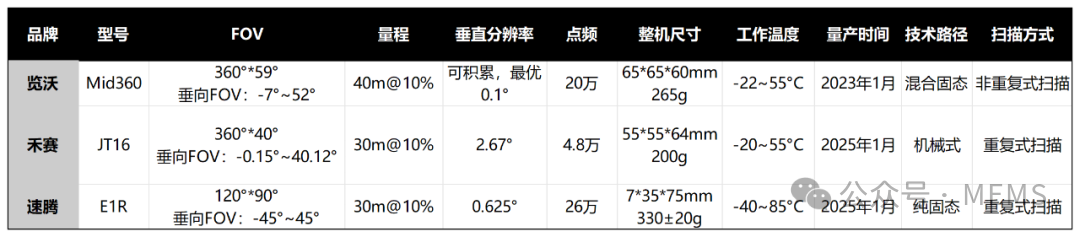
This article focuses on three representative laser radar products in robotic navigation and obstacle avoidance: Lanwo Mid360, Hesai JT16, and Suton E1R. First, we present a core parameter comparison table for the three radars for easy visual comparison.
01
Lanwo Mid360: Non-repetitive Scanning + Long Range
The core feature of the Lanwo Mid360 is its non-repetitive scanning technology. Unlike the repetitive scanning mode of traditional laser radars that can lead to “striped voids” in point clouds, the unique non-repetitive scanning of the Mid360 effectively addresses this issue (as shown below), improving spatial resolution with increased integration time. With a range of 40m and a 360°×59° FOV, the detection coverage distance and range have increased.
Scene Adaptability: Precise Perception in Multiple Scenarios
In the mowing scenario, the Lanwo Mid360’s long range and wide FOV can cover large areas of lawn, improving mapping efficiency, and the high-density point cloud helps accurately identify small obstacles (such as stones, low shrubs, toys, and small animals), providing stable environmental perception support for mowing equipment.
For most robots, shopping malls are one of the most complex scenarios, with materials such as glass, tiles, and metal, as well as moving pedestrians, placing high demands on sensors. From official tests of the Mid360, it can be seen that the robot can detect features in complex scenes, and with the anti-sunlight interference function, it can model both indoor and outdoor scenes.
In unmanned handling scenarios, the Lanwo Mid360 has a point cloud density advantage of 200,000 points/second, combined with non-repetitive scanning to clearly present the details of pallet contours, guiding AGVs to accurately identify standard pallets and non-standard irregular pallets, providing robust data for precise pick-and-place, theoretically reducing collision risks.
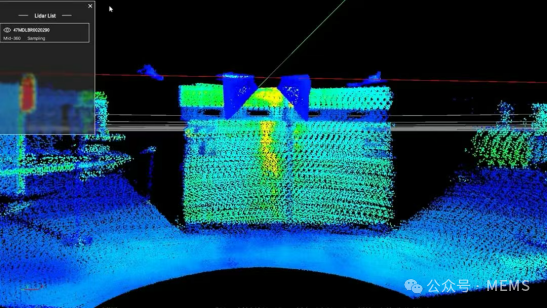
Point cloud effect of the pallet with 3s integration for Mid-360
As a product released in 2023, the Mid360 still has advantages in measurement range, FOV, and other core parameters, but in the increasingly competitive laser radar market, whether Lanwo can maintain performance advantages while effectively controlling costs to provide more cost-effective products is worth our attention. In addition, the performance ceiling of non-repetitive scanning is higher, and the Mid360 still has significant algorithm development potential. As the team’s core business gradually focuses on drones and robots, the application exploration of Lanwo in related scenarios is worth looking forward to.
02
Hesai JT16: Lightweight + Low Power Design
The Hesai JT16 features a compact design, with a total weight of only 200g, and low power characteristics, making it easy to integrate into small devices. The 360°×40° field of view allows for safe operation of robots in all directions, and in terms of cost control, the JT16 has a certain cost-performance advantage among similar products, suitable for scenarios sensitive to weight, power consumption, and price.
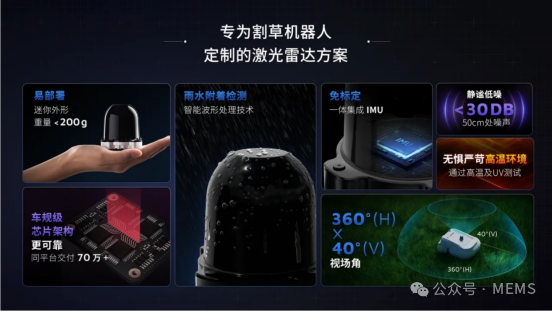
Scene Adaptability: Focus on Miniaturization and General Integration
In small scene applications such as mowing scenarios, the lightweight advantage of the Hesai JT16 is significant, with a diameter of 55mm and a height of 64mm, weighing 200g, making it suitable for portable robots and small service devices that have strict requirements for weight and size.
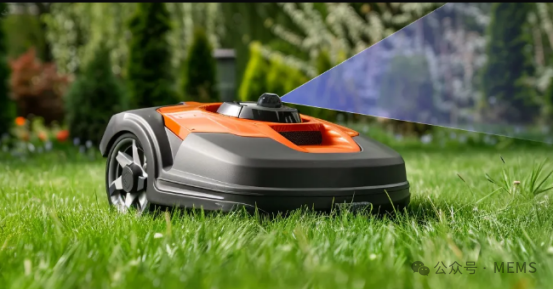
In terms of general integration, the lightweight design makes it easy to embed in various embedded systems, making designs more aesthetically pleasing, and the 4.3W low power advantage also shows application potential in consumer-grade robots and lightweight industrial equipment.
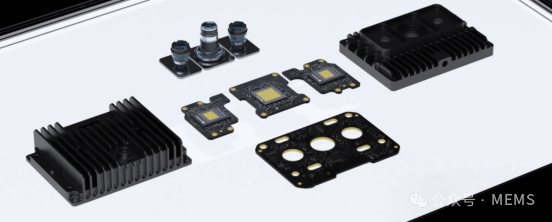
Previously, Hesai primarily targeted the automotive market, and the JT16, as a new product released in 2025, provides another option for mini 3D laser radars in the robotics field, with a range of 30m@10% that can meet the needs of most small robot scenarios. However, from the parameters, the JT16’s point cloud density is 48,000 points/second, which is lower compared to the other two laser radars, and in complex or open environments, better algorithms and data support are needed to ensure stable navigation and obstacle avoidance.
03
Suton E1R: Automotive-grade Solid-State Flash Radar with 120°×90° FOV
The Suton E1R adopts automotive-grade design standards, with a working temperature range covering -40℃ to 85℃, suitable for extreme environments, and its pure solid-state architecture theoretically better withstands continuous high-frequency vibrations in complex robotic scenarios.
Vertical 90° FOV, with 45° up and down, can effectively cover the near-ground blind spots when installed horizontally, reducing collision risks. The 0.625°×0.625° angular resolution helps identify small obstacles near the ground or suspended.
Scene Adaptability: Suitable for Harsh Environments & Special Scenarios
In extreme environment scenarios, the Suton E1R’s wide temperature characteristics and automotive-grade design ensure stable operation of the equipment in severe cold and high-temperature environments, assisting robots in adapting to outdoor inspections, special operations, and cold chain handling in scenarios with high environmental tolerance requirements..

In road and port modeling scenarios, the E1R has high modeling efficiency. The E1R can output up to 260,000 points per second, with 144 lines of point cloud neatly arranged, allowing for precise detection of various dynamic and static small obstacles, efficiently completing 3D mapping.
Also as a new product in 2025, the Suton E1R has the product advantage of automotive-grade reliability, but how to quickly find suitable robotic scenarios and thoroughly refine and validate them may be the primary goal for the E1R. The E1R adopts a 120° horizontal field of view, which limits its large scene coverage capability compared to the other two 360° scanning solutions. It can meet omnidirectional positioning and edge operation needs by increasing deployment points or using other sensors, but this will also lead to further cost increases.
04
Technical Routes Determine Scene Adaptation Directions
-
The Lanwo Mid360, with its non-repetitive scanning technology providing long range, wide field of view, and high precision advantages, is suitable for multiple robotic fields that require high perception accuracy and coverage, such as intelligent mowing, outdoor cleaning, and unmanned logistics handling.
-
The Hesai JT16 focuses on lightweight, low power, and cost advantages as its core, entering low-speed robotic scenarios such as mowing through a hemispherical + ring scanning solution, continuously providing customers with high cost-performance laser radar products.
-
The Suton E1R relies on automotive-grade reliability, wide temperature adaptability, and solid-state radar technology, aiming to penetrate outdoor and special robot markets with stringent environmental adaptability requirements, and we expect Suton to replicate its successful experience in the automotive front-end field to the robotics market.
In summary, from the perspective of technical routes and product positioning, the three laser radars exhibit differentiated scene adaptability capabilities. The Lanwo Mid360, as a mature solution mass-produced in 2023, has completed large-scale verification in scenarios such as lawn mowers and AGVs, accumulating a high level of industry recognition. However, the market is ever-changing, and continuous innovation is essential for progress. The entry of more players like Hesai and Suton is accelerating the innovation of laser radar technology and the iteration of solutions, driving products towards high reliability and strong scene generalization capabilities. This is not just a competition of individual products, but a process of upgrading the entire robotic perception technology.