1083 – Palindromic Numbers
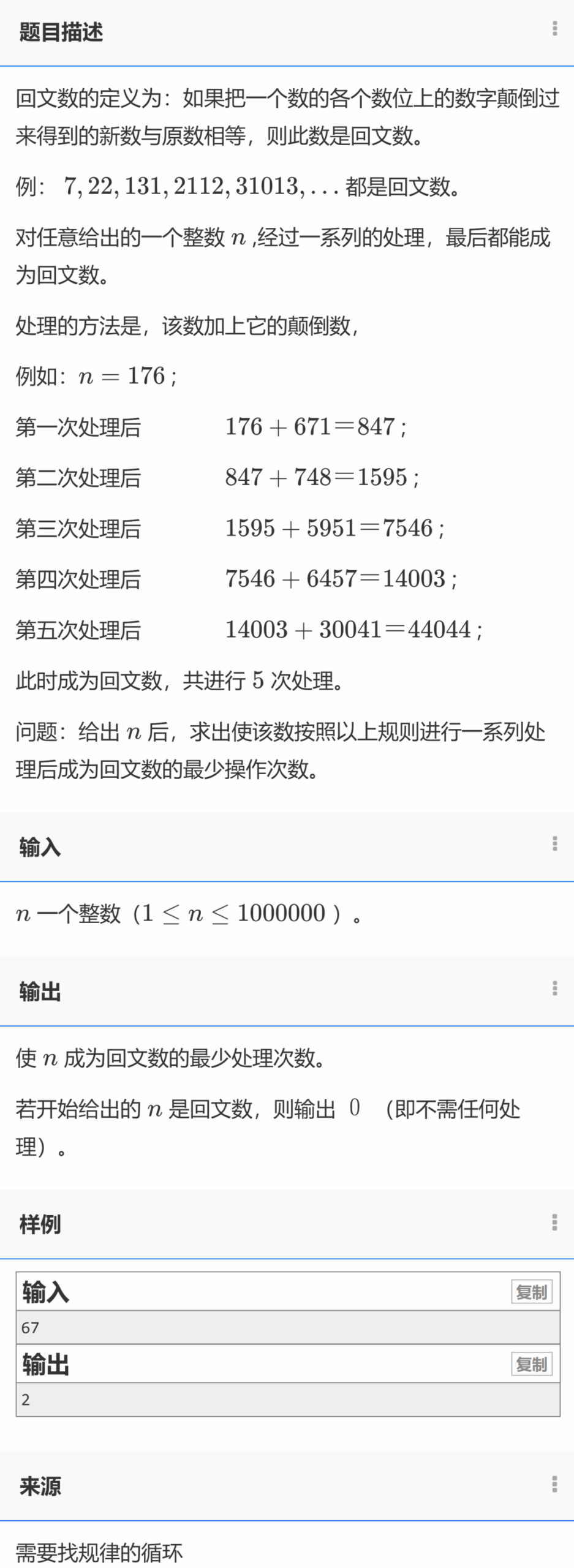
This program addresses an interesting mathematical problem: How many steps does it take to turn a number into a palindromic number by continuously adding it to its reverse?
What is a palindromic number?
It is a number that reads the same forwards and backwards, like “12321”.
How does the program work?
-
First, we write a small utility (
<span>fun</span>function) that helps us reverse a number. For example, inputting 123 will return 321. -
Then, we prompt the user to input a number (for example, 57).
-
We start checking: Is this number a palindromic number?
-
If not, we perform addition: number + its “reverse” (57 + 75 = 132)
-
Record this as step 1
Check if the new number (132) is a palindromic number?
-
132 + 231 = 363, this is step 2
-
Now 363 is a palindromic number, stop!
Finally, inform the user: it took 2 steps
Why is it designed this way?
-
Using the
<span>fun</span>function specifically for reversing numbers makes the main program clearer -
Using a
<span>while</span>loop to continuously check until a palindromic number is obtained -
Using the
<span>c</span>variable as a counter to record how many times addition has been performed
Reference Code
#include<bits/stdc++.h> // Include all standard library headers to avoid the hassle of including them individually
using namespace std;    // Use the standard namespace, allowing direct use of cout/cin, etc.
// Define the function to reverse a number
int fun(int n){    int r = 0; // Variable to store the reversed number
    // Reverse the number using short division
    while(n != 0){          // Continue while n has not been fully divided
        r = r * 10 + n % 10; // Add the last digit of n to r
        n = n / 10;         // Remove the last digit from n
    }    return r; // Return the reversed number}
int main() {    // Test code, can be removed in the final program
    // cout << fun(123); // Should output 321
    int n, c = 0; // n is the user input number, c is the counter (step count)
    cin >> n;     // Get the number from the user
    // Continue looping as long as n is not a palindromic number
    while(n != fun(n)){        c++;             // Increment step count
        n = n + fun(n);  // Add the number and its reverse
    }
    cout << c; // Output the required number of steps
    return 0;  // Program ends normally}
1. What does the program do?
This program calculates how many times you need to repeatedly “add its reverse” to a given number to obtain a palindromic number. For example:
-
Input 56 → 56 + 65 = 121 → 1 step
-
Input 57 → 57 + 75 = 132 → 132 + 231 = 363 → 2 steps
2. Core Function Analysis
<span>fun</span> function – Number Reverser:
-
Working principle: Like peeling an onion, take each digit from right to left
-
<span>n % 10</span>gets the last digit (for example, 123 % 10 = 3) -
<span>n / 10</span>removes the last digit (123 / 10 = 12) -
<span>r = r * 10 + digit</span>appends the digit to the right -
Example:
-
Input: 123
-
Process:
-
r = 0 * 10 + 3 = 3, n = 12
-
r = 3 * 10 + 2 = 32, n = 1
-
r = 32 * 10 + 1 = 321, n = 0 → return 321
3. Main Program Flow
① Preparation Stage
-
<span>int n, c=0</span>: Create two “boxes” -
n: stores the number given by the user
-
c: records the number of additions, initially 0
② Input Number
-
<span>cin >> n</span>: Prompt the user to input a number
③ Palindromic Check Loop
-
<span>while(n != fun(n))</span>: Check if the current number is a palindromic number -
<span>c++</span>: Record another addition -
<span>n = n + fun(n)</span>: Add the number to its “reflection” -
When it is not a palindromic number:
-
This loop will continue until the number becomes palindromic
④ Output Result
-
<span>cout << c</span>: Inform the user how many steps are needed
4. Important Details
-
Why use a while loop: Because we do not know how many times we need to add, we must keep trying until a palindromic number appears
-
Purpose of c: Like counting jumps in a physical education class, increment by 1 each time you jump
-
Palindromic Check Technique: Directly compare the number with its reverse to see if they are the same
-
Number Reversal Principle: Utilize the property of integer division that removes the decimal point
5. Actual Running Example
User input: 196
Calculation process:
-
196 + 691 = 887 → c=1
-
887 + 788 = 1675 → c=2
-
1675 + 5761 = 7436 → c=3
… (may take many steps, some numbers require many steps)
6. Notes
-
Not all numbers can quickly become palindromic; some require many steps
-
If the number is too large, it may exceed the int range (consider using long long)
-
This program does not handle negative number inputs
7. How to Test Yourself
You can modify the code to add a line in the loop:
cout << "Step " << c << ": " << n << " + " << fun(n) << " = " << n + fun(n) << endl;This way, you can see the calculation process at each step.
I hope this explanation helps beginners fully understand this program! If there are still unclear points, you can try to follow the program step by step with pen and paper.