IntroductionIn the fields of electronics and digital communication, the SPI (Serial Peripheral Interface) protocol stands out for its flexibility and speed. However, when it comes to connecting multiple devices, traditional SPI configurations can quickly become cumbersome in terms of wiring and resource management. This is where the concept of Daisy Chain SPI emerges, providing an elegant solution that revolutionizes the management of serial devices and offers an efficient and cost-effective alternative for the design of complex electronic systems. This article explores the unique advantages of Daisy Chain SPI compared to traditional configurations and highlights the innovations it brings to the design of complex electronic systems.
1. Working Principle of Traditional SPITraditional SPI uses synchronous communication, involving COPI (Controller Output, Peripheral Input) and CIPO (Controller Input, Peripheral Output) lines between the controller and multiple devices, along with a clock line (SCLK) and chip select line (CS: Chip Select). Each device requires its own CS line, which can complicate connection management as the number of devices increases. For a deeper understanding of the differences between communication protocols, including SPI, please refer to our comparison article on ParlezVousTech.
Despite certain limitations in device management and wiring complexity, the principles of Daisy Chain SPI provide an elegant solution to these challenges. Now, let’s explore this advanced configuration that simplifies the connection of multiple devices while maintaining the efficiency of the SPI protocol.
2. Principles of Daisy Chain SPIIn Daisy Chain SPI, devices are connected in series through a single chip select line (CS), forming a chain. Unlike traditional SPI, where each device requires its own CS line, this configuration allows data to be passed sequentially from one device to the next. Each device receives data from the controller, processes it, and then passes it to the next device in the chain. This greatly reduces the number of required connections, simplifying system design. Additionally, Daisy Chain SPI allows for the addition or removal of devices without disrupting the entire network, providing greater flexibility in hardware resource management. This approach also enhances signal integrity by minimizing potential interference, which is a significant advantage for systems requiring high communication reliability.
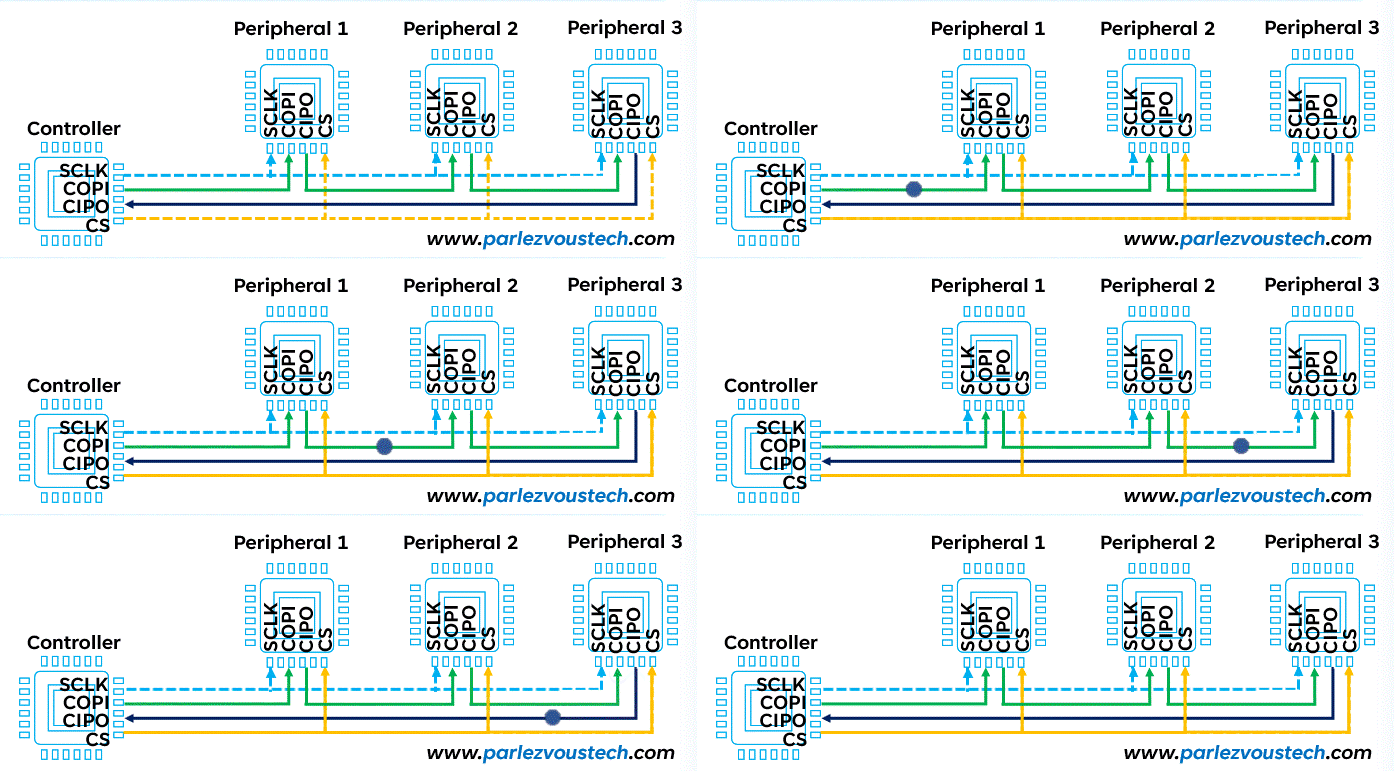
3. Advantages of Daisy Chain Compared to Traditional SPIDaisy Chain SPI offers several advantages over traditional SPI, particularly in significantly reducing wiring complexity and associated costs, as it requires fewer chip select lines (CS) when connecting multiple devices. This configuration also simplifies the addition or removal of devices without the need to completely reorganize the system. Furthermore, Daisy Chain SPI improves signal integrity for long-distance transmission, reducing the risk of interference and enhancing the reliability of communication between the controller and devices.
4. Disadvantages of Daisy ChainThe drawbacks of Daisy Chain SPI include the potential reduction in data transfer speed, as each device in the chain may introduce delays. Managing device errors and fault detection may also be more complex, as data must pass through multiple points before reaching its final destination. Additionally, the design and debugging of Daisy Chain systems may be more complicated than traditional SPI configurations, requiring special attention to communication order and signal integrity.
5. Comparison Table of Traditional SPI and Daisy ChainTo clarify the choice between traditional SPI and Daisy Chain, a comparison table is essential. It highlights the fundamental differences and helps understand how each configuration fits different design requirements. Additionally, the aspects of software implementation are a key factor for developers when selecting a communication protocol.
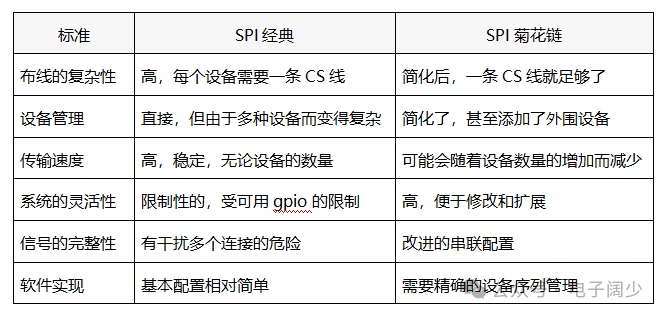
The table summarizes key considerations, facilitating decision-making between traditional SPI architecture and Daisy Chain configuration based on specific project requirements.
6. Implementation Example of Daisy Chain SPI
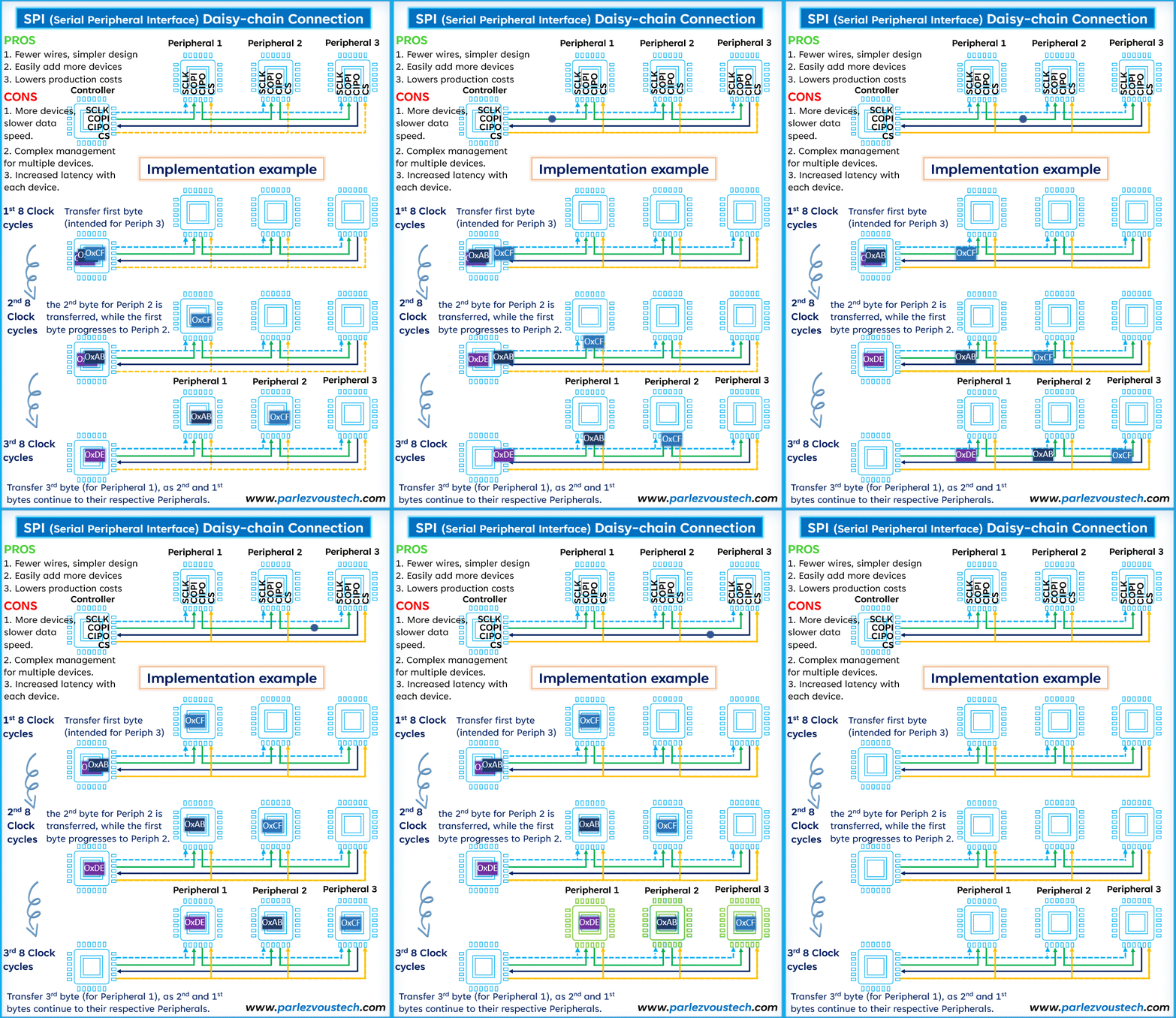
In our implementation example of Daisy Chain SPI, data transmission between the controller and three devices occurs over multiple clock cycles, with each cycle consisting of 8 clock pulses, demonstrating the sequential propagation of data bytes among devices.
Detailed Transmission SequenceFirst 8 Clock Cycles: The controller sends 0xCF. During this cycle, 0xCF is loaded into Device 1.Second 8 Clock Cycles: The controller sends 0xAB. Meanwhile, 0xCF is passed from Device 1 to Device 2, while 0xAB is loaded into Device 1.Third 8 Clock Cycles: The controller sends 0xDE. At this point, 0xCF reaches Device 3, 0xAB is passed from Device 1 to Device 2, and 0xDE is loaded into Device 1.Response ManagementAfter these three 8 clock cycles, each device has received its dedicated byte. Device 3, which received 0xCF, sends a response back to the controller.
Software Implementation ConsiderationsInitialization: Prepare the SPI controller to handle the transmission sequence, including configuring the SPI mode and clock frequency.Transmission Loop: Precise management of the transmission loop is crucial to ensure bytes are sent in the correct order and timing.Listening for Responses: The controller must be ready to receive the response from the last device after the transmission sequence, which requires special attention to synchronization and the integrity check of received data.This Daisy Chain SPI transmission sequence demonstrates the efficiency of managing multiple devices in serial communication while minimizing the use of connection resources. It emphasizes the importance of precise synchronization and meticulous programming for achieving effective bidirectional communication in complex systems.
7. Typical Applications of Daisy ChainDaisy Chain SPI is typically applied in areas where efficient management of multiple devices is crucial. It is commonly used in embedded systems, sensor networks, and communication devices, where space and cost reduction are critical.
In instrumentation and measurement systems: Daisy Chain SPI configurations are particularly suitable for connecting analog-to-digital converters (ADC) or digital-to-analog converters (DAC) among a series of precision measurement devices. It allows for sequential reading of multiple sensors’ data without adding CS lines, optimizing circuit design and system response.
In LED or LCD display management: For complex displays requiring individual control of multiple segments or LEDs, Daisy Chain SPI simplifies the connection between the controller and display modules. This approach facilitates the expansion of display capabilities without compromising update speed or the complexity of signal routing.
For digital I/O expansion: SPI shift registers configured in a Daisy Chain can increase the number of available digital outputs for microcontrollers. This method is particularly well-suited for applications requiring a large number of digital commands, such as LED matrix control or complex user interface management.
In embedded systems and automation: Daisy Chain configurations are especially useful for systems requiring fast and reliable communication between a central controller and a series of sensors or actuators. It significantly simplifies wiring and better manages space on printed circuit boards, which is crucial in space-constrained environments or where high connection density is needed.
Conclusion
The Daisy Chain SPI configuration is an innovative and effective solution for managing communication between controllers and multiple devices in many electronic systems. By reducing wiring complexity and optimizing hardware resource usage, it provides significant flexibility for the design and evolution of embedded systems. Although this approach presents some challenges, such as delay management and the complexity of software implementation, the advantages in simplifying design and saving space are undeniable. Typical applications in industrial automation, instrumentation systems, and consumer electronics showcase the versatility and efficiency of Daisy Chain SPI. Designers can leverage this configuration according to the specific characteristics of each project to develop more powerful, scalable, and cost-effective communication systems.