Click↑↑Jicheng Training, follow and pinto subscribe for free long-term
180,000+industrial control people follow this WeChat platform: technical sharing, learning exchange, industrial control videos
PLC networks are composed of several levels of subnets, and the communication process of each level is determined by communication protocols, while the communication methods are the core content of these protocols. Communication methods include access control methods and data transmission methods. The so-called access control method (also known as access control) refers to the issue of how to obtain the right to use the shared communication medium, while the data transmission method refers to how to transmit data after a station has obtained the right to use the communication medium.
1. Cyclic I/O Communication Method
The cyclic I/O communication method is commonly used in remote I/O links of PLCs. Remote I/O links operate in a master-slave manner, with the PLC remote I/O master unit as the master station and other remote I/O units as slave stations. A “remote I/O buffer” is established in the master station, using a mailbox structure, divided into several sub-boxes corresponding to each slave station—each sub-box is further divided into two sections, one for sending and one for receiving. The communication processor in the master station adopts a cyclic scanning method, sequentially exchanging data with each slave station, sending the data from the corresponding sub-box to the slave station, and reading data from the slave station into the corresponding sub-box’s receiving section. This process repeats, refreshing the “remote I/O buffer” in the master station cyclically.
In the master station, the CPU unit of the PLC is responsible for scanning the user program, processing in a cyclic scanning manner, where a segment of time is concentrated for I/O processing during each cycle, at which time it performs read and write operations on the local I/O unit and the remote I/O buffer. The periodic cyclic scanning of the PLC’s CPU unit and the periodic scanning of the communication processor for each remote I/O unit are asynchronous. Although the PLC’s CPU unit does not directly operate on the remote I/O units, the periodic refresh of the remote I/O buffer means that the read and write operations on the remote I/O buffer are equivalent to directly accessing the remote I/O units. This communication method is simple and convenient but occupies the PLC’s I/O area, so it is only suitable for communication of small amounts of data.
2. Global I/O Communication Method
The global I/O communication method is a serial shared memory communication method mainly used for communication between PLCs with link areas.
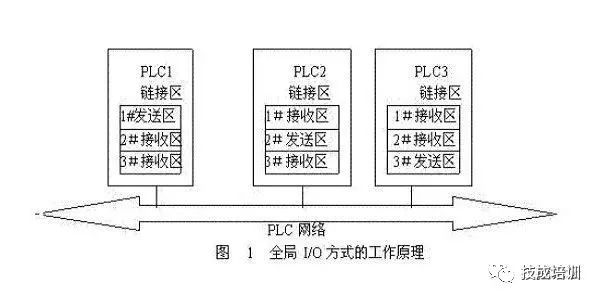
The communication principle of the global I/O method is illustrated in the above image. In each PLC’s I/O area in the PLC network, a block is designated as a link area, and each link area adopts a mailbox structure. The sending area and receiving area with the same number are of the same size, occupying the same address range, one being the sending area and the others being receiving areas. Communication is done using a broadcast method. PLC1 broadcasts the data from the 1# sending area on the PLC network, and PLC2 and PLC3 receive and store it in their respective 1# receiving areas. PLC2 broadcasts the data from the 2# sending area on the PLC network, and PLC1 and PLC3 receive and store it in their respective 2# receiving areas. PLC3 broadcasts the data from the 3# sending area on the PLC network, and PLC1 and PLC2 receive and store it in their respective 3# receiving areas. It is evident that through the above broadcast communication process, the data in the link areas of PLC1, PLC2, and PLC3 are the same; this process is called the equalization process. Through equalization communication, the data in the link area of each PLC in the PLC network remains consistent. It contains not only the data it sends out but also the data sent by other PLCs. Since each PLC’s link area is the same size and occupies the same address range, accessing its own link area is equivalent to accessing the link areas of other PLCs, thus facilitating data exchange with other PLCs. This way, the link area becomes a true shared memory area, and the shared area becomes a medium for data exchange among PLCs.
The link area can be refreshed asynchronously (equalization) or synchronously. Asynchronous refresh is independent of the user program in the PLC, with each PLC’s communication processor performing broadcast communication in sequence, maintaining equalization in all link areas; synchronous refresh is initiated by a send instruction in the user program, refreshing only when the data in the link area’s sending section changes.
In the global I/O communication method, the PLC directly performs read and write operations on the link area, which is simple, convenient, and fast; however, it should be noted that a write operation on a certain address in one PLC can only be read in other PLCs for the same address. Like the cyclic I/O method, the global I/O method also occupies the PLC’s I/O area, hence it is only suitable for communication of small amounts of data.
3. Master-Slave Bus Communication Method
The master-slave bus communication method, also known as 1:N communication method, refers to a bus-structured PLC subnet with N stations, where there is only 1 master station and the others are slave stations.
The 1:N communication method uses centralized access control technology to allocate bus usage rights, typically employing a polling table method. The so-called polling table is an ordered list of slave station numbers configured in the master station, which polls the slave stations in the order of the list to determine if they need to use the bus, thereby achieving the purpose of allocating bus usage rights.
For stations with high real-time requirements, the polling table can allow their slave station numbers to appear multiple times, granting that station higher communication priority. In some 1:N communications, the polling table method is combined with interrupt methods, allowing urgent tasks to interrupt normal cyclic polling and gain priority.
In the 1:N communication method, when a slave station obtains bus usage rights, there are two data transmission methods. One only allows master-slave communication, not slave-to-slave communication; for slave stations to exchange data, they must go through the master station. The other allows both master-slave communication and slave-to-slave communication; after a slave station obtains bus usage rights, it first arranges master-slave communication, then arranges communication with other slave stations.
4. Token Bus Communication Method
The token bus communication method, also known as N:N communication method, refers to a bus-structured PLC subnet with N stations, all of which are equal with no distinction between master and slave, meaning that all N stations can be considered as master stations.
The N:N communication method uses token bus access control technology. A logical ring is formed on the physical bus, allowing a token to circulate in a specific direction; the station that obtains the token gains bus usage rights. The token bus access control method limits each station’s token holding time, ensuring that each station has the opportunity to obtain bus usage rights as the token circulates around, and provides priority services, thus ensuring good real-time performance.
The station that obtains the token has two data transmission methods: unacknowledged data transmission and acknowledged data transmission. In the unacknowledged data transmission method, the station that obtains the token can immediately send data to the destination station, and once the sending is complete, the communication process is finished; in the acknowledged data transmission method, the communication process is not complete until the destination station has obtained the token and sent an acknowledgment frame back to the sending station. The latter has a significantly increased response time, resulting in decreased real-time performance.
5. Floating Master Communication Method
The floating master communication method, also known as N:M communication method, is suitable for bus-structured PLC networks, referring to a bus with M stations, among which N (N < M) are master stations, and the rest are slave stations.
The N:M communication method combines token bus and master-slave bus access control technology. First, N master stations form a logical ring, with the token circulating among them to allocate bus usage rights, which is the meaning of floating master. The master station that obtains bus usage rights then determines which stations to communicate with during its token holding time according to a polling table configured in the master station, polling the other master and slave station numbers arranged on the polling table.
The master station that obtains bus usage rights can use various data transmission methods to communicate with the destination station, with the unacknowledged connectionless method being the fastest.
6. CSMA/CD Communication Method
The CSMA/CD communication method is a random communication method suitable for bus-structured PLC networks, where all stations are equal with no distinction between master and slave, using the CSMA/CD access control method, i.e., “listen before talk, talk while listening.”
The CSMA/CD access control method cannot guarantee that each station on the PLC network can obtain bus usage rights within a certain time period, making it a non-real-time access control method. However, it employs a random method, which is simple, and can utilize communication resources efficiently as long as the bus is free, thus making the CSMA/CD communication method suitable for upper-level production management subnets in PLC networks.
The data transmission methods in CSMA/CD communication can include connected, unconnected, acknowledged, unacknowledged, and broadcast communication, allowing for selection based on communication speed and reliability requirements.
The above are the commonly used communication methods in PLC networks; additionally, there are a few PLC networks that adopt other communication methods, such as token ring communication. Furthermore, in some PLC networks, multiple communication methods are often integrated and configured at a certain level of subnet, which is a trend in future technological development.
Source: Network, copyright belongs to the original author, deletion upon infringement
 If you like it, remember to click Read More
Click↓Read the original text, for more free learning on electrical engineering and PLC content!