In modern automotive manufacturing plants, the efficient collaboration between Automated Guided Vehicles (AGV) and Programmable Logic Controllers (PLC) is a key factor in ensuring smooth production. This article analyzes typical issues and their solutions encountered during the interaction between AGVs and PLCs based on a real case from an automotive battery pack production line, providing technical references for the industry.
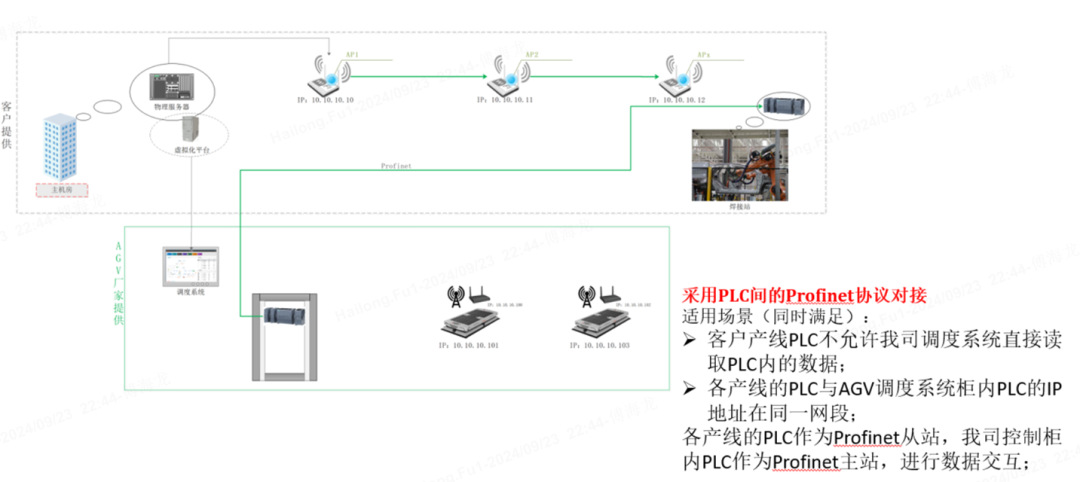
1. Analysis of the Standard Interaction Process between AGV and PLC
In automated production lines, the interaction between AGVs and PLCs follows a standardized signal transmission mechanism:
-
Request to Enter Phase: The AGV continuously sends a request signal to enter the workstation until it receives an entry permission command from the PLC, at which point it stops sending. This mechanism ensures that the AGV does not enter the workstation until it is ready.
-
Entering Phase: The AGV begins to send an “entering” signal, and the PLC temporarily disables the workstation’s safety light curtain, allowing the AGV to enter. This signal continues until the AGV sends a “positioned” signal.
-
Positioned Working Phase: After the AGV is positioned, it continuously sends a “positioned” signal, and the PLC starts executing workstation-specific process operations, sending an exit permission signal upon completion.
-
Leaving Phase: After receiving the exit permission signal, the AGV first turns off the positioned signal while sending an “exiting” signal, and the PLC uses this signal to disable the light curtain again. Once the AGV completely leaves the light curtain area, it stops sending the exit signal, and the PLC restores the normal function of the light curtain.
This seemingly simple signal interaction process faces many challenges in practical applications. The following sections will categorize common issues and their countermeasures.
2. Classification of Typical Issues and Technical Solutions
1. Signal Interaction Anomalies
Case 1: The AGV’s positioned signal at the glue application station was not cleared in time.
- Phenomenon: After the AGV completed the glue application and left, the positioned signal was not cleared properly, preventing subsequent AGVs from entering.
- Root Cause Analysis: Logs show that the AGV sent the exit signal, but the PLC status was not cleared properly. Possible reasons include network packet loss or PLC program logic defects.
- Solution:
- Use network testing tools to verify signal transmission reliability.
- Add a status timeout auto-reset mechanism in the PLC program.
- Add signal status visualization monitoring functionality to the AGV operation interface.
Case 2: The AGV’s rework online function at the EOL testing station failed.
- Phenomenon: The rework package could not be automatically loaded onto the AGV, requiring manual intervention.
- Root Cause Analysis: The rework route logic was not fully implemented in the system, and the AGV’s path planning lacked critical nodes.
- Solution:
- Complete the configuration of virtual stations for the rework route.
- Add rework task trigger logic in the MES system.
- Add a special task handling module in the AGV control system.
2. Navigation and Positioning Issues
Case 3: The AGV did not stop at the designated position at the plasma cleaning station.
- Phenomenon: After manually recognizing the ground code, the AGV did not stop at the workstation’s stopping point and passed through directly.
- Root Cause Analysis: The ground code layout within the workstation was incomplete, and the AGV lacked precise position references.
- Solution:
- Add high-precision ground codes at the workstation stopping point.
- Optimize the AGV’s code reader parameter settings.
- Add transitional guiding markers between ground codes.
Case 4: The AGV deviated at the upper cover bolt tightening station.
- Phenomenon: The AGV’s driving trajectory deviation led to visual detection failure.
- Root Cause Analysis:
- Changes in the AGV’s dynamic characteristics after acceleration.
- Excessive spacing between ground codes, leading to decreased navigation accuracy.
- Solution:
- Reduce the turning speed from 300mm/s to 200mm/s.
- Densify the layout of critical workstation ground codes (reduce spacing by 30%).
- Add path compensation parameters in the AGV control algorithm.
3. System Coordination Issues
Case 5: AGV Stagnation Between Workstations.
- Phenomenon: After completing work at the current workstation, the AGV does not immediately proceed to the next workstation and must wait for the downstream AGV to leave.
- Root Cause Analysis: Lack of virtual transition stations between workstations, leading to discontinuous AGV path planning.
- Solution:
- Add virtual waiting stations between workstations.
- Optimize the AGV task scheduling algorithm to achieve “request to enter/leave without stopping” functionality.
- Add workstation status prediction logic in the PLC program.
Case 6: Uneven AGV Distribution at the SOC Testing Station.
- Phenomenon: Multiple AGVs concentrate on requesting the same testing workstation, while other idle workstations are not utilized.
- Root Cause Analysis: The task allocation algorithm did not consider workstation load balancing.
- Solution:
- Implement real-time monitoring of workstation busy/idle status in the scheduling system.
- Develop a dynamic allocation algorithm for AGVs based on load balancing.
- Add workstation priority management functionality in the MES.
3. System Optimization and Preventive Measures
Based on the analysis of the above issues, we summarize the following systematic optimization plans:
-
Network Architecture Optimization:
- Implement IP address pool management to prevent IP conflicts between AGVs.
- Use industrial-grade switches to achieve AGV network isolation.
- Deploy a network signal quality monitoring system.
Improving Equipment Reliability:
- Establish a regular calibration system for AGVs (recommended once a week).
- Add auxiliary positioning sensors at critical workstations.
- Implement an AGV battery management system, setting a 30% battery level automatic offline threshold.
Human-Machine Interaction Improvement:
- Integrate a task cancellation function into the AGV operation interface.
- Develop a signal status visualization monitoring interface.
- Implement automatic identification of faulty AGVs.
Program Logic Improvement:
- Add a status timeout auto-reset function in the PLC.
- Optimize the handshake protocol between AGV and PLC.
- Develop a safe recovery process for abnormal situations.
4. Experience Summary and Industry Recommendations
Through in-depth analysis of these issues, we draw the following important insights:
-
The Importance of Testing and Verification: Many issues stem from insufficient verification after program changes (e.g., AGV over-stop issues). It is recommended to establish a strict change management process.
-
System Coordination Design: AGVs, PLCs, and MES must be designed as an integrated system; merely optimizing individual links often yields limited results.
-
Parameter Fine-Tuning: Parameters such as AGV speed and ground code spacing need to be dynamically optimized based on actual working conditions; there is no universal optimal value.
-
Preventive Maintenance System: Establish a data-driven predictive maintenance mechanism to avoid problems rather than addressing them after they occur.
-
The Criticality of Personnel Training: Most operational issues stem from insufficient understanding of the system, necessitating enhanced cross-departmental technical training.
As automotive manufacturing evolves towards flexibility and intelligence, the stability and intelligence level of AGV systems will become key factors limiting production efficiency. The cases and experiences described in this article can provide valuable references for the industry, helping enterprises avoid pitfalls in their digital transformation.
Next Issue Preview: We will delve into the special application challenges of AGVs in automotive assembly workshops, including complex interaction scenarios with hanging chains, elevators, and other equipment. Stay tuned.
—END—Previous Recommendations:
AGV Practical Operation: RFID Landmark System Technology Breakdown and Practical Guide
[Recommended] Detailed Motor Selection Steps in Various Logistics Scenarios
In-Depth Analysis of Action Logic for Box-Type Four-Way Shuttle Vehicles: The Core Engine of Intelligent Warehousing