Click 【Industrial Automation Insights】 to follow us!
Source: Electrical Automation Learning
How are PLCs classified?
1. Classification by Structural Composition
PLCs can be divided into two categories: one is the integrated PLC (also known as unit type), characterized by the integration of the power supply, central processing unit, and I/O interfaces within a single enclosure;
the other is the standard modular structured PLC (also known as combination type), which features independent structural modules for the power supply, central processing unit, and I/O modules. These can be selected based on specific application requirements and installed in a fixed rack or rail to form a complete PLC application system.
2. Classification by I/O Point Capacity
(1) Small PLC: The I/O point count of small PLCs is generally below 256 points, such as Siemens’ S7-200SMART PLC.
(2) Medium PLC: Medium PLCs adopt a modular structure, with I/O point counts generally ranging from 256 to 1024, such as Siemens’ S7-300 PLC.
(3) Large PLC: PLCs with I/O point counts generally exceeding 1024 are referred to as large PLCs, such as Siemens’ S7-400 PLC.
What are the performance indicators of PLCs?
Although each manufacturer’s PLC has its unique features, their main performance indicators are similar.
(1) Input/Output Point Count
The input/output (I/O) point count is the most important technical indicator, referring to the number of external input and output ports connected on the PLC panel, commonly referred to as “points,” represented by the sum of input and output points. The more points, the more inputs and outputs the PLC can connect, indicating a larger control scale.I/O point count is one of the most important indicators when selecting a PLC.
(2) Scan Time
Scan time refers to the speed at which the PLC executes programs, measured by the time required to execute 1K instruction steps (usually in ms). One step occupies one address unit.
(3) Memory Capacity
Memory capacity is commonly expressed in K words (KW), K bytes (KB), or K bits (Kbit). Here, 1K = 1024. Some PLCs measure in steps, with one step occupying one address unit. Memory capacity indicates how many user programs the PLC can store.
For example, the Mitsubishi FX2N-4SMR PLC has a memory capacity of 8000 steps. Some PLCs can have their memory capacity configured according to needs, while others can have expandable memory.
(4) Instruction System
The instruction system indicates the strength of the PLC’s software functions. The more instructions available, the stronger the programming capabilities.
(5) Internal Registers (Relays)
The PLC has many internal registers for storing variables, intermediate results, data, etc., along with many auxiliary registers available for user use. Therefore, the configuration of registers is also an indicator of PLC functionality.
(6) Expandability
Expandability is one of the important indicators reflecting PLC performance. In addition to the main control module, PLCs can also be configured with high-function modules for various special functions, such as A/D modules, D/A modules, high-speed counting modules, remote communication modules, etc.
Comparison of PLCs and Relay Control Systems
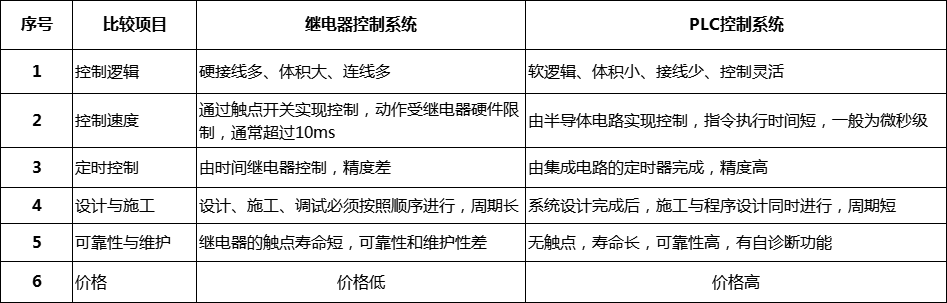
Before the advent of PLCs, hardwired relay circuits were the only executors of logic and sequential control, characterized by their simple structure and low cost, and were widely used.
With the emergence of PLCs, they have surpassed relay control systems in almost all aspects. The comparison between the two is shown in the table below.
The development trends of PLCs include the following aspects:
1. Development towards high performance, high speed, and large capacity
2. Networking, enhancing communication capabilities
3. Miniaturization, low cost, and ease of use
4. Continuous improvement of programming software functions
5. New modules suitable for PLC applications
6. Software-based and miniaturized PLCs

↓
Long press the QR code to register online