Author: Chen Minshan, Zhou Zhongguo, Xu Li, Zhang Yaojun, Lin Ximeng
Source: Chinese Journal of Digestive Surgery, 2021, 20(12)
Abstract
Currently, there is controversy regarding the definition, classification, and Chinese naming of ICC (intrahepatic cholangiocarcinoma). It is unclear whether ICC belongs to liver cancer or bile duct cancer, and the terms “intrahepatic bile duct cancer” and “cholangiocarcinoma” are used interchangeably in clinical practice, causing confusion in actual work. Based on authoritative literature at home and abroad, the authors propose new suggestions on the classification and Chinese naming of ICC, indicating that the Chinese translation of cholangiocarcinoma should be “bile duct epithelial cancer (cholangiocarcinoma)” instead of “bile duct cancer”; the mass-forming ICC should be classified as “primary liver cancer” and named “hepatobiliary cell cancer”; while the periductal infiltrating ICC and intraductal growing ICC should still be classified as “bile duct cancer” and named “hilar cholangiocarcinoma”, thus classifying “bile duct cancer” into hilar cholangiocarcinoma, perihilar cholangiocarcinoma, and distal bile duct cancer.
Editor’s Note
Hepatobiliary cell cancer (intrahepatic cholangiocarcinoma, ICC) is a highly malignant liver tumor with strong invasiveness and poor prognosis. ICC originates from the bile duct located in the liver, and it can be classified as both primary liver cancer and bile duct cancer, leading to unclear classification and naming controversies. The more the truth is debated, the clearer it becomes. Upholding the concept of a hundred schools of thought contending, this journal establishes an academic debate column for scholars and readers to discuss different academic opinions, hoping to deepen and clarify the issues through enthusiastic attention and rational thinking, thus promoting academic prosperity and development.
1. Controversy over ICC Definition
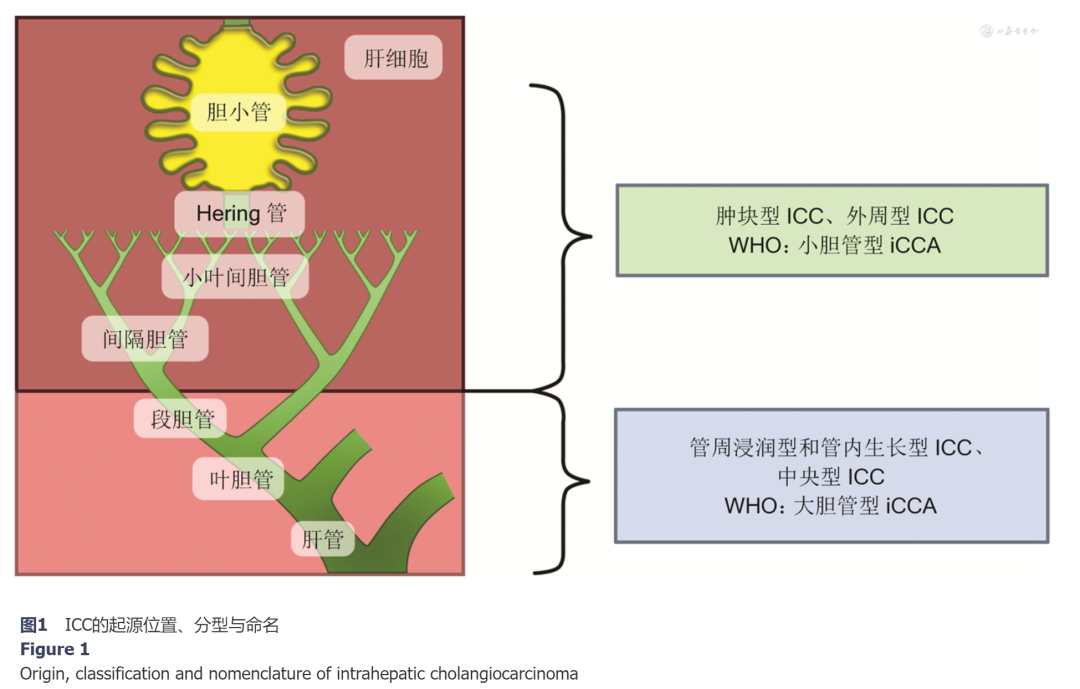
Regarding ICC, Professor Cong Wenming defines it as: “Specifically refers to malignant tumors occurring in the epithelial cells of the intrahepatic bile duct tree at all levels, including malignant tumors originating from the secondary bile ducts near the hilum of the liver, the segmental bile ducts, and their associated periductal glands (hilar-type ICC), as well as malignant tumors that grow in the peripheral parts of the liver, originating from the small bile ducts below the liver segment (interlobular bile ducts, small bile ducts) (peripheral-type ICC).” This definition has a broad scope for ICC, with tumor occurrence sites ranging from small bile ducts in the liver’s periphery to secondary bile ducts in the hilum. The closer the ICC is to the liver’s periphery, the more similar it is to hepatocellular carcinoma; the closer it is to the hilum, the more similar it is to extrahepatic bile duct cancer. ICC originating from different sites significantly differs in pathogenesis, biological behavior, histological morphology, treatment methods, and prognosis, leading to inconsistent classification and naming in clinical practice.
Both the “Consensus on the Diagnosis and Treatment of Cholangiocarcinoma” in China and the NCCN guidelines classify ICC as bile duct cancer and divide it into three subtypes: mass-forming, periductal-infiltrating, and intraductal growing. However, the “WHO Classification of Tumours of the Digestive System” (5th edition) has changed ICC to iCCA, independently staged it, and classified it as “malignant tumors of the liver and intrahepatic bile ducts”, dividing it into “small duct type iCCA” and “large duct type iCCA”, where small duct type iCCA is essentially mass-forming ICC. Whether classified into three subtypes according to the NCCN guidelines or into two pathological types according to the WHO, the differences in pathogenesis, biological behavior, histological morphology, treatment methods, and prognosis among the various subtypes are significant. See Figure 1.
In light of the above reasons, the author suggests reclassifying the original three subtypes of ICC.
★
Click the link below to view the full text
★
Suggestions for Redefining, Classifying, and Naming ICC
References [Omitted]
Contact Information for Platform Cooperation
Phone: 010-51322382
Email: [email protected]