Source: Advantech Industrial IoT
IoT Think Tank Reprint
Introduction
The industrial hazardous waste treatment system is crucial for high-tech factories. Manual inspection methods are limited by human resources and pose serious health and safety issues. Advantech’s LoRaWAN-based WISE series products help administrators monitor operations in real-time, predict system failures, and improve production efficiency through automated data collection and remote wireless technology. Nowadays, many high-tech products involve hazardous chemicals that are not only dangerous but also severely pollute the environment. The treatment of industrial hazardous waste and the measures taken for treatment have become particularly important. At this point, factories need to install industrial hazardous waste treatment systems to ensure the safety of employees and the environment. However, industrial hazardous waste treatment systems often require routine manual inspections to ensure stable operation. If a factory with numerous inspection points relies entirely on manpower to complete tasks, this can be very time-consuming. Moreover, some industrial hazardous waste output points are located high up on exhaust chimneys, making it a very dangerous operation for inspectors.Advantech’s LoRaWAN-based WISE series products can provide strong support for automated monitoring solutions in factories. By replacing traditional manual inspections with automated data collection and remote wireless technology, administrators can monitor operations in real-time, predict system failures, and improve production efficiency.
Here we share a real application case of automated industrial hazardous waste treatment monitoring in a semiconductor wafer factory:
A global heavyweight semiconductor wafer manufacturer with more than 10 factories in Asia is equipped with an acidic industrial hazardous waste treatment system to handle corrosive hazardous liquid gas generated during lithography and etching processes. The hazardous liquid gas can only be disposed of after meeting environmental protection standards.
The factory inspectors used to check the old waste system’s motors and fans for abnormalities using handheld vibration meters. However, due to the presence of over 20 exhaust fans around the factory, manual inspections could only be arranged once a day. Additionally, the industrial hazardous waste systems are mostly installed on rooftops, making daily climbs very dangerous for inspectors.
Therefore, to complete inspections more effectively and reduce employee risks, the factory decided to implement an automated monitoring system solution, utilizing sensors and gateways for predictive automated monitoring of equipment.
Solution Requirements
1. ISO 10816 level sensors to ensure sensor data consistency with handheld devices
2. Use of wireless networks without wiring
3. Long-distance transmission coverage to avoid signal interruptions or unstable network connections
4. Establish a dedicated network to prevent data leakage
5. Durable hardware products suitable for harsh outdoor environments
6. Modbus communication protocol support for uploading data to the monitoring system
Product Solution
Advantech provides two products for the automated industrial hazardous waste monitoring project:
LoRaWAN Smart Vibration Sensor WISE-2410
LoRaWAN IoT Gateway WISE-6610
What is the principle of automated industrial hazardous waste monitoring?
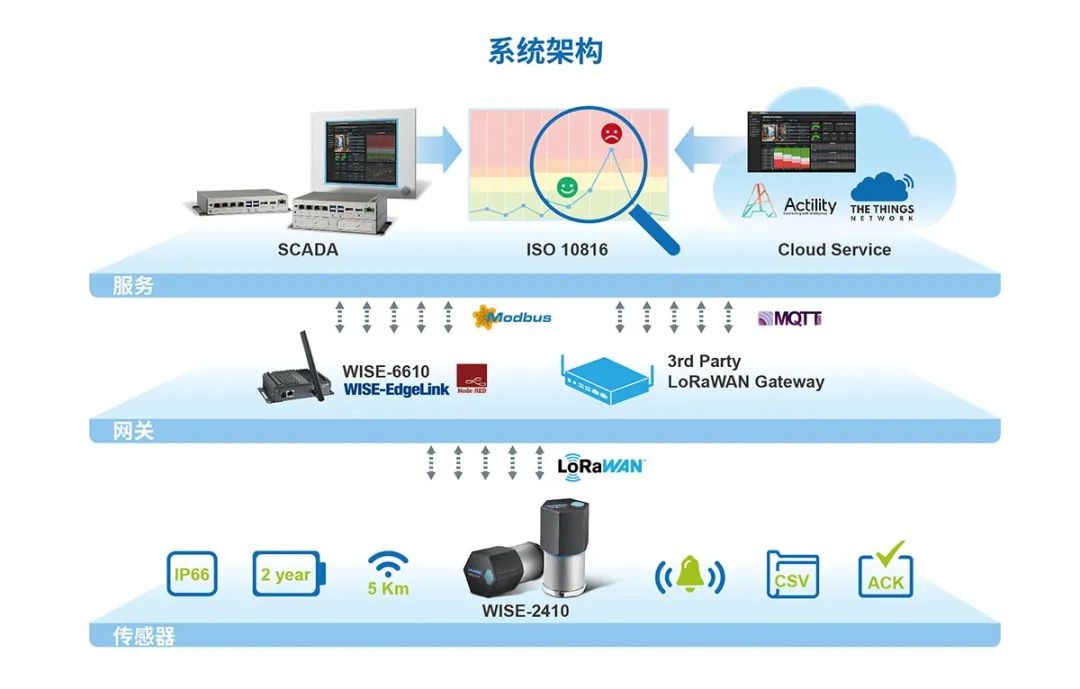
WISE-2410 wireless vibration sensor is magnetically connected to the motor to collect vibration data, which is used to calculate speed and displacement characteristics, and then transmits the data to the WISE-6610 gateway every half hour via a LoRaWAN-based wireless network. WISE-6610 decodes the data packets and uploads the data to the wafer factory’s existing monitoring and data acquisition (SCADA) system via Modbus. Once the data is obtained, the system compares it with the ISO 10816 severity chart to diagnose the health status of the motor.
Why choose these two products?
WISE-2410 is a smart device with a built-in ARM Cortex-M4 processor, 3-axis accelerometer, and temperature sensor. It calculates complex characteristic values (including VRMS, ARMS, peak, displacement, kurtosis, crest factor, skewness, and standard deviation) before outputting, which helps reduce network bandwidth load. In addition to eliminating network wiring issues, the WISE-2410’s built-in LoRa transceiver also features low frequency, long-range, low power consumption, and high penetration capabilities. Actual test results show that the WISE-2410 can achieve a transmission distance of up to 15 kilometers, which is more than sufficient for the wafer factory’s 500-meter area.
WISE-2410 also fully utilizes the openness, flexibility, and low-cost deployment advantages of LoRaWAN. Users can establish a suitable network without the help of network operators, allowing data to be transmitted directly instead of in a circular manner (i.e., transmitted to the operator’s base station before returning to the user). Therefore, users can save on operator costs while obtaining the necessary data confidentiality protection.
WISE-6610 is a high-performance LoRaWAN IoT gateway that provides reliable connectivity in industrial environments. It meets the wafer factory’s requirements for reliable and effective data transmission to the central monitoring system as it supports the Modbus protocol, which is commonly used in factories. Another benefit is that WISE-6610 can connect up to 500 WISE-2410 devices, which is desirable for expanding the automated monitoring range as needed while maintaining existing hardware.
In summary, the industrial hazardous waste treatment system is crucial for high-tech factories. Manual inspection methods are limited by human resources and pose serious health and safety issues. Now, through automated monitoring solutions, industrial hazardous waste treatment systems can be executed and monitored without personnel on site. Advantech’s LoRaWAN automated monitoring solution, compliant with ISO 10816 standards, provides results consistent with manual inspections. Its simple installation aids rapid deployment, and topics can be added at any time as factory needs change. The transmission quality is faster than Wi-Fi and Bluetooth, with better coverage, penetration, and anti-interference capabilities. The wafer manufacturer has seen excellent results from Advantech’s solution in this project, and plans to apply it to other factory facility monitoring, such as air conditioning systems, in addition to the industrial hazardous waste treatment system. Contact Us Phone: 400-810-0345 QQ: 8008100345 WeChat: Advantech Industrial IoT Email: [email protected] Official website: http://www.advantech.com.cn