In C++ program development, memory management is an unavoidable core challenge, and traditional dynamic memory allocation methods have significant pain points. Frequent calls to new/delete can produce a large amount of memory fragmentation, with scattered free memory blocks that cannot be effectively reused, leading to a significant decrease in memory utilization. At the same time, the frequent triggering of system calls increases overhead and reduces program execution efficiency, especially in high-concurrency and high-frequency memory operation scenarios, where these issues can more easily lead to program stuttering or even exceptions.
The memory pool technology precisely addresses these dilemmas, with its core advantage being “pre-allocation + reuse”: by pre-allocating a contiguous block of memory space and dividing it into fixed or variable-sized memory blocks as needed, it avoids frequent requests for memory from the system, fundamentally reducing fragmentation; at the same time, memory allocation and recovery are completed within the pool, significantly reducing system call overhead and improving memory operation efficiency. Mastering the implementation logic of C++ memory pools can not only specifically optimize program memory management performance to adapt to high-performance scenario requirements but also deepen the understanding of C++ low-level memory mechanisms. The following text will explore the basic principles to core implementation steps, helping developers tackle memory management challenges.
1. Introduction to C++ Memory Pools
A memory pool is a method of memory allocation, also known as fixed-size block allocation. Typically, we are accustomed to directly using APIs like new and malloc to request memory allocation. The downside of this approach is that due to the variable size of the requested memory blocks, frequent usage can lead to a large amount of memory fragmentation, thereby reducing performance.
In the kernel, there are many places where memory allocation cannot fail. As a method to ensure allocation in these situations, kernel developers created an abstraction known as a memory pool (or “mempool”), which is essentially a type of backup cache that strives to maintain a list of free memory for urgent use.
1.1 Why Use Memory Pools?
The default memory management in C++ (new, delete, malloc, free) frequently allocates and releases memory on the heap, leading to performance loss, generating a large amount of memory fragmentation, and reducing memory utilization. The default memory management is designed to be quite general, so it cannot achieve optimal performance. Therefore, many times it is necessary to design dedicated memory managers based on business needs to facilitate memory management for specific data structures and usage scenarios, such as memory pools.
(1) Memory Fragmentation Issues
A major reason for low heap utilization is memory fragmentation. If there is unused storage, but this storage cannot be used to satisfy allocation requests, memory fragmentation occurs. Memory fragmentation can be divided into internal fragmentation and external fragmentation.
- Internal Fragmentation: Internal fragmentation occurs when an allocated block is larger than the effective payload. (Assuming a block of 10 bytes was previously allocated, and now only 5 bytes are used, the remaining 5 bytes will be internal fragmentation). The size of internal fragmentation is the sum of the difference between the size of the allocated block and their effective payload. Therefore, internal fragmentation depends on the previous memory request patterns and the allocator’s implementation (alignment rules).
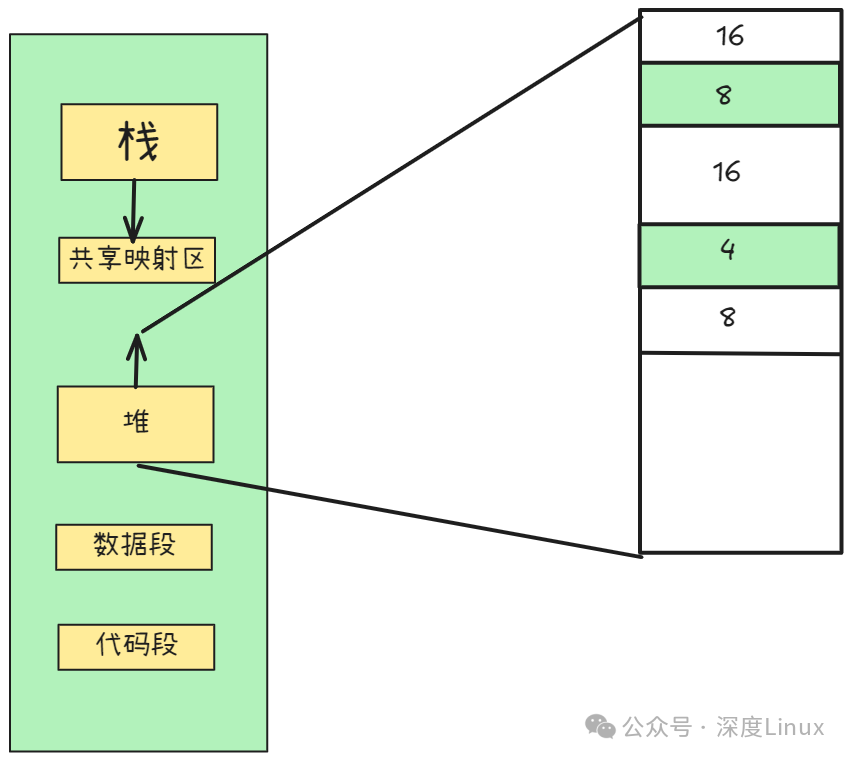
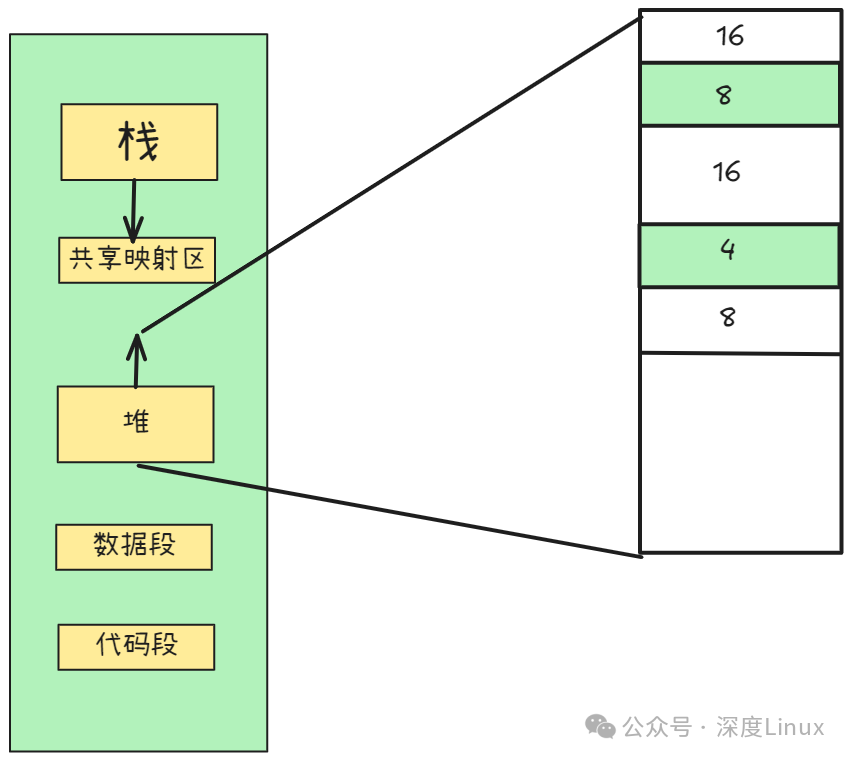
- External Fragmentation: Suppose the system sequentially allocates 16 bytes, 8 bytes, 16 bytes, and 4 bytes, leaving 8 bytes unallocated. At this point, if a request for 24 bytes is made, the operating system recovers two of the 16-byte blocks above, resulting in a total remaining space of 40 bytes, but it cannot allocate a continuous 24-byte space, which is the external fragmentation problem.
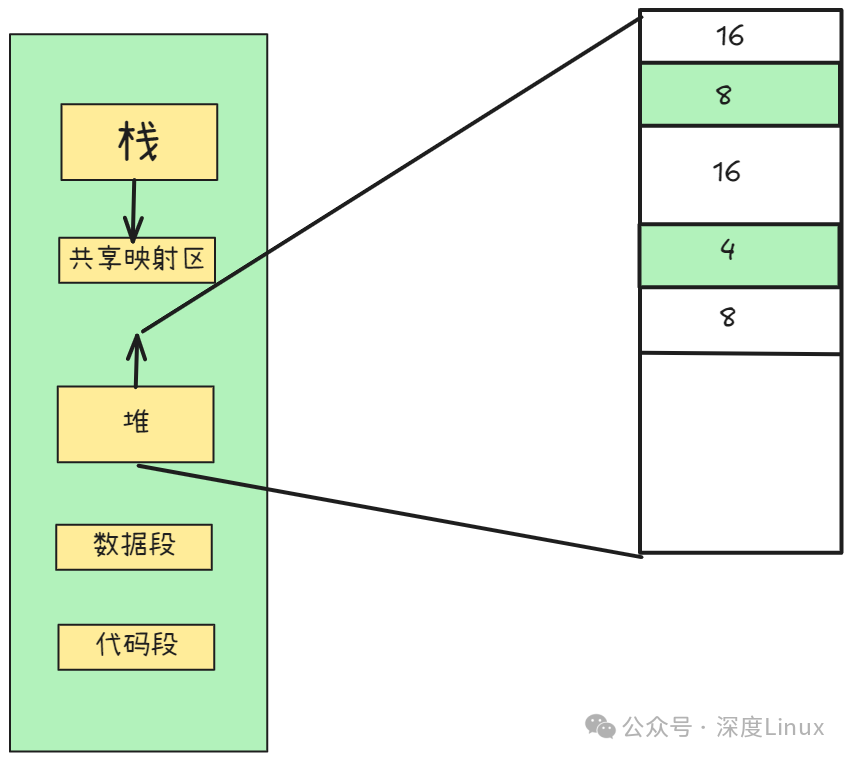
(2) Allocation Efficiency Issues
For example: just like the living expenses given by our family when we were in school, suppose the living expenses for a semester are 6000 yuan.
- Method 1: At the beginning of the semester, 6000 yuan is given to you directly, and you manage it yourself, deciding how to spend it.
- Method 2: Every time you need to spend money, you contact your parents, and they transfer the money.
Both methods involve 6000 yuan, but the first method is definitely more efficient because the second method incurs too much communication cost with parents.
In the same way, the program is like us in school, and the operating system is like parents. In scenarios where memory is frequently requested, each request for memory is like applying to the system, which inevitably affects efficiency.
1.2 Principles of Memory Pools
The idea of a memory pool is to pre-allocate a certain number of memory blocks of preset sizes before actually using memory. When there is a new memory demand, a portion of memory blocks is allocated from the memory pool. If the memory blocks are insufficient, new memory is requested. When memory is released, it returns to the memory blocks for subsequent reuse, thereby improving memory usage efficiency, and generally, it will not produce uncontrollable memory fragmentation.
Memory Pool Design Algorithm Principles:
- Pre-allocate a memory chunk, dividing the memory into multiple memory blocks according to object size.
- Maintain a linked list of free memory blocks, connected by pointers, marking the head pointer as the first free block.
- Each time a new object space is requested, the memory block is removed from the free list, updating the head pointer of the free list.
- Each time an object space is released, the memory block is added back to the head of the free list.
- If a memory area is full, a new memory area is opened, maintaining a linked list of memory areas, with pointers connected, and the head pointer pointing to the latest memory area, with new memory blocks reallocated and requested from that area.
Disadvantages of General Memory Allocation and Release:
- When using malloc/new to allocate heap memory, the system needs to search for a free memory block in the free block table based on first-fit, best-fit, or other algorithms; when using free/delete to release heap memory, the system may need to merge free memory blocks, resulting in additional overhead.
- Frequent usage can lead to a large amount of memory fragmentation, thereby reducing program execution efficiency.
- It can cause memory leaks.
The memory pool (Memory Pool) is a common method to replace direct calls to malloc/free, new/delete for memory management. When requesting memory space, it looks for suitable memory blocks from the memory pool instead of directly requesting from the operating system.
Advantages of Memory Pool Technology:
- Very little heap memory fragmentation.
- Memory allocation/release is faster than malloc/new methods.
- Check whether any pointer is in the memory pool.
- Write a heap dump to disk.
- Memory leak detection: when allocated memory is not released, the memory pool (Memory Pool) will throw an assertion.
Memory pools can be divided into variable-length memory pools and fixed-length memory pools. Typical implementations of variable-length memory pools include apr_pool in Apache Portable Runtime and obstack in GNU lib C, while fixed-length memory pools include boost_pool. For variable-length memory pools, there is no need to create different memory pools for different data types, but the downside is that allocated memory cannot be returned to the pool; for fixed-length memory pools, memory can be returned to the memory pool after use, but different memory pools need to be created for different types of data structures, and memory must be requested from the corresponding memory pool when needed.
2. C++ Memory Fragmentation and Inefficiency
In the world of C++, memory management is a crucial yet challenging task. When we write C++ programs, we often use new and delete (or malloc and free) for dynamic memory allocation and release. For example, when we need to create an object or an array, we use new to obtain the required memory space, and when we are done, we use delete to release it.
int* ptr = new int;*ptr = 10;// Use ptrdelete ptr;However, this seemingly simple and direct memory management method exposes many issues when faced with frequent memory allocation and release operations, among which the most prominent are memory fragmentation and inefficiency.
2.1 Memory Fragmentation Issues
As the program runs, if small blocks of memory are continuously allocated and released, the memory space becomes increasingly fragmented. It’s like having a large bookshelf (memory space) where all the books (data) are neatly arranged at first, with ample space. But as books are borrowed (memory allocated) and returned (memory released), many scattered small gaps (memory fragmentation) appear on the shelf, which cannot be fully utilized. Even if new books need to be placed (new memory allocation requests), they may not be able to fit due to insufficient large continuous gaps, leading to reduced memory utilization.
This memory fragmentation is divided into internal fragmentation and external fragmentation. Internal fragmentation refers to allocated memory blocks being larger than actually needed, with the excess portion being unusable; external fragmentation occurs due to frequent allocations and releases, causing free memory to be scattered into many small blocks, unable to meet the allocation needs for larger memory blocks.
2.2 Inefficiency Issues
Every time memory operations are performed using new and delete, interaction with the operating system is required, which involves system call overhead and consumes time. Especially in scenarios where memory needs to be frequently allocated and released, such as in game development where many game objects are created and destroyed, or in network programming where small data packets are frequently processed, this overhead accumulates and severely affects program execution efficiency. Imagine if you had to run to a distant warehouse every time you needed a tool, returning it after use; such frequent operations would inevitably lower work efficiency. Similarly, C++ programs frequently requesting and returning memory from the operating system also significantly reduce execution efficiency.
To address these issues, memory pool technology has emerged, acting as an efficient memory manager that can manage memory more reasonably and enhance program performance and stability.
3. Detailed Explanation of C++ Memory Pool Technology
3.1 Why Use Memory Pools
- Resolve internal fragmentation issues.
- Since the memory blocks requested from memory are relatively large, it can reduce external fragmentation issues.
- Request a large block of memory at once and use it gradually, avoiding frequent memory requests, thus improving memory allocation efficiency.
- However, internal fragmentation issues cannot be avoided and can only be minimized.
3.2 Evolution of Memory Pools
The simplest memory allocator uses a linked list to point to free memory, where allocation involves taking out a block, rewriting the list, and returning it, while release involves putting it back into the list and merging it. Care must be taken to mark and protect against double releases, and some effort can be spent on how to search for the most suitable size memory block to reduce fragmentation, and if there is time, the list can be replaced with a buddy algorithm.
- Advantages: Simple implementation.
- Disadvantages: Low efficiency in searching for suitable memory blocks during allocation, high overhead in merging after returning memory, making it impractical in real scenarios.
Fixed-size memory allocators implement a FreeList, where each FreeList is used to allocate fixed-size memory blocks, such as a fixed memory allocator for 32-byte objects. Each fixed memory allocator contains two linked lists: OpenList for storing unallocated free objects and CloseList for storing allocated memory objects. Allocation involves taking an object from OpenList and placing it into CloseList, returning it to the user, while release involves moving it back from CloseList to OpenList. If there are insufficient blocks, OpenList needs to grow: request a larger memory block and cut it into, for example, 64 equally sized objects to add to OpenList. This fixed memory allocator returns all previously requested memory blocks to the system during recovery.
- Advantages: Simple and effective, high efficiency in allocation and release, effectively solving specific problems in practical scenarios.
- Disadvantages: Single function, can only solve fixed-length memory needs, and occupies memory without releasing it.
The FreeList pool with hash mapping, based on fixed-size allocators, constructs a dozen fixed memory allocators according to different object sizes (8, 16, 32, 64, 128, 256, 512, 1k…64K). When allocating memory, it aligns according to the requested memory size and checks the hash table to determine which allocator is responsible. After allocation, a cookie is written at the header of the memory block to indicate which allocator allocated that block, so that it can be correctly returned during release. If it exceeds 64K, the system’s malloc is used for allocation, thus at the cost of wasting memory, you achieve an allocation time close to O(1). The downside of this memory pool is that if a certain FreeList occupies a large amount of memory during peak periods, it cannot support other FreeLists that are short on memory, failing to achieve balanced allocation.
- Advantages: This is essentially an improvement of the fixed-length memory pool, with high efficiency in allocation and release. It can solve problems of a certain length.
- Disadvantages: There are internal fragmentation issues, and once a large memory block is cut into smaller ones, it cannot be used for large memory requests. In multi-threaded concurrent scenarios, lock contention is fierce, reducing efficiency.
Example: The space allocator in the six major components of SGI STL is implemented in this way.
Understanding the Underlying Principles of malloc
The C standard library function malloc uses a method called segregated fit, where the allocator maintains an array of free linked lists, each free linked list organized into some type of explicit/implicit list. Each list contains blocks of different sizes, which are members of size classes. When allocating a block, we determine the size class, then perform first-fit on the appropriate free linked list to find a suitable block. If found, it can optionally be split, and the remaining part is inserted into the appropriate free linked list. If not found, we search the next larger size class’s free linked list, repeating until a suitable block is found. If there are no suitable blocks in the free linked lists, we request additional heap storage from the operating system, allocating a block from this new heap storage and placing the remaining part in the appropriate size class. When a block is released, we perform merging and place the result in the corresponding free linked list.
- Advantages of malloc: Using an array of free linked lists improves allocation and release efficiency; reduces memory fragmentation and can merge free memory.
- Disadvantages of malloc: Maintaining implicit/explicit lists requires maintaining some information, leading to low space utilization; in multi-threaded situations, thread safety issues arise, and if resolved with locking, efficiency is greatly reduced.
3.3 Core Principles of Memory Pools
The working principle of memory pools is based on a strategy of pre-allocation and reuse. During the program startup phase, the memory pool requests a large contiguous block of memory from the operating system at once, akin to renting an entire building (large block of memory) in advance. Subsequently, the memory pool divides this large memory according to certain rules into multiple smaller memory blocks, which are like individual rooms in the building.
To effectively manage these memory blocks, memory pools typically utilize some data structures, with linked lists and hash tables being common. For example, in a linked list, all free memory blocks are connected by pointers, forming a linked list of free memory blocks. When the program has a memory allocation request, the memory pool takes a suitable memory block from this list to allocate to the program, just like selecting a room from a list of available rooms. When the program is done using the memory and releases it, that memory block is reinserted into the free linked list, waiting for the next allocation, similar to how a room becomes available for new tenants after the previous tenant checks out.
A hash table can also quickly locate suitable-sized memory blocks. By using the size or other characteristics of memory blocks as keys, the hash table can find the required memory block in nearly constant time, greatly improving memory allocation efficiency, especially in scenarios where different-sized memory blocks need to be frequently allocated.
3.4 Significant Advantages of Memory Pools
- Reduce memory fragmentation: Memory pools avoid the memory fragmentation issues caused by frequent requests and releases of small memory blocks by pre-allocating large blocks of memory and managing small memory internally. Since memory allocation and release within the memory pool occur within the pre-allocated large memory range, it does not affect the layout of the space outside the pool, thus maintaining the continuity and orderliness of memory space and improving memory utilization.
- Enhance allocation and release efficiency: Since memory allocation and release operations in memory pools are performed in user mode, there is no need for frequent interaction with the operating system kernel, avoiding the overhead of system calls. It is like retrieving and placing items in your own warehouse without needing to request permission from the administrator each time, saving communication costs and time. Moreover, memory pools can employ more efficient data structures and algorithms to manage memory blocks, making allocation and release operations faster, significantly enhancing program performance in scenarios with frequent memory operations.
- Reduce the risk of memory leaks: Memory pools can be designed with an automatic recovery mechanism. When certain memory blocks in the program are forgotten to be released, the memory pool can recover these memory blocks at appropriate times, reintegrating them into the allocatable memory pool, thus reducing the likelihood of memory leaks. For example, when an object allocated memory from the memory pool reaches the end of its lifecycle, the memory pool can automatically detect and recover the memory occupied by that object without requiring the programmer to manually release it, minimizing the memory leak issues caused by human oversight.
4. C++ Memory Pool Implementation Solutions
4.1 Design Issues
When designing the implementation plan for a memory pool, the following issues need to be considered:
① Can the memory pool grow automatically?
If the maximum space of the memory pool is fixed (i.e., non-automatically growing), then when the memory in the memory pool is fully requested, the program will not be able to request memory from the memory pool again. Therefore, it is necessary to determine whether automatic growth is needed based on the actual memory usage of the program.
② Is the total memory usage of the memory pool only increasing and not decreasing?
If the memory pool is automatically growing, it raises the question of whether the total memory usage of the memory pool is only increasing and not decreasing. Imagine that the program requests 1000 memory slices of 100KB each from an automatically growing memory pool and returns all of them after use. If the program’s subsequent logic only requests a maximum of 10 memory slices of 100KB, then the remaining 900 memory slices of 100KB will remain idle, and the program’s memory usage will not decrease. Programs that have requirements for memory usage size need to consider this.
③ Are the sizes of memory slices in the memory pool fixed?
If the sizes of memory slices requested from the memory pool are not fixed, then the sizes of each available memory slice in the memory pool will be inconsistent. When the program requests memory slices again, the memory pool needs to balance between “matching the best size of memory slices” and “matching operation time.” While “the best size of memory slices” can reduce memory waste, it may lead to longer “matching time.”
④ Is the memory pool thread-safe?
Is it allowed for multiple threads to simultaneously request and return memory slices from the same memory pool? This thread safety can be implemented by the memory pool or guaranteed by the user.
⑤ Do the contents of memory slices need to be cleared before allocation and after returning to the memory pool?
Programs may attempt to read and write memory using the address pointer of a memory slice after it has been returned to the memory pool, which can lead to unpredictable results. Clearing the contents can only attempt to (but not necessarily) expose the problem, but it does not solve any issues, and clearing the contents consumes CPU time. Therefore, it is ultimately best for the users of the memory pool to ensure this safety.
⑥ Is it compatible with std::allocator?
Most classes in the STL standard library support user-provided custom memory allocators, with std::allocator being the default. For example, std::string:
typedef basic_string<char, char_traits<char>, allocator<char> > string;If our memory pool is compatible with std::allocator, we can replace the default std::allocator with our own memory pool, such as:
typedef basic_string<char, char_traits<char>, MemoryPoll<char> > mystring4.2 Common Memory Pool Implementation Solutions
(1) Fixed-size Buffer Pool
The fixed-size buffer pool is suitable for frequently allocating and releasing fixed-size objects.
(2) dlmalloc
dlmalloc is a memory allocator written by Doug Lea since 1987, with the latest version being 2.8.3. It is widely used and studied due to its high efficiency and other characteristics.
(3) SGI STL Memory Allocator
The SGI STL allocator is one of the best-designed C++ memory allocators, with its internal free_list[16] array managing memory blocks of different sizes from 8 bytes to 128 bytes (chunk), each memory block consisting of many chunks of fixed size (fixed size block) connected by pointer linked lists.
(4) Loki Small Object Allocator
The Loki allocator uses vectors to manage arrays and allows specifying the size of fixed-size blocks. Free blocks are distributed within a contiguous large memory block, and free chunks can automatically grow and decrease in number based on usage, avoiding excessive or insufficient memory allocation.
(5) Boost object_pool
Boost object_pool allocates memory blocks based on the size of user-specific application classes, managing them through a linked list of free nodes. It can automatically increase nodes, starting with 32 nodes, and each increase requests memory blocks from the system heap in a doubling manner. Memory blocks managed by object_pool are only returned to the system heap when their objects are destroyed.
(6) ACE_Cached_Allocator and ACE_Free_List
The ACE framework includes an allocator that can maintain fixed-size memory blocks, managing a contiguous large memory block through a Free_list linked list defined in ACE_Cached_Allocator, which contains multiple fixed-size unused memory chunks (free chunk), while also using ACE_unbounded_Set to maintain used chunks.
(7) TCMalloc
The Google open-source project gperftools provides a memory pool implementation solution. TCMalloc replaces the system’s malloc with more low-level optimizations for better performance.
4.3 STL Memory Allocators
The allocator is a component of the C++ standard library, primarily used to handle memory allocation and release for all given containers (vector, list, map, etc.). The C++ standard library provides a default general allocator std::allocator, but developers can customize allocators.
In addition to providing the default allocator, GNU STL also offers __pool_alloc, __mt_alloc, array_allocator, and malloc_allocator memory allocators.
- __pool_alloc: SGI memory pool allocator.
- __mt_alloc: Multi-threaded memory pool allocator.
- array_allocator: Global memory allocation, only allocates without releasing, leaving it to the system to release.
- malloc_allocator: Encapsulation of heap std::malloc and std::free.
5. Specific Implementation of C++ Memory Pools
5.1 Diverse Types of Memory Pools
In C++ programming, memory pools can be categorized into different types based on their allocation methods and characteristics, each with its unique applicable scenarios. Understanding these types and scenarios can help us more accurately select and use memory pools to optimize program performance.
(1) Fixed Memory Pool
A fixed memory pool, as the name suggests, allocates memory units of a fixed size from the memory pool each time. The size of the memory blocks is predetermined during program initialization. For example, we create a fixed memory pool for managing small data structures (like linked list nodes), with each memory block set to 32 bytes. When the program needs to create a linked list node, it directly obtains a 32-byte memory block from this memory pool without needing to request memory from the operating system.
The advantages of fixed memory pools are significant. Since the size of memory blocks is fixed, allocation and release operations are very efficient, like taking and placing items in a warehouse filled with boxes of the same size, without needing to select and measure. Moreover, because the sizes of memory blocks are consistent, there will be no different-sized memory holes during allocation and recovery, effectively reducing memory fragmentation and improving memory utilization. In game development, many game objects (like bullets, monsters, etc.) have the same size and structure, and using a fixed memory pool to manage the memory allocation of these objects can significantly enhance the performance and stability of the game.
(2) Variable Memory Pool
A variable memory pool offers greater flexibility, allowing for the allocation of memory blocks of different sizes based on actual needs. When the program needs to allocate 10 bytes of memory for small data and 100 bytes for larger data structures, a variable memory pool can meet these different requirements.
Variable memory pools are suitable for scenarios with significant fluctuations in memory demand. In network programming, the size of network data packets is uncertain, ranging from small packets of a few dozen bytes to large packets of several thousand bytes. In such cases, a variable memory pool can adapt well to these changes, allocating suitable memory space for different-sized data packets. However, the implementation of variable memory pools is relatively complex, as it requires managing memory blocks of different sizes, and more complex algorithmic operations are needed during allocation and release to ensure efficient memory utilization and avoid fragmentation, akin to searching for items in a warehouse filled with variously sized objects, requiring more time and effort to find and organize.
5.2 Case Implementation Analysis
(1) Case Analysis
We plan to implement a class MemoryPool for memory pool management, which has the following characteristics:
- The total size of the memory pool grows automatically.
- The sizes of memory slices in the memory pool are fixed.
- Supports thread safety.
- Clears the contents of memory slices after they are returned.
- Compatible with std::allocator.
Since the sizes of memory slices in the memory pool are fixed, there is no need to match the most suitable size of memory slices. Due to frequent insertions and removals, but less searching, a linked list data structure is chosen to manage the memory slices in the memory pool.
The MemoryPool contains two linked lists, both of which are doubly linked lists (designed as doubly linked lists mainly to quickly locate the preceding and following elements when removing a specified element, ensuring the integrity of the list after the element is removed):
- data_element_ records the allocated memory slices.
- free_element_ records the unallocated memory slices.
① Memory Block Structure: The memory block structure is the basic unit managed by the memory pool, representing each allocatable memory block in the memory pool.
struct MemoryBlock { MemoryBlock* next; // Pointer to the next memory block, used to build the linked list // Other metadata, such as memory block size identifiers, can be added here};In this structure, the next pointer plays a crucial role, linking the various memory blocks together to form a linked list structure. Through this linked list, the memory pool can conveniently manage free memory blocks and allocated memory blocks. For example, in the free memory block linked list, each node is a MemoryBlock structure, and the next pointer can quickly find the next free block. When there is a memory allocation request, it can swiftly take out a free block from the linked list for allocation.
② Free Memory Block Linked List: The free memory block linked list is the core data structure for managing free memory in the memory pool. It is a linked list composed of MemoryBlock structures, where each node represents an available free memory block.
class MemoryPool {private: MemoryBlock* freeList; // Head pointer of the free memory block linked list // Other member variables and functions...};freeList serves as the head pointer of the linked list, pointing to the first free memory block in the list. When the memory pool initializes, it adds the pre-allocated memory blocks to this linked list, making them available free resources. During memory allocation, the memory pool takes a memory block from the head of freeList and updates the freeList pointer to point to the next free block. When memory is released, the released memory block is reinserted at the head of the linked list, becoming a new free block, ready for the next allocation.
(2) Allocation and Release Process
① Memory Allocation Process: When the program requests memory allocation from the memory pool, it first checks whether the free memory block linked list freeList is empty. If the list is not empty, it indicates that there are available free memory blocks, and the memory pool directly takes a memory block from the head of the list and returns it to the program, while updating the freeList pointer to point to the next free block. This process is akin to taking an item off a shelf and adjusting the shelf’s indicator.
void* MemoryPool::allocate() { if (freeList == nullptr) { expandPool(); // Memory insufficient, expand the memory pool } MemoryBlock* block = freeList; freeList = freeList->next; return block;}If freeList is empty, it means there are no free memory blocks available for allocation in the current memory pool. In this case, the memory pool needs to expand its memory space. The method of expanding the memory pool usually involves requesting a new, larger memory area from the operating system, then dividing this new memory according to the size of memory blocks and adding the newly divided memory blocks to the free memory block linked list for subsequent allocation.
② Memory Release Process: When the program has finished using memory and releases it back to the memory pool, the memory pool reinserts the released memory block at the head of the free memory block linked list freeList. Thus, the memory block becomes available free resources again, waiting for the next allocation.
void MemoryPool::deallocate(void* ptr) { MemoryBlock* block = static_cast<MemoryBlock*>(ptr); block->next = freeList; freeList = block;}This process is akin to placing returned items back on the shelf in a prominent position for quick retrieval next time. Through this method, the memory pool achieves memory recycling, greatly improving memory usage efficiency.
(3) Thread Safety Mechanism
In a multi-threaded environment, the memory pool faces data competition and inconsistency issues. When multiple threads access and operate on the memory pool simultaneously, it may occur that one thread reads the free memory block linked list while another thread modifies the list, leading to inaccurate data readings or errors such as memory blocks being allocated or released multiple times.
To address these issues, common methods for implementing thread safety include:
① Mutex: A mutex is a commonly used synchronization mechanism that ensures that only one thread can access the critical data structures and operations of the memory pool at any given time. In C++, std::mutex can be used to implement a mutex.
class MemoryPool {private: std::mutex mtx; MemoryBlock* freeList;public: void* allocate() { std::lock_guard<std::mutex> lock(mtx); // Memory allocation logic } void deallocate(void* ptr) { std::lock_guard<std::mutex> lock(mtx); // Memory release logic }};In the allocate and deallocate functions, a lock object is created with std::lock_guard<std::mutex> lock(mtx);, which automatically locks the mutex mtx upon construction and unlocks it upon destruction, ensuring that during the execution of these two functions, other threads cannot access the memory pool simultaneously, avoiding data competition.
② Lock-Free Data Structures: Lock-free data structures utilize atomic operations and special algorithms to achieve multi-thread safety, avoiding the overhead brought by locks. For example, using std::atomic types to implement a lock-free linked list. Through atomic operations of std::atomic, modifications to the linked list pointers can be guaranteed to be atomic and not interrupted by other threads, thus achieving safe operations in a multi-threaded environment. However, the implementation of lock-free data structures is relatively complex and requires a deep understanding of atomic operations and concurrent programming.
(4) Practical Exercise: Code Example
To better understand the implementation of C++ memory pools, let’s look at a simple code example of a fixed memory pool. This memory pool is specifically designed to allocate fixed-size memory blocks and manages free memory blocks through a linked list.
#include <iostream>#include <cstdlib>#include <cassert>// Define memory block structurestruct MemoryBlock { MemoryBlock* next; // Pointer to the next memory block};class MemoryPool {public: MemoryPool(size_t blockSize, size_t initialBlocks) : blockSize(blockSize), initialBlocks(initialBlocks) { // Initialize memory pool initializePool(); } ~MemoryPool() { // Release all memory in the memory pool MemoryBlock* current = poolStart; while (current) { MemoryBlock* next = current->next; free(current); current = next; } } void* allocate() { if (!freeList) { // Free list is empty, expand memory pool expandPool(); } MemoryBlock* block = freeList; freeList = freeList->next; return block; } void deallocate(void* ptr) { MemoryBlock* block = static_cast<MemoryBlock*>(ptr); block->next = freeList; freeList = block; }private: void initializePool() { // Request initial memory blocks and build free list poolStart = static_cast<MemoryBlock*>(malloc(blockSize * initialBlocks)); assert(poolStart != nullptr); freeList = poolStart; MemoryBlock* current = poolStart; for (size_t i = 1; i < initialBlocks; ++i) { current->next = static_cast<MemoryBlock*>(reinterpret_cast<char*>(current) + blockSize); current = current->next; } current->next = nullptr; } void expandPool() { // Expand memory pool, adding 10 new memory blocks each time size_t newBlocks = 10; MemoryBlock* newBlock = static_cast<MemoryBlock*>(malloc(blockSize * newBlocks)); assert(newBlock != nullptr); MemoryBlock* current = newBlock; for (size_t i = 1; i < newBlocks; ++i) { current->next = static_cast<MemoryBlock*>(reinterpret_cast<char*>(current) + blockSize); current = current->next; } current->next = freeList; freeList = newBlock; } size_t blockSize; // Size of each memory block size_t initialBlocks; // Initial number of memory blocks MemoryBlock* poolStart; // Starting address of the memory pool MemoryBlock* freeList; // Head pointer of the free memory block list};// Example usageint main() { MemoryPool pool(16, 5); // Each memory block is 16 bytes, with an initial 5 memory blocks void* ptr1 = pool.allocate(); void* ptr2 = pool.allocate(); pool.deallocate(ptr1); pool.deallocate(ptr2); return 0;}The MemoryBlock structure defines the structure of a memory block, containing a pointer next to the next memory block.
The MemoryPool class is the core class of the memory pool, containing the following members:
Constructor: MemoryPool(size_t blockSize, size_t initialBlocks), receives the size of each memory block blockSize and the initial number of memory blocks initialBlocks, and calls initializePool to initialize the memory pool.Destructor: ~MemoryPool(), releases all allocated memory in the memory pool.Allocate function: Takes a memory block from the free list and allocates it to the user. If the free list is empty, it calls expandPool to expand the memory pool.Deallocate function: Re-inserts the released memory block at the head of the free list.
- initializePool function: When initializing the memory pool, it requests memory of size blockSize * initialBlocks from the operating system at once and links these memory blocks into a free list, with freeList pointing to the head node of the list.
- expandPool function: When the free list is empty, this function is called to expand the memory pool. Each time it expands, it adds 10 memory blocks, linking the newly allocated memory blocks to the head of the free list.
- Main function: Demonstrates the basic usage of the memory pool, first allocating two memory blocks and then releasing them.
Through this example, we can see how the memory pool achieves efficient memory allocation and release by pre-allocating memory and managing the free linked list, reducing memory fragmentation and system call overhead.