“ Discussing several types of Unix-like operating systems from the perspective of system evolution.”
Unix-like
The definition of “Unix-like OS” according to Wiki is as follows:
A Unix-like (sometimes referred to as UN*X or *nix) operating system is one that behaves in a manner similar to a Unix system, while not necessarily conforming to or being certified to any version of the Single UNIX Specification.
A Unix-like operating system is one that behaves similarly to a Unix system to some extent, and it does not necessarily require certification to a specific “Single UNIX Specification”.
Upon careful consideration, this definition is actually quite vague, as it restates the definition logically and literally.
This may be understood as there being no authoritative unified definition for “Unix-like systems”.
If we borrow a gaming analogy, the Linux system, as the “main quest” (which is definitely a Unix-like OS), was even claimed by C language and Unix operating system father Ritchie to be: “Linux is actually Unix (they are the same thing)”.

01
—
Unix Shell
1.1 Common Shells of Unix-like OS
So, what are the commonalities of Unix-like systems? — From the perspective of user interaction, it is usually observed that Unix-like OS should have a Unix shell to provide a Unix command line UI.
The Unix shell is the command line interpreter of Unix-like operating systems, providing the command line UI.
When the shell is referred to as a language, it serves both as a command language and as a scripting language provided by the system.
The Unix shell is typically the core interface of Unix-like OS, located at the “lowest” and “innermost” component of the operating system.
Therefore, the important position of the Unix shell is not hard to imagine (just think back to the dawn of the information revolution):
About half a century ago, Ritchie invented the C language based on the B language and rewrote the Unix system in C (which brought about the third industrial revolution – the enlightenment of the electronic information industry). The hardware resources and system complexity of that time should not have been able to support today’s complex desktop systems (such as Windows, macOS, Linux/Debian/Ubuntu) with GUI interfaces.
Note: Ken Thompson is the inventor of the B language, and the two were long-time collaborators at Bell Labs, jointly creating Unix. — Thus, they received numerous professional honors, including government honors awarded by Clinton.
Therefore, users can log into the system through the Unix shell, start system scripts, and the Unix shell retains their account passwords, configures current user parameters, and (through the Unix shell) executes other command interactions (and uses various command tools).
As OS progresses, for example, modern macOS can usually achieve the above operations directly through the GUI interface (the Unix shell is no longer the only user interaction UI).
1.2 Types of Shells
The Thompson shell is the earliest version of the Unix shell, developed by Ken Thompson.
Bourne Shell
The Bourne shell, created by Bell Labs, along with its variants, is the mainstream type of shell today.
-
Almquist shell (ash): BSD-licensed, commonly used in resource-constrained environments. The POSIX-enhanced performance sh is used in FreeBSD, NetBSD.
-
Bourne-Again shell (bash): A superset of the Bourne Shell from the GNU Project, used in most Linux systems.
-
Debian Almquist shell (dash): The modern ash used in Debian/Ubuntu.
Additionally, the standard shell defined by the POSIX standard specification comes from the Korn shell (an enhanced version of the Bourne shell).
C Shell
The C shell, csh, provides a syntax similar to the C programming language and was released in some BSD Unix. Note: It was created by Bill Joy, a graduate student at the University of California, Berkeley.

02
—
System V Family (Unix): “The Sect Mission”
From the perspective of system project evolution, a brief history of the development of Unix-like OS can more clearly categorize modern “Unix-like operating systems”.
Unlike other narratives, this article emphasizes the brief history of Unix-like OS, which is inseparable from the development of the BSD license and the GPL Copyleft certificate (the latter brought about the “free software movement” and the “open source initiative”).
2.1 Ritchie Rewrites and Truly Creates: Unix
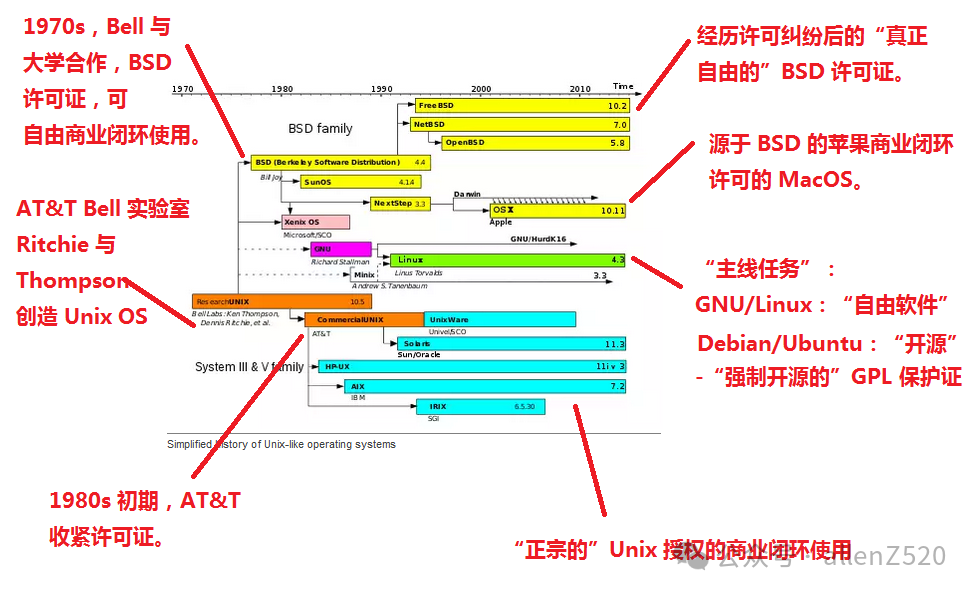
As shown in the figure, the Unix operating system was born in the 1970s. As mentioned above, C language inventor Ritchie rewrote (and truly created) the Unix OS in C.
2.2 System V Family: “Authentic (Continuing, Source Sect) Unix”
-
Starting in 1979, AT&T tightened licensing, but commercial copyright releases were not that expensive. Several large commercial companies joined in, which we will refer to as “authentic” (continuing) Unix OS.
-
As shown in the figure, they are mainly the System III & V family.
-
Due to the characteristics of commercial closed-loop usage, there is not much information available on the evolving Unix OS from two or three companies. It can be considered as optimized versions for the proprietary processors of the aforementioned companies.
-
Even as “authentic” heritage, its modern influence seems negligible. However, historically, it was the differences in the evolution of various company versions on this “sect mission” that led to the emergence of unified standards: POSIX and the “Single UNIX Specification”.
-
Additional note: The server EulerOS, as a Linux release, has also obtained “Single UNIX Specification” certification, which may be one of Huawei’s various efforts to break through limitations in the early days.
03
—
BSD (Unix-like): “The Hall Mission” (Academic, Lenient BSD License)
-
The University of California, Berkeley, early on obtained the Unix OS source code from Bell Labs (the open heritage spirit of Unix-like began to emerge). For the BSD license, which originated from the campus atmosphere, it is understood as equivalent to “lenient (almost unrestricted)”. That is, the source code can be freely downloaded, modified, and used in a commercial closed-loop manner (without the need to disclose any modified code), with the only requirement being to include the BSD license copyright notice in the modified source code.
-
In the 1980s, after copyright disputes, BSD replaced all AT&T source code.
-
As shown in the figure, under the BSD license, Apple’s commercial closed-loop MacOS is derived from early BSD.
-
Currently evolving BSD Unix-like OS includes: FreeBSD, NetBSD, OpenBSD. Note: Some materials mention that BSD defaults to no GUI interface (only the traditional Unix shell), and users can choose to load a GUI.
-
Note: Due to the aforementioned copyright disputes, “BSD” is often not directly associated with “Unix” and is intentionally referred to as “Unix-like”.

04
—
GNU/Linux (Unix-like): “Main Quest” (Free Software Movement, GPL and Copyleft)
4.1 Free Software and GPL (General Public License)
-
Coming from different cultural circles, it can be hard to imagine the reasons behind the initiation of the “free software movement.” After studying some materials, possible speculations are: (1) From a broader perspective, it was the eve of an exciting industrial revolution (the information industry revolution), coinciding with a great era of desire for individuality and freedom. (2) From the perspective of industry development, around 1980, the software industry finally began to reach the stage of copyright disputes. The Unix licensing disputes, incidents where logical time bombs were deliberately embedded in software during certain commercial copyright disputes, and the then-popular hacker culture catalyzed the emergence of the legendary figure Richard Stallman (see the text annotation in the purple box under “GNU” in the image). (3) Additionally, some products, although they are leniently licensed, allowing arbitrary downloading, modification, and closed-loop use, the copyright owner of the product retains exclusive rights to the product and has the right to prevent other programmers from participating in the modification and advancement of that named product (if one wants to modify, they can download the source code and modify it privately, releasing their own product. As for whether to publish the modified source code, it is up to the modifier. But in any case, the original copyright must be acknowledged). This characteristic may have also stimulated Stallman.
-
Richard Stallman devoted his life to leading the “free software movement.” He personally wrote the terms of the GPL (certificate).
-
The GPL allows for the free downloading and modification of source code, but also grants the modifier the “freedom to publish their modified source code” (here, it is understood that the so-called “freedom to publish modified source code” has profound duality. On one hand, the GPL provides freedom for other contributors to participate in the product project. On the other hand, the GPL itself is mandatory; those who modify the project are actually forced to contribute, as they must publish the source code to ensure that the project continues to evolve/iterate).
-
The GPL has derivative characteristics; any derivative product based on GPL also defaults to holding GPL (certificate).
-
Looking back at history, an attempt to understand: Stallman or represents a certain type of programmer (elite), who selflessly dedicates themselves to software engineering projects to resist commercial licensing. He created the GPL (General Public License), optimizing the BSD license, which is nearly unconstrained. The GPL prevents project owners from exclusively holding copyrights, thus ensuring the freedom of other developers to participate in the project. This, in turn, guarantees that participants maintain a continuous contribution to the project, resulting in a product that is completely free for users to use.
-
Stallman seems quite persistent, emphasizing that “free software” is entirely unrelated to commercial interests (this will later lead to the “open source initiative”). He himself rejected Apple’s proposal to commercially license a variant of GCC for Apple (which may have stimulated the subsequent emergence of the Clang compilation chain).
-
Summary: (1) The complete “freedom” of the GPL is only for users. (2) For developers who study the source code and modify it, it has profound duality, providing developers the freedom to participate in the evolution and progress of the project while also mandating “(modified) source code publication.” (3) For companies, the publication of source code leads to an inability to use it in a commercial closed-loop manner, resulting in huge R&D investment losses and potential security risks, not to mention enjoying the pleasure of “free software.” This is only a last resort. (4) For GPL projects (“free software”), due to the continuous participation of contributors, many projects can achieve continuous progress/iteration, yielding products that users can freely use with relatively small investments.
-
Note 1: Because of Stallman’s efforts, “free software” is now a proper noun, referring to the GPL software with the aforementioned characteristics and implicitly the movement itself.
-
Note 2: The “free” in “free software” should be understood as “freedom” rather than “free of charge” (although users of free software typically use it for free).
-
Note 3: “Commercial closed-loop” refers to the common translation of “closed” as “closed-loop,” “proprietary,” or “non-open-source.” This concept is usually opposed to “free software” and “open source.”
-
Due to the aforementioned characteristics of GPL/free software, some people refer to the GPL certificate as a “virus certificate” because its certificate spreads to derivatives. The characteristics summarized here may inevitably cause discomfort, especially for young students who are completely unprepared and have not been reminded in class. The deeper one studies GPL source code, the more they understand, and the more they contribute, the more they may sever their potential for future creative development (limited by the mandatory contribution certificate of GPL). Of course, for large projects like this, 99.99% of students will likely not independently create a new operating system or compiler in their future studies or work, so delving into GPL projects like GNU may not be an issue. However, campus students often lack practical experience and are unaware of their future work potential. What if that one in a million genius is you?
-
Of course, conversely, as a progressive figure supporting “free software,” actively participating in GPL software, hoping to leave their name in history through free software like Linus did in Finland, that is another matter (this article does not hold any opinions, nor does it lean towards either BSD-like or GPL-like, merely providing a simple introduction).
4.2 “Copyleft” and GPL
(1) First Explanation of Copyleft
Discussion: The core connotation of “free software” and “GPL (General Public License)” is also hidden within the term “copyleft,” which Stallman has endowed with new energy.
In 1985, Stallman elaborated on the concept of “copyleft” in the “GNU Manifesto”:
GNU is not in the public domain. Everyone will be permitted to modify and redistribute GNU, but no distributor will be allowed to restrict its further redistribution. That is to say, proprietary modifications will not be allowed. I want to make sure that all versions of GNU remain free.
GNU does not belong to the public domain. Everyone is allowed to modify and redistribute GNU, but no distributor is allowed to restrict its further redistribution. In other words, proprietary modifications are not allowed. I want to ensure that all versions of GNU remain free.
(2) Reading Comprehension
The reading comprehension here is as follows, for reference:
-
GNU does not belong to the public domain: It is not like the BSD license, where anyone can freely modify the source code and use it in a commercial closed-loop manner. At the same time, if a developer intends to modify and enhance the product, the original author cannot refuse.
-
Proprietary modifications are not allowed: Anyone can modify and publish based on the modifier’s work. The modifier has no proprietary rights, meaning they cannot privatize the modified source code, and the modifier must publish the modified source code.
-
Ensuring that all GNU versions remain free: “free” should be translated as “freedom,” not merely “free of charge.” It refers to the aforementioned characteristics of “free software.”
(3) Original Meaning of Copyleft
-
Copyleft, the original origin, comes from Stallman’s mail discussions with others, namely “Copyleft – all rights reversed.”
-
Semantic Speculation: (1) Copyleft: Under the existing copyright framework, a unique copyright is designed that is contrary to traditional copyright concepts (opposite, reversed). (2) Purpose: To facilitate the free dissemination of free software and (various modifications and improvements) re-releases.
-
In the Chinese context, Baidu Translate translates it as “著佐权.” This understanding is very accurate, as the translator precisely grasps the meaning within the technical domain. “著佐权” should be distinguished from “copyright.” It is unclear who was the predecessor of this Chinese translation, but it is both elegant and accurate.
-
Simply translating it as “anti-copyright” is insufficient. Copyleft is not truly “anti-copyright”; it is a design of a “new copyright (usually GPL)” that complies with legal copyright systems to “counter (traditional) copyright.” The purpose is: (1) to protect users (rather than owners) and to maximize the dissemination of product re-releases. (2) Conversely, it also grants new rights to owners, namely, forcing derivative products to comply with the same “Copyleft” rights. (3) This structure is called “reciprocity,” where the modifier benefits from the work of predecessors, and the new modifiers of the future derivatives benefit from the current work of the modifier. (4) How can such reciprocity be achieved? By requiring that the modifier’s software be provided along with its source code (to enable later modifiers to produce derivatives), thus logically proving the necessity of mandating the publication of modified source code.
-
The label of Copyleft is a reversed “C.” The traditional copyright symbol is a right-facing, normal “C,” while the Copyleft symbol is a mirrored “C,” opening to the left (in 2016, Unicode included this character, code point U+1F12F, i.e., “Copyleft symbol”). Whether this coincidentally relates to the “left” in “copyleft” is left as an intuitive association for reference, as time did not allow for verification.
-
“Permissive license”: (1) For BSD software, what is needed is a “BSD certificate” or “BSD license”. “License” is a concept that is completely opposed to “copyleft” in terms of “derivative nature” (it does not require derivative modifications to comply with similar Copyleft derivative certificates). (2) For GPL software, strictly speaking, it cannot be called a “license”; it belongs to “Copyleft certificate” or “protective certificate”. (3) And the GPL itself should be translated as “General Public Certificate”.
-
However, Baidu Translate does not distinguish between “Permissive license” and “license,” translating them both as “许可证.” This may lead to confusion in the entire Chinese learning environment, causing the “GPL certificate” to be misinterpreted as “GPL license,” leading to confusion with “BSD certificate (a type of license).” This certainly increases the difficulty for students in the Chinese context to understand the concepts of “BSD certificate (BSD license)” and “GPL certificate (GPL protective certificate/Copyleft certificate).”
-
“Protect License/Copyleft”: Why is Copyleft referred to as a “protective certificate”? It is understood that it “protects” (developers) the rights to modify and redistribute free software.
-
Copyleft/GPL, as a creation under the legal copyright system, is protected differently in different countries, along with the corresponding GPL (certificate) terms. As I am not a professional in intellectual property, I am unclear about the legal protection terms of copyleft certificates in China, but they are likely similar.
-
Expanding Discussion: With this introduction, new thoughts arise. Standing about 40 years later, we can view Stallman’s free software movement and GPL (Copyleft certificate) with a higher-dimensional rational perspective. (1) This does not deny Stallman’s historical position. Without the GPL, there would be no easily accessible source code. Moreover, the GPL forces commercial companies to release more BSD-like source code products (both free for users). (2) However, as different dissenters have pointed out, under the banner of “free software,” GPL-like software can freely absorb source code from BSD-like, integrate it into GPL software, and then publish it under the GPL derivative certificate model (forcing derivatives to comply with the GPL certificate). So who is the true “free” one?
4.3 GNU/Linux
-
If, in the invisible digital space, Stallman advocates and leads a certain sociological movement, then he represents a tech community of high moral quality, progressive thought, and selflessly serving others.
-
From a sociological perspective, leading figures in a group often need to leverage their position, join teams, and seek support, which is quite challenging. However, in the binary tech information world, this is sometimes unnecessary. This implies the immense opportunities provided by the era for tech developers to showcase their capabilities: “What I say, I preach, I can do myself, and I can spread my influence through the rapid dissemination of products.”
-
Stallman is such an outstanding engineer; he initiated the GNU project (September 1983), which is an Unix-like computer operating system (entirely composed of “free software”).
-
Note: This is an important basis for the narrative style of this article, which must explain the related concepts of “free software/free software,” “GPL (General Public License/通用公共证书),” “Copyleft/著佐权,” and the opposing “BSD Permissive License (BSD 许可证).” Only then can learners truly understand what Stallman is doing and what the GNU operating system is.
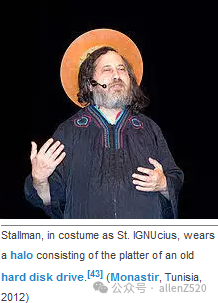
The following illustrations are from the Wiki page on “Richard Stallman”:
Discussion:
-
Interestingly, Stallman’s education and work experience stem from institutions like Harvard and MIT.
-
However, he firmly established free software and the GPL certificate, unaffected by the typical academic certificates of MIT (BSD-like). Of course, conversely, as his fame grew, MIT still adhered to the MIT license, unaffected by Stallman.
-
Moreover, the MIT license highlights even more “leniency.” If I understand correctly, the MIT license is more “tolerant” than the BSD license, as it even allows derivative software to still be advertised and promoted under the original software’s name.
4.4 Composition of the GNU/Linux Project
As an engineer with OS development experience, Stallman led the following projects of the GNU operating system:
-
text editor (Emacs),
-
compiler (GCC),
-
debugger (GNU Debugger),
-
build automator (GNU make).
The evolution path of the famous kernel is as follows:
-
In 1990, GNU member Mach microkernel, i.e., GNU Hurd (see the evolution branch in the historical diagram).
-
In 1991, Finnish student Linus contributed the Linux kernel. From then on, it entered the “main quest.”
Stallman often argues that when referring to this operating system, people (even the engineers who contributed) only mention “Linux.” This is quite unfair; he believes this system is clearly: GNU/Linux.
Of course, from the perspective of opponents, it can also be argued that since the OS kernel Linux kernel was constructed first, it is only natural to port various mature tools from GNU free software to the Linux OS. The Linux OS is inherently derived from Linus’s core contribution, considering his background, this naturally provides immense encouragement to young students entering the information industry. Here, I will briefly outline each perspective.
Expanding Introduction: Those who are passionate about leading social movements in technology will ultimately be tracked due to their statements being amplified in public opinion. Some of Stallman’s remarks seem indifferent to the harm done to the young, leading to significant doubts and criticisms of his true morality, yet Stallman insists on not resigning from his role as the head of the GNU project (he only resigned from some unrelated social or campus positions).
05
—
Conclusion
Based on the brief history of Unix-like, this article introduces Unix OS and two types of Unix-like operating systems:
-
System V Family (Unix): “The Sect Mission”
-
BSD (Unix-like): “The Hall Mission”
-
GNU/Linux (Unix-like): “Main Quest”