As AI large models accelerate their penetration, edge AI is undergoing a qualitative change from “function addition” to “capability reconstruction.” Next-generation smart devices not only need to handle complex tasks such as real-time environmental perception and multimodal interaction but must also achieve localized decision-making under stringent power consumption constraints. Behind this computational power migration is the industry’s extreme pursuit of data privacy, real-time response, and energy efficiency.
“Compared to cloud-based AI large models, edge AI can serve as a good complement, saving a significant portion of cloud resources and bandwidth costs, and achieving this in a very low-power manner,” said Lyu Yajun, Marketing Director of the MCU product line at Infineon Technologies’ Security Connected Systems Division.
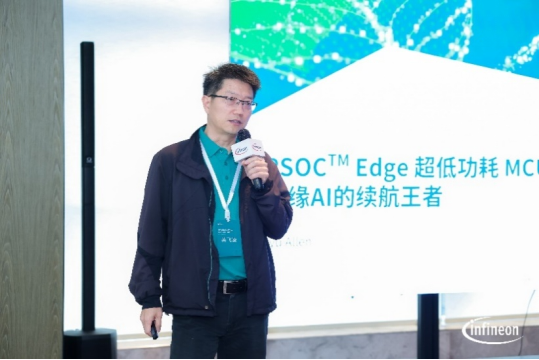
Infineon Technologies Security Connected Systems Division MCU Product Line
Marketing Director Lyu Yajun
From “Connection” to “Perception”: The Multidimensional Balancing Challenge of Edge AI
The transformative trend of edge AI poses unprecedented demands on underlying hardware and development ecosystems. Recognizing the core contradiction between “high performance” and “low power consumption,” Infineon has actively laid out its edge AI strategy in recent years: on one hand, by launching products like PSOC™ Edge to precisely match the computational power and power consumption needs of edge scenarios; on the other hand, by building a complete development ecosystem that supports soft-hard collaboration, providing comprehensive support for all stages of edge AI development. The goal of this combination is clear—to upgrade edge AI development from difficult low-level tuning to more efficient integration and innovation, fundamentally accelerating the deployment process of smart devices.
Peng Zunian, Marketing Director of Infineon Technologies’ Consumer, Computing, and Communications Business in Greater China, mentioned that two core trends are driving the rise of edge AI: first, the proliferation of massive IoT devices, with over 40 billion devices expected to be connected globally by 2030. These devices are evolving from simple connectivity to intelligent perception, urgently requiring more humanized AI capabilities that understand user intentions; second, the shift away from cloud dependency, where traditional device AI capabilities heavily rely on the cloud, leading to bandwidth pressure, response delays, and privacy risks, while also increasing overall costs due to server energy consumption. Edge AI addresses this by transferring more than half of the intelligent processing to local devices, uploading only critical data to the cloud, thus achieving breakthroughs in traffic savings, real-time response, and data protection.
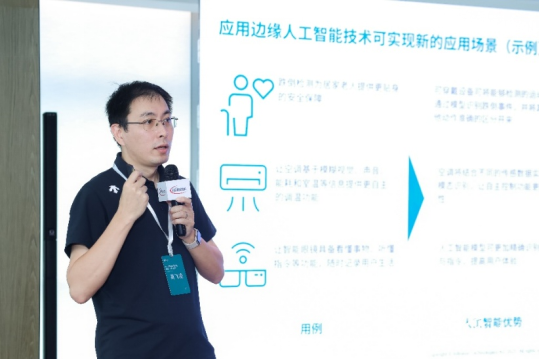
Infineon Technologies Greater China Consumer, Computing, and Communications Business
Marketing Director Peng Zunian
Facing Complex Demands: The Success of Edge AI
Lyu Yajun stated that the success of edge AI no longer depends solely on single computational performance but requires disruptive chip architecture and multidimensional fine balancing. He explained, “For such a ‘cost-effective’ lightweight system, its AI capability is a balance of multiple factors—including NPU computational power, bus architecture, memory bandwidth, chip process, and overall power consumption. Only by truly balancing these factors can we deliver applicable edge AI products to users.”
PSOC™ Edge Hardcore Innovation—How to Become the “Energy Efficiency King” of Edge AI?
In the face of system-level challenges in balancing performance, power consumption, and real-time capabilities for edge AI, Infineon’s answer is the PSOC™ Edge series—a platform that redefines energy efficiency boundaries through heterogeneous computing architecture and a full-stack software solution.
Taking the PSOC™ Edge E8x series as an example, it includes a big-little system based on Arm® Cortex®-M55, Arm® Ethos-U55 neural network processor, and Arm® Helium DSP technology to meet high computational demands for voice and vision; it also includes an Arm® Cortex®-M33 core + Infineon NNLite neural network accelerator specifically designed for ultra-long standby requirements to achieve extreme energy efficiency.
Lyu Yajun stated that PSOC™ Edge has redefined the energy efficiency standards for edge AI through system-level innovations. Its core breakthrough lies in constructing a complete solution that is meticulously optimized for computational power, energy efficiency, and security: achieving a balance between performance and power consumption through a hierarchical heterogeneous architecture design, significantly extending battery life while maintaining AI capabilities; equipped with up to 6.5MB of on-chip SRAM, ensuring that most machine learning models can run efficiently without external storage by reducing data movement; integrating a fully autonomous analog front end that can independently complete sensor data collection and preliminary analysis even when the CPU/NPU is in sleep mode.
As one of the world’s leading suppliers of security chip technology, Infineon deeply integrates its inherited security genes into this architecture, achieving PSA Certified Level 4 certification with the security protection provided by the built-in hardware security island. Overall, PSOC™ Edge provides a meticulously optimized complete solution for edge AI, covering computational power, energy efficiency, and security.
Peng Zunian further elaborated on its power management mechanism: “Based on the characteristic that edge devices spend 99% of their time in standby mode, we use the M33+NNLite combination to handle constant monitoring tasks, dynamically waking up the M55 and Ethos-U55 high-performance computing units only upon detecting critical events.” This precise power domain design allows most areas of the chip to remain in a powered-off sleep state for the majority of the time, thereby enhancing the device’s endurance to a new level.
Addressing Core Pain Points of Edge AI: Solving “Resource” and “Development” Challenges
In the era of edge AI, the core competition among chip manufacturers is shifting from single hardware performance to providing users with complete solutions that integrate software and hardware. Infineon’s practice shows that the ease of use of software, the completeness of tools, and the richness of the ecosystem have become key factors determining its market competitiveness.
Lyu Yajun stated, “In our communications with customers, we found that edge development currently faces two core pain points: one is the difficulty in finding resources, and the other is the difficulty in development.”
Infineon’s DEEPCRAFT™ AI Suite is a powerful tool to address these challenges.
To tackle the resource acquisition challenge, Infineon has built a one-stop platform for edge AI software—DEEPCRAFT™ AI Hub. This platform offers over 50 content resources, covering open-source models, Infineon software, tools, and solutions, as well as research cases for industrial, consumer, and automotive applications. Notably, its layered model resources: Ready Model is available for direct deployment; Accelertors Model serves as a “semi-finished product” supporting deep customization, accompanied by complete application notes and technical documents, allowing developers to quickly access the resources they need through a unified entry point.
To address development challenges, Infineon’s AI toolchain forms a seamless collaborative closed loop. In addition to DEEPCRAFT™ AI Hub as the entry point and resource center for the complete AI development toolchain, other core components include: DEEPCRAFT™ Studio, an end-to-end model factory supporting diverse data from audio to computer vision; DEEPCRAFT™ model converter ensuring efficient migration of mainstream framework models such as PyTorch, TFLite, and Keras; and ModusToolbox for system integration, combining optimized models with application code for final deployment. Additionally, Infineon provides a wealth of five-minute video tutorials and drag-and-drop visual development designs, further lowering the development threshold and helping developers quickly establish project prototypes.
In the face of the complex challenges of edge AI, traditional embedded manufacturers are actively transitioning from a purely hardware ecosystem to a soft-hard collaborative model. Against this backdrop, Infineon has strategically acquired Imagimob, rapidly building a foundational software capability in the field of edge machine learning. This key move not only injects a mature end-to-end development platform and professional team but also integrates into a unified DEEPCRAFT™ development ecosystem through subsequent upgrades. This marks that Infineon has internalized the complete edge AI toolchain as a core advantage, enabling it to provide customers with truly integrated software and hardware solutions.
On the Eve of Edge AI Explosion: How to Empower Diverse Intelligent Needs?
The edge AI market is exhibiting typical “fragmentation” characteristics and is now on the brink of explosion. From smart wearables and smart homes to industrial automation and robotics, application scenarios are rapidly expanding.
“The Chinese edge AI market is showing a high degree of fragmentation and diverse demand, experiencing rapid development from functional iteration to form innovation. Taking smartwatches as an example, products have evolved from basic functions to integrated voice interaction, smart connectivity, and are exploring the deployment of large model capabilities. Meanwhile, smart glasses, as an emerging track, are giving rise to diverse forms from professional tools to consumer products,” Peng Zunian analyzed.
Infineon is promoting the expansion of PSOC™ Edge-related applications, precisely focusing on three high-growth tracks to drive the deep landing of smart technology in key scenarios:
In the smart home and human-machine interaction field, through low-power voice wake-up and local command recognition, creating a more natural and private device interaction experience; innovatively using thermopile and other non-visual sensors to achieve non-intrusive personnel detection, allowing appliances like air conditioners to achieve true environmental perception and intelligent control while protecting user privacy.
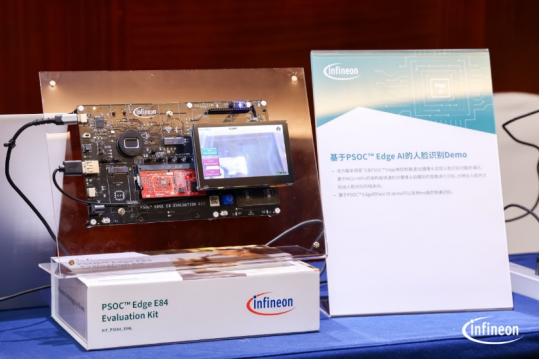
The PSOC™ Edge E84 evaluation board helps developers quickly get started,
experiencing the performance and energy efficiency of handling complex visual tasks.
In the health monitoring and wearable device field, deploying AI models such as fall detection in ultra-low power devices to provide non-intrusive, real-time, and reliable safety protection for the elderly, precisely targeting the high-value segment of the silver economy.
In the next-generation smart glasses track, providing a complete low-power voice interaction solution, ensuring that users can experience an AI assistant around the clock even on lightweight frames under 40 grams, continuously overcoming performance challenges in human-machine interaction.
In the currently hot robotics field, especially in the extremely complex scenario of humanoid robots, Lyu Yajun proposed a distributed intelligent architecture of “small brain” and “big brain.” Since current robots generally rely on a single “big brain” to process all data, this leads to transmission delays, bandwidth pressure, and computational bottlenecks. PSOC™ Edge is expected to play the role of a domain controller in robotic systems, for example, achieving real-time perception and decision-making in sensor-dense areas (such as robotic arms) to alleviate the computational pressure on the central processor. After completing local data processing, Infineon’s other product lines can also provide supporting technologies such as motor control, driving the development of edge AI applications through comprehensive technical support.
He pointed out that the current core task of edge AI is to promote the rapid landing of AI technology in diverse scenarios, where multimodal fusion is an inevitable trend. The fusion of multiple sensors (such as microphones, image sensors, IMUs, and radars) can provide richer data sources for AI, and Infineon is addressing this demand by developing compact and efficient models. Moreover, at the hardware level, PSOC™ Edge has comprehensive interface support, ensuring that the chip can flexibly adapt to various sensors, laying a solid hardware foundation for multimodal AI applications.
Looking to the future, Reshaping the “Core” Power of Edge AI
Standing at the starting point of the edge AI explosion, Infineon has a clear plan for the future evolution path. Lyu Yajun pointed out that innovation will continue to deepen along three dimensions: first, the relentless pursuit of low power consumption and extreme energy efficiency, which is the lifeline of edge devices; second, continuous iteration in storage technology, similar to the focus on computational power and storage in AI chips, MCU storage technology innovation will also be a future focus, such as introducing advanced storage technologies from cloud-based large models (like HBM, LPDDR5/6) and high-speed direct connection storage technologies; finally, forming systematic solutions to address the fragmented market through a wide-ranging product matrix—including AI-focused PSOC™ Edge, industrial control PSOC™ Control, wireless connectivity PSOC™ Connect, and perception processing PSOC™ Sense.
As both experts pointed out during this interview: the competition in edge AI is essentially an engineering art about “how to pack infinite intelligence into limited resources.” The underlying logic is how to build a one-stop software ecosystem to empower developers based on market and customer needs through precise energy efficiency design and an expandable product series. When every embedded engineer can easily access AI capabilities, the era of intelligent everything will truly have the most solid “core” foundation.
END
Note: The cover image of this article is sourced from Freepik, self-made by the author, and publicly available media, all authorized.
Industry Community