“Blind Men Touching an Elephant” is a classic fable. Several blind men wanted to know what an elephant looked like, so they touched it. The one who touched the elephant’s leg said it was like a pillar; the one who touched the trunk said it was like a thick rope; the one who touched the body said it was like a wall; and the one who touched the ear said it was like a large fan. They each insisted on their own views and argued endlessly, all believing they were right. This story teaches us that if we only see part of something and jump to conclusions, we will make the error of generalizing from insufficient evidence; understanding things requires a comprehensive examination.
Professor Qian Chengdan is a renowned contemporary historian in China and was the academic advisor for the once-popular CCTV documentary “The Rise of Great Powers.” Mr. Qian once served as a part-time doctoral supervisor at the School of History and Culture at Shandong University. My master’s classmate, Liu Xiaoyan, and my dorm mate, Wang Jianbo, both followed Mr. Qian to pursue their PhDs. Because of this connection, I met Mr. Qian during my graduate studies at Shandong University, although it was only during a thesis proposal defense.
Later, I went to Nankai University to study. My advisor, Professor Ma Shili, offered a course related to modernization, for which I collected some books on the subject and read a few. Among them was a book edited by Mr. Qian titled “The Process of Global Modernization,” and I also found a small booklet of his, though I can’t remember the title. Because of Professor Ma’s course, I also discovered the “Towards the Future” series published by Sichuan People’s Publishing House and diligently read some of those books. These readings had a significant impact on me. In the aforementioned booklet, Mr. Qian discussed how historians study history, likening it to blind men touching an elephant. Nankai University’s History Department is home to many distinguished professors, and I attended some of their classes out of admiration. I remember Mr. Liu Zehua, an expert in the history of Chinese political thought, stating that the mission of historians is to seek truth. Professor Li Zhian, an expert in Yuan history, made a similar statement during a lecture.
In fact, during a class on historical theory at Shandong Provincial Education College (now Qilu Normal University), the professors from the History and Culture College at Shandong University discussed these ideas in an academic forum, but at the time, I didn’t grasp their significance. The truth is often simple; we may have encountered it at some stage, but we were too young to understand it fully.
Seeking truth and understanding the reality of the world is the mission of historians engaged in historical research. Observing the world, understanding it, and experiencing it is likely the lifelong quest of every ordinary person as they navigate through life.
According to Mr. Qian, historians studying history are like blind men touching an elephant. From this, we can deduce that different scholars may approach the same issue differently. A single scholar studying the same issue may also have varying perspectives. In the first scenario, Scholar A may spend their entire life exploring the elephant’s leg, starting near the foot, moving slightly upward to the knee, and with more effort, reaching the upper part of the leg near the belly. Regardless, in this scholar’s eyes, the elephant resembles a pillar. Because of their deep engagement in this area, the expert who has touched the elephant’s leg is firmly convinced of their judgment about what an elephant is. Conversely, another scholar, Scholar B, who happens to touch the elephant’s trunk, may firmly believe that the elephant resembles a thick rope. Different scholars have different angles, understandings, and interpretations of the same issue, leading to diverse opinions.
To better illustrate Scholar A’s situation, I attempted to retell the story of the blind men touching an elephant in a new version. In this new version, the same blind man touches the elephant three times, each time making an effort to touch different parts of the elephant’s leg at varying heights. The first time, he touches near the foot, the second time at the calf, and the third time at the thigh. Regardless of the position on the leg, in this blind man’s understanding, the elephant always resembles a pillar. I used this retelling as a prompt for several commonly used AI tools, resulting in three images. The results from Yuanbao were quite satisfactory, and I would like to share them with everyone.
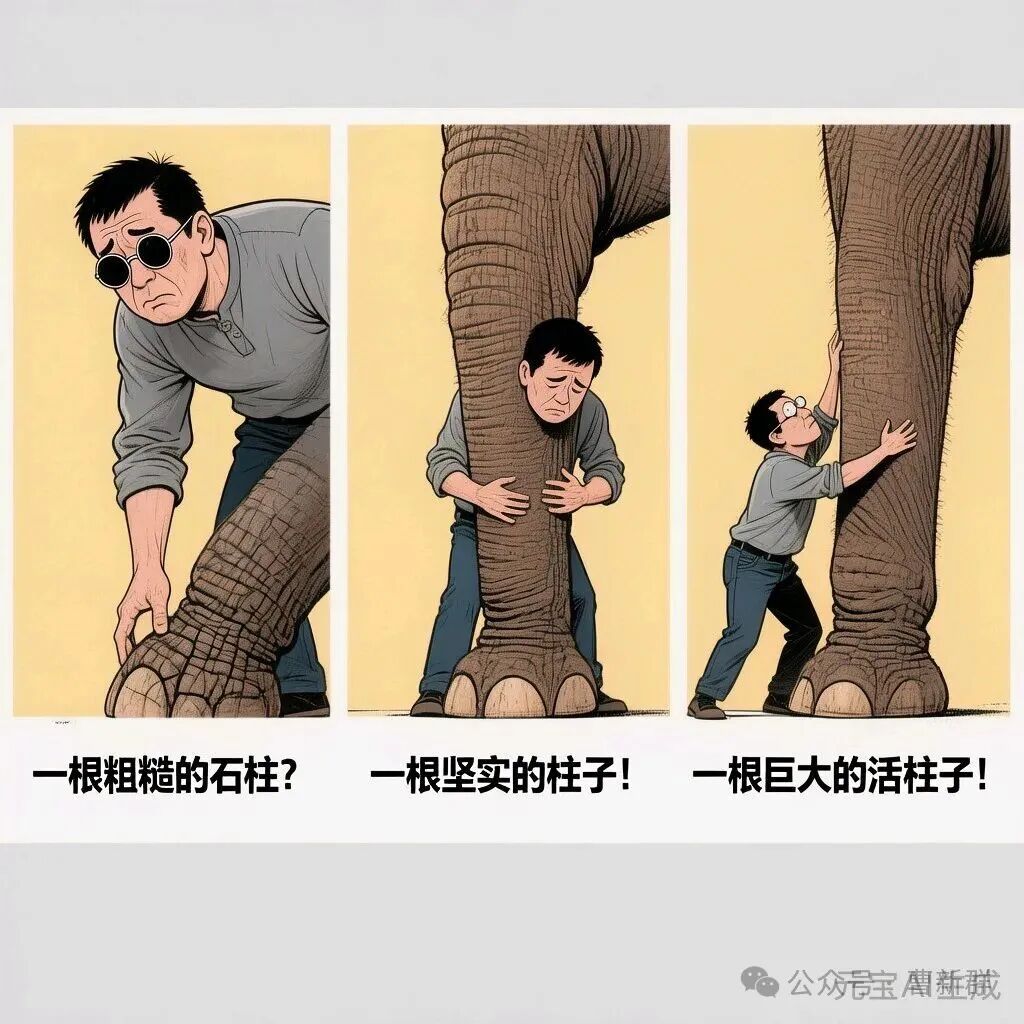
Returning to the topic of academic research, a single scholar may dedicate their entire life to studying the same issue, field, or discipline, thus becoming an expert in that area. Some may regard them as an expert, and they may also believe it to be true. How does this expert differ from the blind man in the new version of the story who touched the elephant’s leg at different heights?
How do experts from different disciplines studying various fields differ from the blind men in the classic version of the story?
The world is like an elephant. We come into this world, interact with it, and understand it. Our journey through life is essentially a performance of both the old and new versions of the blind men touching an elephant. So, what insights do the old and new versions of this story offer us?

How do we spend our lives? I believe that as a reader, you may have your own new thoughts, perhaps even your own answers, or perhaps you feel more confused.
2025 is referred to as the “Year of Artificial Intelligence.” We live in a brand new era. In the face of such an era, some people are filled with panic, fearing that they or even humanity will be replaced by AI. Others are excited, believing that opportunities have arrived.
Indeed, this is an era full of challenges and opportunities. In this era, people have more chances to see the world, to explore a broader world, and to reach deeper and higher places, infinitely approaching the truth of the world.
Why do I say this, and how can we achieve it? In the next issue, we will continue to discuss this slowly…
Written on
November 22, 2025, at 8 AM
On a train from Beijing to Jinggangshan
A song for everyone, because the lyrics include the line about heading towards spring, like a train that keeps moving, just like our journey…