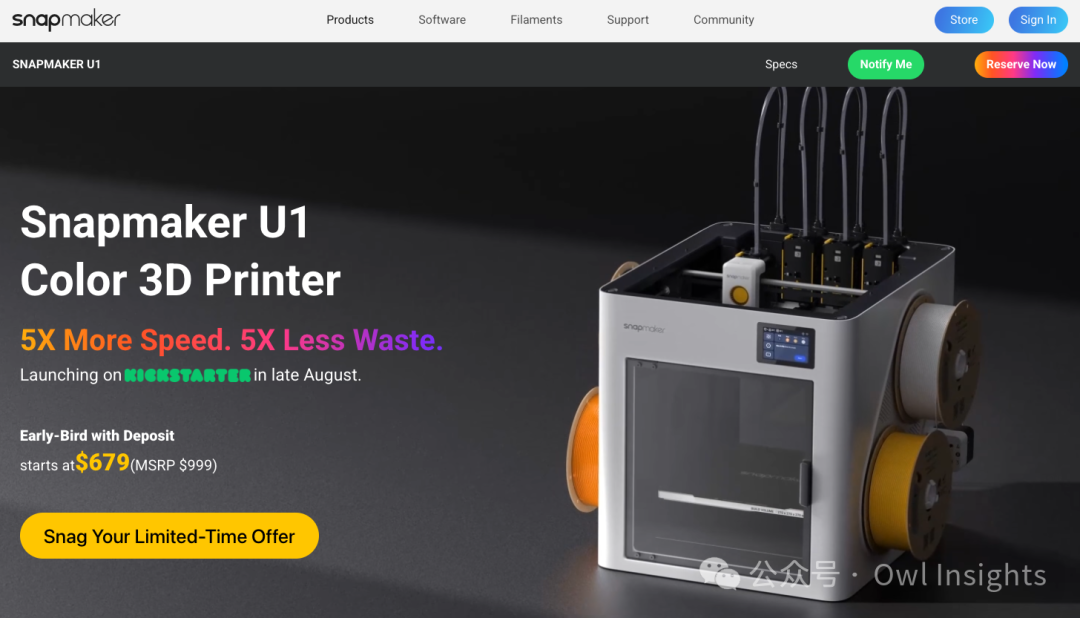
Image Source: Snapmaker
Snapmaker is bringing crowdfunding back to the forefront. The company has confirmed that the U1 is expected to launch on Kickstarter in late August, and through a “reservation fee → early bird → shipping cashback” structure, it has lowered the effective threshold to $679 (original price $999). This is not just a routine replacement, but a directional statement: shifting from a “do-it-all multifunctional workshop” to something that ordinary users can perceive daily,minimizing the two most annoying aspects of multi-material printing: waiting and waste. Meanwhile, Bambu is accelerating on a different track: while maintaining the integrated experience of AMS, it continues to expand its product line towards “multi-tool/team and enterprise scenarios” (such as the recent H2D Pro direction). The two companies meet at the same price point but offer two different reasons for purchase:one sells a system, the other modifies variables.
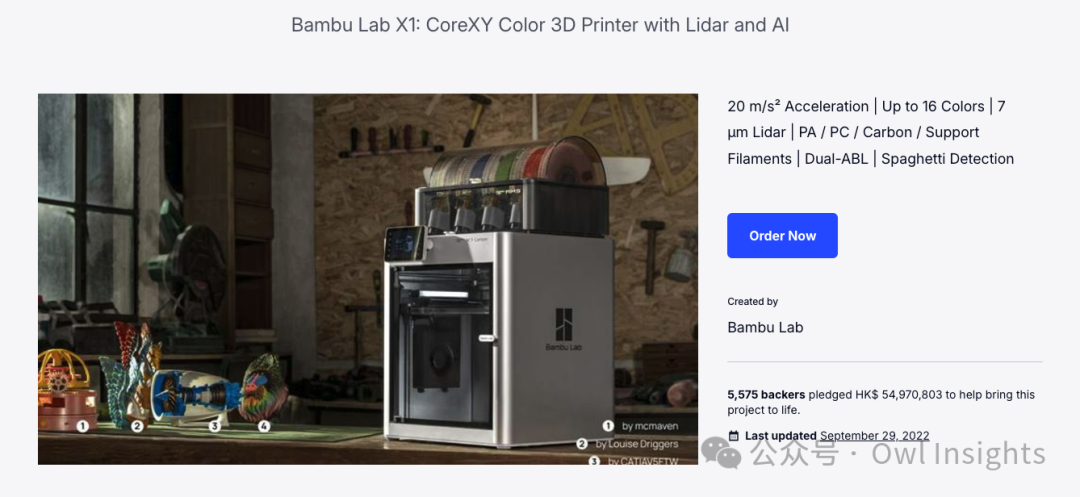
Image Source: Kickstarter
Looking back at the timeline, both companies started from crowdfunding: Bambu debuted its brand on Kickstarter with the X1 series, quickly shifting to self-operated and frequent new releases, forming a closed loop around “complete machine + AMS + software + content”; Snapmaker has repeatedly used crowdfunding as a “validation ground” to test pricing and demand. This time, the U1 chooses to “insert an efficiency wedge” into the mainstream price range: the same multi-color daily use,less waiting, less waste becomes a more direct reason for purchase. For users, this is clearer than a feature list of “I can also laser and engrave”: it does not lengthen the list but rewrites the account.
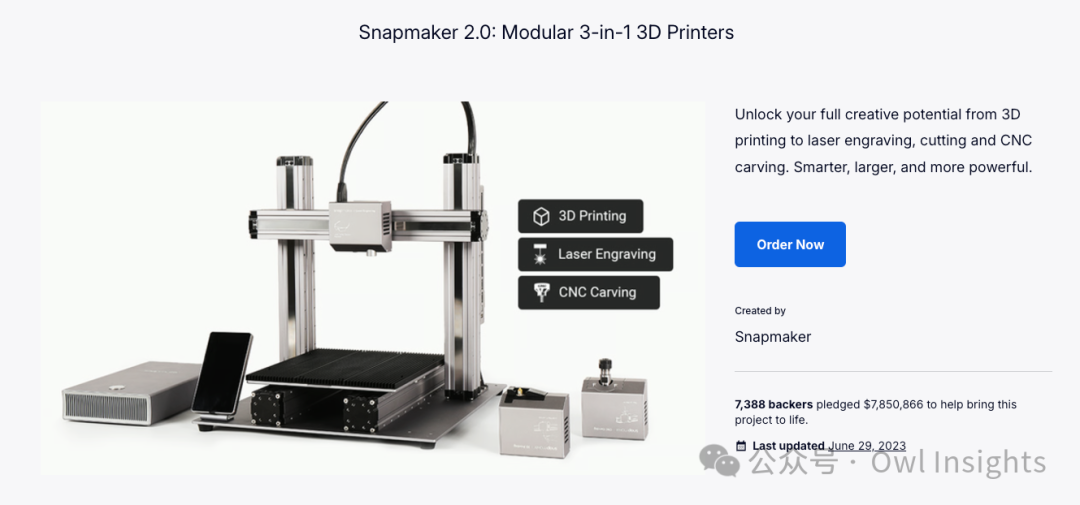
Image Source: Kickstarter
The business logic behind this account is straightforward. Bambu’s approach is “systematic scale replication“: creating an “out-of-the-box, stable, and efficient” experience that most people can replicate, then broadening the audience with SKU gradients, accessories, and content, gradually extending capabilities to teams and enterprises. Its keyword ispeace of mind. Snapmaker’s approach is “extreme focus on a single point“: minimizing the two costs that users can most perceive (switching wait time and cleaning waste) and gathering the first batch of users who are highly sensitive to this issue through crowdfunding. Its keyword isintuitive benefits. The two methods serve different “daily needs”: the former is like paving a highway to a larger ecosystem, while the latter is like driving a clear efficiency anchor into the same piece of land.
The pricing and channel strategy follows the same logic. The effective threshold of $679 brings “multi-nozzle multi-color” into the public budget, while Kickstarter plays the role of “testing prices + gathering seeds + unified narrative”: using a standard multi-color sample to make the differences in “time-saving/material-saving” visible; transferring the memory point of the effective threshold to subsequent channels; and using clear process templates to lower learning costs. In contrast, Bambu’s “self-operated + frequent new releases + ecosystem amplification” provides another form of certainty: no need to get tangled in parameters and combinations,a single system can cover more use cases. These two forms of certainty will coexist at the same price point, with users flowing according to their needs and channels matching scenarios.
Who will be the first to be impressed by the U1? Not the “general 3D printing users”, butthose with sharp pain points: creators and small studios in high-frequency color-changing scenarios such as logos, board game pieces, educational models, and cartoon color schemes. They are highly sensitive to “waiting time” and “waste piles” and are willing to pay to “reduce these two costs”. In contrast, users who value process stability, team collaboration, and content ecosystems will more naturally remain within Bambu’s system. This is not an either-or situation, but alayered narrative within the same price range: one side is “integrated like home appliances”, while the other is “visible efficiency dividends”.
To clarify the matter of “variables being corrected”, communication must also be extremely simple and repeatable. For users, all that is needed is a phrase that can be relayed by friends,the same model, less waiting, less waste, is a better daily experience. In retail and evaluation, this should be made into a demonstrable process: a standard multi-color sample that completes within an hour in-store, comparing the real differences in time and material consumption, allowing “seeing” to precede “believing”. For partners and channels, the story remains a single sentence,at mainstream price points, we offer another form of certainty: the efficiency dividends brought by multi-materials; this is easier to reach a consensus than a feature list.
In the coming year, there is no need to bet on macro shares, but to focus onground signals: immediate conversions brought by standard sample demonstrations; whether the frequency of routine maintenance and calibration stabilizes and decreases; whether the installation rate of efficiency-related accessories such as closed covers, wear-resistant nozzles, and cameras increases; and whether user content around “saving time/materials” spreads naturally in the community. If these numbers continue to improve, it indicates that the narrative of “less waiting, less waste” is not just appealing, but is bringingcustomer acquisition and word-of-mouth compounding. For channels, this means shorter demonstration paths and higher certainty; for brands, this is a more sustainable growth engine than “the more features, the better”.
Because of this, Snapmaker’s direction is not about “directly competing with Bambu on a specific machine”, but ratherredefining mental boundaries within the same market: those who care more about ecosystems, collaboration, and a broader capability map will vote for the system; those who are more sensitive to waiting and waste will vote for the variables. Each side will strengthen itself while also pulling each other: the systematic side will continue to optimize algorithms and default parameters, further lowering the perceived costs of switching and cleaning; the variable side will refine the experience of “multi-nozzle ≈ daily replicable” to be more foolproof and stable, reducing the mental burden of maintenance and learning.As both ends converge towards “more peace of mind”, the speed at which multi-materials transition from “troublesome” to “default” will accelerate.
Late August is just the starting point. What truly determines the direction isthe real account of the same model, how long it takes, how much it uses, and how much extra care is needed. When “less waiting, less waste” is consistently reproduced, it is no longer a promise in the parameter table, but a consensus on the merchant’s shelf. For users, this is a friendlier choice; for the industry, this marks the beginning of moving from “single-path leadership” to “multi-path resonance”. What is most anticipated is not who defeats whom, butmulti-materials truly becoming the default experience on the desktop.
#3DPrinting #Multi-MaterialPrinting #ToolHeadChange #FilamentChangeSystem #SnapmakerU1#Bambu #AMS #DesktopManufacturing #CrowdfundingKickstarter #EfficiencyImprovement #LessWaitingLessWaste #MakerEcosystem #EducationAndStudios #MainstreamPriceSegment


Owl Insights focuses on global technology, business, and innovation, dedicated to bringing you the latest industry dynamics and in-depth analysis. We curate product information, financing cases, and market trends to resonate with global wisdom, providing insights into future opportunities and challenges. Whether you are an entrepreneur, investor, or a technology enthusiast, this is the best platform for you to engage with global innovative thinking and expand your horizons.