 Advanced Manufacturing · Introduction
2025 is widely defined by the industry as the “Year of the AI Agent.” In this year, AI agent technology is expected to experience explosive growth, rapidly transitioning from cutting-edge concepts in laboratories to various industries, gradually emerging in the industrial sector.
Unlike general large models, AI agents can not only understand human instructions but also perceive the environment, plan actions, and utilize tools to autonomously adapt to industrial scenarios. Through continuous interaction with real-world situations, AI agents accumulate experience and optimize strategies, ultimately achieving a leap from “passive response” to “active execution.” From office process automation to deep interactions in intelligent customer service, and to autonomous operation and maintenance in complex industrial environments, AI agents demonstrate extraordinary potential in the industrial field.
Today, let us explore what AI agents are and how they bring about changes in industrial scenarios.
What is an AI Agent Based on Large Models?
AI Agent is an AI system characterized by autonomy, reactivity, proactivity, and social capabilities, driven by large models, and includes key components such as Planning, Memory, and Tools usage.
▷Planning: Responsible for breaking down large tasks into sub-tasks, optimizing solution steps through self-reflection and thinking chains, and improving the quality of output content.
▷Memory: Responsible for storing information; short-term memory refers to learning related content in context, while long-term memory is used to retrieve external databases to complete complex tasks.
▷Tools: Responsible for calling external tools, such as application programming interfaces (APIs), to obtain additional information.
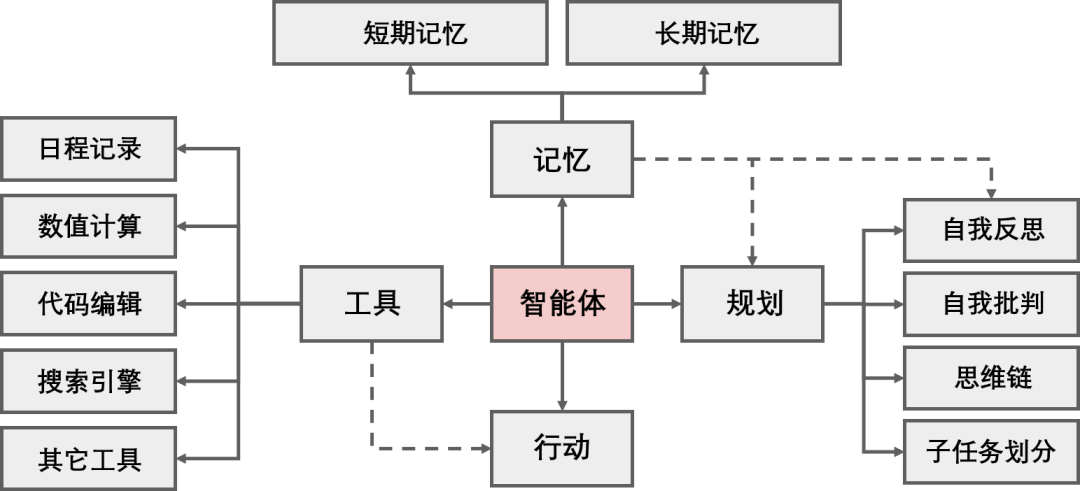
Overview of AI Agent Structure (Image Source: Reference [2])
In industrial scenarios, AI agents perceive environmental signals through sensors, relying on large models to complete business data searches, plan industrial actions, call external tools, and ultimately make decision reasoning to execute industrial operations. At the same time, these AI agents possess natural language interaction capabilities, enabling collaboration and competition among multiple agents, applicable in real scenarios such as product blueprint design and operation and maintenance decision-making.
Application Scenarios: AI Technology Drives Innovation Across the Industrial Chain
In the wave of technological iteration, AI agents based on large models have sparked a wave of process reconstruction and model innovation across multiple industries. We will focus on data governance and intelligent operation and maintenance, exploring how AI agents use technological power to break industry dilemmas.
Platform Solution 1: Build Intelligent Operation Solutions for Data Assets
Industry Pain Points: In industries such as manufacturing and finance, which are highly dependent on data, data governance has long faced constraints from “manual shackles.” In traditional models, data analysis, metric calculation, and report generation rely entirely on manual operations, which are time-consuming and labor-intensive; the complex structure of data assets makes it difficult to support rapid decision-making, becoming a “stumbling block” for enterprises to respond to market changes.
AI Agents Breakthrough: In response to these pain points, AI agents serving data governance have emerged, covering data production management, retrieval analysis, and value pushing processes to create a self-operating “data knowledge base” for enterprises.
In the data production management phase, AI agents act as “data asset managers,” autonomously constructing an enterprise data knowledge repository based on an indicator system. Utilizing large models and retrieval-augmented generation (RAG) technology, they project relationships between business metadata and technical metadata, weaving data without needing to rebuild existing data warehouses, accurately identifying effective data assets and completing semantic encapsulation. The woven data includes core elements such as metrics, field names, tags, dimension values, and physical tables, as well as their historical relationships, laying the foundation for constructing a data knowledge graph and achieving a self-closed loop of “data production-governance-sedimentation.”
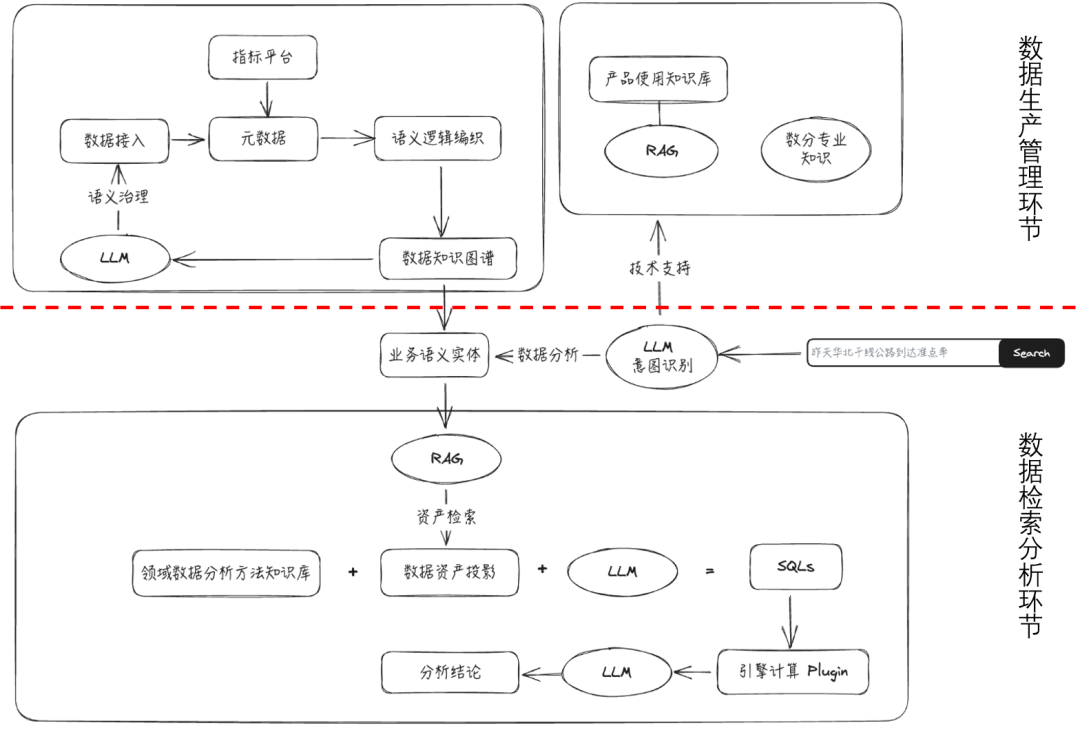
Data Production Management and Retrieval Analysis (Image Source: Platform Solution)
In the data retrieval analysis phase, AI agents transform into “decision analysts,” allowing data queries and analyses to break free from “technical barriers.” Users only need to input their requirements in natural language, and the AI agent can complete semantic understanding and instruction decomposition through large models, accurately finding matching asset projections in the data knowledge graph using RAG technology. Subsequently, the AI agent automatically generates multiple structured query statements (SQL), constructing a complete analytical thought chain, providing clear analytical advice like a “professional consultant.”
In the data value pushing phase, AI agents become “data salespeople,” transforming business models from “passive queries” to “active pushes.” Relying on large model technology, they organize the contextual logic of data assets through data catalogs, standardization, and contextualization, subsequently sensing the specific industry scenarios of users. Without the need for user inquiries, AI agents can insightfully understand user needs like a “personal advisor,” creating real-time analysis tasks and actively pushing core information to users, allowing business personnel to obtain immediate decision-making basis without mastering SQL or industry knowledge.
Implementation Results: AI agents, by automatically generating SQL and reports through large models, significantly reduce manual intervention in data governance processes, shorten decision-making cycles, and enhance business response speed. In data retrieval analysis, AI agents have served over 8,000 users, with total usage exceeding 320,000 times; in data value pushing, the market business valuation of related AI agents has approached 100 billion yuan, proving the value of AI agent technology in digital governance.
Platform Solution 2: Establish a Digital Operation Team with Multi-Agent Collaboration
Industry Pain Points: As digital transformation deepens, the IT environment of enterprises is becoming increasingly complex, with explosive growth in operation and maintenance demands and continuous pressure on human resources. The traditional “manual monitoring and passive response” operation and maintenance model has become unsustainable, and how to use technology to liberate manpower and improve efficiency has become a challenge faced by enterprises in digital transformation.
AI Agents Breakthrough: In the wave of digital reform, digital operation teams based on multi-agent collaboration have emerged. The core of this team consists of job-specific AI agents and tool AI agents, which quickly generate various solutions through multi-agent collaboration, empowering and enhancing the efficiency of actual operation and maintenance personnel, reshaping operational processes, and helping enterprises maintain a competitive edge in the wave of digital transformation.
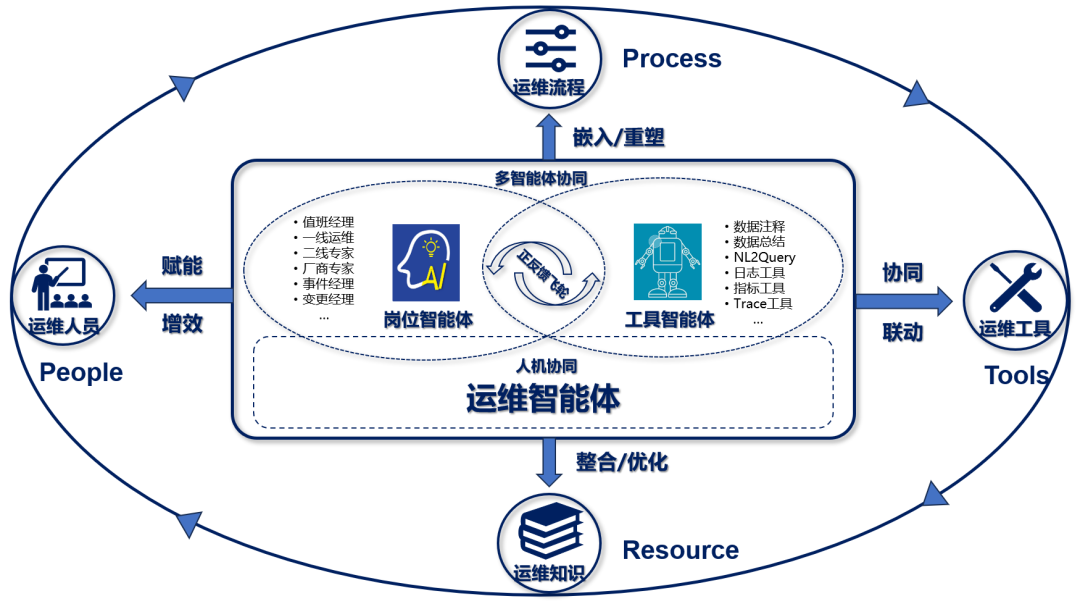
Overall Framework of Operation and Maintenance AI Agents (Image Source: Platform Solution)
Job-specific AI agents are the “professional backbone” of the team, trained using deep learning and professional knowledge graph technology to simulate the professional roles of operation and maintenance positions. Whether it is network monitoring, system optimization, or fault diagnosis, each job-specific AI agent is equipped with knowledge and experience in the corresponding field, capable of making professional judgments in complex scenarios that rival human experts.
Tool AI agents serve as the “bridge” connecting job-specific AI agents and actual operation and maintenance tools. These agents possess basic functionalities for using tools while also understanding high-level task objectives, autonomously deciding how to apply tools based on context, and proactively providing analytical suggestions, ensuring that technical tools genuinely serve operational goals.
Implementation Results: Through multi-agent collaboration, operation and maintenance AI agents can autonomously complete most workflows, allowing operation and maintenance personnel to efficiently handle massive amounts of operational information by focusing only on key aspects. Currently, this AI agent has successfully empowered 120,000 engineers, providing professional operation and maintenance support for various manufacturing industries, helping enterprises establish a foothold in the digital wave.
Conclusion
Although there are still many issues in industrial scenarios, such as data silos, lack of reliability verification, and incomplete standard systems, the trend of AI agent technology taking root in industry has already formed. With the rapid implementation of large model technology in industrial scenarios and the gradual improvement of the multi-agent cross-process collaboration ecosystem, AI agents will become the core link connecting industrial digital twins and actual production, building a smarter and more efficient production environment for manufacturing enterprises. For enterprises and practitioners, grasping the evolution logic of AI agents and proactively laying out intelligent transformation of core processes will be key to seizing future competitive advantages.
Source: China Industrial Internet Research Institute