Yesterday, I mentioned three companies that have successfully commercialized humanoid robots, the top three domestic robot manufacturers. Who will emerge victorious in the future? I found that many people tend to think that robots, especially humanoid robots, and artificial intelligence are the same thing, but they are actually not.To put it simply, a robot is a machine that can perform specific physical tasks. In contrast, artificial intelligence is the development of a system that can think like a human. From a definitional standpoint, the two are completely unrelated. A robot does not necessarily need to have a brain, and artificial intelligence does not require a body.
|
Feature Dimension |
Artificial Intelligence (AI) |
Robot |
|---|---|---|
|
Core Definition |
Technology or system that simulates human intelligence (algorithms, software) |
A mechanical device that can perform physical tasks (hardware, entity) |
|
Essential Form |
Mainly virtual (existing in computer programs) |
Mainly physical entities (with mechanical structures, sensors, actuators) |
|
Core Objective |
To mimic human cognitive functions (learning, reasoning, decision-making, perception) |
To replace or assist humans in completing specific physical tasks |
|
Main Application Areas |
Data analysis, image recognition, natural language processing, recommendation systems, predictive models, etc. |
Industrial manufacturing (welding, assembly), medical surgery, warehousing logistics, cleaning services, etc. |
|
Interaction with Environment |
Typically interacts indirectly through data |
Directly interacts with the physical world |
So, what creates the intersection between the two? The answer is intelligent robots.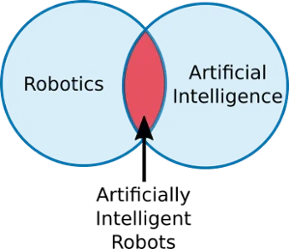 In other words: robots with brains.However, what truly confuses many people into thinking that humanoid robots and artificial intelligence are the same is the influence of Stanford’s Fei-Fei Li and NVIDIA’s Jensen Huang. At the GTC 2024 conference, Huang explicitly pointed out that the next key point in AI development is “Physical AI”.Although Physical AI does not specifically refer to robots, it also includes technologies like autonomous driving and smart spaces. However, autonomous driving is not a new concept; it has been discussed for decades, and its imaginative scope is limited. In contrast, robots, especially humanoid robots, are filled with imaginative potential, leading people to unconsciously equate humanoid robots with AI.In reality, while robots represent the largest application and development space for Physical AI, artificial intelligence is not everything for robots. AI can serve as the brain of a robot, but a robot cannot function solely with a brain.Just as humans have muscles, bones, and nerves, robots also have multiple systems. The brain can only issue commands, but the actual work relies on other components. A robot with only artificial intelligence but no body is like Stephen Hawking, capable of thinking but unable to perform (in a physical sense); a robot with a body but no AI guidance is like a person with cerebral palsy, only able to perform simple tasks.The two are essentially a soft and hard relationship, a brain and a body.Finally, let’s discuss why humanoid robots are unique.In fact, robots with brains do not have to be humanoid; quadruped robots (robot dogs) or wheeled robots can also fit this description. Their characteristic is the ability to physically interact with the environment (rather than relying on fixed programs).In terms of efficiency, humanoid robots are often not cost-effective in many situations. For example, in industrial settings, one or more robotic arms may suffice, and there is no need for a head and legs. Even in scenarios that require mobility, adding wheels is much simpler.So why create humanoid robots?Because the world we live in—from doorknobs, stair heights, to car steering wheels and workbench designs—is built around human body shapes and operating habits. Humanoid robots can directly utilize these existing environments and tools without needing to specially modify the world for them, which is an inherent advantage that other forms of robots cannot match, and this versatility brings great imaginative potential to humanoid robots.However, ideals are abundant, but reality needs to support them. Currently, for humanoid robots to truly enter households, it will take at least 10 years. They may enter industrial scenarios sooner, but industrial scenarios do not necessarily require humanoid robots, which creates a contradiction.