The “Think Tank Observation” series report is written by senior researchers from the China Academy of Information and Communications Technology (CAICT), focusing on telecommunications, the internet, information technology, and intelligent manufacturing. It utilizes the latest domestic and international ICT regulatory policies, market hotspots, and new technology developments to provide quick feedback, analyze causes, and assess impacts. This issue of “Think Tank Observation” presents the selected report on “Applications and Development Prospects of Edge Computing in the IoT” for your reference.
With the rapid development of wireless mobile communication technology and the popularization of mobile internet and cloud computing, the application and implementation of IoT and related technologies in vertical industries have been accelerated. Consequently, a new computing paradigm called “edge computing” has begun to frequently appear in our view. Edge computing refers to the method of processing data close to the location of the object or data generation, using an open platform that integrates network, computing, storage, and application core capabilities, emphasizing local data processing to reduce system response time, protect data privacy and security, extend battery life, and save network bandwidth, etc., to meet the basic requirements for real-time business, application intelligence, and security and privacy protection.
According to IDC’s predictions, by 2020, there will be over 50 billion sensors and terminals connected to the internet, with more than half of the terminals and IoT networks facing bandwidth limitations, and 40% of the data needing to be computed, analyzed, processed, and stored at the network edge. In the future, the edge computing market is expected to exceed one trillion, becoming an emerging market on par with cloud computing. The increasing attention to edge computing is due to several reasons: firstly, the exponential growth of sensors in the IoT era has led to various dimensions and formats of data, making network bandwidth and computing throughput performance bottlenecks for cloud computing; secondly, sensors are ubiquitous, collecting real-time or sporadic physiological data, application data, and other types of private data, thus raising higher demands for information security; thirdly, in specific application scenarios within IoT networks, there is a need for local real-time processing of small data generated by devices, which does not need to be sent to the cloud.
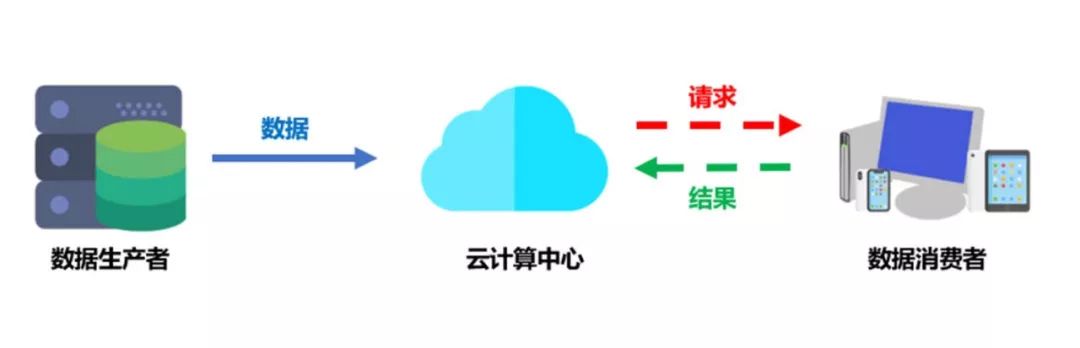
Figure 1: Traditional Cloud Computing Structure
The above figure shows the traditional cloud computing structure, where data producers collect (or generate) raw data and transmit it to the cloud computing center (hereinafter referred to as cloud center), and data consumers send requests to the cloud center to use the data after authentication. This structure can still meet business needs in the PC internet and mobile internet eras, but it cannot meet the needs in the IoT sensing era. Of course, offloading computation tasks to the cloud is an effective way because cloud computing capabilities are usually much faster than edge devices. However, due to limited bandwidth, as the number of sensors and terminals connected to the network increases, for example, in smart homes, various sensors and even smart furniture are integrated with chips that possess communication and computing capabilities. As the data continues to increase, data transmission speed becomes a bottleneck for enhancing cloud computing capabilities. An autonomous truck generates over 1GB of data per second, requiring real-time processing of data to make accurate judgments about the operating states of the tractor and trailer. If all data is sent to the cloud for processing, the response time will become very long, and if too many vehicles are computing simultaneously in a certain area, it will pose significant challenges to network bandwidth and reliability. Therefore, it becomes crucial to analyze and process business and data directly on edge devices.
Edge computing can compute the upstream data generated by various terminals in application scenarios at the network edge, as well as the downstream data generated by the cloud computing center. Regardless of whether it is called edge computing, fog computing, or proximity computing, it refers to all computing and network resources between the data source and the cloud computing center. Smartwatches and smartphones are the edges between individuals and the cloud. Smart speakers and smart gateways are the edges between smart homes and the cloud; smart rearview mirrors and smart dashcams are the edges between vehicles and the cloud. The core of edge computing is to perform computations close to the data source.
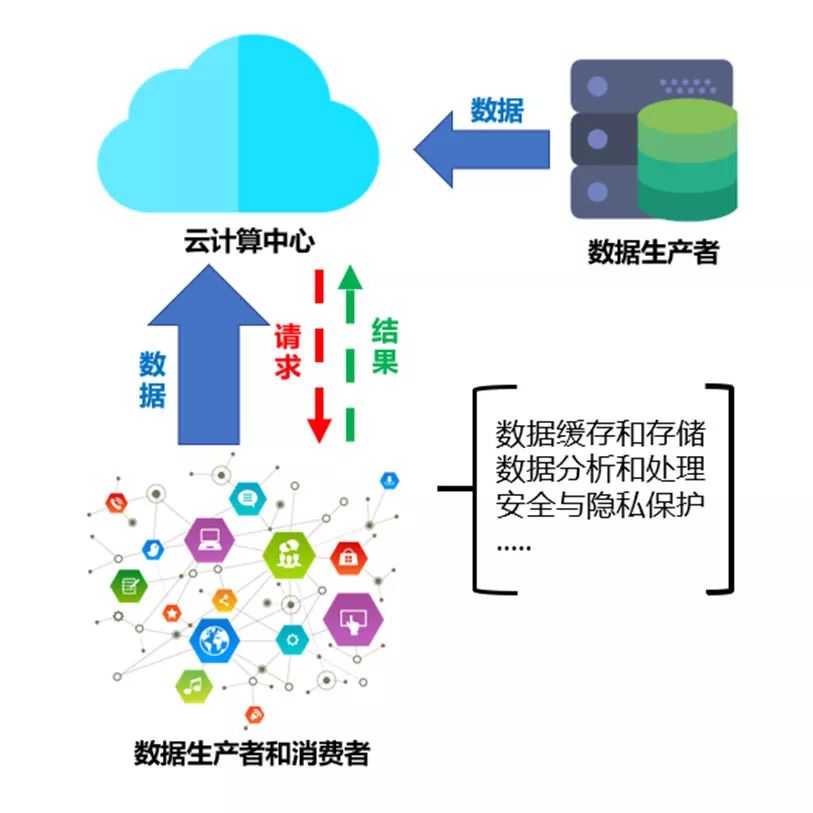
Figure 2: Edge Computing Structure
The above figure shows the structure of edge computing, demonstrating the bidirectional computation flow. In edge computing, terminals or sensors are not only data producers but also data consumers. Terminals and sensors can not only request content and services from the cloud computing center but can also perform independent computations. Sensors and terminals have certain storage capabilities, allowing them to cache, store, and process “small data,” and when connected to the network, they can send requests and cloud services to users. The design of edge computing should be reasonably planned based on the user needs of the application scenario, meeting business demands while ensuring reliability, security, and protection of privacy data. In practical applications, edge computing also involves three types of applications in multi-faceted scenarios:
1. Personal Edge: Centered around individuals, computations will revolve around the individual and involve the surrounding environment related to the individual, such as smart homes and small offices. Personal edge involves various sensors and terminal devices related to individuals, such as smartphones, smart bands, smart glasses, smart speakers, etc. When an individual moves from home to other scenarios, personal edge computing devices will enter the business edge.
2. Business Edge: Refers to work scenarios, which can be indoors or outdoors, such as factories and large office environments. These scenarios usually come equipped with data centers that provide certain processing and storage capabilities and can be quickly deployed in the existing environment. Devices involved in the business edge field include: sensors, robotic arms, vehicles, drones, etc.; manufacturing and engineering are the two major fields where business edge computing is rapidly developing.
3. Multi-cloud Edge: A topological term for service providers or enterprise network edges, where business first enters the home or remote branch through dial-up modems.
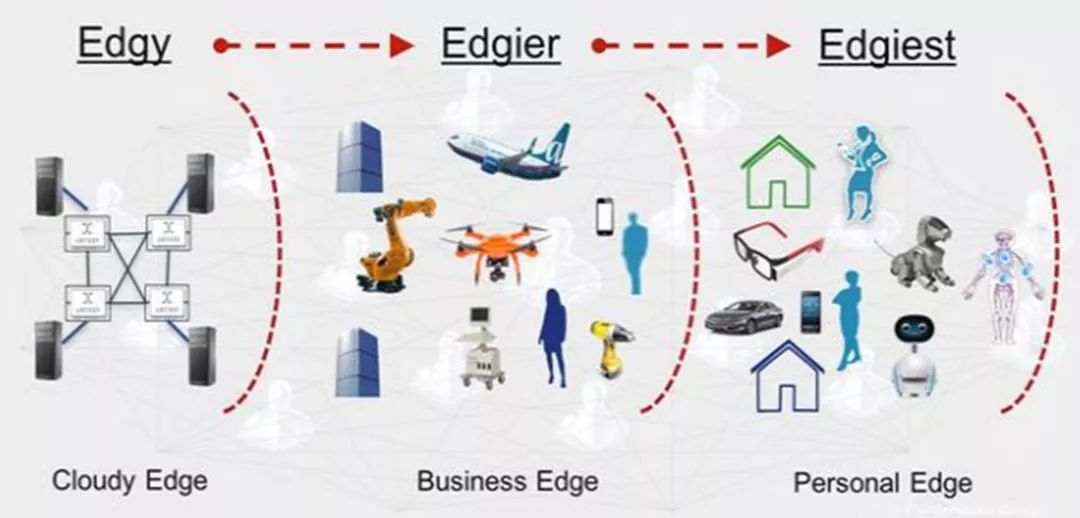
Figure 3: Three Types of Edge Computing
Personal edge, business edge, and multi-cloud edge, especially the first two as the primary application types of edge computing, have broad application prospects. In edge computing, due to the availability of certain computing resources at the edge, it can undertake a portion of the computing tasks, alleviating the pressure on cloud computing, reducing delays caused by bandwidth during data uploads and downloads, and mitigating system delays caused by prolonged cloud computing times. In smart home or smart community scenarios, there are numerous sensors and terminals that can transmit data to the cloud via Wi-Fi, Bluetooth, ZigBee, cellular networks, etc. However, considering the massive volume of this data and that many data need to be used locally, cloud computing is not the most suitable computing paradigm for smart communities and smart homes. Edge computing will take its place, running IoT edge operating systems on smart gateways (or smart speakers with gateway functions, service robots, etc.), allowing various electronic devices to connect to the gateway via a local area network to deploy relevant services, perform computations, and achieve unified control. With the rapid development of 5G technology, characterized by its wide coverage, low latency, massive connectivity, and high reliability, edge computing will have even broader application scenarios. 5G will accelerate the penetration of IoT technology into more vertical industries, and in the future, various scenarios in life and work will likely integrate into the IoT, becoming both data producers and consumers. 5G will support massive machine communication, with typical application scenarios represented by smart cities and smart homes deeply integrated with mobile communications, and it is expected that billions of devices will access the 5G network while generating massive operational data.
With the development and promotion of communication technologies like 5G, some potential issues included in edge computing urgently need to be addressed, such as reliability issues, privacy and security issues, and how to optimize networks and bandwidth. Taking privacy and security as an example, if edge computing is deployed at home, a large amount of user physiological data, usage data, and other private data will be collected. For instance, by analyzing data from smart mattresses and smart pillows, one can determine whether someone is resting, what time they rest, and what position they rest in; by analyzing data from smart locks and peepholes, one can know when someone is home. Therefore, how to provide quality services without infringing on privacy is also a critical consideration. Certain private data can be anonymized before processing and only stored locally (on the gateway), not uploaded to the cloud. Along with privacy issues comes the issue of data ownership; the data generated in home scenarios by edge computing belongs to the data producer, i.e., the owner, and keeping user private data where it is generated will better protect user privacy. As users become increasingly aware of data privacy protection, builders or operators are paying more attention to how to protect owners’ privacy, such as setting up data upload and download switch functions for home gateways, allowing owners to decide which data to upload to cloud service providers and when.
Due to the rapid proliferation of IoT sensors and their penetration into various vertical application scenarios in life and industries, to ensure data and run in a shorter time, the reliability of business and the security of data, an increasing number of cloud computing services will migrate from the cloud to the network edge in the future. IoT sensors and various terminal devices play a crucial role, and their roles are also changing, transforming from data consumers to both data producers and consumers. With the rapid evolution of the entire edge computing ecosystem, including chips, modules, communication technologies, networks, and system platforms, edge computing will become a key technological direction for the development and layout of the industrial internet in the future.
Author Introduction
Ge Hantao: Currently serves as the Deputy Director of Strategic Planning and Research Department of the CAICT’s TIER Terminal Laboratory/Chief Researcher in the IoT industry. His research areas include various IoT vertical directions: research, planning, and consulting work in smart cities, smart sanitation, smart communities, smart homes, etc. He has participated in the research and development of multiple technical standards in the fields of smart communities and smart homes. He has published dozens of articles in domestic professional journals and co-authored several monographs. He has received the Microsoft Most Valuable Professional award three times.
Email: [email protected]
This article is published in “Think Tank Observation” Issue 7, 2019
“Think Tank Observation” series reports are produced by CAICT, revealing diverse changes in a timely manner, helping clients capture trends and market patterns in telecommunications, the internet, information technology, and intelligent manufacturing from multiple perspectives to support major decisions. 24 issues per year, each with 3-4 reports.
Ordering Contact: [email protected]
Welcome to scan the QR code for consultation

Click Read the original text for more report information.
Proofread by | Chen Li, Shan Shan
Edited by | Ling Xiao
Welcome to forward and share!
If you need to reprint, please contact for authorization:
Email: [email protected]
”
Recommended Reading
 5G New Track, New Journey for Mobile Internet | Think Tank Observation How to Cultivate China’s Operating System Industry Ecosystem | Think Tank Observation



Click Read the original text for more reports