The transformation of traditional industries by the internet has become a powerful tool for increasing valuations in the capital market in recent years. The vast traditional heavy industry of the automotive sector connecting to the internet has sparked exciting market possibilities. This is why the topic of the Internet of Vehicles has become a focal point for investors and the industry in recent times. From the displays of various tech companies’ layouts in the automotive industry at the CES exhibition earlier this year to Tencent’s acquisition of shares in NavInfo, Alibaba’s strong alliance with SAIC, and the deep cooperation between Huawei and Dongfeng and Changan, all of these have stirred the nerves of the market.
The Core of the Internet of Vehicles: Networking Based on the “Car” Entity
Although the term Internet of Vehicles is well-known, explaining what it actually entails can be quite challenging. Is having more internet functions on the screen of a car’s central control panel considered the Internet of Vehicles? Is the currently popular OBD box part of the Internet of Vehicles? Is the one-click repair service provided by General Motors’ Onstar part of the Internet of Vehicles?
The author believes that these are merely external manifestations of the Internet of Vehicles. The form of achieving the Internet of Vehicles is not the core issue; what is most important is the internal thinking expressed by the concept of the Internet of Vehicles. The emergence of PCs and the internet has enabled networking between people. The popularity of smartphones and mobile networks has further facilitated the Always-on model of networking between people. In this sense, the focus of the Internet of Vehicles should be on achieving networking among the “car” entities, which can be broadly interpreted as networking between cars, between cars and people, and between cars and the environment. Based on this, a wide range of business applications can emerge, such as intelligent transportation, vehicle maintenance based on the Internet of Vehicles, automotive insurance, and so on.
Product Thinking of the Internet of Vehicles: “Car” Thinking and “Network” Thinking
The commercial models for developing Internet of Vehicles products are numerous. According to our analysis, the construction of various business models is based on certain specific thinking patterns, which are often determined by the corporate DNA. We can broadly categorize the thinking patterns for constructing business models in the Internet of Vehicles into two types: one focuses on vehicle applications, achieving the “digitalization” of vehicle applications, which we can call the “car” thinking pattern; the other focuses on “internet” services, aiming to transplant some current internet functions and services into the vehicle scenario, which we refer to as the “network” thinking pattern.
The starting point of the “car” thinking is to construct a business model from vehicle applications, and most of this type is the main direction driven and developed by traditional car manufacturers (car manufacturer DNA). General Motors’ Onstar is a typical application of car thinking, where users connect to a call center through the Onstar button, and then the vehicle’s GPS chip locates the vehicle and user position, providing related services, including vehicle safety, lifestyle services, navigation, etc.
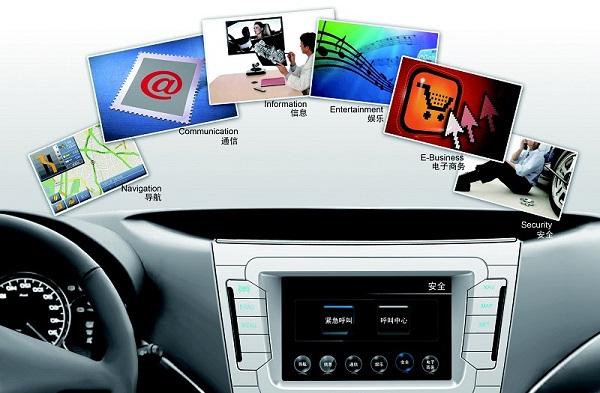
The “network” thinking pattern in the Internet of Vehicles industry considers automotive applications from the perspective of the internet, transplanting currently mature internet products—especially applications not related to the vehicle itself—into the vehicle scene, thereby forming new business models for the Internet of Vehicles. This involves the concept of the so-called “fourth screen,” viewing the central control panel as a function similar to a smartphone touchscreen, integrating current smartphone-based internet applications with vehicle usage scenarios.
SAIC’s “inkaNet” is a product of this “network” thinking. InkaNet can perform functions such as making calls, sending texts, checking news, checking vehicle status, checking the weather, scrolling through Weibo, and using WeChat. The creators of network thinking pattern products are often companies outside the automotive manufacturer system, making it easier to break free from the “project” DNA of automotive companies.
Dialectical Analysis of “Car” Thinking and “Network” Thinking
The “car” thinking pattern and the “network” thinking pattern are currently the two mainstream models in the Internet of Vehicles industry.
The “car” model is an ongoing attempt to digitalize various vehicle applications, aiming to enhance the driving experience. The key to measuring the success of this type of model is evaluating vehicle sales, which is also the drawback of the “car” model driven primarily by manufacturers. Manufacturers still adopt traditional project-like approaches to these types of Internet of Vehicles projects, and the affiliated vehicle companies still match teams according to traditional automotive project systems, making it difficult to adapt to a customer-centric approach aimed at enhancing customer experience, which is the essence of the “internet spirit”.
The “network” model is a product of companies in the Internet of Vehicles field actively aligning with the “internet spirit”; some companies even aspire to make the “fourth screen” comparable to a smartphone terminal screen. We appreciate this attempt as it breaks the project-based culture characteristic of automotive companies and takes a strong step towards an “internet culture” centered around the customer. However, when we revisit these “network” models, we notice conflicts between the in-car screen and the smartphone screen. Why should functions that smartphones can achieve need to be realized on the in-car screen? Does the in-car screen have more advantages compared to the smartphone screen? The in-car screen has limited customer stickiness compared to the smartphone screen; is there a necessity for extensive applications?
Standards for the Internet of Vehicles Are Still Being Established
As mentioned earlier, the core of the Internet of Vehicles lies in achieving networking based on the car as the entity. This raises several questions. First, what technological means to use for networking? Is it based on mobile internet or an internal local area network between vehicles? Second, what standards to use for networking? Are these standards determined by individual manufacturers, communication operators, or tech giants like Apple and Google?
The first question is somewhat easier to answer. Due to the underdevelopment of V2V technology (vehicle-to-vehicle communication), almost all current models are based on mobile internet for connectivity. However, it is certain that V2V will become an important technical direction for the future of “networking”; in the field of intelligent transportation applications, if vehicle-to-vehicle communication relies solely on mobile internet, the speed will be significantly slower than in the direction of vehicle-to-vehicle internet.
The second question is relatively complex. The importance of standards to an industry is self-evident. In the smartphone field, the operating system standards are controlled by iOS and Android, forming the dominant positions of Apple and Google in the mobile space. The competition for standards in the automotive industry is even more intense. Some manufacturers set their own standards, such as General Motors and Ford’s Applink and MyLink systems. When the market share of a single company is insufficient, some manufacturers join forces to establish standards like Mirrorlink. Google even established OAA, uniting multiple manufacturers to launch Android Auto, while Apple introduced Carplay, all with the intention of establishing industry standards. Currently, the Internet of Vehicles industry is at a critical stage for standard formation, but everything remains unclear.
We believe that the various Internet of Vehicles projects currently being hyped by domestic automotive manufacturers are actually aimed at establishing similar internal brand standards for the Internet of Vehicles and building the supporting services behind them.
The inability to unify the Internet of Vehicles standards across different automotive brands results in the failure to form a truly integrated platform for Internet of Vehicles applications. Different brands of vehicles are like isolated information islands; the data within the vehicles cannot effectively communicate and collaborate. Currently, it is only possible to achieve Internet of Vehicles services within the same platform (like General Motors’ Onstar), but the market scale formed this way is clearly just the tip of the iceberg of the Internet of Vehicles market. Without sufficient market scale, it is impossible to achieve extremely low marginal costs for products and services, so the high annual fees for these services often become the biggest obstacle to consumer adoption.
The OBD box is actually an attempt to establish an automotive data application platform from another perspective.
Why has the OBD box model become popular? The reason is that since manufacturers cannot achieve vehicle-to-vehicle connections, some third-party companies create OBD box hardware through the OBD interface inside the vehicle to extract the vehicle’s data information and establish such a platform via a mobile app. The OBD model currently has a realistic foundation.
Whether through the OBD box approach or by establishing unified Internet of Vehicles standards across different automotive brands, it is foreseeable that a platform connecting all vehicle models will eventually be established, which will serve as the foundation for the entire industry’s explosion.
Future Characteristics of the Internet of Vehicles Industry
The new Internet of Vehicles industry is expected to achieve breakthrough development in the coming years. We believe that the new Internet of Vehicles industry will be a fusion of “car” thinking and “network” thinking, characterized by the following:
The realization of standards for Internet of Vehicles data will root all business models in these standards, regardless of their form;
Product design will center on “customer needs,” neither purely digitalizing vehicle applications nor merely transplanting internet products to in-car platforms;
The mining and classification of vehicle data, and the commercialization of relevant applications based on this, will be the main driving force for growth in the future Internet of Vehicles industry;
Companies providing Internet of Vehicles products will be truly customer-facing commercial enterprises, where professional capabilities and brand influence will be the core value of future Internet of Vehicles companies (truly meaningful Internet of Vehicles companies).
Investment Opportunities in the Internet of Vehicles Industry
The Internet of Vehicles industry will be one of the fastest-growing industries in the next decade, presenting enormous investment opportunities. From a research framework perspective, we establish a logical chain from “data collection” to “data standardization” to “data application.”
In terms of automotive data standardization, there are mainly two models: the OBD+APP model and the vehicle machine model. The OBD+APP model involves related companies obtaining automotive data through the reserved OBD ports in vehicles and building their platforms to enable interaction between different vehicle models. The vehicle machine model is currently mainly led by manufacturers, who build TSP systems for automotive companies. With the promotion of industry standard construction by internet giants, vehicle machine companies are expected to benefit from the popularization of the Internet of Vehicles within vehicles.
Source: Tencent Automotive
====================================
Organizer:Changan Automobile – Management Innovation and IT Center
Share this article:Click the button in the upper right corner of the screen to share this article with your friends!
Follow us:
Please click on “Internet Innovation Research” below the article title
or click the button in the upper right corner of the screen to select “View Public Account” or “View Official Account”
or search for the WeChat public account “Internet Innovation Research”!